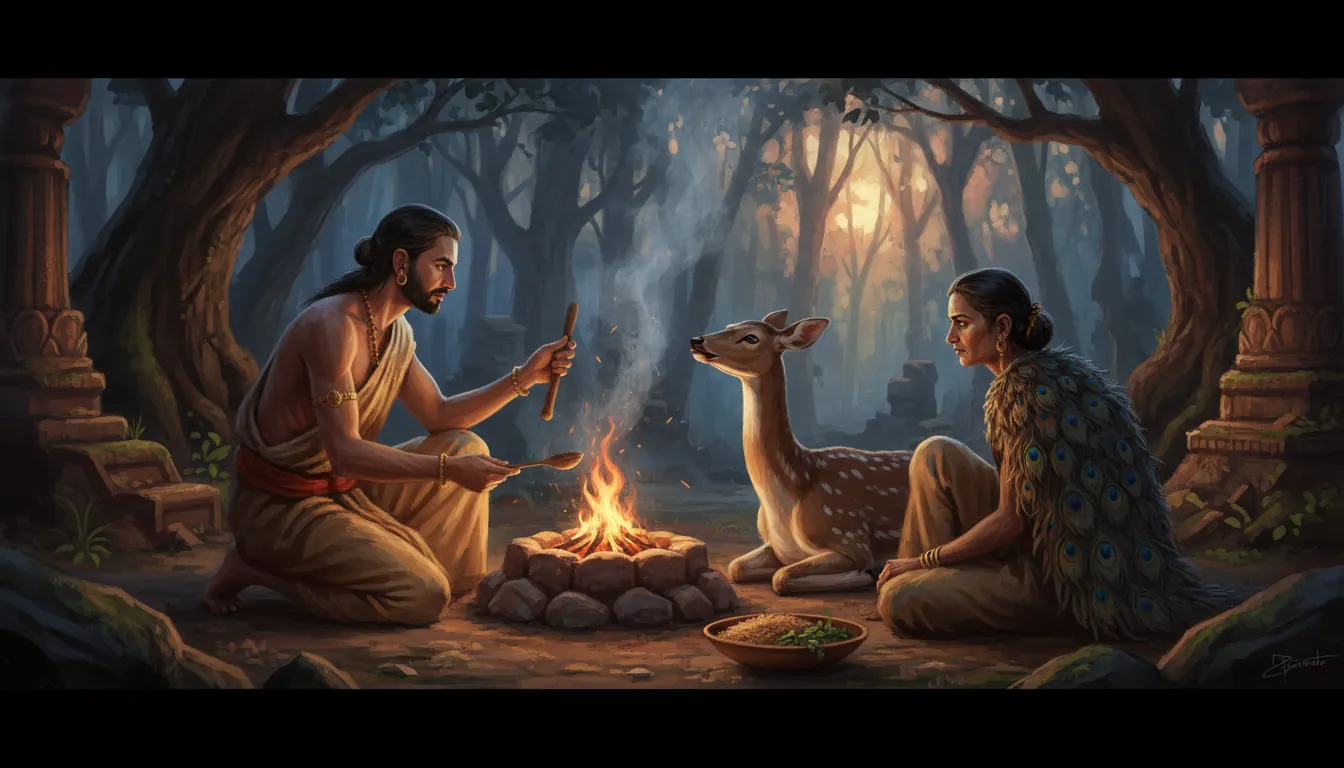
The Fourfold Religion of Compassion
Bhishma on abstaining from meat, and the kings who kept the vow
In short
Yudhishthira asks the grandsire how a man who has injured others in thought, word and deed can be cleansed. Bhishma answers that compassion has four parts and cannot stand if one is missing, that all other religions are engulfed in it as footprints are engulfed in the elephant's, and that the discipline begins at the dinner plate. He grants that flesh is the most delicious food on earth, names the three kinds of slaughter that reach the man who only buys, cites the fall of King Vasu of Chedi, and lists the ancient kings who kept the month of Kartika without meat.
Told in the Anushasana ParvaSet in Kurukshetra and Chedi23 min read
The Question After Brihaspati Went Up
Vaishampayana said that the teacher of the gods, when he had said what he had come to say to king Yudhishthira the just, rose upward toward heaven before their eyes.
That was Brihaspati. He had been asked which of the six doors of piety was the greatest, and he had answered that the man who practises the religion of universal compassion achieves his highest good, and that one should never do to another what one regards as injurious to one's own self. Then he went up out of the air and left them standing on the field at Kurukshetra with the answer in their hands.
The old man on the bed of arrows had not spoken during that visit. Bhishma was still lying where the shafts had put him, waiting for the sun to turn north, and the king had been coming to him every day with the questions that the war had left behind.
Yudhishthira, a man of great energy and the most eloquent of men, turned back to his grandsire and spoke to him.
"You who are so wise," he said, "the rishis and the brahmanas and the gods, guided by the authority of the Vedas, all praise the religion whose mark is compassion. But, king, what I ask you is this. How does a man who has injured others in word, in thought and in deed manage to cleanse himself from misery?"
It is worth noticing what he did not ask. He did not ask how a man stays innocent. He asked about the man who has already done the harm, and who has done it in all three of the ways a man can do harm, and he asked it standing over a battlefield that he had won by killing his own family. He wanted to know whether there was a road back.
Bhishma's answer began not with a remedy but with a warning that compassion has parts, and that a thing with parts can be broken.
The Animal That Cannot Stand on Three Legs
"Those who speak of Brahma have said that there are four kinds of compassion, or abstention from injury," Bhishma said. "If even one of those four is not observed, they say, the religion of compassion is not observed."
Then he gave the image that fixes it.
"Just as no four-footed animal can stand on three legs, so the religion of compassion cannot stand if any one of those four parts is missing."
This is a harder rule than it looks. It does not say that a man who keeps three parts out of four has three quarters of the virtue. It says he has an animal on the ground. The parts are not a score to be totalled. They are legs, and the fourth one missing is not a deduction, it is a collapse.
And then the second image, which makes the same claim from the other direction.
"Just as the footprints of all other animals are swallowed up in the elephant's, so all other religions are said to be contained in the religion of compassion."
Every other duty a man has can be set down inside this one and disappear into it, the way the print of a jackal or a deer or a dog vanishes when an elephant sets its foot over the place. Compassion is not one item on the list of the virtues. It is the print that holds all the others.
Then he named the ways the injury is done, because those are the parts he had been counting.
"A person becomes guilty of injury through acts, words and thoughts. One should first give it up in thought, and then give it up in word and in deed."
The order is deliberate and it is not the order a man would choose. The mind first, where nobody can see, then the mouth, then the hand.
"He who abstains from eating meat by this rule is said to be cleansed in three ways. We hear that those who speak of Brahma trace the sin of eating meat to three causes. That sin may cling to the mind, to words, and to acts. That is why wise men rich in penance refrain from eating meat."
The general teaching had narrowed, in a few sentences, to a plate of food.
Like the Flesh of One's Son
"Listen, king, while I tell you the faults that cling to the eating of meat," Bhishma said. "The meat of other animals is like the flesh of one's own son. That foolish person, stupefied by folly, who eats meat is regarded as the vilest of human beings."
He did not soften that and he did not explain it away. He set the eater's dinner beside the body of the eater's child and left the two things touching.
Then he traced where the act goes after it is done.
"The union of father and mother produces an offspring. In the same way, the cruelty that a helpless and sinful wretch commits produces its own offspring: rebirth after rebirth, full of great misery."
Cruelty breeds. It has children the way a marriage has children, and the children are the lives you will be born into afterwards, one after another, each of them a consequence of a meal.
Then he came to the reason the thing is so hard to give up, and he named it exactly.
"As the tongue is the means by which we know taste, so the scriptures declare that attachment comes from taste. Well dressed, cooked with salt or without, in whatever form one takes it, meat gradually draws the mind and enslaves it."
Not persuades. Enslaves. And the enslavement is gradual, which is the point of the sentence, because a man does not notice a chain that is put on him one link at a time over a lifetime of dinners.
"How will those foolish men who live on meat ever come to hear the sweet music of heavenly drums and cymbals and lyres and harps?"
A man whose ears are full of the kitchen will not hear the drums of heaven when they are played for him.
"Those who eat meat praise it highly, letting its taste stupefy them, and they call that taste something beyond conception, beyond description and beyond imagining. Even such praise of meat carries demerit."
The praise itself is a sin. Not only the eating, but the talking about the eating, the connoisseur's delight in it.
"In former days," Bhishma said, "many righteous men gave the flesh of their own bodies to protect the flesh of other creatures, and through such acts of merit they have gone to heaven. In this way, king, the religion of compassion is surrounded by four considerations. So I have described to you the religion that holds all other religions within it."
But the Fathers Are Fed With Meat
Yudhishthira had been listening as a king listens, which is to say with the rites of his household in his mind, and he found a hole in it at once.
"You have said many times that abstention from injury is the highest religion," he said. "Yet in the Shraddhas performed in honour of the Pitris, people should, for their own good, offer many kinds of meat. You said so yourself when you spoke earlier on the rules for Shraddhas. But how can meat be obtained without killing a living creature? Your teachings therefore seem to me to contradict each other."
It is a fair objection and he pressed it. The same grandsire, on the same bed of arrows, had already laid down that the dead fathers are gratified by flesh offered at their rites, and had specified which flesh and for how long each kind satisfies them. Now the same mouth was calling the eater of flesh the vilest of men. One of the two teachings had to give way.
"So a doubt has arisen in our minds about the duty of abstaining from meat," he said, and then he broke the doubt into the pieces he wanted answered separately, because he had learned by then that the grandsire answers what he is asked.
What are the faults that one incurs by eating meat, and what are the merits one wins by not eating it. What are the demerits of the man who eats meat that he has killed himself. What are the merits of the man who eats only the meat of animals killed by others. What are the merits and demerits of the man who kills a living creature for somebody else. And of the man who neither kills nor asks, but simply buys it in the market.
"Sinless one, I want you to speak to me on this subject in detail. I want to know this eternal religion with certainty."
Then he added the four things every man wants, and asked where they come from.
"How does one attain to longevity? How does one acquire strength? How does one attain to faultlessness of limbs? Indeed, how does one come to bear excellent marks?"
He had asked, without quite meaning to, a question about butchery and a question about beauty in the same breath, and Bhishma answered both of them with one word.
What the Rishis Decided Among Themselves
"Listen, son of Kuru's line, to the merit that belongs to abstaining from meat," Bhishma said. "Great-souled people who desire beauty, faultless limbs, long life, understanding, strength of mind and body, and memory should abstain from acts of injury."
That was the answer to the second question, and it was the same as the answer to the first. Then he said where the doctrine came from, which matters, because he was not inventing it.
"The rishis held countless discussions on this subject. Listen, Yudhishthira, to what they concluded."
He gave the opinions as a roll, one authority at a time.
The merit won by a man who, steady as a vow, worships the gods every month with horse sacrifices is equal to the merit of one who gives up honey and meat. The seven heavenly rishis, the Valakhilyas, and the rishis who drink the rays of the sun, all of them of great wisdom, praise abstention from meat.
The Self-born Manu has said that the man who does not eat meat, or slay living creatures, or cause them to be slain, is a friend of all creatures. No creature can oppress such a man. He has the trust of all living beings, and besides that he always has the approval and praise of the righteous.
The righteous-souled Narada has said that the man who wishes to increase his own flesh by eating the flesh of other creatures meets with calamity.
Brihaspati, who had gone up into the sky in front of them not long before, has said that the man who abstains from honey and meat acquires the merit of gifts and of sacrifices and of penances.
"In my estimation," said Bhishma, adding his own name to the list, "these two are equal: he who worships the gods every month with a horse sacrifice for a hundred years, and he who abstains from honey and meat."
Then he said the thing that concedes the difficulty instead of pretending it away.
"The man who has eaten meat and gives it up afterwards wins by that act a merit so great that the study of all the Vedas, or the performance of all the sacrifices, cannot give its like. It is exceedingly hard to give up meat once one has come to know its taste."
And he named what such a man is actually handing out, in the language of the sacrificial fee.
"The learned person who gives all living creatures the Dakshina of complete safety is surely regarded as the giver of life-breath in this world."
The Man Nobody Is Afraid Of
"We see that even men of learning who seek Emancipation are not free from the fear of death," Bhishma said. "What, then, of those innocent and healthy creatures who love life, when sinful wretches who live by slaughter seek to kill them?"
Then he described the man who has stopped, and the description is a list of the places where men are ordinarily afraid.
That man is never put in fear, wherever he may be. In terrible wildernesses. In inaccessible fastnesses. By day or by night or at the two twilights. In the open squares of towns and in assemblies of men. Before upraised weapons. In places where there is great fright from wild animals or from snakes. All creatures seek his protection. He never causes any anxiety in others, and he himself has never to become anxious.
Then Bhishma looked at the trade from the other end.
"If there were nobody who ate flesh, there would then be nobody to kill living creatures. The man who kills living creatures kills them for the person who eats flesh. If flesh were held to be inedible, there would be no slaughter of living creatures. It is for the eater that the slaughter of living creatures goes on in the world."
That is the sentence that answers Yudhishthira's careful question about the man who only buys. There is no such man. The knife is held at the far end of a rope, and the eater is holding the other end of it.
"I heard this long ago, son of Kunti, from Markandeya, when that rishi spoke on the evils of eating flesh."
And Markandeya had counted the slaughterers, and there were three of them.
He who eats the flesh of animals that wanted to live, whether he killed them himself or another did, incurs the sin of the slaughter. He who purchases flesh slays living creatures through his wealth. He who eats flesh slays living creatures through the act of eating. He who binds or seizes and actually kills is the slaughterer. Those are the three kinds of slaughter. And he who does not himself eat flesh but approves of an act of slaughter is stained with the sin of it all the same.
Later Bhishma widened the roll again, and by the time he had finished there was nobody left standing outside it. He who arranges for obtaining flesh, he who approves of those arrangements, he who slays, he who buys, he who sells, he who cooks, and he who eats, are all regarded as eaters of flesh.
The King Who Said It Was Edible
Yudhishthira's objection about the Shraddha was still standing. Bhishma answered it without withdrawing anything he had said.
"One should never eat the meat of animals that were not dedicated in sacrifice, that were killed for nothing, and that were not offered to the gods and the Pitris according to the rules. There is not the slightest doubt that a person who eats such meat goes to hell. If one eats meat made holy because it came from animals dedicated in sacrifice and killed to feed brahmanas, one incurs a small fault."
A little fault. Not none. That is the whole of the concession, and it is worth reading twice: the ordinance that permits the offering does not pronounce it clean, it only prices it low.
"The religion whose marks are acts has been ordained for householders, best of kings, and not for those who seek emancipation. Manu himself has said that meat which is sanctified with mantras and properly dedicated, in rites performed in honour of the Pitris, is pure. All other meat counts as the fruit of useless slaughter, and so it is not to be eaten, and it leads to hell and disgrace."
Then he reached back past the ordinances, to a time when the rites were performed without any animal at all.
"We hear that in the ancient Kalpa, people who wanted worlds of merit hereafter sacrificed with seeds, regarding the seeds as the animals they dedicated."
Grain on the fire, and the grain counted as the beast. That was the old way, and the rishis fell to arguing about whether the newer way was lawful. They took the question to Vasu, the ruler of the Chedis, a king famous for his truth who travelled through the sky in a chariot of his own.
"King Vasu, knowing that flesh is inedible, answered that it was edible."
He knew the answer and gave the other one. From that moment Vasu fell down from the firmament on to the earth. He had been a king who flew. He landed. And then, having landed, he repeated his opinion, with the result that he had to sink below the earth for it.
Two words, and a man went from the sky to the ground and from the ground to under it.
"Wishing to benefit all men, great-souled Agastya, by the power of his penances, dedicated the wild animals of the deer kind to the gods once and for all. So there is no longer any need to sanctify those animals before offering them."
The Shraddha stands. Agastya paid for it long ago, on behalf of everybody.
The Kings Who Kept the Month of Kartika
"There is complete happiness in abstaining from meat, king," Bhishma said. "One who practises severe austerities for a hundred years and one who abstains from meat are equal in merit."
Then he laid out the vow in its practicable forms, for men who could not manage the whole of it at once.
In the lighted fortnight of the month of Kartika in especial, one should abstain from honey and meat, and in this there is great merit. He who abstains for the four months of the rains acquires the four valued blessings of achievement, longevity, fame and might. He who abstains for the whole month of Kartika transcends all kinds of woe and lives in complete happiness. They who abstain by either months or fortnights at a stretch have the region of Brahma ordained for them.
Then he named the men who had kept it, because a rule is only a rule until somebody keeps it.
"Many kings in ancient days, son of Pritha, who had made themselves the souls of all creatures and who knew the truth of all things, abstained from flesh either for the whole month of Kartika or for the whole of its bright fortnight."
They were Nabhaga and Ambarisha, and the high-souled Gaya, and Ayu and Anaranya and Dilipa and Raghu and Puru and Kartavirya and Aniruddha and Nahusha and Yayati and Nrigas and Vishwaksena and Shashabindu and Yuvanaswa, and Sivi the son of Usinara, and Muchukunda and Mandhatri and Harishchandra.
Bhishma stopped at that last name and made his grandson a present of a second rule.
"Always speak the truth. Never speak an untruth. Truth is an eternal duty. It is by truth that Harishchandra roves through heaven like a second Chandramas."
Then he went on, and the list did not get shorter.
These other kings also, Syenachitra and Somaka and Vrika and Raivata and Rantideva and Vasu and Srinjaya, and Dushmanta and Karushma and Rama and Alarka and Nala, and Virupaswa and Nimi, and Janaka of great intelligence, and Aila and Prithu and Virasena, and Ikshvaku and Shambhu and Shveta and Sagara, and Aja and Dhundhu and Subahu and Haryaswa and Kshupa and Bharata, did not eat flesh for the month of Kartika.
And as a result they reached heaven, and shone with radiance in the region of Brahman, worshipped by Gandharvas and surrounded by thousands of maidens of great beauty.
"The man who practises this religion, or recites it so that others may hear it," Bhishma said, "will never have to go to hell, even if his conduct is exceedingly wicked in other ways."
Then Why Is It the Best Thing There Is
Yudhishthira came back with the honest difficulty, which was not about doctrine at all.
"Alas, those cruel men who turn away from every other kind of food and crave only flesh are truly like great Rakshasas," he said. "Alas, they do not enjoy all the kinds of cakes, and all the sorts of greens, and the many kinds of juicy Khanda, as much as they enjoy flesh. My understanding is bewildered in this matter. I think there is nothing which can compare with flesh in the matter of taste."
He was not defending the eaters. He was admitting that he could see why they do it, and asking his grandsire to tell him plainly what flesh is and what exactly is edible and what is not.
Bhishma did not deny the premise. That is the striking thing in the whole discourse.
"It is just as you say, mighty-armed one. There is nothing on earth better than flesh in taste. There is nothing more beneficial than flesh to people who are lean, or weak, or afflicted with disease, or exhausted with travel. Flesh quickly increases strength. It builds the body greatly. There is no food, scorcher of foes, better than flesh."
He granted the cook and the physician everything they could ask, and then said that none of it was the question.
"But, joy of the Kurus, great merit belongs to men who abstain from it. That man who wishes to increase his own flesh by the flesh of another living creature is such that there is none meaner and more cruel than he. In this world there is nothing dearer to a creature than his life. Hence one should show compassion to the lives of others as one does to one's own."
The case against meat was never that it is bad food. It is the best food. The case is that it is somebody.
Then he gave the kshatriya his own ordinance, since he would not pretend that kings live like hermits.
"They incur no fault by eating flesh won by spending their own prowess. All the deer of the wilderness were dedicated to the deities and the Pitris in days of old by Agastya, so the hunting of deer is not condemned. There can be no hunting without risk of one's own life. There is equality of risk between the slayer and the slain. Either the animal is killed, or it kills the hunter. That is why even royal sages take to hunting."
The permission is narrow, and what narrows it is the word equality. What is allowed is not the eating. It is the risk.
Since He Has Eaten Me, I Shall Eat Him
Bhishma had one more thing to say about where the eaters go, and he said it in the language of the body.
"While they live in the womb, all creatures are cooked in its juices, alkaline and sour and bitter, which are painful and hard to bear. There they lie helpless, and are torn and pierced again and again. Those who crave meat are seen to be cooked again and again in the womb in this state. Passing through many kinds of birth, they are cooked in the hell called Kumbhipaka."
Cooked. He used one word for the womb, the hell and the kitchen, and having used it three times he did not need to explain the joining.
"Those who eat the flesh of animals that long to live are surely eaten in turn by the animals they eat. 'Since he has eaten me, I shall eat him in return': this, Bharata, is why flesh is called Mansa."
That is the old etymology, and it is a sentence spoken by the meat. Mam sa. Me, he. The syllables are the animal's promise, carried in the mouth of every man who names what is on his plate.
"The slayer is always slain. After him the eater meets with the same fate. Whatever acts one does in whatever body, one must suffer their consequences in that body."
Then the grandsire stopped arguing and began simply to name the thing, over and over, the way a man tolls a bell.
Abstention from cruelty is the highest Religion. Abstention from cruelty is the highest self-control. Abstention from cruelty is the highest gift. Abstention from cruelty is the highest penance. Abstention from cruelty is the highest sacrifice. Abstention from cruelty is the highest power. Abstention from cruelty is the highest friend. Abstention from cruelty is the highest happiness. Abstention from cruelty is the highest truth. Abstention from cruelty is the highest Sruti.
"The gifts made in all sacrifices, the baths taken in all sacred waters, and the merit of all the gifts the scriptures name: none of these equals abstention from cruelty. The penances of a man that abstains from cruelty are inexhaustible. He is regarded as always performing sacrifices. He is the father and the mother of all creatures."
He had begun by calling compassion an animal that cannot stand on three legs. He ended by calling it a parent.
"These are some of the merits of abstention from cruelty. In all they are so many that one could not finish naming them even by speaking for a hundred years."
He had rather less than that left.
Dharma Lesson
Bhishma does not pretend that the thing being given up is worthless. He says outright that flesh is the best food there is, better than any cake or potherb, and most useful precisely to the weak and the sick who need it most. The renunciation he asks for is only meaningful because the loss is real. What he sets against it is not a better flavour but a plain accounting: that the eater stands at the far end of the rope from the knife, and that nothing anyone owns is dearer to him than the life that has to be taken to make the meal.