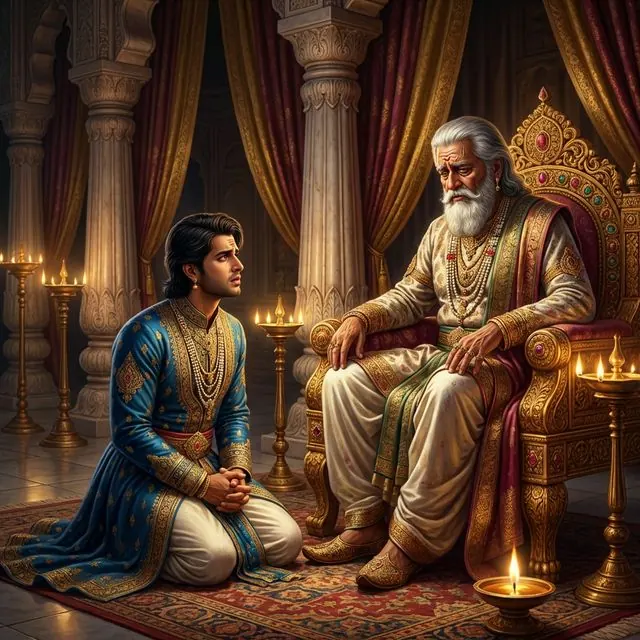
The Shield Around Bhishma
Ninth day: Satyaki trades darts with the grandsire, Abhimanyu unhorses Chitrasena, and Duryodhana orders a wall of men built round Bhishma
In short
On the afternoon of the ninth day Arjuna scatters Susharma's Trigartas, and both armies collapse inward on the place where Bhishma is fighting. Satyaki and the grandsire hurl darts at each other and each cuts the other's out of the air; Abhimanyu kills Chitrasena's horses and driver; Bhima unhorses the aged Bahlika and Drupada retreats from Drona rather than die of an old quarrel. Then Duryodhana tells Dushasana that protecting Bhishma is the army's highest duty, and sends Shakuni's cavalry and ten thousand horse against Yudhishthira and the twins to make room for it.
Told in the Bhishma ParvaSet in Kurukshetra13 min read
Sanjaya Tells the Ninth Afternoon
When Sanjaya came to the ninth day in his account, the blind king in Hastinapura wanted it told to him the way the other eight had been told, in order, with nothing left out.
"Tiger among men," Sanjaya said, "with his whetted arrows Arjuna sent the kshatriyas who followed Susharma to the abode of the King of the Dead."
Susharma was the ruler of the Trigartas, an old enemy of the Pandavas who had led the raid on Virata's cattle, and on that afternoon he was faring badly. He pierced Partha with his shafts. He pierced Vasudeva, who was driving, with seventy. He pierced Arjuna once more with nine. Arjuna checked all of it with his showers of arrows and then went through the Trigarta troops as Death goes through the world at the end of a yuga, and the men behind Susharma broke.
Sanjaya described the breaking carefully, because it is the same every time and the king had not seen it. Some abandoned their horses. Some abandoned their chariots. Some left their elephants standing and ran. Others took horse and elephant and chariot with them and fled at speed, and the foot-soldiers threw their weapons down in that dreadful battle and went off in every direction without any regard for one another. Susharma ordered them back. Other leading kings ordered them back. They did not stay.
"Seeing that host routed," said Sanjaya, "your son Duryodhana himself, at the head of the whole army and with Bhishma ahead, attacked Dhananjaya with all his strength, to save the life of the ruler of the Trigartas."
That was the shape of the hour. Duryodhana stayed in the battle scattering diverse kinds of arrows with all his brothers behind him, and every other man on that wing had fled. And the Pandavas, clad in mail, went the other way for the sake of Phalguni, straight toward the place where Bhishma was.
They knew perfectly well what the wielder of Gandiva could do without them. They went anyway, with loud cries, and surrounded the grandsire on all sides.
The Palmyra Banner at Noon
Then the palmyra-bannered hero covered the Pandava army with his straight shafts.
The palmyra tree on a golden field was Bhishma's device, and after eight days every man on that plain could find it in the dust without being told. The sun reached the meridian while they were closing on him, and after that, Sanjaya said, the Kauravas fought with the Pandavas in one confused mass. There were no wings any longer and no formation to speak of. There were only the duels that men found in front of them.
The heroic Satyaki, of the Satvata race, pierced Kritavarma with five arrows and stayed where he was, scattering his arrows by thousands. Kritavarma was a Vrishni too, a kinsman out of the same city, and he had come to this war on the other side with an army of his own.
King Drupada found Drona, which surprised nobody who knew the two of them, and pierced that bull among brahmanas with many whetted arrows, and then with seventy more, and put seven into his charioteer.
Bhimasena went for the oldest man on the field. Bahlika was the brother of Shantanu, his great-grandfather, an old king who had lived long enough to see his own house divided and had chosen the wrong half of it, and Bhima pierced him and then uttered a loud roar like a tiger in the forest, and did not sound at all like a man who regretted the arrow.
Sanjaya gave these three in a row, without comment, the way he gave everything. A Vrishni against a Vrishni. A king against the teacher who had taken half his kingdom. A great-grandnephew roaring over a great-granduncle.
And in the middle of all that, a boy of sixteen found somebody his own size.
Mercury and Saturn
Chitrasena was one of Dhritarashtra's hundred, a great bowman among the brothers and a chariot warrior of standing, and he had picked out Arjuna's son.
The son of Subhadra struck first with many swift shafts, and drove three arrows deep into Chitrasena's chest, and then the two of them stood to it and would not give ground, and the men around them stopped to watch.
Locked in battle with each other, Sanjaya said, those two great warriors shone on the field like the planets Mercury and Saturn in the sky.
It is worth pausing on the image, because Sanjaya chose it and Sanjaya was not a man who reached for ornament. Mercury is the quick one, the planet that runs close beside the sun. Saturn is the slow one, the heavy one, the planet that men watch with unease. He is saying that these two burned steadily in one quarter of the sky while everything else on that field was smoke and running, and that anyone looking up could see them both.
The boy ended it. That slayer of foes, the son of Subhadra, killed his opponent's horses with four arrows and his charioteer with nine, and then uttered a loud shout, which is the one detail that gives away how young he was. Sixteen years old, in the ninth day of the greatest war ever fought, and he had beaten a grown prince of the Kuru house in single combat, and he shouted about it.
Chitrasena did the only sensible thing left to him. That mighty chariot warrior jumped down quickly from the chariot whose horses had been killed, and without delay mounted the chariot of Durmukha, another of his brothers, who was fighting nearby.
Across that quarter, Drona pierced Drupada with straight shafts and struck his charioteer as well.
Two brothers on one chariot, in front of Subhadra's son. That was the state of that corner of the field when the grandsire's part of the battle pulled everything back into itself.
Two Old Men Leave the Field
Drupada broke first, and the reason he broke is the oldest quarrel in the epic.
He was afflicted at the head of his own troops, with Drona in front of him and no way through, and Sanjaya says exactly what went through his mind: he retreated on his swift horses, remembering the hostility between them from the old days. That is the whole history in a clause. Two boys in an ashrama who promised to share everything. A poor brahmana who came to a king's court to collect on the promise and was laughed out of it. A war fought to take half of Panchala away from him and give it to the teacher. A sacrificial fire lit afterwards, and a son born out of it whose only purpose was to kill Drona.
The son, Dhrishtadyumna, was somewhere else on that field commanding the army. The father, who had lit the fire, turned his horses and went, because a man may hate another man for thirty years and still know what will happen if he stays where he is standing.
Bhimasena, in a moment, stripped King Bahlika of his horses, his chariot and his charioteer, in the very sight of all the troops.
There was no duel in it and no exchange worth the name. One rush, and the old king was standing on a wrecked chariot with nothing under him. In great danger and with fear in his heart, Bahlika, that best of men, jumped down from it and quickly mounted the chariot of Lakshmana, Duryodhana's son, who happened to be within reach.
So the oldest man in the Kuru house rode out of that quarter of the battle on the chariot of the youngest prince of it, and both of them would be dead before the war ended, and the man who had unhorsed the old king went on fighting without looking back.
Sanjaya reported it in two sentences and moved on, because the grandsire had begun to be dangerous again.
The Two Darts
Satyaki, having checked Kritavarma, left him and went to find Bhishma.
He fell on the grandsire and rained arrows of every kind on him, sixty whetted, feathered arrows, and Sanjaya says that while he was doing it he seemed to dance in his chariot, shaking his large bow. He was the best of the Vrishni bowmen, a pupil of Arjuna, and he fought like a man who was enjoying himself even here.
Bhishma answered him with a dart.
It was made of iron and decked with gold, very swift, and beautiful, Sanjaya said, as a daughter of the Nagas. The serpent people are described in the epic as the most beautiful of all beings and the most deadly, and that is what an old man threw at Satyaki across the ninth day of the war.
Seeing that irresistible thing rushing at him like Death himself, the illustrious Vrishni warrior escaped it by the speed of his movements. He simply was not where it arrived. The fierce dart, unable to reach him, fell down on the earth like a large meteor that had lost its splendour.
Then Satyaki took up his own dart of golden brilliance in a firm hand, and hurled it at the grandsire's chariot.
Hurled with the strength of Satyaki's arms, it rushed on, said Sanjaya, like the fatal night rushing swiftly toward a doomed man. There was no swerving from it and nothing to be done about it, and every man watching knew what was on the other end of its flight.
Bhishma cut it in two in the air with a couple of keen horseshoe-headed arrows, and the two halves fell on the earth.
When he had cut that dart, the grinder of foes, Ganga's son, burning with wrath and smiling all the while, struck Satyaki in the chest with nine arrows.
The smile is the thing to keep. Then the Pandava warriors came in with their chariots and elephants and horses and surrounded Bhishma on every side, to rescue the hero of Madhu's line, and the battle closed over the two of them again.
It Is Your Duty to Protect That Illustrious Man
Duryodhana had been watching from the place where the palmyra banner stood.
Bhishma was burning with wrath and surrounded on all sides by the Pandavas, and Sanjaya gave the king the picture he had made of it: like the Sun in the sky covered by the clouds at the end of summer. The sun is not put out by them. It is only that nobody can see it, and nobody can be sure.
Duryodhana turned to Dushasana.
"Bull of Bharata's line, this heroic great bowman Bhishma, this slayer of heroes, has been surrounded on all sides by the brave Pandavas. It is your duty, hero, to protect that illustrious man. If we protect him in battle, our grandsire Bhishma will slay all the Panchalas along with the Pandavas. So I think the protection of Bhishma is our highest duty, for this great bowman, true to his vows, protects us in return. So surround the grandsire with all our troops and protect him, for he always achieves the most difficult feats in battle."
It is the plainest speech Duryodhana makes in all of Bhishma's days of command, and there is no cunning anywhere in it. He had spent eight days accusing the old man of fighting softly. Now he had looked at the field and understood that the eighth of his army standing round that one chariot was the only thing between his house and the end of it, and he said so, in front of his brother, without embellishment.
Thus addressed, Dushasana surrounded Bhishma with a large force on all sides and took up his position.
Then Subala's son Shakuni came out with hundreds and thousands of horsemen, bright spears and swords and lances in their hands, a proud, well-dressed and strong body bearing standards, mingled with excellent foot-soldiers all well-trained and skilled in battle, and he began to hold back Nakula and Sahadeva and Yudhishthira, surrounding those great warriors on all sides.
The gambler was fighting. Not with dice, and not through anybody else, and his cavalry was very good.
Ten Thousand Horse, and the Sun Going Down
Then Duryodhana sent ten thousand more brave horsemen against the Pandavas.
They rushed like so many Garudas, and the earth, struck with their hoofs, trembled and uttered a loud noise like a large forest of bamboos burning on a mountain. Dust rose to the sky and hid the Sun itself, and the Pandava army was agitated the way a large lake is agitated when a flight of swans suddenly comes down on its bosom, and for a time nothing could be heard over the neighing.
Three men stopped that charge.
King Yudhishthira and the two sons of Pandu by Madri checked it, Sanjaya said, like the continent bearing the force of the surging sea at full tide, swollen with the waters of the rainy season. Then those three chariot warriors cut off the horsemen's heads with their straight arrows. Slain by those strong bowmen, they fell to the earth like mighty elephants tumbling into mountain caves. All over the ground horses could be seen fallen or falling with their riders, lifeless, and what was left of the ten thousand fled the way small animals flee at the sight of the lion.
The Pandavas blew their conches and beat their drums.
Duryodhana, filled with grief at the sight of his troops vanquished, went to the ruler of the Madras.
"Look there: the eldest son of Pandu, with the twins beside him in battle, is routing our troops before your very eyes, mighty-armed one. Mighty-armed one, hold him back as the land holds back the ocean. Everyone knows your might and prowess are irresistible."
Shalya was the twins' own uncle, their mother's brother, tricked into this army on the road to the war, and he went where he was sent with a large body of chariots.
Yudhishthira met that host as a shore meets a wave, and put ten shafts into the centre of Shalya's chest, and Nakula and Sahadeva struck him with three straight shafts. Shalya struck each of the three with three arrows, then pierced Yudhishthira with sixty sharp-pointed ones, and excited with wrath put two more into each of the sons of Madri.
Bhima saw his eldest brother standing within reach of Shalya's chariot as if in the very jaws of Death, and went to him.
Then, when the Sun had passed the meridian and was sinking, a fierce and terrible battle began on that part of the field.
Dharma Lesson
Duryodhana spent eight days doubting whether Bhishma was fighting hard enough for him, and on the ninth he told his brother that guarding the old man was the highest duty the army had. Protection given late and out of fear is still protection, but it changes what the protected man is: Bhishma stops being the commander of this army in that moment and becomes the thing it is built around. Satyaki and Abhimanyu, meanwhile, show what the field looked like where nobody was guarded, and both of them came off better for it.