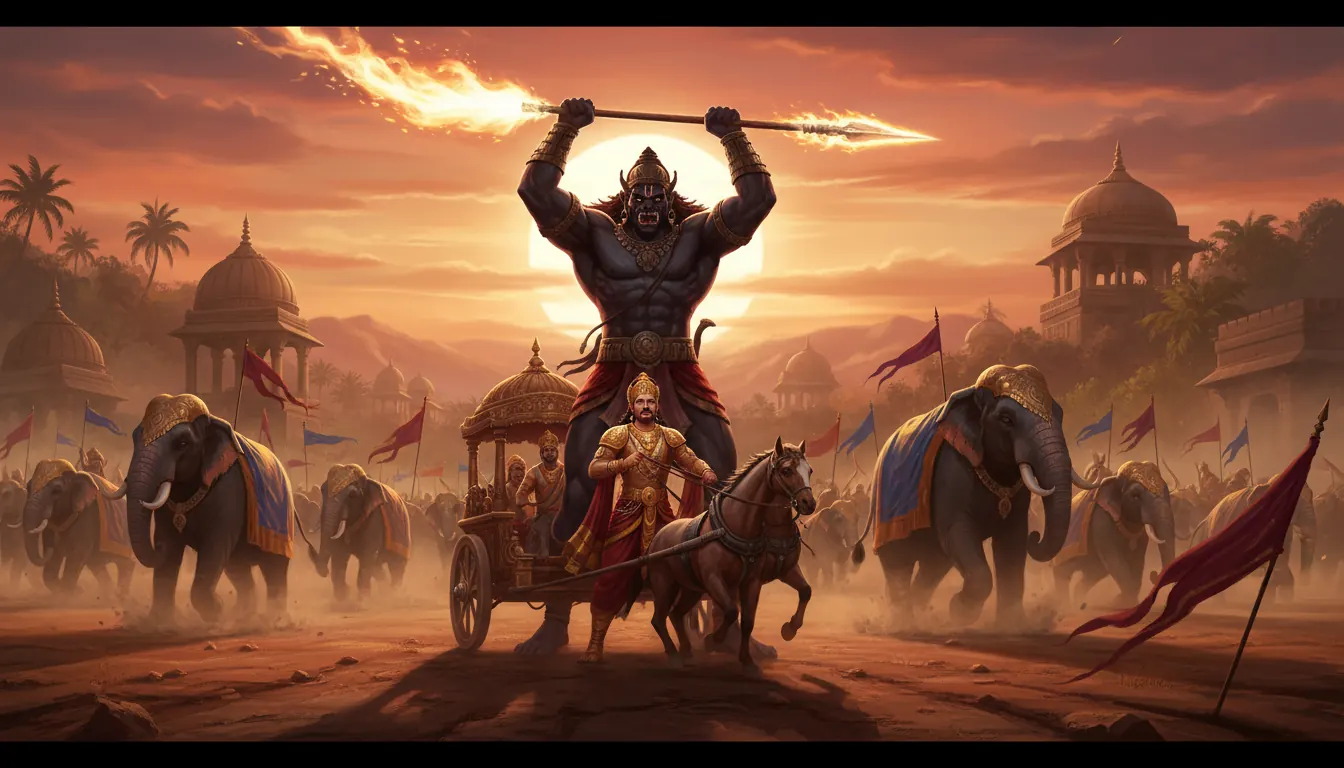
Ghatotkacha and the Javelin of Bhagadatta
Duryodhana asks to kill a Rakshasa, and a Rakshasa breaks a javelin across his thigh
In short
On the evening of the eighth day, beaten by Ghatotkacha's illusion, Duryodhana asks Bhishma for leave to kill him, and is told instead that a king fights kings. Bhagadatta of Pragjyotisha is sent out on his elephant Supratika, and Ghatotkacha catches his flung javelin in the air and snaps it across his thigh in the sight of all the kings. Abhimanyu unhorses king Ambashtha and slips the sword thrown at him, night ends the fighting, and Duryodhana walks by lamplight to Bhishma's tent to ask for what Karna has told him to ask.
Told in the Bhishma ParvaSet in Kurukshetra and Pragjyotisha23 min read
The King Comes to the Grandsire
Sanjaya said: The eighth day of the war ended badly for us, king. Towards sunset your whole army broke and ran, routed by Ghatotkacha, and neither Bhishma nor I could hold them, though we both shouted at the top of our voices that what they were seeing was only Rakshasa illusion. They did not believe us. They fled to their tents in every direction, and behind them the Pandavas blew their conches, beat their drums and counted the victory theirs.
When it was over, King Duryodhana went to Ganga's son. He came to him humbly and saluted him, and then he began to tell him everything that had happened, Ghatotkacha's victory and his own defeat, and as he told it he sighed again and again like a man who cannot get his breath.
"Lord," he said, "I relied on you, as the enemy relies on Vasudeva, when I began this fierce war with the Pandavas. I have eleven akshauhinis of famous troops, and they and I are all at your command. And yet, placed as I am, I have been beaten in battle by the Pandava warriors led by Bhimasena, because they had Ghatotkacha to rely on. That burns through my limbs like fire through a dry tree.
"So, blessed grandsire, by your grace and relying on you, whom no one can defeat, I want to kill Ghatotkacha myself, that worst of Rakshasas. Please see that this wish of mine is granted."
The Rakshasa he was asking permission to kill was his own cousin's son. Ghatotkacha was born to Bhimasena of the Rakshasa woman Hidimbi in the years of the forest, and he had come to Kurukshetra with his kinsmen to fight for his father, and on the eighth day he had emptied a Kaurava field by making every man on it believe he was already dead.
A King Strikes a King
Bhishma heard the request out, and what he said in answer was not about the Rakshasa at all. It was about where a king belongs in a battle.
"Listen, king of Kuru's line, to what I tell you about how you should always conduct yourself. In battle, whatever happens, a man must protect his own life. You should always fight King Yudhishthira the Just, or Arjuna, or the twins, or Bhimasena. A king keeps a king's duty before him, and a king strikes a king."
That was the whole of the correction, and it was a rebuke wrapped in a rule. Duryodhana had asked to spend himself on the son of a Rakshasa woman. The grandsire told him that his own rank had a match on the other side of the field and that he had no business seeking any other.
Then he told him who would do the work instead.
"I myself, and Drona, and Kripa, and Drona's son, and Kritavarma of the Satvata race, and Shalya, and Somadatta's son, and that mighty chariot warrior Vikarna, and your brave brothers led by Dushasana, will all fight that mighty Rakshasa for your sake. Or if your grief over that fierce prince of the Rakshasas is too great, let this man go out against that wicked warrior: King Bhagadatta, who is a match for Purandara himself in a fight."
Bhagadatta was standing there. He was the ruler of the Pragjyotishas, an old king out of the eastern country, and he rode into battle on an elephant named Supratika. The grandsire, who knew how to speak, turned to him in front of the king, so that the charge was given where everybody could hear it.
"Go quickly, great king, against that invincible warrior, the son of Hidimbi. Hold that cruel Rakshasa back in battle, carefully, in full view of all the bowmen, as Indra long ago held back Taraka. Your weapons are celestial, and your prowess is great. You fought many battles with the Asuras in days gone by, tiger among kings. You are a match for that Rakshasa in a great battle. With your own troops behind you, king, kill that bull among Rakshasas."
Bhagadatta set out with a lion's roar, facing the enemy ranks.
The Elephant That Bore the Sea
They saw him coming like a mass of roaring clouds, and the great chariot warriors of the Pandava army came out to meet him, blazing with anger: Bhimasena, and Abhimanyu, and the Rakshasa Ghatotkacha, and the five sons of Draupadi, and Satyadhriti, and Kshatradeva, and the rulers of the Chedis, and Vasudana, and the king of the Dasharnas. Bhagadatta on Supratika charged straight into the middle of them.
What followed added to the population of Yama's kingdom. Arrows shot from chariots fell on elephants and on other chariots. Huge elephants with split temples, blind with the juice running down their bodies, came together fearlessly and drove their tusks into one another like men fighting with clubs. Horses with fine tails, ridden by men with lances, crashed into one another at full gallop. Foot-soldiers went down by the hundreds and thousands under darts and lances.
Bhagadatta came at Bhimasena through it, scattering thousands of arrows from Supratika's head like Purandara himself on Airavata. The elephant had juice running down him in seven streams, so that he looked like a mountain with as many rivulets running down its face after a shower. The arrows fell on Bhima the way clouds break on a mountainside at the end of summer.
Bhima answered by killing the men. More than a hundred of them, the picked guards who protected the elephant's flanks and rear, went down under his showers of arrows, and Bhagadatta, seeing them lying there, drove his great elephant at Bhima's chariot, and the animal went like an arrow leaving a bowstring.
Then the ruler of the Dasharnas rode out to stop it on an elephant that was itself the size of a mountain, and Supratika took that charge and stood, the way the land bears the rush of the surging sea. The Pandava troops cheered their own man's beast and cried out, "Excellent, excellent."
The king of the Pragjyotishas sent fourteen lances at it. They went through the fine gold-decked armour that covered the animal and into its body like snakes going into anthills. Its fury broken, that elephant wheeled round with great force and fled shrieking, and crushed the Pandava ranks as it went, like a storm going through trees.
The Javelin Broken on a Knee
They came back at him anyway, with Bhima at their head, shouting, throwing every kind of weapon they had. Bhagadatta was perfectly fearless. He urged his elephant on with the hook and his toe, and the animal took on the form of the Samvarta fire that appears at the end of the yuga. It crushed crowds of chariots, and other elephants, and horses with their riders, and turned this way and that, and killed foot-soldiers by the hundreds and thousands. That great Pandava army shrank, said Sanjaya, like a piece of leather held to a fire.
It was then that Ghatotkacha saw the array his father was standing in come apart, and he rushed at Bhagadatta with his face blazing and his eyes red as fire.
He took on a terrible form. He took up a bright dart that could split the very hills, and he hurled it with all his strength, and it flew out flaming along its whole length, meant for the elephant.
Bhagadatta did not move his beast an inch. He sent one beautiful crescent-headed arrow at the thing coming toward him and cut it in two in the air, and the gold-decked dart dropped in halves on the ground like the thunderbolt flashing down through the sky.
Then the old king took up a large javelin with a golden shaft, bright as a flame, hurled it at the Rakshasa, and called out to him as he threw.
"Wait. Wait."
Ghatotkacha saw it coming at him like the thunderbolt through the sky, and he did not cut it and he did not dodge it. He leapt up and caught it out of the air with his hands and gave one loud shout with it held over his head. Then he set it across his thigh and broke it, in full sight of all the kings.
It seemed a great wonder. The gods in the sky, with the Gandharvas and the Munis, were amazed at the sight, and the Pandava warriors led by Bhimasena filled the earth with cries of "Excellent, excellent."
The javelin lay in two pieces on the field, and the man who had thrown it had to stand there and listen to them.
What the Old King Did With His Bow
Bhagadatta could not take those shouts calmly. He drew his great bow, which shone like Indra's thunderbolt, and roared back at the chariot warriors of the Pandava army, and as he roared he shot.
He pierced Bhima with one arrow and the Rakshasa with nine. He pierced Abhimanyu with three and the Kekaya brothers with five. With one straight arrow from a bow drawn to its fullest he pierced Kshatradeva's right arm, and the bow, with an arrow already on the string, dropped out of that man's hand. He struck the five sons of Draupadi with five arrows. Then, in his anger, he killed Bhimasena's horses. With three feathered arrows he cut down Bhima's standard with its lion device. With three others he pierced Bhima's charioteer, and Vishoka, who had driven that chariot since the war began, was in such pain that he sat down on its floor.
So Bhima, greatest of chariot warriors, had no chariot. He jumped down from the useless vehicle, took up his mace and stood with it raised, looking like a crested hill, and all your troops, Bharata, were struck with fear at the sight.
That was the moment when the son of Pandu who had Krishna for his charioteer came up out of the fighting, killing the enemy on every side as he came, and found the place where father and son, Bhimasena and Ghatotkacha, those two tigers among men, were fighting the ruler of the Pragjyotishas. When Arjuna saw his brothers in that position he went straight into the fight, scattering his arrows.
Duryodhana sent a whole division of chariots and elephants at him, and Arjuna of the white horses went into it. Bhagadatta, still crushing the Pandava ranks on his elephant, turned and drove at Yudhishthira, and a fierce battle began between him and the Panchalas, the Srinjayas and the Kekayas with their weapons raised.
And in the middle of all that, Bhimasena told Keshava and Arjuna in detail about the killing of Iravan, which had happened earlier that day and which Arjuna had not yet heard.
Shame on That Wealth
Iravan was Arjuna's son by a Naga princess, and he had been killed earlier that day by the Rakshasa Alambusha. When he heard of it, Dhananjaya was filled with grief and sighed like a snake, and in the middle of the battle he spoke to Vasudeva, who was holding his reins.
"Wise and great-souled Vidura must have seen this terrible destruction of the Kurus and the Pandavas with his mind's eye long ago. That is why he tried to stop King Dhritarashtra. In this battle, slayer of Madhu, many heroes have been killed by the Kauravas, and many of the Kauravas have been killed by us. Vile things are being done for the sake of wealth, best of men. Shame on the wealth for which kinsmen are slaughtered like this. For a man who has no wealth, even death would be better than wealth won by killing his kinsmen. What will we gain, Krishna, by killing our assembled kinsmen?
"Alas, through the fault of Duryodhana and of Shakuni, and through Karna's evil counsel, the kshatriya race is being wiped out. Now I understand that the king was wise when he asked Suyodhana for only half the kingdom, or failing that, for just five villages. And even that the wicked wretch would not grant. When I see so many brave kshatriyas lying dead on the battlefield, I blame myself, and I say: shame on the calling of a kshatriya.
"The kshatriyas would think me a weakling in battle. That alone is why I fight. Otherwise, slayer of Madhu, this war with my kinsmen is hateful to me. Drive the horses fast towards the Dhartarashtra army. With my own two arms I will reach the far shore of this ocean of battle that is so hard to cross. There is no time to lose, Madhava."
Keshava urged the white horses on. The noise that rose then among your troops, king, was like the roar of the ocean at full tide with a storm on it.
So the afternoon began, and the warriors paired off. Bhishma and Kripa and Bhagadatta and Susharma all went toward Dhananjaya. Kritavarma and Bahlika rushed at Satyaki. Your sons surrounded Drona and went against Bhimasena. And King Ambashtha placed himself in front of Abhimanyu.
The Wolf Among the Sons
When Bhimasena saw your sons coming, he blazed up with anger like a fire fed with clarified butter. They covered him with arrows from every side, the way clouds drench a mountainside in the rains, and that hero, quick as a tiger, licked the corners of his mouth.
Then he began.
He brought down Vyudoroska with a sharp horseshoe-headed arrow, and that son of yours fell dead. With another broad-headed arrow, well-tempered and sharp, he brought down Kundalin as a lion fells a smaller animal. Then, with the rest of them in reach, he took up a number of well-tempered arrows and shot them with careful aim, and they carried your sons out of their chariots: Anadhriti, and Kundabhedin, and Virata, and Dirghalochana, and Dirghavahu, and Subahu, and Kanykadhyaja. As they fell from their chariots, said Sanjaya, those heroes looked like mango trees in spring, bright with blossom, coming down.
Your other sons fled, taking mighty Bhimasena for Death himself.
Drona came in over the top of it and covered the man who was destroying your children with arrows from every side, pouring them on him as clouds pour rain on a mountain. The prowess of Kunti's son that we saw then was a wonder, for though Drona was holding him in check he still went on killing your sons. As a bull bears a shower of rain falling from above, so Bhima cheerfully bore the teacher's shower of arrows.
It was a wonderful feat, king, that Vrikodara performed there. He killed your sons in that battle and held off Drona at the same time.
Arjuna's elder brother played among those brave sons of yours like a mighty tiger in a herd of deer. As a wolf in the middle of a herd will chase the deer and frighten them and not need to hurry, so Vrikodara chased your sons in that battle and frightened them.
Meanwhile Ganga's son, and Bhagadatta, and the mighty chariot warrior Gautama were holding Arjuna, and that matchless warrior, checking their weapons with his own, was sending the leading heroes of your army to the realm of Death.
The Sword That Ambashtha Threw
Abhimanyu was sixteen years old, and the king who had placed himself in front of him was a seasoned man, the ruler of the Ambashthas, counted among the famous and foremost chariot warriors of your army.
Subhadra's son took his chariot away from him with arrows. He cut it out from under him piece by piece until there was nothing left to stand on, and the king came down.
Without a chariot, and about to be killed by Subhadra's famous son, that king jumped down in shame. He had lost his chariot in front of the whole field, to a boy, and what he did with the shame was draw his sword and hurl it at the great-hearted Abhimanyu. Then, knowing every move of battle, he ran and climbed onto the chariot of Hridika's son, Kritavarma, so that he was covered before the sword had finished its flight.
Abhimanyu saw the blade flying at him and dodged it by the sheer speed of his own movements. He did not cut it and he did not shield himself. He was simply not where it arrived.
Loud cries of "well done, well done" went up among the troops.
After that the battle stopped being anything that could be described in single combats. Dhrishtadyumna and the others went in against your troops, and your troops went in against theirs, and the fighting was fierce, and the fighters did the most difficult feats. Brave men seized one another by the hair and fought with nails and teeth, with fists and knees and palms and swords and their strong, shapely arms. Grappling with one another, they sent one another to Yama's realm. Father killed son, and son killed father.
Bows with golden shafts lay where they had slipped from the hands of dead warriors. Arrows washed with oil and winged with pure gold and silver lay scattered like snakes that had shed their skins. Swords with ivory handles, shields bright with gold, barbed darts and axes and coats of mail, elephants' housings and yak tails and fans lay on the ground together, and among them lay men who looked alive though the breath of life had gone out of them.
Then the fighters were worn out and routed and crushed, and dark night fell, and the battle could no longer be seen. Both the Kurus and the Pandavas withdrew their armies into that terrible pitch-black night and went back to their tents.
Lamps of Gold on the Way to a Tent
In the camp, King Duryodhana and Shakuni the son of Subala and your son Dushasana and the invincible son of the Suta met and took counsel on one question: how could the sons of Pandu and their followers be beaten in battle?
"Drona, Bhishma, Kripa, Shalya and Somadatta's son do not stand up to the Parthas," Duryodhana said. "I do not know why they behave like this. None of them kills the Pandavas, and the Pandavas are destroying my forces. So, Karna, my strength is draining away, and my weapons are running out too. I am full of doubt about how I will ever beat them in battle."
Karna had an answer ready, and it was the answer of a man who had been waiting a week to give it.
"Do not grieve, chief of the Bharatas. I will do what pleases you. Let Shantanu's son Bhishma withdraw from the great battle, and soon. Once Ganga's son has withdrawn from the fight and laid down his weapons, I will kill the Partha and all the Somakas with him, before Bhishma's very eyes. I give you my word, king. The truth is that Bhishma shows mercy to the Pandavas every day. Besides, he is not able to defeat those mighty chariot warriors. Bhishma is proud of showing his prowess in battle, and he loves a fight. So why would he defeat the assembled Pandavas? Go now to Bhishma's tent and ask that revered old man to lay down his weapons. After that, think of the Pandavas as already dead, killed by me alone."
Duryodhana told Dushasana to have his whole retinue dressed at once, and Dushasana helped that tiger among kings onto his horse. Smeared with fragrant sandal-paste the colour of the Bhandi flower, bright as burnished gold, in clean clothes, with a diadem on his head and bracelets on his arms, Duryodhana went along the streets of the camp with the easy stride of a lion, and looked like the sun in the sky.
His brothers walked behind him like the gods walking behind Vasava. Men on horses and on elephants and on chariots surrounded him. Attendants in gold-decked headdresses, carrying canes and Jhariharas, gently made the crowd give way. Noble men stood around him holding lighted lamps of gold fed with fragrant oil, so that the king moving among them looked like the moon attended by the blazing planets.
Bards praised him as he went, and he acknowledged them with his right arm raised, and so he came to the quarters of Ganga's son and got down off his horse.
Wordy Daggers, and the Guard at Dawn
He saluted the grandsire and sat down on a fine golden seat spread with a rich coverlet, and then, with his hands joined, his eyes full of tears and his voice choked, he said what he had come to say.
"Under your protection, killer of enemies, we set out to defeat the very gods and Asuras with Indra at their head. So what is there to say about the sons of Pandu? Show me mercy, son of Ganga. Kill the brave sons of Pandu as Mahendra killed the Danavas. I will kill all the Somakas and the Panchalas and the Karushas, along with the Kekayas: those, Bharata, were your words to me. Let them come true. If out of kindness for the Pandavas, king, or out of hatred for unlucky me, you spare them, then let Karna, that ornament of battle, fight. He will defeat the Parthas with all their friends and kinsmen."
Then he shut his lips and said nothing more.
Bhishma, deeply pierced by those daggers of words, was filled with grief, and did not answer with a single harsh word. He sighed like a snake and thought in silence for a long while. Then he raised his eyes, and looked as though in his anger he would burn up the world with its gods and Asuras and Gandharvas, and spoke calmly.
"Why, Duryodhana, do you pierce me like this with daggers of words? I always strive with all my might to do what is good for you. To please you I am ready to throw away my life in battle. The Pandavas truly cannot be beaten. When the son of Pandu pleased Agni in the Khandava forest and defeated Shakra himself in battle, that was proof enough. When that same son of Pandu rescued you as the Gandharvas were carrying you off a prisoner, after your brave brothers had all fled, and Radha's son with them, that was proof enough. In Virata's city he fell on all of us together, alone. That was proof enough. He beat Drona and me in his anger and took away our robes. That was proof enough. He defeated the Nivatakavachas, whom even Vasava could not defeat. That was proof enough. Who can defeat a man whose protector is the Protector of the Universe?
"In your folly, Suyodhana, you do not know what should be said and what should not.
The Wall of Chariots at Dawn
A man on the point of death sees every tree as made of gold. In the same way you see everything upside down. You have stirred up this bitter enmity, so now fight it yourself. Let us see you act like a man. As for me, I will kill all the Somakas and the Panchalas together, sparing Shikhandi alone. He was born in Drupada's palace as a girl, and became a man by the grant of a boon, and after all he is Shikhandini. Him I will not kill, even if it costs me my life. Go and sleep peacefully tonight, son of Gandhari. Tomorrow I will fight a fierce battle that men will talk about as long as the world lasts."
Duryodhana bowed his head and went back to his own tent and spent the night there. Bhishma, for his part, took those laments as a command, and lay a long time thinking of a fight with Arjuna and resenting his place as a servant, and in the morning Duryodhana understood from the signs what the old man had been thinking.
When the night gave way to dawn he ordered the forces drawn up, and he called Dushasana.
"Have chariots quickly assigned to protect Bhishma. Send all twenty-two divisions forward. In this, I think, protecting Bhishma is our first duty. If we protect him, he will protect us and kill the Parthas in battle. He told me: I will not kill Shikhandini; she was a woman before, and I must avoid her in battle. Even a wolf can kill a lion left unprotected in the great forest. Do not let Ganga's son be killed by Shikhandi like a lion killed by a wolf. Let our maternal uncle Shakuni, and Shalya, and Kripa, and Drona, and Vivingsati guard the son of Ganga carefully. If he is protected, our victory is certain. Yudhamanyu guards the left wheel of Arjuna's chariot and Uttamaujas the right, and Arjuna guards Shikhandi. See to it, Dushasana, that Shikhandi cannot kill Bhishma because we left him unprotected."
So they surrounded Ganga's son with a large division of chariots and went out to battle with him in front, shaking the earth and the sky, and took up their places around him as the gods once stood round the wielder of the thunderbolt in the war with the Asuras.
Across the field, Arjuna looked at that wall of chariots closing about one old man, and spoke to the prince of Panchala.
"Prince, put that tiger among men, Shikhandi, in front of Bhishma today. I myself will protect him."
Dharma Lesson
Bhishma tells Duryodhana that a king should strike a king, and the rule is not snobbery but a warning: a man who spends himself on the enemy he most resents has stopped fighting the war and started nursing an injury. Duryodhana cannot hear it. He goes away and asks a second time by another road, at night, with lamps and bards around him, and what he asks for is that the old man either kill everyone or step aside. The reply he gets is a list of things Arjuna has already done, and a promise to fight anyway, which is what obedience looks like when it has stopped being belief.