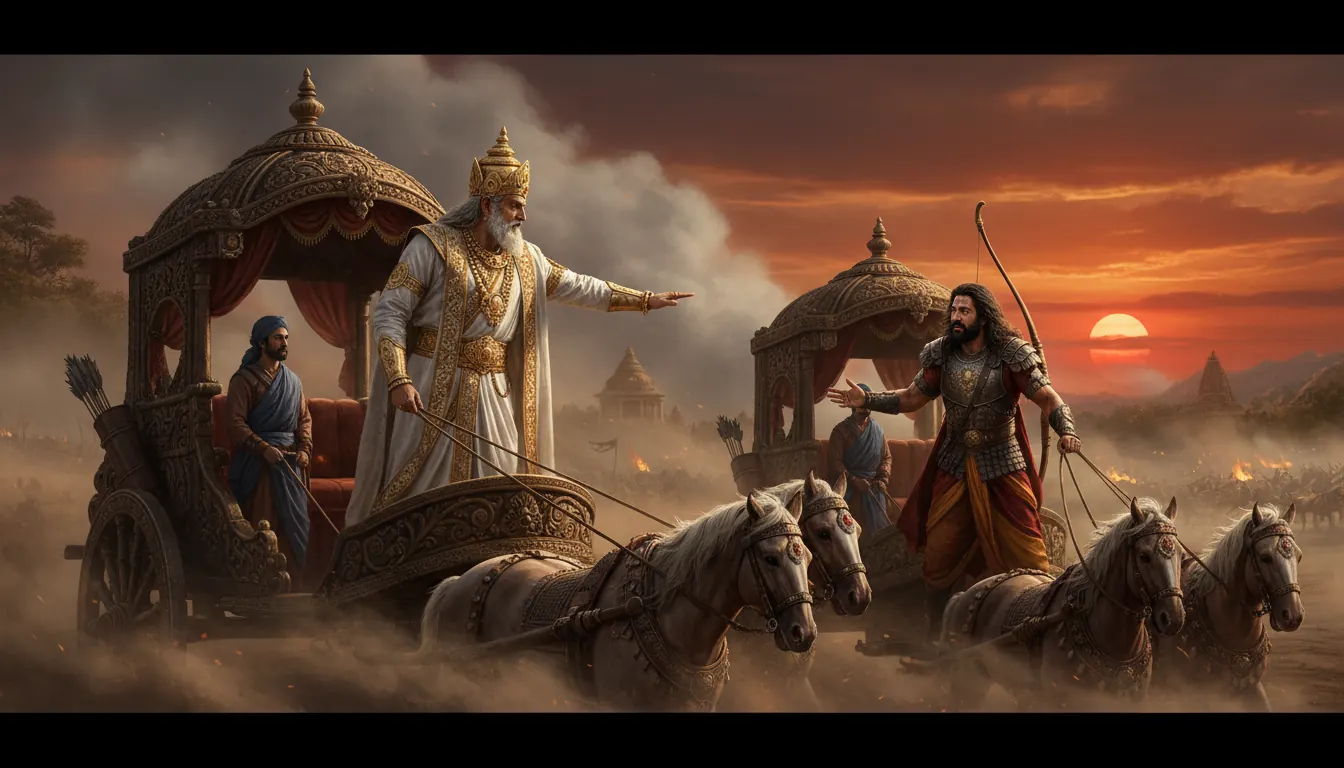
In short
Unable to hear Gandiva behind Krishna's conch, Yudhishthira breaks and orders Satyaki to go after Arjuna. Satyaki answers that Arjuna charged him personally, in Krishna's hearing, with the single task of guarding the king, and that Drona has sworn to seize Yudhishthira the moment the guard leaves. He argues, is overruled, and rides out having named aloud exactly what will go wrong.
Told in the Drona ParvaSet in Kurukshetra19 min read
A Boy With a Bird on a String
"Tell me how Yuyudhana rushed against the son of Bharadwaja," Dhritarashtra said. "I am very eager to hear it."
"Then listen, king, and it will make your hair stand on end."
Satyaki had been cutting the Kuru army apart in front of Drona's own position, and Drona came for him himself. Satyaki opened with five and twenty small arrows. Drona took deliberate aim and answered with five, whetted, equipped with wings of gold, and those five went through the armour, drank the blood underneath it and went on into the earth on the far side like hissing snakes. Satyaki, inflamed like an elephant struck with the hook, put five hundred iron arrows into him that looked like flames of fire.
And then it stopped being an exchange.
"He was shooting countless keen arrows, king, and Yuyudhana knew not what to do. That is the phrase the men used afterwards and I will not improve on it. His face went cheerless. He had crossed half a war to get where he was and now a brahmana of eighty-five was taking him apart in front of everybody, and your sons saw it, and became exceedingly cheerful, and began to roar."
Yudhishthira heard the roaring and understood what it meant.
"The greatest of the Vrishnis," he said to his troops, "whose prowess cannot be checked, is about to be devoured by Drona, like the sun by Rahu. Go, all of you, and rush to the place where Satyaki is fighting."
Then he turned to Prishata's son.
"Rush at Drona, quickly. Why do you wait? Do you not see the danger to us that has already arisen from him? He is a great bowman and he is playing with Yuyudhana in battle like a boy with a bird tied on a string. Go, all of you, with Bhimasena at your head. I will follow behind you with my troops."
Guests Arrived of Their Own Will
So the whole of the Pandava center went at one old man, and the Srinjayas with them, and they covered him with showers of keen arrows feathered with the plumes of Kankas and peacocks.
"He received them smiling, king. That is the other phrase I will not improve on. Drona received all those heroes smilingly, like a householder receiving guests who have arrived of their own will, with seats and water. And they were treated to the shafts of his bow as guests are treated to the hospitality of good hosts."
None of them could look at him. He stood in the middle of that rush like the thousand-rayed sun at midday and scorched them. Five and twenty warriors among the Panchalas went down in that one encounter, every one of them a Maharatha, every one of them approved as such by Dhrishtadyumna himself. He killed a hundred among the Kekayas and routed the rest on every side and then stood there with his mouth open like the Destroyer.
"Your Majesty's warriors were saying that he was old."
"They were saying it before the war."
"They stopped saying it that afternoon. The Pandavas and the Srinjayas could see no protector at all. They were like elephants sunk in a swamp. The gods and the Gandharvas and the Pitris in the sky said to one another, 'Look, the Panchalas and the Pandavas are fleeing with all their troops.'"
And it was exactly then, with the line bending and nobody able to stand in front of Drona, that king Yudhishthira the just heard a sound come out of the far distance that changed the subject entirely.
The Conch and Not the Bow
It was Panchajanya. Vasudeva was blowing it, and blowing it hard, out where Arjuna had gone in the morning after the Sindhu king.
That by itself was not the problem. The problem was what did not come with it.
"He could hear the conch, king, and he could not hear Gandiva. The protectors of the ruler of the Sindhus were fighting out there and your sons were roaring in front of Arjuna's chariot, and through all of that, the twang of the Gandiva could not be heard."
The royal son of Pandu swooned where he stood, and came up out of it, and swooned again.
All is not well with Partha. That was the thought and it went round and round. Without doubt all is not well with Partha, since that prince of conchs is giving such blasts and since the Kauravas, filled with joy, are shouting like that.
He was stupefied, king. But I have watched that man through every day of this war and I will say this for him: even repeatedly stupefied, he did not once lose sight of what was to be done next. He came out of the second swoon, turned his chariot, and went looking for the one man on the field he had already decided he was going to send.
And when he found him his voice was choked with tears, which is a thing a commander should never let his officers hear, and which he did not trouble to hide.
I Will Lay a Burden on You
"Grandson of Shini. The time has come for the eternal duty that the righteous of old laid down for friends towards friends in times of distress.
"I have thought it over and I do not see, among all my warriors, one who wishes us better than you do. The man who is always loyal, the man who is always obedient, is the one I think should be given a grave charge in times of distress. As Keshava is the refuge of the Pandavas themselves, so are you, of the Vrishni race, who are like Keshava in prowess. So I will lay a burden on you, and you must not defeat my purpose.
"Arjuna is your brother, your friend and your teacher. In this battle, help him in his time of distress.
"He who gives up his body fighting in battle for his friends is equal to the man who gives away the whole earth to brahmanas. We have heard of kings who went to heaven for giving away this entire earth with due rites. I beg you with joined hands: win that reward, or something higher, by risking your own life for Arjuna.
"There is one, Krishna, who is always willing to give up his life in battle for a friend. You, Satyaki, are the second. There is no third.
"Once, in the Dvaita woods, when you were not there, Arjuna described you to me in a gathering of righteous people and gave me great pleasure by it. He said you had extraordinary lightness of hand. He said you knew every mode of warfare and were never bewildered in battle. He said, 'Satyaki is my disciple and my friend. I am dear to him and he is dear to me.' He said that even if Keshava and Rama and Aniruddha and Pradyumna and Gada and Sarana and Samba, with all the Vrishnis, put on armour to help us, he would still choose you to aid us, because there is no one equal to you.
"Suyodhana, armoured by Drona himself, has suddenly gone after Arjuna. The other great chariot-warriors of the Kauravas went ahead of him. Loud uproars can be heard around Arjuna's chariot. Before him is the division of Jayadratha and behind him is the division of Drona. He went into that host at sunrise. The day is about to end. I do not know whether he lives or not.
"Go. Bhimasena and I, well armed and with all our forces, will hold off Drona if he advances against you."
What Arjuna Charged Me With, In Krishna's Hearing
Satyaki heard the whole of it out, and did not refuse, and did not agree either.
"King of unfading glory, I have heard everything you have said, and it is just, and it is delightful, and it brings fame, and it is said for Phalguna's sake. At such a time, when a man is as devoted to you as I am, you should command him as freely as you would command Partha himself. I am ready to give up my life for Dhananjaya. At your word I am ready to fight the three worlds, gods, Asuras and men together.
"But I must tell you what Vasudeva said, and what wise Arjuna said.
"Arjuna charged me, firmly and again and again, in the midst of all our warriors and in the hearing of Vasudeva, in these words: 'Today, Madhava, nobly resolved in battle, protect the king carefully until I have killed Jayadratha. If I leave the king with you, or with that great chariot-warrior Pradyumna, I can go towards Jayadratha with an easy heart. You know Drona in battle, the warrior held to be the greatest among the Kurus. You know too the vow he made before everyone. The son of Bharadwaja is always eager to seize the king, and he is able to do him harm. I leave king Yudhishthira the just in your keeping, and today I will go to destroy the ruler of the Sindhus. See that Drona does not seize the king by force in battle. If Bharadwaja's son seizes Yudhishthira, I will not succeed in killing Jayadratha, and my grief will be great. If that best of men is seized, it is clear that we will have to go into the woods again. My victory over Jayadratha will bring no benefit at all if Drona, burning with rage, succeeds in seizing Yudhishthira in battle.'
"So you see, king. Savyasachin gave you into my keeping as a trust, because of his constant fear of Bharadwaja's son.
"There is nobody except Rukmini's son who is a match for Drona in battle. I am also held to be a match for him. I cannot betray the reputation I have, or disregard the commands of my teacher, or leave you. The teacher, armoured in impenetrable mail and light of hand as he is, will take you in battle and will play with you as a child plays with a little bird.
"Who will protect you when I am gone? In whom can I trust, so that I may go towards Phalguna? I tell you truly, great king, that unless I can leave you with somebody in this great battle, I will not go towards Arjuna. Think this over from every side with your own intelligence, decide what is for your highest good, and then command me."
Go, at My Command
"It is just as you say, mighty-armed one," Yudhishthira said. "For all that, my heart is not easy about Arjuna."
And that, king, is the whole of the argument on the other side. There was nothing else in it. He had been given a correct answer and he had no correct answer of his own, and what he had instead was a noise coming from three yojanas away and the fact that he could not bear it.
"I will take the greatest care to protect myself. Go, at my command, where Dhananjaya has gone. I have weighed my own protection in battle against the need for you to go to Arjuna, and the second seems to me the better course. Make yourself ready.
"The mighty Bhima will protect me. Prishata's son with all his brothers born of the same mother, and all the mighty kings, and the sons of Draupadi, will without doubt protect me. The five Kekaya brothers, and the Rakshasa Ghatotkacha, and Virata, and Drupada, and the mighty chariot-warrior Shikhandi, and Dhrishtaketu of great strength, and Kuntibhoja, and Nakula, and Sahadeva, and the Panchalas, and the Srinjayas, all these will very carefully protect me. Drona at the head of his troops, and Kritavarma too, will not succeed in harming me.
"Dhrishtadyumna, showing his prowess, will hold back the angry Drona as the shore holds back the sea. Wherever Prishata's son stands, Drona will never be able to force his way through our troops. This Dhrishtadyumna sprang from the fire for the destruction of Drona, clad in mail, armed with bow and arrows and sword, and decked with costly ornaments.
"Go, grandson of Shini, with an easy heart. Do not be anxious on my account."
And Satyaki, standing in front of him, had already told him, in plain words and in Arjuna's, what Drona was going to do about that.
Let No One Say
He obeyed. But I want you to understand, king, exactly what he weighed, because it was not what you would think.
Hearing those words of the king, that bull among the Shinis feared Arjuna's reproach if he left the king. He had been given a charge in front of witnesses by the man he calls his teacher, and he was now being ordered off it by the man he calls his king, and either way somebody was going to say that he had failed.
And then he saw the second thing, which was that if he went on refusing, people would put a different name to it.
Let no one say that I am afraid to go towards Arjuna.
That is what he said to himself. He reflected on it repeatedly, and then he answered.
"If you think these arrangements will be enough to protect you, king, then I will do as you say and follow Bibhatsu. I tell you truly, there is none in the three worlds dearer to me than Phalguna. I will follow in his track at your command. There is nothing I will not do for your sake. The commands of my teacher always carry weight with me. But your commands weigh more still, my lord.
"Taking your command on my head, I will go, piercing through this impenetrable host. Darting in anger through Drona's force like a fish through the sea, I will go where king Jayadratha waits, relying on his troops, in fear of the son of Pandu, protected by Drona's son and Karna and Kripa.
"The distance from here to where Partha stands is three yojanas. Though he is three yojanas away I will follow in his track with a stout heart, and stay with him until Jayadratha's slaughter.
"What man goes to battle without the commands of his superiors? And when one is commanded, as I have been by you, who is there like me that would not fight?"
Five Times What the Books Say
Then he told his king what was between him and Arjuna, in order, pointing at each of it, so that nobody afterwards could say the risk had not been stated.
"That elephant division you see, of a thousand elephants, all of the breed known as Anjana, is ridden by a great many Mlecchas who delight in battle and are skilled at striking. Those beasts are shedding their juice like clouds pouring rain. They never retreat once their riders urge them forward. They cannot be beaten unless they are killed.
"Those chariot-warriors beyond them, thousands of them, are all of royal lineage and all Maharathas. They are called the Rukmarathas. They are masters of the science of weapons and skilled at fighting from chariots and from elephant-back, and at fists, and at maces, and at close work with sword and shield. Every day they defeat a vast number of men in battle. Even Vasudeva praises them as great chariot-warriors. They are commanded by Karna and devoted to Dushasana, and it is at Karna's command that they turned back from pursuing Arjuna, so that they are unfatigued and unworn, and they are waiting for me.
"Those other elephants, seven hundred of them, armoured and ridden by Kiratas." He paused there. "The king of the Kiratas presented those to Savyasachin, once, when he wanted to keep his life, and sent servants with them. They used to be employed in your service, king. See the reversals that time brings about. They are waiting for me now under the orders of Duryodhana.
"Those chariot-warriors with the golden standards, so hard to resist, are Kambojas. They are brave and skilled and firmly devoted to the science of weapons, and they are firmly united, each wanting the good of the others. They make up a full akshauhini of angry men, and they are on the alert with their eyes on me.
"So let those who equip chariots put quivers and everything needed on mine in their proper places, and let the chariot carry five times what the teachers of military science prescribe. In such a battle many kinds of weapons must be taken. And let famous horses of the best breed, bearing auspicious marks, be yoked, once they have drunk their fill and been groomed."
The Sending Out
So Yudhishthira had the quivers filled and the weapons and everything needed placed on Satyaki's chariot by his own orders.
They took the four horses out of the yoke first and let them drink, and walked them, and bathed them, and fed them, and plucked the arrows out of them, and adorned them with golden chains, and then yoked them again: golden in colour, well trained, very fast, cheerful, exceedingly docile. They set up a tall standard on the chariot bearing a lion with golden manes, with banners the colour of white clouds attached round it.
Then the younger brother of Daruka, who was Satyaki's charioteer and his dear friend, came and reported that the chariot was fully equipped, the way Matali reports to Vasava that his chariot is ready.
And Satyaki, who was about to ride three yojanas into an army, did every single one of the small things first, in order.
He bathed and purified himself and underwent the auspicious ceremonies. He gave nishkas of gold to a thousand Snataka brahmanas, who blessed him. He drank kairata honey, and his eyes reddened and rolled a little, and his energy doubled, and he touched a brazen mirror and looked like a blazing fire. He took his bow and arrows on his shoulder. The twice-born performed the rites of blessing for him. Fair maidens honoured him with fried paddy and perfumes and floral garlands.
And then, with joined hands, he worshipped the feet of Yudhishthira, and the king bent down and smelt his head.
Bhimasena, honoured by the king, set out with him. And Satyaki, seeing Bhima cased in mail and following, saluted him and said the thing he had been arguing for all afternoon, one last time, to the only other man who could do it.
"Protect the king, Bhima. That is your duty above all things. I will go and pierce through this host whose hour has come. Whether now or later, the protection of the king is your highest duty. You know my prowess and you desire my good. Return."
"Go then," said Bhima, "for the success of your object. I will protect the king."
They embraced, and Satyaki said that his victory was assured, since Bhima had been won over by his merits and was obeying him, and that when the sinful ruler of the Sindhus had been slain by the son of Pandu he would come back and embrace king Yudhishthira of virtuous soul.
Then he turned and looked at your army the way a tiger looks at a herd of deer, and your troops, seeing him look at them, became stupefied and began to tremble violently.
The Way My Teacher Has Walked
He went through your host, king, and it broke into a hundred struggling bodies. He crushed seven great bowmen in the front rank. Sometimes he pierced a hundred warriors with one shaft and sometimes one warrior with a hundred.
And then Drona came and stood in the road.
They exchanged shafts for a while, seven and six and ten and fourteen and ten again, and then Drona spoke, and he spoke to wound.
"Your teacher has gone away like a coward, leaving the battle, avoiding me while I was fighting him and slipping past my flank. You of Madhu's race, if you too do not quickly avoid me in this battle, as your teacher did, you will not escape me today with your life."
Satyaki did not take it.
"At the command of king Yudhishthira the just, I will follow in the track of Dhananjaya. Blessings on you, brahmana. Otherwise I would lose time. A disciple should always walk the way his teacher has walked. So I will follow the track my teacher has taken."
And he told his driver where to go: past the host of the Avantis, past the Southerners, past the Bahlikas, into the gap between two divisions and on towards Karna's own force, and to take the horses at a tolerable speed and not a headlong one.
Drona pursued him from behind, shooting countless shafts, and could not stop him. Kritavarma came across and lost his charioteer and had to hold his own horses. And then, king, Drona made his own arrangements.
He placed his troops in a proper position. He handed the burden of protecting them to the ruler of the Bhojas. And then, firmly resolved, he turned his own chariot and went after Yuyudhana.
Which left the son of Dharma standing on that field with everything Satyaki had listed for him, and without the one thing Arjuna had left behind on purpose.
Dharma Lesson
A command given out of fear puts the burden of the consequence on the one who obeys, not on the one who was afraid. Satyaki states the whole risk aloud, is overruled anyway, and goes; the fault stays with the man who could not bear the silence. Authority that will not hear its own officer's objection has stopped being authority and become anxiety wearing a crown.