In short
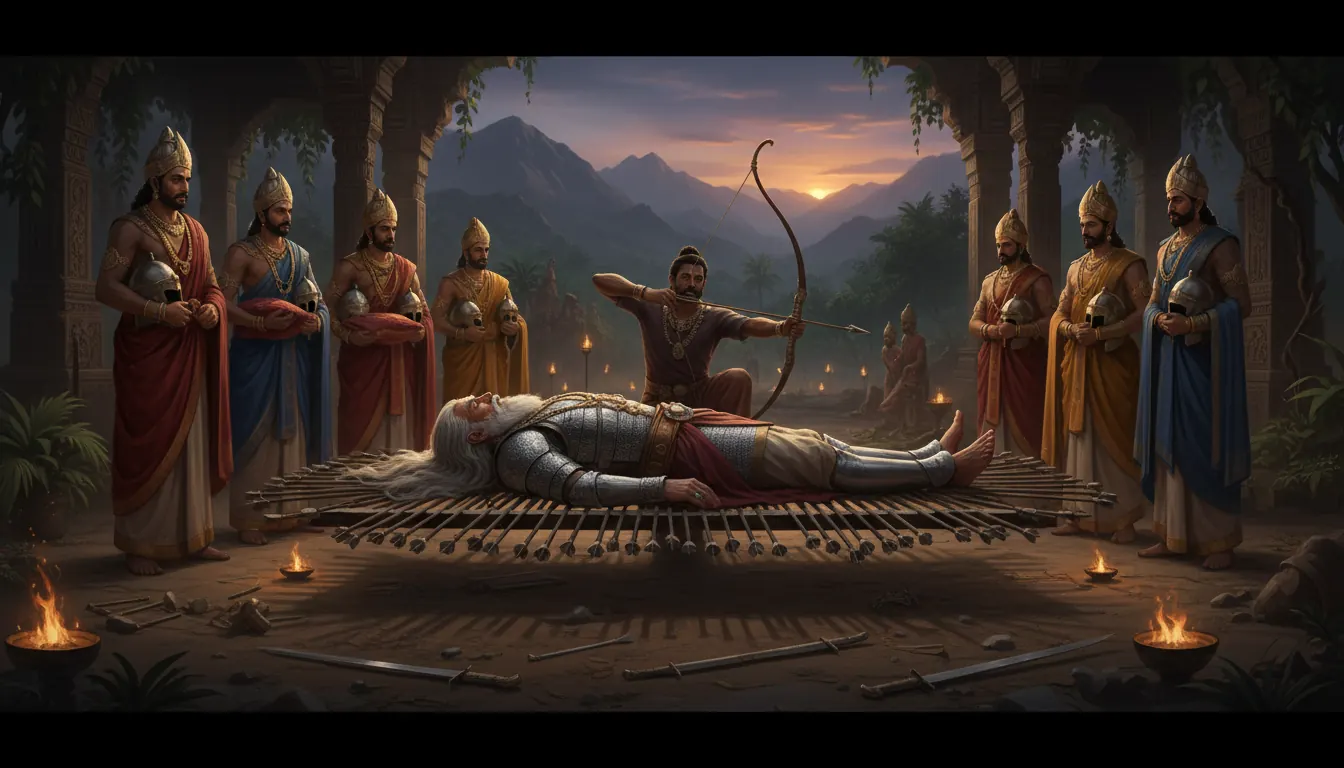
Drona falls off his chariot at the news that Bhishma is down, and both armies stop fighting and walk out unarmoured to the bed of arrows. Kings bring soft cushions and are laughed at; Arjuna understands, and shoots three shafts into the earth to hold up the old man's head. Bhishma dismisses the surgeons and begs Duryodhana for peace.
Told in the Bhishma ParvaSet in Kurukshetra, Pandava Camp and Indraprastha17 min read
A Heart Made of Adamant
"Alas, Sanjaya, what became of my warriors when they lost the mighty, godlike Bhishma, who took the vow of a Brahmacharin for his revered father's sake? I counted the Kurus as dead already from the moment he scorned the son of Drupada and would not strike him. And now, wretch that I am, I hear of the slaughter of the man who was a father to me. What sorrow could be heavier? My heart must be made of adamant, since the news does not break it into a hundred pieces.
"Tell me, you who keep your vows so well, what that lion of the Kurus did when he was struck down in battle. I cannot bear to think that Devavrata has been killed. Jamadagni's son could not kill him long ago, with all his heavenly weapons. And now he has been brought down by Drupada's son Shikhandi, the prince of Panchala."
"He was struck down in the evening," Sanjaya said, "and he saddened the Dhartarashtras and delighted the Panchalas. He fell down on the earth and lay on his bed of arrows, and his body did not touch the ground anywhere. There were so many shafts in him that he came to rest on the ends of them, held up off the earth, and that is how he has lain ever since.
"When he fell from his chariot, every creature cried out in grief. The great tree that marked the boundary of the Kurus was down, and fear went into the hearts of the kshatriyas of both armies at once. Both sides saw his standard thrown down and his armour cut open, and both sides lost heart. Gloom filled the sky. The sun itself grew dim. The earth seemed to shriek."
What the Creatures Said
"Here lies the greatest of all who know the Vedas," the creatures of the field were saying over him. "Here lies the best of all who know the Vedas."
And the rishis, and the Siddhas, and the Charanas, standing in the air above that bed, said the other thing about him, the thing that was said of him first and that will be said of him last.
"Long ago, seeing his father Shantanu tormented by desire, this man resolved to draw his own vital seed upward."
On the ground the two armies were doing very different arithmetic. Your sons did not know what to do with their hands. The splendour went off their faces and they stood about in shame with their heads hanging. The Pandavas had won and they stood at the head of their ranks and blew their large conches decked with gold, and thousands of trumpets went off at once, and in the middle of that noise I saw Bhimasena sporting about in great glee, having just killed a great many strong men very quickly.
A swoon came over the whole Kaurava host. Karna and Duryodhana stood there drawing long breaths, one after another, and neither of them said anything to the other.
Then Dushasana turned his horses and went at speed into Drona's division. He had been posted by his elder brother, clad in mail and at the head of his own troops, for the protection of Bhishma, and he had failed at it, and now he had to carry the news himself. Wherever he went along that line he plunged the men into grief simply by passing them, and the Kauravas closed around his chariot because they wanted to hear what he had come to say.
The Teacher Falls Off His Chariot
He told Drona that Bhishma was down.
Drona heard it and fell off his chariot.
He was the second man of that army, the teacher of both sides, a brahmana who had spent his life not being surprised by anything on a battlefield, and when the words reached him his body simply let go and he went over the rail onto the ground.
Then the valiant son of Bharadwaja got his senses back, stood up, and forbade the Kuru army to continue the fight. He gave no reason for it. Nobody asked for one.
And the Pandavas, seeing the Kurus stop, sent messengers out on fleet horses along their own line and stopped their army too. Nobody negotiated this. Nobody sent a herald across with terms. Both hosts stopped because the same man had fallen, and then the kings of both armies put off their armour and went out on foot to where he was lying.
Thousands of other warriors followed them, walking out over their own dead, the way the celestials go towards the Lord of all creatures. They came up to Bhishma where he lay on that bed and stood there, and offered him their salutations.
And he spoke to them, Kurus and Pandavas together, standing in one crowd in front of him.
"Welcome, blessed ones. Welcome, mighty chariot warriors. It gladdens me to see you, the equals of the gods themselves."
Then, because his head was hanging back off the ends of the arrows and had been hanging back for some time, he said the next thing.
"My head hangs down greatly. Let a pillow be given to me."
The Kings Bring Cushions
The kings went and fetched pillows. They brought back a great many of them, and they were excellent pillows, very soft, made of the most delicate fabrics that could be found in the baggage of two royal armies, and they were the best thing that any of those men could think of to do for him.
The grandsire did not want them.
He looked at the heap of soft and costly things that a hundred kings had assembled at the side of his bed of arrows, and that tiger among men, that mightiest of chariot warriors in all the worlds, laughed at them.
"These, kings," he said, "are not fit for a hero's bed."
And then he looked past all of them and found the one man on that field who would understand what he had actually asked for, and it was the man who had put him there.
"Dhananjaya. Mighty-armed one. My head hangs down, my son. Give me a pillow, whatever kind you think fit."
Three Shafts Into the Ground
Arjuna strung his large bow. He saluted the grandsire reverentially, and his eyes were full of tears, and he said what he had said to him at every stage of his life except one.
"Greatest of the Kurus, first of all who bear arms, invincible one, command me, for I am your slave. What shall I do, grandsire?"
"My head hangs down, my son. Phalguni, greatest of the Kurus, get me a pillow. Give me one at once, hero, one that suits this bed of mine. You can do it. You are the greatest of all bowmen. You know the duties of a kshatriya, and you have both wisdom and goodness."
"So be it," Arjuna said.
He took up Gandiva and picked out three straight shafts and inspired them with mantras, and then he asked the old man's permission, and got it. Then he shot the three of them into the earth under Bhishma's head, at such a height and such an angle that when he had finished, the head of Shantanu's son was resting on them and was no longer hanging back.
Bhishma, who had asked for exactly that and had not said so, understood that Arjuna had read his mind, and was delighted, and applauded him in front of everyone.
"Son of Pandu, you have given me a pillow fit for my bed. If you had done anything else, I would have cursed you in my anger. This is how a kshatriya who keeps to his duty should sleep on the battlefield, on his bed of arrows."
Then he looked around at all the Bharatas standing there in the dusk with their armour off.
"Look at the pillow the son of Pandu has given me."
Until the Sun Turns North
"I will sleep on this bed," he told them, "until the sun turns at the northern solstice. Those kings who come to me then will see me give up my life. When the sun, in his swift chariot drawn by seven horses, turns towards the quarter where Vaishravana dwells, then I will let my life go the way a man sends off a dear friend who is also dear to him.
"Kings, have a ditch dug around this place where I lie. Pierced with hundreds of arrows as I am, I will worship the sun from here.
"And as for you: give up your enmity. Stop the fighting."
He had been given the choosing of the hour of his own death when he was a young man, in a boon given by a father who had nothing else to give him, and now he was using it. He would not go while the sun was in the south. He would lie in the open field on the ends of Arjuna's arrows through as many weeks as that took.
Then the surgeons arrived.
They came with all the proper appliances of their profession, well trained men, skilled in the plucking out of arrows, sent for by somebody who had not yet grasped what he was looking at. Bhishma saw them coming and spoke to Duryodhana about them, not to them.
"Send these physicians away with gifts of wealth, after paying them proper respect. In the state I am in, what need do I have of physicians? I have won the highest and most honoured state the kshatriya code lays down. Rulers of men, lying as I do on a bed of arrows, it would not be right for me to let physicians treat me. I should be burned with these arrows still in my body."
Duryodhana honoured them as they deserved and sent them away. And the kings of the different realms, seeing that constancy in virtue, were filled with wonder, and saluted him, and walked around him three times, and posted guards all around the place where he lay, and went back to their tents in the evening with their bodies still drenched in blood and their hearts plunged in grief, thinking about what they had seen.
By Good Luck, Victory
Later that night Madhava came to the Pandavas, who were sitting together cheerfully, filled with joy at the fall of Bhishma, and spoke to Dharma's son.
"What good fortune, son of the Kuru line, that victory is yours. What good fortune that Bhishma has fallen, a mighty chariot warrior no man could kill, whose aim never failed. Or perhaps destiny decreed that this master of every weapon should meet in you an enemy who can kill with a look, and he has been burned up by your angry glance."
Yudhishthira the just did not take the compliment.
"Victory comes by Your grace," he said. "Defeat comes by Your anger. You drive away the fears of those who are devoted to You. You are our refuge. It is no wonder that those whom You always protect in battle, and whose good You always seek, should win, Keshava. With You for our refuge, nothing seems a wonder to me."
Janardana answered him with a smile.
"Best of kings, no one but you could say such a thing."
And on the other side of the plain, in the Kaurava camp, nobody said anything at all like that to anybody.
The Morning the War Stopped
After the night had passed away, all the kings of both parties went out to the grandsire again. They saluted that bull of their order, that hero lying on a hero's bed, and stood in his presence.
Then the maidens came. They came by thousands, and they showered powdered sandalwood over Shantanu's son, and fried paddy, and garlands of flowers, gently, so as not to move the shafts. Women came, and old men, and children, and ordinary spectators who had nothing to do with either army, all of them going towards him the way creatures of the world go out to look at the Sun. Trumpets came by hundreds and by thousands. Actors came, and mimes, and skilled mechanics.
And the Kurus and the Pandavas, with the fighting stopped and their coats of mail put aside and their weapons laid down, came and stood together around the invincible Devavrata.
They were assembled as they had been in the old days. They spoke to one another cheerfully, each according to his age, the younger deferring, the elder answering, exactly as men of one house do. That conclave of Bharata kings by hundreds, with Bhishma in the middle of it, looked as beautiful and as blazing as a conclave of the gods in heaven engaged in adorning the Grandsire.
It lasted one morning. Every man there knew what he would be doing to the man beside him the next day, and for that morning it did not seem to matter.
Bhishma lay in the middle of it holding his agonies down with fortitude, burning with the arrows that were still in him, sighing like a snake. Nearly out of his senses from the weapon wounds, he cast his eyes over those kings and asked for water.
Water Out of the Earth
The kshatriyas ran and came back with fine food and several jars of cold water, and set them down where he could see them.
"I can no longer use anything that men enjoy, my sons," Bhishma said. "I have passed beyond the bounds of human life. I am lying on a bed of arrows. I am waiting here only for the turning of the moon and the sun."
Having rebuked them with that, he said what he wanted.
"I wish to see Arjuna."
Arjuna came and saluted him and stood with his hands joined. "What shall I do?"
"My body is covered all over with your arrows, and it is burning terribly. Every vital part of me is in agony. My mouth is dry. Lying here in this agony, I need water, Arjuna. Give it to me. You are a great bowman. You can give me water in the proper way."
"So be it," Arjuna said.
He mounted his chariot and struck Gandiva and began to stretch it, and at the twang of that bow and the slap of his palms, which together sounded like thunder, the troops and the kings standing about the field were filled with fear, because the last time they had heard it the war had still been going on.
He drove once around the prostrate chief of the Bharatas. Then he took a blazing arrow, inspired it with mantras and identified it with the Parjanya weapon, and in the sight of the entire army he pierced the earth a little to the south of where Bhishma lay.
A jet of water came up out of the hole. It was pure, and auspicious, and cool, and it had the scent and the taste of nectar, and Partha quenched the old man's thirst with it where he lay.
The rulers of the earth were filled with wonder. The Kurus trembled like cattle in the cold. Kings pulled off their upper garments and waved them in the air, and the conches blared and the drums beat all over the field, for water.
Let This Battle End With My Death
His thirst quenched, Bhishma praised him in front of all those kings.
"Mighty-armed one, this is no wonder, coming from you. Narada spoke of you as an ancient rishi. With Vasudeva beside you, you will do many mighty deeds that the king of the gods himself, with all the gods behind him, would surely not dare to attempt. Those who know such things know you as the destroyer of the whole kshatriya race. As man is first among creatures, as Garuda is first among winged things, as the ocean is first among the waters and the cow among four-footed beasts, as the sun is first among the lights of heaven and Himavat among mountains, so you are first among all bowmen."
Then he turned his eyes to his grand-nephew, who had been standing in that crowd the whole morning.
"Dhritarashtra's son would not listen to what was said to him again and again, by me, and by Vidura, and by Drona, and by Rama, and by Janardana, and by Sanjaya too. Out of his senses, like a fool, he trusted none of it. He is past all teaching, and he will surely lie down for ever, crushed by the might of Bhima."
Duryodhana's face fell, and Bhishma, watching him, changed his voice.
"Listen, king. Let go of your anger. You have seen how clever Partha brought up that jet of cool, nectar-scented water. No one else in this world could do such a thing. The weapons of Agni, Varuna, Soma, Vayu and Vishnu, and those of Indra and Pashupati and Paramesthi, and those of Prajapati and Dhatri and Tvashtri and Savitri and Vivaswat, are known to Dhananjaya alone among men. Krishna the son of Devaki knows them too. No one else here knows them.
"Make peace with that truthful hero, king, and make it soon. While the mighty-armed Krishna is not yet roused to anger, it is right to make peace with the heroic Parthas. While what is left of your brothers is still alive, make peace. Before Yudhishthira, his eyes burning with anger, burns up your troops, make peace. Before Nakula and Sahadeva and Bhimasena wipe out your army, let friendship be restored.
"Let this battle end with my death, my son. What Phalguni has done already is enough. Let my death bring peace to everyone. Let these kings of the earth mingle happily with one another. Let fathers have their sons back. Let sisters' sons have their uncles back. Relent, king. Give half the kingdom to the Pandavas, and let King Yudhishthira the just go to Indraprastha. Do not earn a wicked name among the kings of the earth as the man who set his own family at war. If, for lack of understanding and in the grip of folly, you will not listen to this timely advice, you will bitterly regret it. What I say is true. So stop, even now."
Having said this out of affection, in the middle of all those kings, the son of the ocean-going Ganga became silent. His vital limbs were burning with the arrow wounds. He prevailed over the agonies and applied himself to yoga.
"And your son," Sanjaya said, "heard those kind and peaceful words, full of both virtue and good sense, and would not accept them, like a dying man refusing medicine."
Dharma Lesson
The only bed fit for a man who kept a hard vow is the one his own choices made for him. Bhishma refuses the cushions and the physicians because comfort would falsify what he spent his life proving, and he asks instead for the pillow his enemy alone knows how to give. The care he does accept is the kind that respects what he chose, not the kind that undoes it.