In short
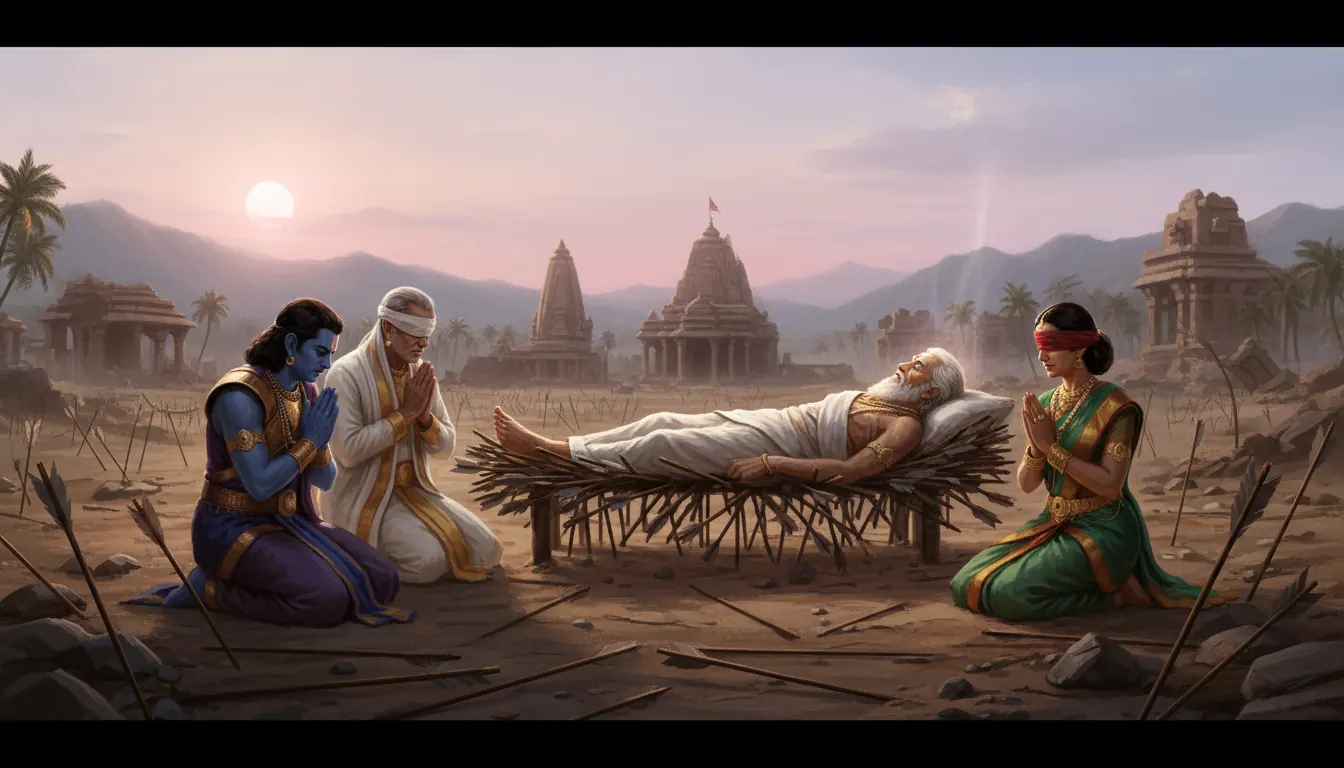
The teaching finished, Vyasa asks Bhishma to release Yudhishthira, and the grandsire names the hour of his own death: the day the sun stops going south. Fifty nights later the king returns with the funeral stores. Bhishma opens his eyes, counts his fifty-eight nights on the arrows, comforts Dhritarashtra, asks Krishna's leave, and draws his breath up through the crown of his head, every wound closing as it passes.
Told in the Anushasana ParvaSet in Kurukshetra, Hastinapura and Ganga16 min read
When the Grandsire Stopped Speaking
"My great-grandsire Yudhishthira heard all of it," said Janamejaya, "the mysteries of duty and the rules that govern gifts, and every doubt he had about righteousness and wealth was cleared away. Learned brahmana, tell me now what else the great Pandava king did."
Vaishampayana said: When Bhishma fell silent, the whole circle of kings seated around him fell perfectly silent too. Nobody moved. They sat there motionless, like figures painted on canvas, waiting for a voice that had been going for weeks to start again, and it did not start again.
Then Vyasa, the son of Satyavati, thought for a moment and spoke to the royal son of Ganga.
"King," he said, "the Kuru chief Yudhishthira has come back to himself, and so have all his brothers and followers. With Krishna of great intelligence beside him, he bows his head to you in reverence. Please give him leave to go back to the city."
It was said gently and it was said in front of everyone, and it meant: you are finished. He has what he came for. Let him go home and be a king, and stop lying here holding the door of your own death open for the sake of one more chapter.
At these words of the holy Vyasa, the royal son of Shantanu and Ganga dismissed Yudhishthira and his counsellors.
Go Back and Be a King
He spoke to his grandson in a sweet voice, and what he gave him was not a farewell but a list of duties, which was the only comfort he knew how to offer.
"Go back to the city, king. Let the fever in your heart pass. Worship the gods with many sacrifices rich in gifts of food and wealth, like Yayati himself, the greatest of kings, who was full of devotion and self-restraint. Keep to the duties of the kshatriya order, son of Pritha, and please the Pitris and the gods. Great blessings will come to you.
"Make all your subjects glad. Reassure them and keep the peace among them all. Honour all your well-wishers with the rewards they deserve. Let all your friends and well-wishers live by depending on you, as birds live by depending on a full-grown tree heavy with fruit that stands on a sacred spot."
Then he named the hour, and he named it as flatly as a man naming a day of market.
"When the hour of my departure from this world comes, king, come back here. I will leave my body when the sun stops in his southward course and begins to turn north."
The son of Kunti answered, "So be it."
He bowed to his grandsire with reverence and then set out, with all his relatives and followers, for the city named after the elephant. He put Dhritarashtra at the head of the procession, and Gandhari, who was deeply devoted to her lord, and with the rishis and Keshava, the citizens and the people of the countryside and his counsellors around him, that foremost of Kuru's race entered the city named after the elephant.
Fifty Nights in the Capital
In Hastinapura, the son of Kunti did the things he had been told to do.
He honoured the citizens and the people of the province and sent them off to their homes. He went to the women who had lost their heroic husbands and their sons in the battle, and consoled them, and gave them abundant wealth, which is what there was to give. Having won back his kingdom, he had himself duly installed on the throne. He reassured all his subjects with many acts of good will. He set himself to earn the lasting blessing of the brahmanas, of the chief military officers, and of the leading citizens.
He was, in short, occupied, in the way that a man is deliberately occupied when there is a date in his mind that he is not looking at.
The blessed king spent fifty nights in the capital. Then he remembered the time his grandsire had named as the hour of his departure from this world, and he went out to look at the sky, and saw that the sun had stopped going south and had begun its northward course.
So he stopped being a king for a few days and became a grandson with a funeral to arrange.
What He Took With Him
With a number of priests he set out from the city named after the elephant, and the train behind him was loaded like a caravan going to a wedding.
He took a large quantity of clarified butter. He took garlands of flowers and scents and silken cloths and fine sandalwood, and Aquilaria Agallocha, and dark sloe wood, for the cremation of Bhishma's body. Many kinds of costly garlands and gems were among those stores. Bhishma's own sacrificial fires were carried in the procession, carefully, so that they would not go out on the road.
He put Dhritarashtra in front, and queen Gandhari, famous for her virtues, and his own mother Kunti, and all his brothers. Krishna went with him, and Vidura of great wisdom, and Yuyutsu, and Yuyudhana, and his other relatives and followers, a large train. Eulogists and bards walked with them, singing his praises the whole way, because that is what happens around a king even when he is going to burn his grandfather.
With all these around him the king set out from his city like a second chief of the gods. Soon he came to the spot where the son of Shantanu still lay on his bed of arrows.
I Am Yudhishthira
He saw his grandsire attended with reverence by Parashara's son Vyasa of great intelligence, and by Narada, and by Devala and Asita, and by the kings who were left alive, gathered from various parts of the country. The king saw that his great-souled grandsire, lying on his hero's bed, was guarded on every side by the warriors posted for that duty. They had been standing over him for fifty nights so that nothing came out of the grass at him.
King Yudhishthira stepped down from his chariot and, with his brothers, bowed to his grandsire, the chastiser of all foes. They also bowed to the rishis, with the island-born Vyasa at their head, and were greeted in return.
Then, with his priests, each of whom looked like the grandsire Brahman himself, and with his brothers, Yudhishthira went up to where Bhishma lay among those revered rishis, and spoke to a man whose eyes were closed and who might or might not still be in there.
"I am Yudhishthira, king. I bow to you, son of the river Janhavi. If you can still hear me, tell me what I can do for you. I have brought your sacrificial fires with me, and I am here to serve you at the hour you named. Teachers of every branch of learning, brahmanas, priests, all my brothers, your son king Dhritarashtra of great energy, are all here with my counsellors, and so is Vasudeva of great prowess. The warriors who are left alive, and all the people of Kurujangala, are here too. Open your eyes, chief of Kuru's race, and look at them. I have arranged and provided everything that this occasion needs. At the hour you named, everything has been made ready."
Fifty-Eight Nights
The son of Ganga opened his eyes and saw all the Bharatas gathered there, standing around him.
The mighty Bhishma took Yudhishthira's strong hand in his own, and that great master of words spoke to him in a voice as deep as the clouds.
"By good luck, son of Kunti, you have come here with all your counsellors. The thousand-rayed maker of day, the holy Surya, has begun his northward course. I have been lying on my bed here for fifty-eight nights. Stretched on these sharp-pointed arrows, I have felt this time to be as long as a century."
Then he told them the date, because he had been keeping it himself, on his back, in the open, without a calendar and without moving.
"Yudhishthira, the lunar month of Magha has come. This is the bright fortnight, and a fourth part of it should still remain."
When he had said this to the son of Dharma, he turned to Dhritarashtra, and spoke to the blind king as an elder speaks to a man who has lost everything and is entitled to hear the truth about how.
"King, you know your duties well. All your doubts about the science of wealth have been settled. You have served many brahmanas of great learning. So you should not grieve, son of Kuru. What was ordained has happened. It could not have been otherwise. In the eyes of morality Yudhishthira and his brothers are as much your sons as they are Pandu's. Keep to the duties of religion and cherish and protect them. They in turn are always devoted to serving their elders. King Yudhishthira the just is pure-souled. He will always be obedient to you. I know that he is devoted to compassion.
"Your sons were all wicked at heart. They were given over to anger and greed. Overwhelmed by envy, they all behaved wickedly. It is not right for you to grieve for them."
Leave Asked of Krishna
Then the Kuru hero spoke to mighty-armed Vasudeva, and the voice changed, because he was no longer instructing anybody.
"Holy one, god of all gods, worshipped by all the gods and Asuras, you who covered the three worlds in three strides, I bow to you, bearer of the conch, the discus and the mace. You are Vasudeva. You are the one Purusha. You are the creator. You are Jiva. You are subtle. You are the Supreme and eternal Soul. Lotus-eyed one, rescue me. Give me permission, Krishna, to leave this world.
"You must always protect the sons of Pandu. You are already their only refuge. Long ago I told the foolish, wicked-minded Duryodhana that where Krishna is, there Righteousness is, and where Righteousness is, there is victory. I advised him to take Vasudeva as his refuge and make peace with the Pandavas. Again and again I told him, 'This is the best time for you to make peace.' The foolish Duryodhana would not do as I asked. He brought great havoc on the earth, and in the end he laid down his own life.
"I know you to be that ancient and best of rishis who lived for many years with Nara in the retreat of Badari. The celestial rishi Narada told me this, and so did Vyasa of stern penances. They too have told me that you and Arjuna are the old rishis Narayana and Nara, born among men. Krishna, give me leave. I will cast off my body. With your permission I will reach the highest end."
"I give you leave, Bhishma," said Vasudeva. "Go to the state of the Vasus, you of great splendour. You have not committed a single wrong in this world. Royal sage, you are devoted to your father. That makes you like a second Markandeya. That is why death waits on your pleasure like your slave, hoping to read your wishes."
Then the son of Ganga spoke to the rest of them, the Pandavas, Dhritarashtra at their head, and all his friends and well-wishers. "I want to give up my life-breaths. Please give me leave. You must strive to reach the truth. Truth is the highest power. Always live among brahmanas of righteous conduct, devoted to penance, who keep away from cruelty and have mastered their souls."
He embraced them all. Then he turned once more to Yudhishthira, with the last instruction of a life made of instructions. "King, let all brahmanas, above all the wise, the teachers, and the priests who can conduct sacrifices, be honoured in your eyes."
The Breath Goes Up
When he had said this to all the Kurus, Bhishma was silent for some time.
Then he drew his life-breaths, one after another, into the parts of the body that Yoga names. The life-breaths of that great-souled man, duly restrained, rose up through him.
And as they rose, the thing happened that everyone standing there remembered for the rest of their lives. Each part of the body of Shantanu's son that the life-breaths left became healed, one after another. The arrows came out of him from the feet upward as the breath climbed, and the wounds closed behind it, so that a body which had been a pincushion for fifty-eight nights was made clean in front of them from the soles to the crown. Among those great-souled men, and the great rishis with Vyasa at their head, it was a strange sight.
Within a short time Bhishma's whole body was free of arrows and of wounds. When they saw it, all those distinguished men with Vasudeva at their head, and all the ascetics with Vyasa, were filled with wonder.
The life-breaths, held in and unable to escape through any of the outlets, at last pierced the crown of the head and went up to heaven. The celestial kettle-drums began to play, and showers of flowers rained down. The Siddhas and the twice-born rishis cried out in delight, "Excellent, excellent!"
Bhishma's life-breaths, bursting through the crown of his head, shot up through the sky like a large meteor and were soon lost to sight. So Shantanu's son, that pillar of Bharata's race, became one with eternity.
The Pyre and Who Held What
Then the great-souled Pandavas and Vidura took a large quantity of wood and many kinds of fragrant scents and built a funeral pyre. Yuyutsu and others stood watching the preparations.
Yudhishthira and Vidura wrapped Bhishma's body in silken cloth and garlands of flowers. After that every man there took up the thing that was his to hold. Yuyutsu held a fine umbrella over the body. Bhimasena and Arjuna each held a pair of pure white yak-tails. The two sons of Madri held two head-dresses. The women stood around the body on every side with palmyra fans and began to fan it softly, as though he were sleeping in the heat and might yet be made comfortable.
Then the Pitri sacrifice of the great-souled Bhishma was duly performed. Many libations were poured on the sacred fire. The singers of Samans sang many Samans.
Then the Kurus covered the body of Ganga's son with sandalwood and black aloe and bark wood and other fragrant fuel and set it alight, and with Dhritarashtra and the others they stood on the right side of the funeral pyre until it had done its work.
The River Comes Up Out of Herself
When they had cremated the son of Ganga, those foremost of Kuru's race went with the rishis to the sacred Bhagirathi. Vyasa followed them, and Narada, and Asita, and Krishna, and the ladies of the Bharata race, and those citizens of Hastinapura who had come to the place. When they reached the sacred river, they all duly offered water to the great-souled son of Ganga.
And when those offerings had been made to her son, the goddess Bhagirathi rose up out of the stream, weeping, distracted by sorrow, and stood in front of them.
"Sinless ones, listen to me as I tell you all that happened to my son. Royal in conduct and nature, rich in wisdom and high birth, my son was the benefactor of all the elders of his race. He was devoted to his father and kept high vows. Even Rama of Jamadagni's race could not defeat him with his celestial weapons of great energy. Alas, that hero has been slain by Shikhandi.
"Kings, my heart must surely be made of adamant, for it does not break even now that my son is gone from my sight. At the Self-choice at Kashi he defeated the assembled kshatriyas from a single chariot and carried off the three princesses for his step-brother Vichitravirya. No one on earth was his equal in might. Alas, my heart does not break even when I hear that Shikhandi has killed my son."
Mighty Krishna heard the goddess of the great river pour out her grief, and consoled her with many soothing words, and the first thing he did was to take the name out of her mouth.
"Gentle lady, be comforted. Do not give way to grief. Your son has surely gone to the highest region of bliss. He was one of the Vasus of great energy, and because of a curse he had to be born among men. It is not right for you to grieve for him. As a kshatriya's duty required, he was slain by Dhananjaya on the field of battle while he fought. He was not slain by Shikhandi, goddess. Not even the chief of the gods himself could have slain Bhishma in battle when he stood with his bow drawn. All the gods together could not have slain him. Your son has gone to heaven. Let the fever in your heart pass."
When Krishna and Vyasa had spoken to her like this, that greatest of all rivers cast off her grief and grew calm again. All the kings there, with Krishna at their head, duly honoured the goddess and took her leave to depart from her banks.
Dharma Lesson
A life held open past its own ending for the sake of what still had to be said is closed, when the hour comes, without struggle. Bhishma spends his last words settling other people's grief rather than his own, and the arrows come out of him only when he has finished. The mourning that follows belongs to the living rather than to the one who left.