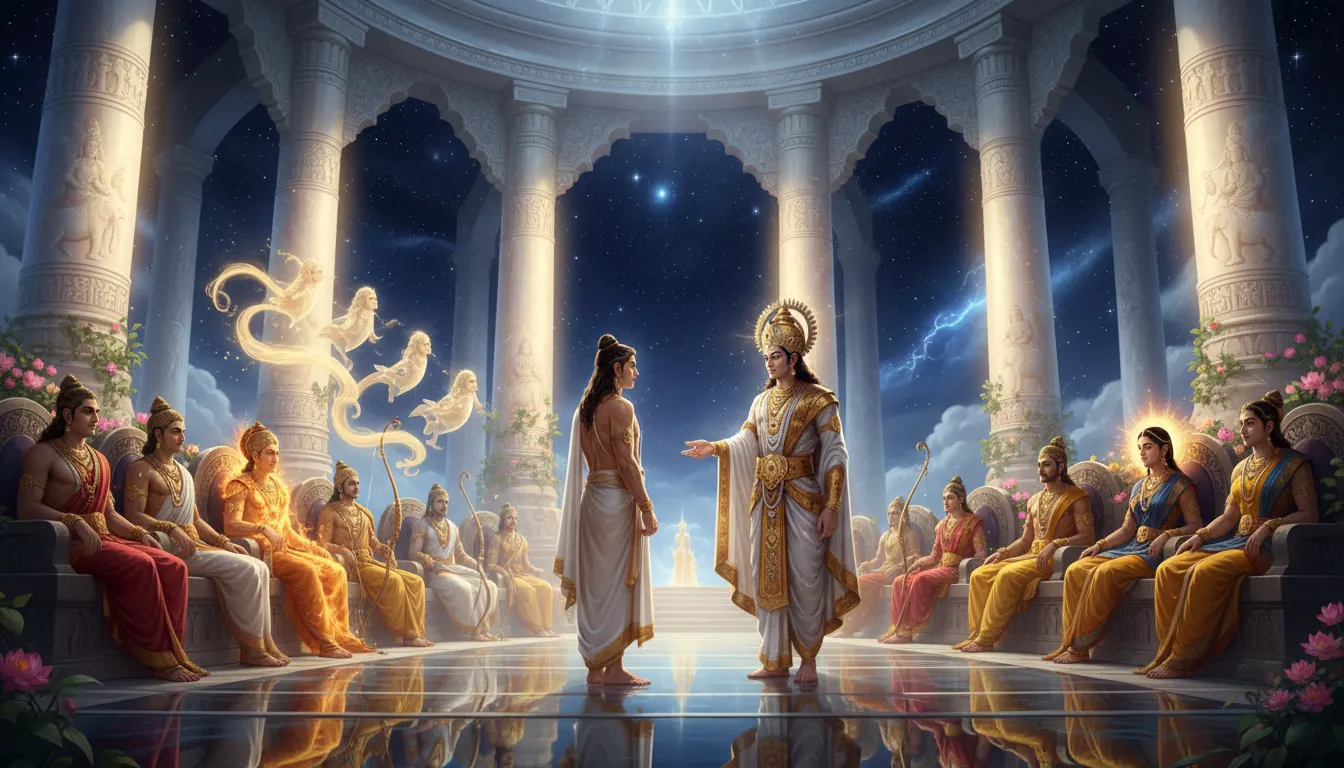
The Return of the Portions
Who everybody turned out to have been
In short
Yudhishthira bathes in the heavenly Ganga and is walked through the assembly while Indra names each figure he loved and fought. Draupadi is Sri, born from no womb; her five sons were Gandharvas. Then Janamejaya asks how long heaven lasts, and Vaishampayana reads the last list: Bhishma to the Vasus, Drona into Brihaspati, Karna into Surya, Balarama under the earth as Ananta.
Told in the Svargarohana ParvaSet in Amaravati, Takshashila and Saraswati17 min read
Divested of All His Enmities
Vaishampayana said: When he had bathed in the heavenly river Ganga, sacred and purifying and always worshipped by the rishis, that royal sage cast off his human body.
He had come a long way to do it. He had been shown Duryodhana on a throne and had turned around and refused the place. He had walked a road stinking of corpses to stand beside voices that said, I am Karna, I am Bhimasena, I am Draupadi, and had told the messenger of the gods to go back and say that he would stay there. He had been informed that the whole of it was the third and last of his father's tests, and he had passed it by failing to be reasonable.
Now he went into the water of the heavenly Ganga, and came out of it in a heavenly form, and because of that bath he was divested of all his enmities and of his grief. Not consoled. Divested. The thing was taken off him like a coat.
Surrounded by the gods, with Dharma beside him and the great rishis singing his praises, the Kuru king Yudhishthira then went on from that spot, and he reached the place where those foremost of men, the Pandavas and the Dhartarashtras both, freed from human anger, were each enjoying his own station.
The first thing he saw there was Govinda, in his Brahma-form. It was a form that had not been seen before, and nothing like it had ever been recognized. He was blazing in it, and adorned with the divine weapons, the terrible discus and the others, each of them standing beside him in its own embodied form, the way retainers stand.
And Phalguna was there, blazing too, worshipping him. The son of Kunti saw the slayer of Madhu also in his own form, and the two foremost of Beings, whom all the gods worship, saw Yudhishthira come in, and received him with proper honours, as hosts do.
A Dozen Suns
In another place, the delighter of the Kurus saw Karna.
The greatest of all who wield weapons was sitting there, like a dozen Suryas in splendour, and Yudhishthira had last seen him in the dark on a road of corpses, calling out his own name in a voice of pain.
In another part he saw Bhimasena of great might, sitting in the midst of the Maruts in a blazing form. He was sitting by the side of the God of Wind in his embodied form, and anyone who had ever watched Bhima come across a field would have said that this was where he belonged and had probably been all along.
In the place belonging to the Ashvinis, the delighter of the Kurus saw Nakula and Sahadeva, each blazing with his own radiance: the two who had been born to Madri out of the physicians of heaven, and who had spent a lifetime being the handsome one and the clever one at the end of a line of five.
Yudhishthira went from one to another of them like a man walking through a house he has lived in and finding that every room has been rebuilt to a plan he was never shown.
They were not in one place, as a family sits. They were distributed: this one among the Maruts, those two with the Ashvinis, that one shining like twelve suns by himself. Each had gone back to the household he had come out of, and the household he had come out of was in every case not the one at Hastinapura.
This One Is Sree Herself
Then he saw the princess of Panchala, decked in garlands of lotuses.
She had reached Heaven, and she was sitting there in a form with the splendour of the sun, and King Yudhishthira suddenly wished to question her. He had a great many questions. He had had them for a long time, and most of them began with the same word, which was why, and were addressed to himself.
He did not get to ask any of them. The illustrious Indra, the chief of the gods, spoke first.
"This one is Sree herself," he said. "It was for your sake that she was born among human beings as the daughter of Drupada, coming from no mother's womb, Yudhishthira, sweetly fragrant and able to delight the whole world. The wielder of the trident created her for your pleasure. She was born in the race of Drupada, and you all enjoyed her love."
Issuing not from any mother's womb. Everybody at Kampilya had known that much: she had come up out of the fire of a sacrifice already grown, full-formed, dark and perfumed, beside a brother who had been made to kill Drona. What Vyasa had told Drupada once, before the wedding, and nobody had said aloud since, in all the years of the dice hall and the forest and the year of hiding and the war, was the other half of it: that she was Prosperity, the goddess herself, and that the whole business of the five husbands and the single garland had been arranged by Shiva before any of them were born.
"These five highly blessed Gandharvas," Indra went on, pointing to five young men who shone like fire, "were, king, the sons of Draupadi and yourself."
The boys killed in their beds by Drona's son on the last night of the war. Yudhishthira looked at them and they were Gandharvas, and had been Gandharvas the whole time, including on the night they were cut down in their sleep.
The Son of Surya, Your Eldest Brother
"Here is Dhritarashtra, the king of the Gandharvas, a being of great wisdom," said Indra. "He was your father's eldest brother."
The blind king was not blind. That was the first thing to be said about him and the epic does not stop to say it.
"This one is your eldest brother, the son of Kunti, who shines like fire. The son of Surya, your eldest brother, the greatest of men: this is the one who was known as the son of Radha. He moves in the company of Surya. Look at this greatest of Beings."
It was said in one breath, twice, so there could be no mistake: your eldest brother, and again, your eldest brother. Karna sat in the light of the god who had fathered him, and travelled with him, and the man being told this had already carried the knowledge for a great many years and had never once been able to put it down.
Yudhishthira had said what it did to him, out loud, in front of the assembled gods, only a little while before.
"At the time of performing the water rites after the battle, I heard my mother say, offer oblations of water to Karna. Ever since I heard those words of my mother, I have been burning with grief. And I grieve without end over this, you gods: that when I noticed how like my mother's feet were the feet of Karna, whose soul had no measure, I did not at once put myself under the command of that scourge of enemy ranks. With Karna joined to us, not even Shakra could have beaten us in battle. Alas, because no one knew how he was related to us, I caused Arjuna to kill him."
That was the wound he had brought up out of the world with him, and he had brought it through a river that takes enmity and grief off a man, and here at the end of it he was being introduced to his brother formally, by the king of the gods, in a hall where nobody was going to argue about anybody's caste.
Where Each of Them Was Sitting
The chief of the gods went on down the hall, naming them, and it was the strangest muster ever read out over that war.
"Among the tribes of the Sadhyas, the gods, the Viswedevas and the Maruts, see, king of kings, the mighty chariot-warriors of the Vrishnis and the Andhakas, those heroes with Satyaki at their head, and those mighty ones among the Bhojas."
"See the son of Subhadra, invincible in battle, now dwelling with Soma. He is the mighty bowman Abhimanyu, who now has the gentle radiance of the great light of the night."
The boy who had been surrounded by six chariots at the age of sixteen because he had been taught the way into a formation and not the way out, was sitting in the moon's light, and it suited him, and his father was in the same hall and could see it.
"Here is the mighty bowman Pandu, now united with Kunti and Madri. Your father often comes to me on his excellent chariot."
A man who had been forbidden by a curse to touch either of his wives was sitting with both of them, and drove up to Indra's house for visits.
"See the royal Bhishma, the son of Shantanu, now in the midst of the Vasus. Know that this one beside Brihaspati is your teacher Drona."
The grandsire had gone back among the eight Vasus, which was the company he had been born out of when Ganga carried him, and which is a story the Kurus had been telling for four generations without ever expecting to see the end of it confirmed.
"These and other kings, son of Pandu, who fought on your side now walk with the Gandharvas, or the Yakshas, or other sacred beings. Some have reached the station of Guhyakas. They cast off their bodies and won Heaven by the merit they had earned through word, thought and deed."
The Question at the Sacrifice
Janamejaya said: "Bhishma and Drona, those two great souls, king Dhritarashtra, and Virata and Drupada, and Shankha and Uttara, Dhrishtaketu and Jayatsena and king Satyajit, the sons of Duryodhana, and Shakuni the son of Subala, Karna's sons of great prowess, king Jayadratha, Ghatotkacha and others whom you have not mentioned, the other heroic kings of blazing form: tell me how long they stayed in Heaven. Was their place there eternal? What end did those greatest of men reach when their acts came to an end? I want to hear this, and that is why I have asked you. Through your blazing penances you see all things."
It was a sharper question than it sounds. Heaven, in this account, is not a destination and not a reward. It is a lodging, and it is paid for out of a stock of merit that runs down like oil in a lamp. The young king wanted to know what happens at the bottom of the lamp.
Vaishampayana said: "Not everyone, king of men, is able to return to his own nature at the end of his deeds. Whether this is so or not is a good question you have asked. Listen, king, to this mystery of the gods. It was explained to us by Vyasa of mighty energy, of divine vision and great prowess, that ancient ascetic, the son of Parashara, whose understanding has no measure, who knows everything, and who therefore knows the end that belongs to every act."
Then he gave the list, and it is the last list in the epic, and it is not a list of who won.
Each Went Back Where He Came From
Bhishma of mighty energy and great radiance reached the station of the Vasus. Eight Vasus, said Vaishampayana, are now seen. He had been the eighth of them once, cursed to be born a man, and the count in the sky was correct again.
Drona entered Brihaspati, the greatest of the descendants of Angiras: the teacher of the gods took back the teacher of the Kurus, and the man who had been born in a pot and had gone begging to Drupada for a cow was a portion of the teacher of Heaven.
Hridika's son Kritavarma entered the Maruts. Pradyumna entered Sanatkumara, from whom he had come.
Dhritarashtra obtained the regions, so difficult of acquisition, that belong to the Lord of treasures. Kubera's country, the wealth of the north, given to the king who had held a kingdom all his life without ever seeing it. And the famous Gandhari obtained the same regions with her husband, and it puts them there together, which is what she had chosen at the beginning by tying the cloth over her eyes.
With his two wives, Pandu proceeded to the abode of the great Indra.
And then a long roll of them, said quickly, the way names are read at a rite: both Virata and Drupada, king Dhrishtaketu, as also Nishatha, Akrura, Samba, Bhanukampa, and Viduratha, and Bhurishravas and Sala and king Bhuri, and Kamsa, and Ugrasena, and Vasudeva, and Uttara, that foremost of men, with his brother Shankha. All these foremost of men entered the gods.
Kamsa is in that list. The tyrant of Mathura, whom Krishna killed, goes back into a god in the same breath as Vasudeva, Krishna's father. Nobody comments. The accounting is not moral. It is simply a return of borrowed things.
Karna Into Surya
Soma's son of great prowess, named Varchas of mighty energy, became Abhimanyu, the son of Phalguna, that lion among men. He had fought, as kshatriya practice requires, with a bravery no one else had ever been able to show, and that mighty-armed and righteous soul entered Soma. The moon had lent his son on terms, for a fixed number of years, and had them back.
Slain on the field of battle, Karna entered Surya.
That is the whole of the sentence. The man who stood in the water every morning with his hands raised to the sun and gave away whatever was asked of him at that hour, who had his armour cut off his body and handed it over on that riverbank, who was refused by his teacher and mocked in the assembly and named after a woman who had pulled him out of a river, went up into the sun. Nobody argued about his caste on the way in.
Shakuni obtained absorption into Dvapara, who is the die of the losing throw and the age that was ending, and it is difficult to think of a more exact place to put him.
Dhrishtadyumna went into the deity of fire, out of which he had walked at Kampilya with a bow in his hand and Drona's death already written on him.
The sons of Dhritarashtra were all Rakshasas of fierce might. Sanctified by death caused by weapons, those high-souled beings all succeeded in attaining to Heaven.
Both Kshattri and king Yudhishthira entered into the god of Righteousness, which is to say that Vidura and Yudhishthira turned out to be the same being twice: Dharma, wearing a servant's son in one place and a king in another, arguing with himself across a hall for a lifetime about what ought to be done.
The holy and illustrious Ananta, who had taken birth as Balarama, went to the region below the Earth, and at the command of the Grandsire, helped by his Yoga power, held up the Earth.
Vasudeva was a portion of that eternal god of gods called Narayana. Accordingly, he entered into Narayana.
Sixteen thousand women had been married to him as his wives. When the time came they went down and plunged into the Saraswati, and cast off their human bodies there, and re-ascended to Heaven, and transformed into Apsaras they approached the presence of Vasudeva. They had come to him when he killed Naraka, the son of the Earth, and they went out through a river, and came up on the other side as something that does not die.
Those heroic and mighty chariot-warriors, Ghatotkacha and others who were killed in the great battle, reached the station, some of gods and some of Yakshas. Those that had fought on the side of Duryodhana are said to have been Rakshasas. Gradually, said Vaishampayana, they have all reached excellent regions of happiness, some to the abode of Indra, some to that of Kubera of great intelligence, and some to that of Varuna.
The Young King Filled With Wonder
Sauti said: Hearing this, at the intervals of the sacrificial rites, king Janamejaya became filled with wonder.
He was a young man sitting at a fire that had been lit to burn every snake in the world, because a snake had killed his father. He had been talked out of finishing it by a boy of the serpent race named Astika, and the fire was still going in front of him while he listened. The sacrificial priests then finished the rites that remained. Astika, who had rescued the snakes from a fiery death, was filled with joy. King Janamejaya pleased all the brahmanas with generous gifts, and, honoured in this way, they went back to their homes. When he had sent those learned brahmanas away, the king came back from Takshashila to the city named after the elephant.
He had asked for the story of his great-grandfathers and had been given, at the very end of it, a different thing: not a judgment, and not a moral, but an inventory.
The gods of Heaven, said Vaishampayana, came to this world for sport. When their task was done, they went up to Heaven once more.
The whole war, read backwards from that hall, is a company of players putting down borrowed masks. The Vasu is a Vasu again. The teacher goes back into the teacher of the gods. Prosperity, who had been walked out of an assembly hall by the hair, sits in her own form wearing lotuses. The sun's son sits in the sun. The seven sons Ganga drowned in a river and the five Draupadi lost in a single night are all standing in one room, in their own shapes, and none of them are angry, because there is no enmity in that place and there never was any at the bottom of it.
And the thing that was actually lost, which is the long years of ordinary human misery in between, is not given back to anybody. It is only, at the very end, explained.
Dharma Lesson
The last accounting is not a verdict on anyone but a restoration: every actor is handed back the self he set down in order to play a part. Kamsa goes into a deity in the same breath as Vasudeva, and nobody comments, because the reckoning is a return of borrowed things rather than a judgment. What is never given back is the ordinary human misery of the years in between; it is only, at the end, explained.