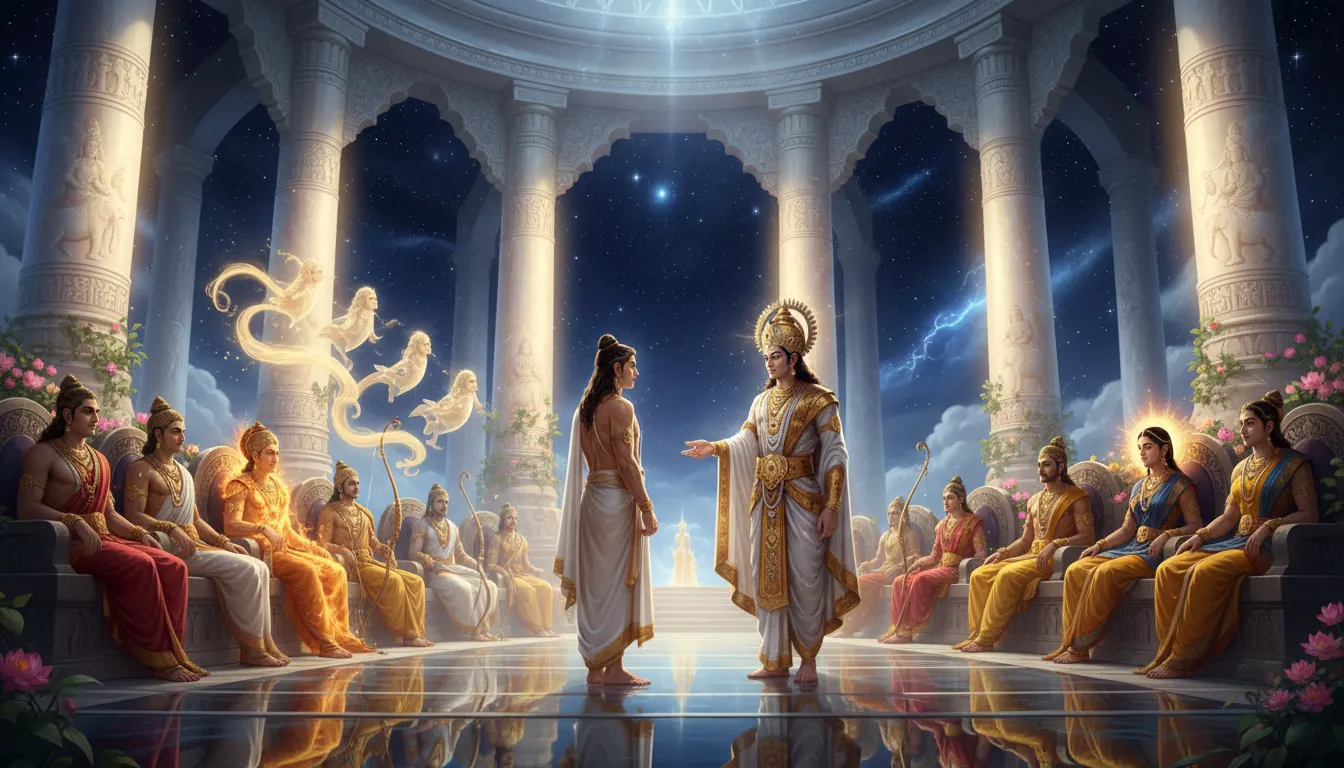
The Rewards of the Eighteen Parvas
Vaishampayana prices each stage of hearing the Bharata against a sacrifice, from the Agnishtoma to twenty-one thousand years with Indra
In short
With the snake sacrifice ended, Janamejaya asks not about the story but about the hearing of it: what rites, what gifts, what reciter, and what reward. Vaishampayana answers by counting out the ten paranas of a full recitation and pricing each one against a great sacrifice, from the Agnishtoma at the first to the Horse-sacrifice at the ninth, and beyond the ninth to twenty-one thousand years in the abode of Indra. He then goes through the eighteen books one by one, naming what should be given away as each is reached, and ends by instructing the listener how to worship the book itself.
Told in the Svargarohana ParvaSet in Takshashila, Amaravati and Indraprastha17 min read
The Question After the Story
Janamejaya had heard the whole of it by then. The snake sacrifice at Takshashila was finished, the fires had been let down, and the king who had begun the rite in order to burn a race of serpents had sat through eighteen books of a history instead. He had asked who the dead of Kurukshetra had turned out to be, and he had been told. Bhishma had gone back into the Vasus. Drona had entered Brihaspati. Karna had gone into the sun.
What he asked next was not about the story. It was about the hearing of it.
"Holy one," Janamejaya said, "with what rites should the learned listen to the Bharata? What fruits does hearing it bring? Which gods are to be worshipped at the different paranas? What gifts should one make, holy one, at each parva or sacred day while the recitation goes on? What qualities should the reciter have who is engaged for it? Tell me all this."
A recitation of the Bharata is not the work of an afternoon. It is taken in stages, over days, and a parana is the end of one of those stages: the pause in which the listener breaks his fast, the day's portion is closed off, the brahmanas are fed and the gifts are made. Ten paranas carry a man from the first line of the history to the last. Janamejaya was asking what a man who sat through all ten of them had bought.
Vaishampayana, the disciple of Vyasa, who had been the mouth of the whole recitation from its beginning, answered him.
"Hear, king, what the procedure is, and what fruits will spring from listening. This, king of kings, is what you are asking me. The gods of Heaven, ruler of Earth, came to this world for sport. When their task was done, they rose again to Heaven."
That was the first thing he said about the reward, and it was the whole of the reward in one sentence. The gods had come down, played out their business on the plain, and gone home. What they left behind was the account of it. A man could still follow them up by sitting still and listening.
Everything in One Place
"Listen to what I will tell you in brief," Vaishampayana said, and then gave the inventory of what is in the book.
In the Mahabharata are found the births of rishis and gods on the Earth. In this work are seen in one place the eternal Rudras, the Sadhyas and the Viswedevas, the Adityas, the two deities named the Ashvins, the regents of the World, the great rishis, the guhyakas, the gandharvas, the nagas, the vidyadharas, the siddhas, the diverse deities, and the Self-born visible in a body with many ascetics about him. In it are the Hills and Mountains, the Oceans and Seas and Rivers, the diverse tribes of apsaras. In it are the Planets, the Years, the Half-years and the Seasons, and the whole universe of moving and unmoving things, with all the gods and the asuras.
That is the claim on which everything that follows rests. The Bharata is not a chronicle of one family that happens to be long. It is the register of everything there is, gathered in one place, and a man who hears it hears the roll called.
"By hearing of their fame," said Vaishampayana, "and through the recitation of their names and achievements, even a man who has committed terrible sins will be cleansed."
Then the practical part. When one has heard the history properly from the beginning, with a concentrated soul and a cleansed body, and has reached its end, one should make Shraddha offerings to the great persons named in it. The dead of the story are treated as one's own dead, and fed.
And to the brahmanas, with due devotion and as far as one's means allow, large gifts should be made: many kinds of gems, and cows, and vessels of white brass for milking cows, and maidens decked with every ornament and skilled in every accomplishment suited to enjoyment, and also many kinds of conveyances, beautiful mansions, plots of land, and cloth. Animals should be given too, such as horses, and raging elephants, and beds, and covered litters carried on men's shoulders, and well-decked chariots. Whatever things of the finest kind are in the house, whatever wealth of great value is in it, should be given away.
Then the line that ends the list and refuses to stop where a list should stop.
"Indeed, one should give away one's own self, one's wives and one's children."
And one condition on the listener, set down before any reward is named. He should hear it without a doubting heart, with cheerfulness and joy, and as he goes on listening to the recitation he should make gifts with great devotion, as far as his means allow.
The Man Who Reads It Aloud
Before the fruits, the two men who have to be right for the fruits to come.
The listener first. Vaishampayana described the man who succeeds with a recitation of the Bharata as one devoted to truth and sincerity, self-restrained, pure in mind, careful of the acts that lead to purity of body, full of faith, and the master of his wrath. Six things, and not one of them is wealth.
Then the reciter, who is described at greater length than anyone else in the whole section, because the king had asked about him by name.
He should be pure of body and of good and pious conduct. He should be robed in white. He should have complete mastery over his passions and be cleansed of all offences. He should know every branch of learning, and be full of faith, free from malice, handsome, blessed, self-restrained, truthful, with his passions under control, and loved by all for the gifts he makes and the honours he holds. A man is not to be engaged for this because he has a good memory. He is to be engaged because he is the kind of man whose mouth the history can pass through without being spoiled.
Then the manner of the reciting, which is set down as exactly as a rule of ritual, because it is one.
He should be seated at his ease, free from all bodily complaints, and with rapt attention. He should recite the text without too much slowness and without a labouring voice, without being fast or quick, quietly, with sufficient energy, without confusing the letters and words together, in a sweet intonation, and with such accent and emphasis as would indicate the sense. He should give full voice to the sixty-three letters of the alphabet from the eight places where they are formed.
Everything in that paragraph is a warning against a particular way of ruining it. Dragging. Straining. Racing. Slurring one word into the next until nobody can hear where a sentence breaks. The instruction is not that the reciter should be moving; it is that he should be audible, and that the sense should be carried on the sound.
And then the opening itself. Bowing to Narayana, and to Nara, the best of men, and to the goddess Saraswati, one should utter the word Jaya.
Not the name of a king. Not a line of the story. One word, victory, which is the oldest name the history has for itself, said aloud before the first verse.
The First Three Paranas
"When the Bharata is recited by a reader of this kind, king," said Vaishampayana, "the listener, keeping his vows all the while and cleansed by purifying rites, gains precious fruits."
Then he counted them out, one parana at a time, and he priced each stage of the hearing against a sacrifice, because a sacrifice was the only currency his listener would understand.
When the first Parana is reached, the hearer should please brahmanas with gifts of everything they could desire. By doing this, one gains the fruits of the Agnishtoma sacrifice.
The Agnishtoma is the smallest of the great soma rites, a day's work with a season's preparation behind it, and it is already beyond the reach of most men who ever lived. That is the bottom rung. And the reward is described in the same breath: he gains a large celestial chariot full of many kinds of apsaras who wait on him, and with a glad heart, and with the gods for company, he goes to Heaven, his heart lost in bliss.
When the second Parana is reached, the hearer gains the fruits of the Atiratra vow, the rite that runs through the night without a break in it. He climbs into a celestial chariot made entirely of precious gems. Wearing celestial garlands and robes, decked with celestial unguents, and always shedding a celestial fragrance around him, he receives high honours in Heaven.
When the third Parana is reached, he gains the fruits of the Dwadasaha vow, the sacrifice of twelve days. He lives in Heaven for myriads of years, like a god.
Read those three together and the shape of the thing becomes visible. The first gives him a chariot and a journey. The second gives him a better chariot and a standing when he arrives. The third stops describing the vehicle altogether and gives him time, and the time is already counted in myriads of years, and there are seven paranas still to come.
Nobody in that sacrificial enclosure could have performed an Agnishtoma, an Atiratra and a Dwadasaha in one lifetime. Three days of sitting still and listening had just been declared to be worth all three.
The Chariot That Moves at the Will of the Rider
"At the fourth Parana he gains the fruits of the Vajapeya sacrifice."
The Vajapeya is the drink of strength, the rite a king performs when he wants pre-eminence among kings, and it has a chariot race in the middle of it that the sacrificer is required to win. That is what the fourth day of listening is now worth, and Vaishampayana spends one line on it and moves on.
At the fifth, twice those fruits are his. Climbing into a celestial chariot like the rising sun or a blazing fire, with the gods for his companions, he goes to Heaven and plays in bliss for myriads of years in the abode of Indra.
At the sixth Parana, twice again, and at the seventh, thrice those fruits become his. And here the account slows down and looks at the chariot, because by the seventh parana the reward has stopped being a quantity and has become a place.
He climbs into a celestial chariot as beautiful as the summit of the Kailasa mountains. It has an altar made of lapis lazuli and other precious gems. It is surrounded by beautiful things of many kinds and decked with gems and corals. It moves at the will of the rider. It is full of waiting apsaras. On it he roams through all the regions of bliss, like a second god of the Sun.
Notice what has been put on board. Not a throne. An altar. The man who sat and listened is given a chariot with a place of sacrifice built into it, so that whatever else he does up there he can go on doing the one thing that got him there. And it goes where he wants it to go without being driven, which is the oldest description in the language of what it is to be free.
Four days of hearing bought a king's rite. Seven bought a mountain that flies.
Rajasuya, and Then the Horse
"At the eighth Parana," said Vaishampayana, "he gains the fruits of the Rajasuya sacrifice."
The Rajasuya is the imperial consecration, the rite that Yudhishthira performed at Indraprastha with the kings of the earth carrying his water and his sandals, and it took years of war to make it possible. Eight days of listening are held to be its equal.
He climbs into a chariot as beautiful as the rising moon, and yoked to it are horses white as the rays of the moon and as swift as thought. He is served by women of the greatest beauty, whose faces are more charming than the moon. He hears the music of the garlands that encircle their waists and of the Nupuras encircling their ankles. Sleeping with his head resting on the laps of women of transcendent beauty, he awakes greatly refreshed.
That last clause is the most human line in the entire catalogue. Everything else in this heaven blazes and tinkles and flies. This one is about waking up rested.
"At the ninth Parana, Bharata, he gains the fruits of the greatest of sacrifices, the Horse-sacrifice."
The Ashvamedha is the rite Yudhishthira performed after the war to be cleansed of the war, and there is nothing above it. A horse is loosed for a year, and wherever it walks a king must submit or fight, and the sacrificer must be able to hold the whole of that.
The chariot that comes with it is described piece by piece. It has a chamber whose roof rests on columns of gold. It has a seat made of stones of lapis lazuli, and windows on all sides made of pure gold. It is full of waiting apsaras and gandharvas and other heavenly beings. On it he blazes in splendour. Wearing celestial garlands and robes and decked with celestial unguents, he plays in bliss, with gods for his companions, in Heaven, like a second deity himself.
The ladder has now run out of sacrifices. There is no rite left in the books that is worth more than the horse. And there is still one parana to go.
Twenty-One Thousand Years
"When he reaches the tenth Parana and pleases the brahmanas," said Vaishampayana, "he gains a chariot."
It tinkles with innumerable bells. It is decked with flags and banners. It has a seat made of precious gems and has many arches made of lapis lazuli, a network of gold all round, and turrets made of corals. It is adorned with gandharvas and apsaras well-skilled in singing. And it is fit for the residence of the Righteous, which is the only line in the description that is not about ornament.
The man himself is described last, and he is described as a king. Crowned with a diadem the colour of fire, decked with ornaments of gold, his body smeared with celestial sandalpaste and hung with celestial wreaths, he roams through all the heavenly regions, enjoying every heavenly pleasure, shining with great splendour by the grace of the gods.
Then the number.
Arrayed like this, he receives high honours in Heaven for many long years. With gandharvas for company, for a full twenty-one thousand years, he plays in bliss with Indra himself in the abode of Indra. Every day he roams at pleasure through the many regions of the gods, riding in celestial chariots and conveyances, and surrounded by celestial damsels of transcendent beauty. He can go to the abode of the god of the sun, of the god of the moon, and of Shiva. He even comes to live in the same region as Vishnu himself.
"It is so, king. There is no doubt of it. A person who listens with faith becomes like this. My teacher has said so."
That is Vaishampayana putting his teacher's name behind the claim, the way a man does when he knows how large a thing he has just said.
And then, immediately, the bill.
"The reciter should be given whatever he may wish. Elephants and horses and chariots and conveyances, especially animals and the vehicles they draw, a bracelet of gold, a pair of ear-rings, sacred threads, beautiful robes, and above all perfumes. By worshipping him as a god one reaches the regions of Vishnu."
Twenty-one thousand years with Indra, and the man who reads it out to you is to be treated as a god while he does it.
What Is Owed at Each Parva
After the fruits, the housekeeping. Vaishampayana went through the eighteen books one by one, naming what should be set before the brahmanas as each was reached. The list is a second telling of the epic in food.
During the Astika-parva, fruits and roots, frumenty, honey, clarified butter, and rice boiled with raw sugar. During the Sabha-parva, havisya with apupas and pupas and modakas. During the Aranyaka-parva, when the Pandavas are in the woods, fruits and roots and nothing else. At the Arani-parva, water-pots full of water. During the Virata-parva, diverse kinds of robes. During the Udyoga-parva, perfumes and garlands and food of every agreeable quality.
Then the war books, where the gifts arm the guests. During the Bhishma-parva, excellent chariots and conveyances, then pure well-cooked food. During the Drona-parva, food of a very superior kind, and beds, and bows and good swords. During the Karna-parva, food of the finest kind, offered with a devoted mind. During the Shalya-parva, confectionery and rice boiled with raw sugar, cakes of wheat, and soothing drinks. During the Gada-parva, food mixed with mudga.
Then the books of grief. During the Stri-parva, gems and precious stones. During the Aishika-parva, rice boiled in ghee. During the Shanti-parva, havisya. At the Ashvamedhika, food of every agreeable quality. At the Asramvasika, havisya. At the Mausala, scents and garlands, and during the Mahaprasthanika the same. At the Svarga-parva, havisya again. Upon the conclusion of the Harivansa, a thousand brahmanas are fed, each presented with a cow and a piece of gold.
At the end, the book itself is worshipped. One learned in the scriptures, robed in white and purified, should place a copy of the Mahabharata on an auspicious spot, cover it with silken cloth, and worship it with scents and garlands, offering them one at a time. Then the names of all the gods should be spoken, and of Nara and Narayana. The reciter should be given a copy, a piece of gold, and land, for there is no gift like the gift of land.
"He who listens with devotion to this Bharata from the beginning is cleansed of every sin, even if he is guilty of killing a brahmana, or of violating his teacher's bed, or is a drinker of alcohol, or a robber of other people's goods, or born in the Chandala order. Destroying all his sins as the maker of day destroys darkness, such a man without doubt plays in bliss in the region of Vishnu, like Vishnu himself."
That is the last thing said in the eighteenth book, and it is not about the Pandavas. The history ends by telling the man who has just finished hearing it how to hear it again.
Dharma Lesson
The epic ends by putting a price on itself, and the price is not devotion in the abstract but a fed brahmana, a gift made at the end of each day's hearing, and a reciter treated as a god while he reads. The rewards climb through every sacrifice a king could perform and then past them, which is the text's way of saying that attention given to the whole of this history is worth more than anything wealth can buy. Note what is asked of the listener before any reward is named: hear it without a doubting heart, with cheerfulness and joy. The fruit is promised to the man who was not calculating the fruit.