In short
Yudhishthira asks at what stage of life charity earns heaven, and Markandeya answers with four wasted lives, sixteen futile gifts, and then the road itself. Yama's country lies eighty-six thousand yojanas off with no shade and no water, and everyone walks it: givers of clothes go clothed, givers of none go naked. Then he dismantles visible austerity altogether.
Told in the Vana ParvaSet in Kamyaka Forest and Vaitarani18 min read
At What Age Should a Man Give
Markandeya had just finished telling how the royal sage Indradyumna, dropped out of heaven when the last man alive who remembered his generosity could no longer be found, went looking across the world for one witness and got his place back.
Yudhishthira had listened to that with the particular attention of a man who has nothing left to give away, and when it was over he asked the practical question underneath it.
"Great muni, tell me at what time of life a man should practise charity if he wants to be admitted to the regions of Indra. Is it by giving while he lives as a householder, or in boyhood, or in youth, or in old age? Tell me what merit charity earns at each of these stages of life."
It is a young man's question and an honest one. Every man who has ever meant to be generous later has asked some version of it. There is a stage of life, it assumes, at which giving properly begins: when the household is established, when the debts are cleared, when there is something to spare.
Markandeya did not answer it in the terms it was asked. He never did. He began instead at the far end, with the accounts of men whose whole lives had been written off, and with the gifts that are handed over and land nowhere at all.
"There are four kinds of futile life," he said, "and sixteen kinds of futile charity."
Four Lives That Come to Nothing
"His life is vain who has no son," said Markandeya, "and his who lives outside the bounds of virtue, and his who lives on the food of others, and lastly his who cooks for himself without giving any of it to the Pitris, the gods and the guests, and eats before all of them."
Four, and the last two are the ones to sit with.
His life is vain who lives on the food of others. Not the guest, who is honoured, and not the ascetic, whose begging is a discipline with a rule around it. The man meant here is the one who has arranged his existence so that it is always somebody else's rice in his bowl, and who has never in his life set a pot on a fire for anybody but himself.
And his who cooks for himself without giving to the fathers, the gods and the guests, and eats before them all. This is a rule about a single moment, repeated twice a day for a lifetime: the moment when the food is ready and there is nobody watching. Something is set aside for the dead of the house. Something goes into the fire. Something is kept back in case a stranger comes to the door before the light goes. Then a man eats.
The whole doctrine of giving that follows is built on that one small act at the hearth, and Markandeya put it at the front on purpose. A man who cannot manage a handful of rice out of a full pot in his own kitchen, where it costs him nothing and nobody applauds, is not going to become generous later on when the amounts are larger.
Sixteen Gifts That Land Nowhere
Then he counted out the wasted gifts, and it is a strange and useful list, because almost every item on it is a gift somebody was proud of making.
"A gift to a man who has fallen away from virtuous vows is in vain, and so is a gift of wealth that was earned wrongly."
There is the first and the hardest. It does not matter to whom the money goes if the money should not have been yours. A gift is not a wash. Wealth got by a crooked measure stays crooked in the hand that receives it, and the giver has bought nothing at all.
"A gift to a fallen brahmana, to a thief, or to a false teacher is in vain. A gift to an untruthful man, to a sinful man, to an ungrateful man, to one who officiates at sacrifices for every class of people in a village, to one who sells the Vedas, to a brahmana who cooks for a shudra, or to one who is a brahmana by birth but has none of the occupations of his order, is in vain. A gift to one who has married a girl after she has reached puberty, to women, to one who plays with snakes, and to one employed in menial work is also in vain. These sixteen kinds of gifts produce no merit."
The common thread, where there is one, is the state of the vessel. A gift is not a thing thrown; it is a thing poured, and it takes the shape of what it is poured into.
"The man whose mind is clouded with darkness, and who gives out of fear or anger, enjoys the merit of that gift while he is still in his mother's womb."
Which is to say: it is spent before he is born, and he arrives owning nothing of it. Frightened giving and angry giving are transactions, and they settle immediately, and there is no balance left over.
"The man who gives to the brahmanas in other circumstances enjoys the fruit of it in old age. So, king, the man who wishes to win the way to heaven should, in every condition of life, give away everything he wishes to give."
The Boat Made of Vedas
"By what means," asked Yudhishthira, "do brahmanas, who accept gifts from all the four orders, save others as well as themselves?"
It was a fair objection and he put it fairly. If a gift takes the shape of the vessel, then the vessel is carrying whatever was poured into it, and a man who spends his life accepting from everybody is taking on the freight of everybody.
"By japa and mantras and homa and the study of the Vedas," said Markandeya, "the brahmanas build a Vedic boat, and with it they save both others and themselves."
That is the answer and it is worth taking literally. The recitation is not decoration on the transaction. It is the hull. A man who takes gifts and has built nothing sinks with what he has taken, and takes the giver down with him, which is why the sixteen were listed first.
"One who knows all the Vedas should give only to an able brahmana who can rescue both the giver and himself, for the able man is the one who can rescue both."
Then he came to the guest, and his voice changed as it always did when he came to the guest.
"Son of Pritha, the sacred fires are not so pleased by libations of clarified butter, or by offerings of flowers and sandal and other perfumed pastes, as by the entertainment of guests. So strive to entertain guests, son of Pandu. Those who give guests water to wash their feet, butter to rub on their tired legs, light in the hours of darkness, food, and shelter, do not have to go before Yama."
Water, oil for the legs, a lamp, food, a roof. Five plain things, none of them expensive, and Markandeya set them above the whole apparatus of the fire.
There Is Nothing Superior to Food
"Son of Bharata, one should give to a man of good family who knows the Vedas; to a man who is poor; to a householder burdened with a wife and children; to one who worships the sacred fire every day; and to one who has done you no service. You should always give to such people, but not to the rich. What merit is there, best of the Bharatas, in giving to a man who is rich?"
To one who has done you no service. That clause is the knife in the passage. The gift that is returned for a favour is a payment, and payments are settled and gone; the only gift that is a gift is the one made to a man who is in no position to have earned it and no position to repay it.
He gave them the measures. One cow must be given to one brahmana; a single cow must not be given to many, for if a cow given that way is sold, the giver's family is lost for three generations. He who gives eighty ratis of pure gold earns the merit of giving a hundred pieces of gold for ever. He who gives away a strong bull, one able to draw the plough, is surely rescued from all difficulties. He that gives land to a learned brahmana has all his desires fulfilled.
And then, above all of them, he set food.
"The tired traveller, his limbs weak and his feet smeared with the dust of the high road, asks for the name of someone who may give him food. There are men who answer him by telling him the name. The wise man who tells these weary people the name of someone who may give them food is without doubt regarded as equal in merit to the giver of the food himself."
Equal. The man who fed nobody, who merely stood in the road and pointed and said, try that house, is counted level with the householder who cooked.
"So, leaving other kinds of gift aside, give food. No merit is as great as the merit of giving food. There is nothing superior to food. It has been said that food itself is Prajapati. And Prajapati is regarded as the Year. And the Year is sacrifice. And everything is established in sacrifice, for it is from sacrifice that all creatures, mobile and immobile, take their origin."
Eighty-Six Thousand Yojanas
The brothers had been listening, and curiosity got the better of them all at once. It was Yudhishthira who put it, but they had been working it out among themselves.
"Great muni, how far is Yama's region from the region of men? How is it measured? How do men cross that distance, and by what means? Tell me all this."
Markandeya did not brush it off as a child's question, and he did not enjoy it either.
"King, best of virtuous men, this question of yours touches a great mystery. It is sacred and much praised by the rishis. Since it concerns virtue, I will speak of it to you."
"The distance from the home of men to Yama's region, king, is eighty-six thousand yojanas."
They let the number sit. It is not a number for the imagination; it is a number for the legs.
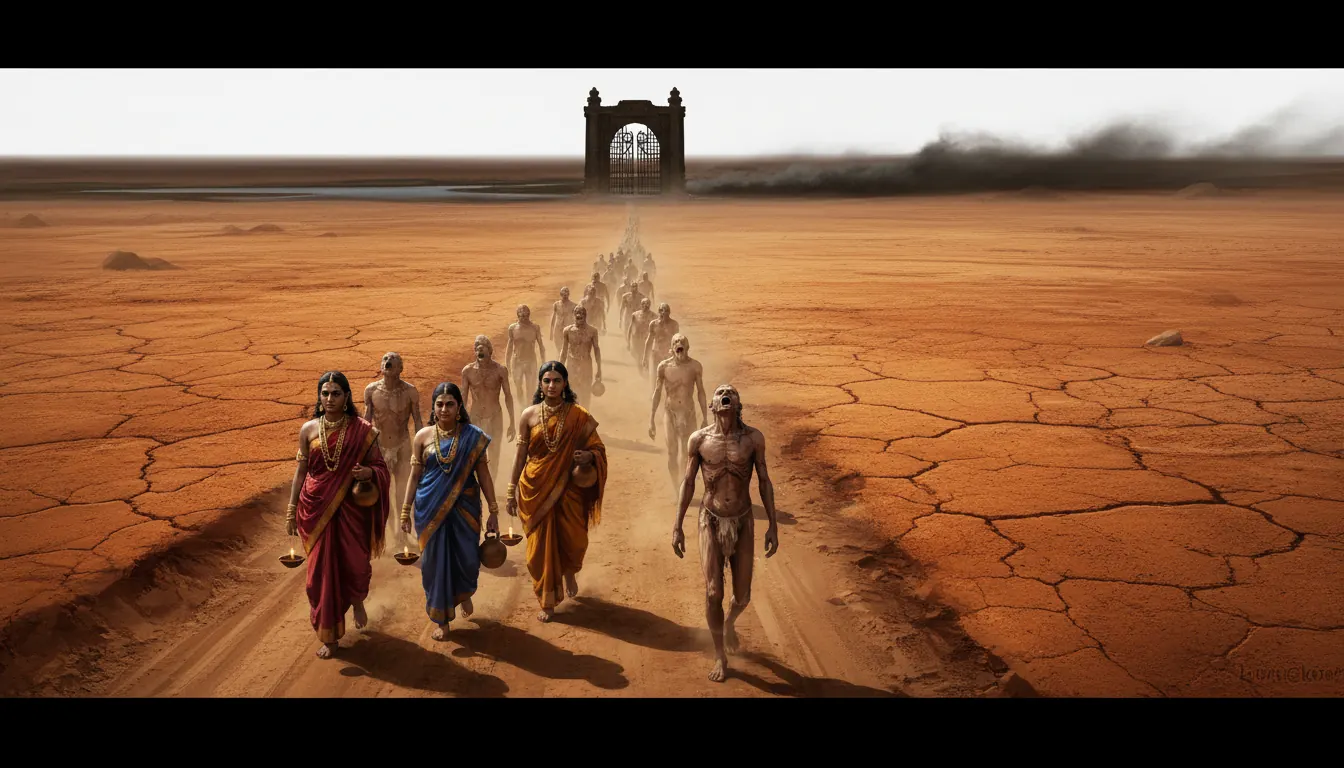
"The way runs through empty space, without water, and it is terrible to see. Nowhere on that road is there the shade of a tree, nowhere any water, and nowhere any resting place where a tired traveller may rest for a few moments."
No shade. No water. Nowhere to sit down. And the crossing is not optional and not negotiable and admits of no exemption whatever.
"And men and women, and everything on earth that has life, are led forcibly along this way by the messengers of Yama."
Forcibly. Kings and ploughmen, the strong-armed and the sick, the ones who were ready and the ones who were in the middle of something. Every person the Pandavas had ever known or fought or lost was somewhere on that road, and would be walking it whether they had prepared for it or not.
What Each Gift Becomes on the Walk
"The creatures who obey the commands of the grim king, and those who have given horses and other good conveyances to brahmanas, travel this way on those animals and vehicles."
And that is the whole system, disclosed in one sentence. Nothing else you owned makes the journey. What a man gave away, and only that, is waiting for him on the road in the form he gave it.
"Those who have given umbrellas travel this way with umbrellas keeping off the sun."
"Those who have given food travel without hunger, while those who have not given food travel tormented by hunger."
"Those who have given robes travel dressed in robes, while those who have given none travel naked."
Naked, on a road eighty-six thousand yojanas long, in the sun, in company. Markandeya did not linger on it. He did not have to.
"Those who have given gold travel in happiness, decked in ornaments themselves. Those who have given land travel with every desire fulfilled. Those who have given grain travel without suffering any want. Those who have given houses travel happily in chariots. Those who have given something to drink travel with cheerful hearts, untroubled by thirst. And those who have given lights travel happily, lighting the way before them."
Lighting the way before them. It is the tenderest line in the passage: the lamps a man set out for other people at dusk, going on ahead of him in the dark of that country, still burning.
"Those who have given cows travel the way happily, freed from all their sins. Those who have fasted for a month travel in chariots drawn by swans. Those who have fasted for six nights travel in chariots drawn by peacocks. And, son of Pandu, he who keeps to a single meal for three nights, without a second meal in that time, goes to a region free of disease and anxiety."
The River Pushpodaka
"And water has this excellent property, that it produces happiness in the region of Yama."
Of all the gifts, this is the one that costs least and carries furthest, and Markandeya gave it its own river.
"Those who give water find a river there called Pushpodaka. Those who gave water on earth drink cool, ambrosial draughts from that stream."
A jar left in the shade at the edge of a road. A cup handed up to a man on a cart. The trouble of walking down to the well twice instead of once because somebody was standing in the yard looking thirsty and would not ask. That, on the far side of eighty-six thousand yojanas of waterless country, is a river with flowers on it, and a man may drink from it as long as he likes.
"And for those of evil deeds, pus is ordained."
Nine words, and the sage went straight on past them.
"So, great king, that river serves every purpose."
One stream. It is not that the cruel are sent to some separate place of punishment; they arrive at the same water as everybody else, and what they find in it is what they have been handing out. The river does not judge. It reflects.
"So, king, honour these brahmanas who are with you as they deserve. His limbs weak from the road he has walked, and smeared with its dust, the traveller asks for the name of someone who gives food, and comes in hope to his house. Honour him with reverent attention, for he is a guest, and he is a brahmana. The gods, with Indra at their head, follow him as he goes. If he is honoured, Indra and the gods are pleased; and if he is not honoured, the gods and their chief are saddened."
Matted Hair and a Hard Heart
"You of great wisdom," said Yudhishthira, "what purification is there by which a brahmana may always keep himself pure?"
He was sitting in deerskin with matted locks when he asked it. So were his brothers. So was every man in that camp. They had been living the outward life of ascetics for years now, not by choice, and it would have been an easy moment for a sage to praise them for it.
"There are three kinds of purity," said Markandeya. "Purity in speech, purity in deed, and purity achieved by the use of water. He who turns to these three reaches heaven without doubt."
And then he took the whole visible apparatus of holiness apart, item by item, and he began with the very things his listeners were wearing.
"The carrying of three staffs, the vow of silence, matted hair on the head, the shaving of the crown, covering one's body with bark and deerskins, the practice of vows, ablutions, the worship of fire, living in the woods, the wasting of the body: all these are useless if the heart is not pure."
Nobody moved.
"The high-souled people who commit no sin in word, deed, heart or soul are the ones said to practise austerities, not those who let their bodies waste away with fasts and penances. He who has no kindness for his relatives cannot be free from sin, even if his body is pure. That hard-heartedness of his is the enemy of his asceticism."
The enemy of his asceticism. Not a blemish on it. Not a deduction from it. The thing that is eating it from the inside while he fasts.
"Asceticism is not mere abstinence from the pleasures of the world. He who is always pure and adorned with virtue, who practises kindness all his life, is a muni even though he lives as a householder. Fasts and other penances cannot destroy sins, however much they may weaken and dry up the body that is made of flesh and blood. The man whose heart is without holiness suffers torture only by undergoing penances in ignorance of their meaning. The fire he worships does not consume his sins."
Nothing So Eternal as a Gift
"Master," said Yudhishthira, "I want to hear the rules of the charity that earns merit."
He had been told, in the space of one evening, that his bark clothes were worth nothing, that his fasts were worth nothing, and that the fire he tended twice a day would not burn off a single fault of his if his heart were hard; and his response was to ask how to give properly. Markandeya, who had been watching men receive instruction for several ages, seems to have liked him for it.
"I have always held the rules of charity you wish to hear in high regard. He who founds a dharmasala, and puts someone there to look after all comers, is crowned with the merits of all the sacrifices. The guest that comes to one's house for food is none other than Indra himself. If he is given food, Indra himself grants the best merit, which never runs out. As men cross seas by vessels, so are the givers saved from all their sins."
He gave the calendar of it too, because he was thorough: a gift on particular lunations twice what it is on other days, a gift in a particular season ten times, in a particular year a hundred times; gifts at the solstices, at the eclipses of the moon and the sun, on the last day of the last month of the year, producing merit that never grows less.
"King, no one can enjoy lands unless he gives away land, and no one can ride in chariots and vehicles unless he gives these away. Gold sprang from Fire, the Earth from Vishnu, and the cows from the Sun. So he who gives away gold, land and cows reaches all the regions of Agni, Vishnu and the Sun. There is nothing so eternal as a gift. Where in the three worlds, then, is anything more auspicious? That, king, is why the wise say there is nothing higher or greater in the three worlds than a gift."
The fire had gone down. Out beyond it the brahmanas of the camp were settling, the men who had followed a landless king into a forest and were fed every day out of what five exiles could find. Yudhishthira had asked at what stage of life a man ought to begin giving, and had been answered with a road eighty-six thousand yojanas long on which the only baggage a man carries is what he handed away, and with the news that the lamps he lights for other people go on ahead of him into the dark. He got up, and went to see that his guests had eaten.
Dharma Lesson
What a person gave away is the only luggage that follows him, and no amount of visible penance substitutes for having been kind while it was inconvenient. Matted hair, bark clothes, fasts and the daily fire are all useless if the heart is hard, because hard-heartedness is not a blemish on asceticism but its enemy. The lamp a man sets out for somebody else is the one that lights his own way through the dark country.