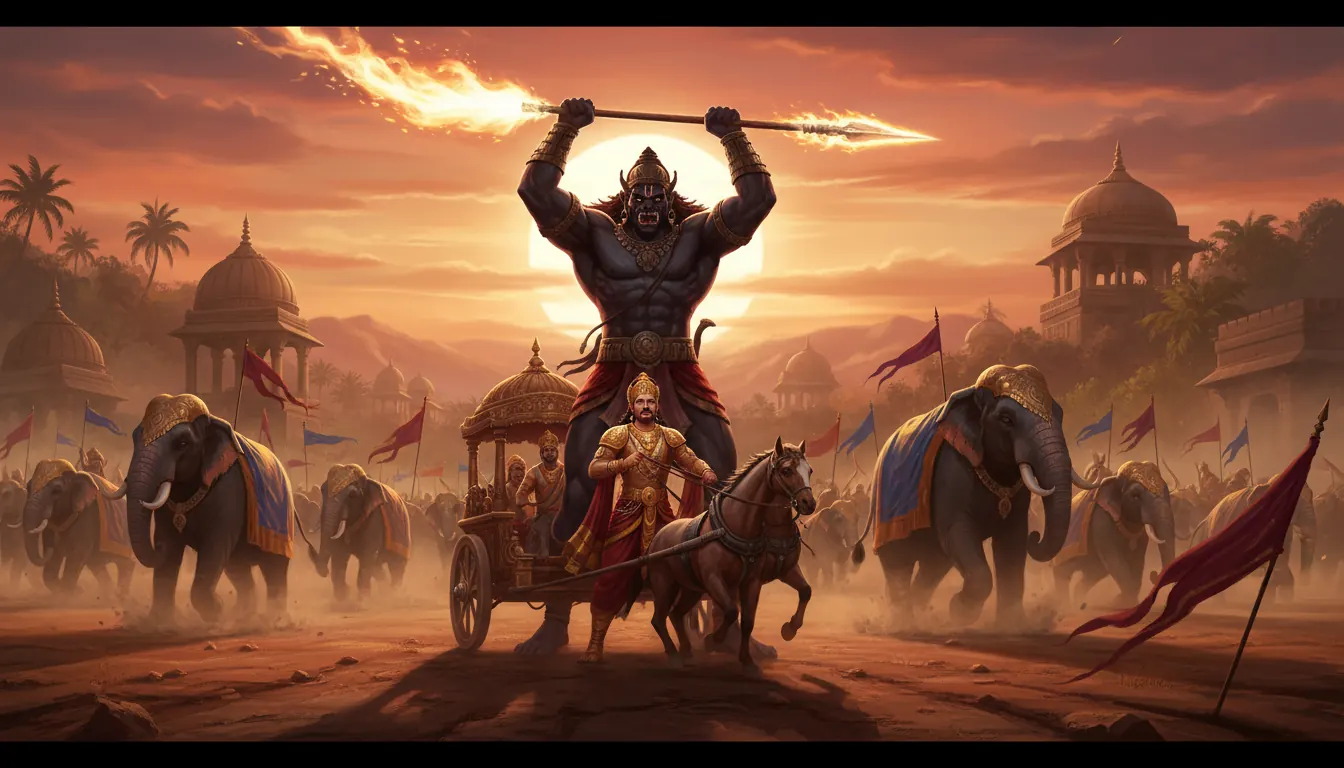
The Sixth Day After Noon
Bhima and Duryodhana wound each other twice, Sanjaya tells the blind king whose fault the war is, and Satanika kills Dushkarna
In short
Dhritarashtra praises his enormous army and blames Destiny for its slaughter, and Sanjaya answers that the dice game and the war were both his own doing. Then he recites the fighting: from the fifth day's afternoon, Arjuna sparing Ashwatthama and Bhima and Duryodhana trading ten arrows each, and from the sixth day, Bhima stepping off his chariot with a mace and vanishing into the Kaurava host, Dhrishtadyumna going in after him, and the standard of the Kuru king cut down at sunset. It ends with Satanika killing Dushkarna in single combat and Yudhishthira smelling the heads of the two men who came back.
Told in the Bhishma ParvaSet in Kurukshetra and Hastinapura23 min read
It Was Your Own Fault
The blind king had been praising his own army.
He had gone through it piece by piece, the way a man counts over something he is afraid of losing. Soldiers neither very old nor very young, neither lean nor fat, free from disease, cased in mail, trained in every kind of weapon, skilled at mounting and dismounting from elephants, at striking, at advancing and retreating. Men taken on pay after testing, and not for their birth, or as a favour, or because they were kin. An ocean of an army, Dhritarashtra said, with its fighters for its waters, its horses for its terrible waves, and swords and maces and darts for the oars piled on it.
Then, having praised it, he asked the only question he ever really asked.
"So large an army, mustered by the rules of the science and bound to us by wealth, and still it is slaughtered in battle. Alas, what can that be but Destiny? Sanjaya, none of this seems natural. All of it, down to the smallest detail, was arranged beforehand by Him, for what the Creator has ordained must happen as He ordained it, and cannot happen otherwise."
Sanjaya had the divine sight. He could see every quarter of that field from a seat in a hall in Hastinapura, and he had been sent back from it to say what he saw. He did not let the answer stand.
"King, this calamity has come on you through your own fault. The wrongs you yourself saw in the way the Pandavas were treated, Duryodhana never saw. It was your fault, king, that the game of dice took place. And it is your fault that this war with the Pandavas has come. You have committed a sin, so you must reap its fruit. Every man reaps the fruit of what he himself has done."
That was said by a servant to his master, in his master's own hall, while his master's sons were on the field.
"So reap the fruit of your own acts, king, here and in the world to come. This calamity has overtaken you, but stay calm all the same, my lord, and listen to the account of the battle as I tell it."
And his account took in the afternoon of the fifth day, when the sun stood over the middle of the field with Bhishma holding the Kaurava line, before it came to the sixth.
Mercy for Drona's Son
It opened with an old man's courtesy. Virata, king of the Matsyas, in whose kitchens and cow-pens the Pandavas had passed the thirteenth year of their exile, came up and pierced Bhishma with three arrows, and Bhishma pierced Virata's horses with three of his own, golden-winged, and neither of them made anything more of it.
Further along the line, Ashwatthama found Arjuna.
He was Drona's son, a brahmana by birth who had taken up his father's trade, and he had learned from Drona not only every weapon but how to withdraw each one, which is the harder half of the science. He put six arrows into the wielder of Gandiva, between the two breasts. Arjuna cut his bow in half and drove five arrows deep into him in return.
Ashwatthama lost his head with anger. He could not bear to have his bow cut, so he took up a tougher one and shot ninety sharp arrows into Arjuna and seventy fierce ones into Krishna, who was driving.
Then, said Sanjaya, Arjuna, his eyes red with anger, and Krishna beside him, breathing long, hot breaths, thought for a moment.
What came out of that moment was serious. Gripping the bow hard in his left hand, Arjuna set a number of arrows on the string, sharp, perfectly straight and deadly, and drove them through Ashwatthama's armour, and those arrows drank his life-blood.
And Ashwatthama did not waver. He shot back arrows of the same kind and stood where he was, unshaken, because his task there was to protect Bhishma of the great vows, and the best warriors of the Kuru army cheered him aloud for it, since what he was doing was standing alone against the two Krishnas together.
Then Arjuna thought about who was in front of him.
This is my teacher's son. He is Drona's own dear son. Above all he is a brahmana, and so he deserves my respect.
So he showed mercy to the son of Bharadwaja and turned away from him. And having turned away, the man with the white horses went into the rest of that army and made a great slaughter of it, his hands moving so fast that Sanjaya could not describe the hands, only the dead.
The Gem on Duryodhana's Breast
Duryodhana came at Bhima with ten arrows, fletched with vulture feathers, decked with gold, whetted on stone. They were good arrows. Everything the king of the Kurus carried was good.
Bhimasena, in a rage, took up a tough and handsome bow that could take an enemy's life, and ten sharp arrows of his own. He aimed them steadily, drew the string back to his ear, and put all ten deep into the broad chest of the king of the Kurus.
There was a gem hanging on Duryodhana's breast on threads of gold. When the ten arrows stood around it in his chest, said Sanjaya, that gem looked beautiful, like the Sun in the sky surrounded by the planets.
It is a strange thing to say about a wound, and Sanjaya said it to the wounded man's father.
Duryodhana, a man of great energy, could not take it calmly. He was like a snake, said Sanjaya, that cannot bear the sound of a man's slap. In a rage, and wanting to protect his army, which was watching, he pierced Bhima back with many golden-winged arrows whetted on stone.
And there they stayed, struggling and mangling each other fiercely, and the two of them together looked like a pair of gods.
Neither of them finished it. That is the shape of the whole day and very nearly the shape of the whole war. These two had thirteen years and a gaming hall and a hall of assembly stacked between them, and they were both good enough with a bow to hurt each other badly and not good enough to end it with a bow, and each of them knew it. The thing between them was going to be settled one day with a mace on the bank of a lake, and until then every meeting could only be this: ten arrows, ten arrows back, blood on the gold, and other men pulling them apart.
The sun was still high. They would find each other again at the next day's sunset.
The Boy Who Danced on the Field
Abhimanyu, the son of Subhadra and Arjuna, was sixteen years old and the best thing in that army to watch.
He pierced Chitrasena with many sharp arrows, Purumitra with seven and Satyavrata with seventy, and then, said Sanjaya, that hero, like Indra himself in battle, began as it were to dance on the field, and caused us much pain. The three of them answered him together, with ten arrows, nine and seven, and he took them and went on. Covered in his own blood, he cut Chitrasena's large and beautiful bow, cut through his coat of mail, and put an arrow into his breast.
Then all the princes of the Kaurava army, brave, united and in a rage, turned on him at once, and Abhimanyu struck them all with keen arrows. Sanjaya told the blind king that his sons had surrounded a boy who was consuming their army the way a swelling blaze consumes a heap of dry grass in summer.
Which is when Lakshmana came out to fight him. Duryodhana's son. Dhritarashtra's grandson, marked with every auspicious sign, about the same age as the cousin he was riding at.
Abhimanyu pierced him and his charioteer with six sharp arrows. Lakshmana pierced Abhimanyu with many keen arrows, and Sanjaya, who had no reason to praise him, said the feat seemed truly wonderful. Then Abhimanyu killed the four horses and the charioteer and came on, and Lakshmana, standing on a chariot that could not move, hurled a dart at him, fierce, irresistible and snake-like, and Abhimanyu cut it out of the air with sharp arrows.
Kripa drove in, took Lakshmana up on his own chariot, and carried him out of it in the sight of all the troops.
After that the fighting became general and stopped being anybody's duel. Men rushed at one another wanting only a life. The Srinjayas fought the Kurus with their bare arms, their hair loose, their mail gone, their chariots gone, their bows broken. And Bhishma, mighty-armed and in a rage, went through the great-hearted Pandavas with his celestial weapons, and the earth was covered with fallen elephants and the men who had guided them.
Bhima Steps Down From His Chariot
On the sixth day, Bhima broke the array.
He went through it with sharp arrows and came out among Duryodhana's younger brothers, and Sanjaya named them for their father as they closed in: Dushasana and Durvisaha and Dussaha and Durmada and Jaya, Jayasena and Vikarna and Chitrasena and Sudarshana, Charuchitra and Suvarman and Dushkarna, and one more called Karna, who was not the Karna, and many other mighty chariot warriors besides. All of them were sons of the man listening to the story. Bhima had driven into the middle of the array that Bhishma himself was protecting, and he was alone in there.
When they saw him in their midst, they said one thing to each other.
"Kings, let us take this man's life."
So the son of Pritha stood surrounded by his cousins, all of them set on it, and Sanjaya reached for the only image large enough. Bhima was like Surya himself in his fierce splendour, ringed by the mighty planets of evil nature at the time of the universal destruction.
Fear did not enter his heart. It had not entered Indra's either, said Sanjaya, in the old battle between the gods and the Asuras, when the Danavas had him ringed the same way.
Thousands of chariot warriors armed with every weapon overwhelmed him, one man alone, with terrible arrows. He ignored the sons of Dhritarashtra entirely and killed the best of the warriors around them instead, men on chariots, men on elephants, men on horses, working outward from where he stood.
Then he understood what his cousins had decided about him, and set his heart on doing to them exactly what they meant to do to him.
And he did the thing that made the rest of the afternoon what it was. He left his chariot. He took up his mace, stepped down off the wheels into the middle of the Kaurava army on foot, and began to strike that sea of Dhartarashtra troops, and behind him, standing empty where he had left it, his chariot waited with the horses held.
Where Is Bhima?
Dhrishtadyumna, the son of Prishata, born out of a fire that had been lit to bring about Drona's death, was the commander of the Pandava army and was at that moment fighting Drona himself. He broke off. He rode across the field toward the place where Shakuni was stationed, checking countless warriors on the way, and came instead upon an empty chariot with a charioteer sitting in it.
The charioteer was Vishoka, who drove Bhima.
Dhrishtadyumna's heart sank, and he was almost beside himself. His voice choked with tears, sighing as he spoke, he asked the man one question.
"Where is Bhima, who is as dear to me as life itself?"
Vishoka joined his hands. "The mighty son of Pandu told me to wait for him here, and with all his great strength he has gone alone into the Dhartarashtra army, which is like the very ocean. He said this to me, and he said it very cheerfully: Wait for me a little while, charioteer, and hold the horses, until I kill the men who are bent on killing me. Then, when our troops saw mighty Bhima charging mace in hand, they were all filled with delight. So in this fierce and terrible battle, prince, your friend has broken the enemy's great array and gone into it."
Dhrishtadyumna heard that out, standing in the open with the battle going on around the two of them, and answered.
"What use is life to me today if I forget my love for the Pandavas and abandon Bhima in battle? If I go back today without Bhima, what will the kshatriyas say of me? What will they say when they learn that while I was on the field, Bhima went alone into the enemy's array, cutting a single opening in it? The gods with Indra at their head bring evil on the man who abandons his comrades in battle and goes home unhurt. And mighty Bhima is my friend and my kinsman. He is devoted to me, and I am devoted to him, that killer of enemies. So I will go where Bhima has gone."
He did not have to look for the way in. There was a road already cut through the Kaurava army, opened by Bhimasena and marked along its whole length by elephants crushed with the mace, and he simply followed it.
At the end of it he found the man on foot, torn with arrows, treading the field, spitting out the poison of his anger, mace in hand, looking like the Destroyer himself at the hour of the universal dissolution, with the ranks closing on him from every side.
Dhrishtadyumna took him up onto his chariot. Then he plucked the arrows out of him, one after another, out of every limb, and embraced him warmly, in the very midst of the enemy.
Pramohana, and the Weapon That Answered It
Duryodhana saw the two of them standing on one chariot together and went straight to his brothers.
"This wicked son of Drupada has joined Bhimasena. Let us all go at him together and kill him. Do not let the enemy come seeking battle in our own ranks."
They came like fierce comets at the hour of the universal dissolution, making the earth shiver with the twang of their bowstrings and the rattle of their chariot-wheels, and they showered Drupada's son the way clouds drench a mountainside with torrents of rain. He did not waver. Instead he used a weapon called Pramohana, which does not cut and does not burn and takes only the mind.
Their senses left them. The princes stood in their chariots with their minds and their strength gone, and the Kauravas around them, seeing the sons of Dhritarashtra swooning like men whose hour had come, scattered in every direction with their horses, their elephants and their chariots.
Elsewhere on the field the tide ran the other way. Drona came up against Drupada, who had been his friend once and his enemy for a long time since, and pierced him with three fierce arrows, and Drupada, remembering the old hostility, left the battle. Drona blew his conch over him, and every Somaka who heard it was struck with fear.
Then Drona was told that the princes were standing senseless in the middle of the field. He left the part of the battle he had won and went to them. He took up the weapon called Prajna, which is the weapon of knowing, and cancelled the Pramohana with it, and Dhritarashtra's sons woke up in their chariots and went back at Bhima and Prishata's son.
Yudhishthira, far off, was uneasy. "Let twelve brave chariot warriors in mail, led by Subhadra's son, follow the track of Bhima and Prishata's son into the battle with all the strength they have. Let us have news of them. My heart is very uneasy."
They went in when the sun had reached its height, drawn up in the array called Suchimukha, the needle's mouth, with Abhimanyu at its point, and the Kaurava chariot-division could not hold them.
And Dhrishtadyumna, seeing his own teacher bearing down on him, lost all interest in killing Duryodhana's brothers. He had Bhima moved onto the chariot of the king of the Kekayas, and turned to meet Drona.
Drona cut his bow with a broad-headed arrow. Remembering the bread he had eaten in Duryodhana's house, he sent hundreds of arrows after the man born to kill him. Dhrishtadyumna took up another bow and put seventy arrows into him. Drona cut that bow too, sent the four horses to Yama's realm, killed the charioteer, and left the commander of the Pandava army standing on a wreck, from which he climbed across onto Abhimanyu's chariot. Then Drona made the whole Pandava army tremble in the sight of both of them, and the Kauravas shouted his name.
When the Sun Turned Red
Then the light went red, and Duryodhana came back for Bhima.
Bhimasena saw him coming, that brave enemy who had nursed his hatred so long, and was seized with a great anger, and said what he had been carrying.
"The hour I have longed for all these years has come. I will kill you today unless you leave the battle. When I kill you today I will end the sorrows of Kunti and of Draupadi, and the misery we suffered in our exile in the woods. You were full of pride, and you humiliated the sons of Pandu. Now see the bitter fruit of that wickedness, son of Gandhari. You took the advice of Karna and of Subala's son, you thought little of the Pandavas, and you treated them just as you had hinted you would. You brushed aside Krishna when he begged you for peace. You sent Uluka to us with your messages, and your heart was glad when you did it. For all of this I will kill you today with all your kinsmen, and so pay you back for every wrong you did us in the days gone by."
Then he bent his bow, stretched it again and again, and sent thirty-six arrows at Duryodhana, blazing like lightning and flying straight with the force of the thunderbolt.
After that he took the king of the Kurus apart in pieces. Two arrows cut the bow. Two took the charioteer. Four sent the four horses to the realm of Yama. Two, shot with great force, cut the umbrella off that fine chariot, the umbrella that is held over a king and nobody else. Three more cut down the handsome blazing standard, and Bhima shouted aloud when it went.
Every king on that field saw it fall. The standard of the Kuru king, with its device of an elephant, decked with many gems and blazing like the sun, came down out of the air onto the earth like a flash of lightning dropping out of the clouds.
Then Bhima, smiling as he did it, put ten more arrows into Duryodhana himself, the way a driver pricks a mighty elephant with the hook.
Jayadratha, king of the Sindhus, brought many brave warriors up onto Duryodhana's flank to shield him. Kripa drove in, as he had for Lakshmana the day before, and took Duryodhana up onto his own chariot, and the king of the Kurus, deeply pierced by Bhimasena and in great pain, sat down on the floor of that chariot and stayed there.
Ten arrows one afternoon and ten at the next day's sunset, and between them the umbrella and the elephant on the ground. Jayadratha closed around Bhima with several thousand chariots.
The Arrows That Went Into the Earth
Dhrishtaketu came, and Abhimanyu, and the Kekaya brothers, and the sons of Draupadi, and met the sons of Dhritarashtra in front of the thousands of chariots.
Abhimanyu pierced every one of them with five straight arrows that looked like the bolts of heaven, and they came back at him all together, a downpour of sharp arrows like rain-heavy clouds pouring rain on the slopes of Meru, and he made all of Dhritarashtra's sons tremble the way the wielder of the thunderbolt makes the Asuras tremble.
Then he found Vikarna.
Of all the hundred, Vikarna was the one who had stood up in the hall of assembly on the day of the dice and said aloud that Draupadi had not been fairly won. He had been shouted down by his brothers, and he had stayed with them, and here he was at sunset on the sixth day with a boy shooting fourteen broad-headed arrows at him, fierce, like snakes of deadly poison.
They brought down his standard. They killed his charioteer and his horses. Then Abhimanyu sent many more arrows after him, well-tempered, straight-flying, able to pierce any armour and fletched with kanka feathers, and those arrows went through Vikarna's body and out of it and into the earth behind him like hissing snakes. Their feathers and their points were decked with gold. Bathed in his blood, they seemed to be vomiting blood onto the ground.
His brothers by the same mother came for the boy at once, and the two lines of cousins stood on their chariots piercing each other, as bright, said Sanjaya, as so many suns.
Durmukha put five arrows into Shrutakarma, Sahadeva's son by Draupadi, cut down his standard with one arrow and pierced his charioteer with seven. Then with half a dozen more he killed the horses, fast as the wind and clad in golden armour, and brought down the driver. Shrutakarma, standing on the dead chariot in a great rage, hurled a dart blazing like a fierce meteor, and it went through Durmukha's hard coat of mail and buried itself in the earth beyond.
Sutasoma saw his brother standing there without a chariot, brought his own alongside and took him up onto it, in full sight of all the troops.
Then Shrutakirti rushed at Jayatsena, wanting to kill him, and Jayatsena, smiling as he did it, cut Shrutakirti's bow in his hands with a single sharp horseshoe-headed arrow while he was still drawing it.
Wait, Wait
Satanika, son of Nakula and Draupadi, saw his brother's bow cut in his hands.
He came at that spot roaring again and again like a lion. He drew his bow with great force, put ten arrows into Jayatsena and trumpeted like a maddened elephant, and then with one more arrow, sharp-pointed and able to pierce any armour, he struck Jayatsena deep in the chest.
Dushkarna was near his brother. Wild with anger, he cut Satanika's bow, and the arrow on it, with a single shot.
So Satanika took up another fine bow that could bear a great strain, aimed a number of sharp arrows, and said two words to Dushkarna in front of Jayatsena before he loosed them.
"Wait. Wait."
Then he sent those sharp, blazing arrows at him like so many snakes. One arrow cut Dushkarna's bow. Two killed his charioteer. Seven went into Dushkarna himself. A dozen sharp arrows killed all his horses, which were fast as thought and of many colours, so that there was nothing left under him or in front of him. And then one broad-headed arrow, well-aimed and swift, went deep into his chest, and Dushkarna fell to the earth like a tree struck by lightning.
Five mighty chariot warriors closed around Satanika, wanting to kill him, and struck the famous warrior with showers of arrows. The five Kekaya brothers came in a rage to get him out. And when Dhritarashtra's sons saw the Kekayas coming they rushed at them like elephants charging mighty elephants: Durmukha and Durjaya and the young Durmarshana and Satranjaya and Satrusha, on chariots like fortified towns, drawn by horses decked with ornaments, under standards of many colours.
That fight lasted only a short while, around sunset, and it added to the population of Yama's kingdom. Chariot warriors and horsemen by the thousand lay strewn over the field around it.
Then Bhishma, the son of Shantanu, in a rage, went into the Pandava troops with his straight arrows and began sending the Panchala fighters to Yama's realm. When he had broken their ranks, he withdrew his own troops and went back to his camp, because the light was gone.
And in the Pandava camp Yudhishthira, who had spent the afternoon not knowing whether the two men he had sent twelve chariot warriors after were alive, saw Dhrishtadyumna and Vrikodara walk in. He took each of their heads and smelt it, which is what a man does to a child who has come home, and full of joy, he went back to his tents.
Dharma Lesson
Dhritarashtra had a perfect army and an explanation ready for its destruction, and the explanation was Destiny. Sanjaya refused it to his face: the dice were yours, the war is yours, reap the fruit of your own acts. The day he then described is the argument in miniature, because nothing in it is fated and everything in it is chosen. Arjuna chooses to spare his teacher's son, Dhrishtadyumna chooses to follow a friend into a formation rather than live with what the kshatriyas would say, and Bhima chooses to step down off his chariot alone. Men do these things; the Creator does not do them for them.