The Tribes Beyond the Pale
Bhishma names the peoples of the borders and dates them to the ending of the first age
In short
Yudhishthira asks the grandsire to describe the lotus-eyed one who made everything and was made by none. Bhishma answers with the whole account: the five elements, the sleeper on the waters, the lotus and the Grandsire, the killing of Madhu, the daughters of Daksha, the four orders and the offices of heaven. Then he turns to the wearing down of the world, how children were got by will in the Krita and Treta ages, by union in the Dvapara, and by marriage in our own, and names twelve border peoples who did not exist on the earth until the first age ended.
Told in the Shanti ParvaSet in Kurukshetra, The Ocean and Gandhara17 min read
The Names of the Lotus-Eyed One
Yudhishthira had spent the morning on the Soul and the elements and the road by which a man leaves the world, and when he opened his mouth again he asked about a person.
"Grandsire, you of great wisdom," he said, "I want to hear in detail, chief of the Bharatas, about that lotus-eyed and indestructible one, who is the Creator of everything but was created by no one, who is called Vishnu because he pervades everything, who is the origin of all creatures and to whom all creatures return, who is known by the names of Narayana and Hrishikesha and Govinda and Keshava, and whom no one can defeat."
It is worth pausing over where that question was asked. Bhishma was lying on the bed of arrows at Kurukshetra, waiting for the sun to turn north before he would let himself die, and the man he had been asked to describe had been walking about that same field a few weeks earlier holding somebody else's horses. Yudhishthira was asking an old man to explain a friend.
Bhishma did not answer on his own authority. He began by naming the men he had it from, which is what a careful teacher does when the subject is larger than he is.
"I have heard about this from Jamadagni's son Rama, when he spoke on it, from the celestial rishi Narada, and from Krishna-Dvaipayana."
Jamadagni's son Rama is Parashurama, the brahmana with the axe, who had once stood against Bhishma himself for twenty-three days on the bank of the Saraswati and could not beat him. Krishna-Dvaipayana is Vyasa. Narada goes everywhere and hears everything and is the epic's standing witness.
"Asita-Devala, son, and Valmiki of austere penances, and Markandeya, speak of Govinda as the Most Wonderful and the Supreme. Keshava, chief of Bharata's line, is the divine and mighty Lord of all. He is called Purusha, and pervades everything, having made himself many."
Then he set out the shape of what he was going to give.
"Listen now, mighty-armed Yudhishthira, to the attributes that great brahmanas say are found in the high-souled wielder of Saranga. I will also, prince of men, recite to you the acts that those who know the old histories ascribe to Govinda."
Attributes first, then acts. The acts turned out to be the making of the world, and at the far end of them, the state of men now.
The Sleeper on the Waters
He is the Soul of all creatures, said Bhishma, the high-souled one, the first of all beings, and by his will he created the fivefold elements, which are Wind, Light, Water, Space, and Earth.
That is the whole inventory of what the world is made of, and it is made by an act of intention and nothing else. There is no material lying about beforehand for him to work in. The five things out of which every later thing is built are themselves the first thought.
Then, when he had created the earth, that mighty Lord of all things laid himself down on the surface of the waters.
It is a strange image to come in the middle of a metaphysical answer, and the epic never softens it. The maker of the elements stretches out on the water like a man lying down at the end of a day, and floats. Nothing else exists to look at him. The next thing that happens, happens while he is lying there.
As he floated there, that refuge of every kind of energy and splendour created Consciousness, the first-born of beings in the universe. He created Consciousness along with the Mind, and Consciousness is the refuge of all created things, and it upholds all creatures and both the past and the future.
Notice the order. Awareness is not a late arrival that shows up once there are animals with heads. It is the first thing born, before there is anybody to be conscious, and it is described as a support rather than a faculty. The past and the future are said to rest on it. Take it away and there is nothing for events to be arranged in.
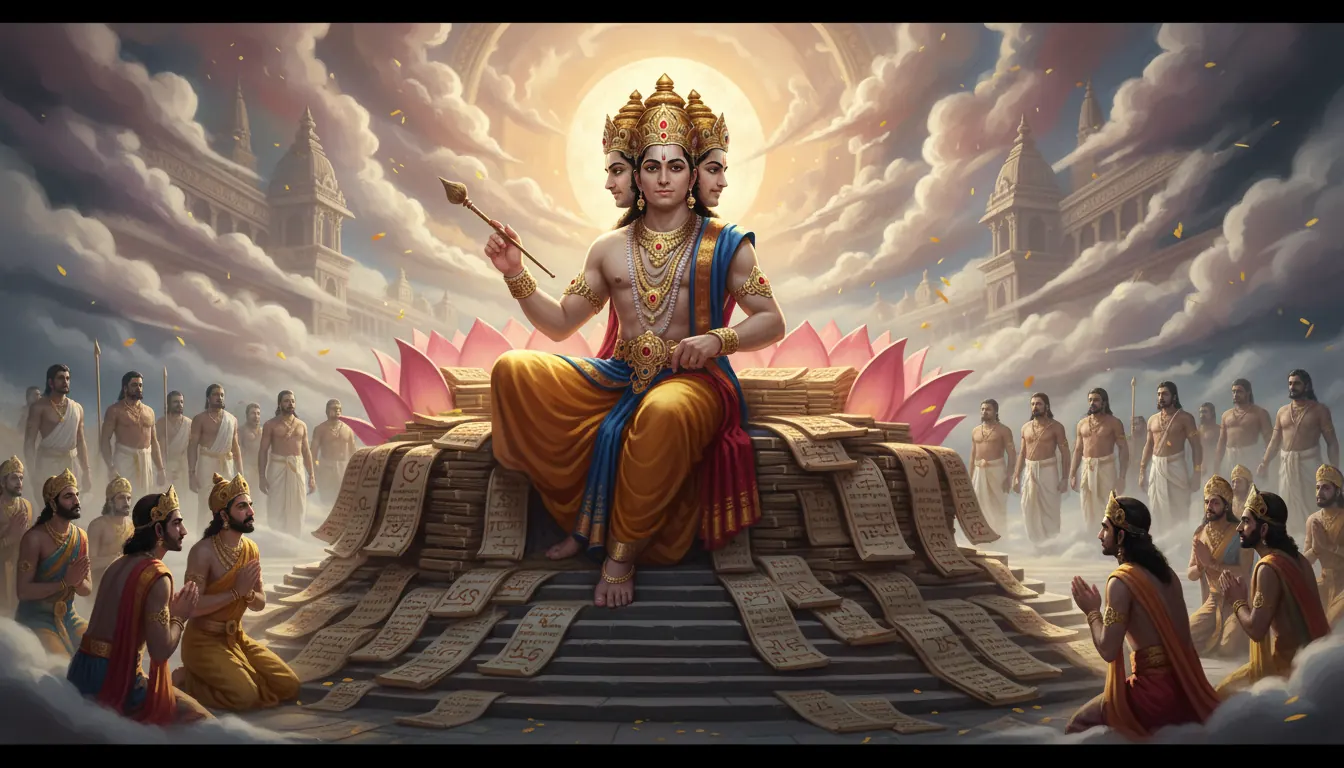
After that great Being had sprung up, a lotus of great beauty, as bright as the Sun, grew out of the navel of the Supreme Being floating on the waters.
Then the illustrious and divine Brahman, the Grandsire of all creatures, sprang into existence from that lotus, lighting up every point of the horizon with his radiance.
So the first light in the account is not the sun. It is a face coming up out of a flower on a stalk over dark water, and throwing brightness out to every quarter at once because there is not yet a quarter that has anything in it.
The Name He Took From a Killing
The Grandsire had barely arrived when something came for him.
After the high-souled Grandsire had thus sprung from the primeval lotus, a great asura named Madhu, having no beginning, came into being, springing from the attribute of Darkness.
Two clauses in that sentence do the damage. Having no beginning, which puts Madhu on the same footing of antiquity as the one lying on the water. And springing from Tamas, which says where he came from without giving him a father. Darkness is one of the three attributes that everything in the manifest world is woven out of, and the epic's position is that as soon as creation is under way, the dark strand in it produces something that wants to end what has just started.
Madhu went straight for Brahman. The text does not stage a battle or give him a speech. It records that he was engaged even then in the fierce act of slaying the Grandsire, which is to say the assault was already in progress when the answer came.
The first of all Beings, to help Brahman, slew that fierce asura of fierce deeds.
That is all the description there is of the killing. What the text is interested in is the consequence, and the consequence is a word.
Because of this killing, son, all the gods and the Danavas and men came to call that most righteous of all beings by the name of Madhusudana, which means the slayer of Madhu.
Consider what that means about the name. Yudhishthira had opened by listing the names he already knew, Narayana and Hrishikesha and Govinda and Keshava, names that describe what the Lord is. Madhusudana is not like them. It is a name conferred from below, by gods and demons and men together, and it commemorates an act rather than an attribute. The three orders of beings agreed on one thing before they agreed on anything else, which was what to call the one who had stood between the newborn creator and the darkness that came to unmake him.
And they named him for the killing. Not for the lotus, not for the elements, not for the sleep on the water. For the one morning when the world nearly did not continue.
Seven Sons and the Daughters of Daksha
With the Grandsire safe, the work of filling the world was handed down a generation, and Bhishma gave the descent plainly, the way such things are given.
By an act of his will Brahman created seven sons, with Daksha making up the number. They were Marichi, Atri, Angiras, Pulastya, Pulaha, Kratu, and Daksha. The eldest, Marichi, by an act of his will fathered a son named Kashyapa, full of energy and the greatest of all who knew Brahma. Daksha had come earlier and by another route: from his own toe, before ever Marichi was born, Brahman had created that son, and he became the progenitor of creatures.
To Daksha were first born thirteen daughters, the eldest of whom was called Diti. Marichi's son Kashyapa, who knew all duties and their distinctions, became the husband of those thirteen.
Then ten more daughters, and these the righteous Daksha gave in marriage to Dharma, and Dharma became the father of the Vasus, the Rudras of immeasurable energy, the Viswedevas, the Sadhyas, and the Maruts.
Then twenty-seven younger daughters still, and the highly-blessed Soma became the husband of them all. Anybody who has looked at a night sky in this tradition knows those twenty-seven by sight. They are the lunar mansions, and the moon is married to every one of them and spends a night in each.
The rest of the descent runs through Kashyapa's household, and its range is the point of it. His other wives gave birth to gandharvas, horses, birds, cattle, Kimpurushas, fishes, and trees and plants. The singers of heaven and the grass in a field come out of the same marriage.
Aditi gave birth to the Adityas, the foremost among the gods and very strong, and among them Vishnu took birth in the form of a dwarf. Otherwise called Govinda, he became the foremost of them all, and through his prowess the prosperity of the gods increased and the Danavas were vanquished.
Diti gave birth to all the asuras of great strength. Danu gave birth to the Danavas, with Viprachitti as their chief.
So the gods and the demons are cousins, born to sisters by one father, and the god who put down the demons had entered the family as the smallest thing in it.
The Four Orders and Who Was Given Charge of What
The slayer of Madhu also created the Day and the Night, and the Seasons in their order, and the Morning and the Evening. After reflection, he created the clouds, and all the other things, unmoving and moving. With his abundant energy, he created the Viswas, and the earth with all things upon her.
Then, said Bhishma, the highly blessed and mighty Krishna once again created from his mouth a hundred of the best brahmanas. From his two arms he created a hundred kshatriyas, and from his thighs a hundred vaishyas. Then Keshava created from his two feet a hundred shudras.
The old figure of the body is being used here for the four orders of men, and the epic gives it without apology and without explanation, mouth and arms and thighs and feet, a hundred of each. What follows is more interesting, because having made the orders he did not then govern them himself. He appointed officers.
Having thus created the four orders of men, the slayer of Madhu made Dhatri, who is Brahman, the lord and ruler of all created beings, and Brahman of immeasurable radiance also became the teacher of the knowledge of the Vedas.
And Keshava made the one called Virupaksha the ruler of the spirits and ghosts, and of those female beings called the Matrikas, the mothers.
And he made Yama the ruler of the Pitris and of all sinful men.
The Supreme Soul of all creatures also made Kubera the lord of all treasures. He then created Varuna the lord of waters and governor of all aquatic animals. And the mighty Vishnu made Vasava the chief of all the deities, which is to say that Indra, whom every reader of the epic has watched fret and scheme and lose his throne to asuras and get it back again, holds the highest office in heaven as an appointment, from somebody else, who then went and lay down.
That is the whole administration of the world in five sentences. Scripture to Brahman, ghosts and the mothers to Virupaksha, the dead and the wicked to Yama, wealth to Kubera, the waters to Varuna, and the sky to Indra. There is no office listed for the one who made the list.
How Children Were Got in Each of the Four Ages
Then Bhishma changed his subject without changing his sentence, and began to describe not the world but the wearing down of it.
In those times, he said, men lived as long as they chose to live, and were without any fear of Yama.
Read that twice. Not that they lived a great while. That the length of a life was a thing a man decided, and death was an appointment he kept when he was ready for it. The god who had just been given charge of the dead had no terror attached to him at all, because nobody was taken.
Sexual union, chief of the Bharatas, was not needed then to carry on the species. In those days children were conceived by an act of will.
That is the Krita age, the first and the whole one. A child came because a parent intended one, in the same manner as the elements themselves had come.
In the age that followed, which is Treta, children still came by resolution alone. Even the people of that age, king, had no need of sexual union.
Nothing has gone wrong yet, and nothing is described as sinful. What had been done by intending it in the first age was still done by intending it in the second.
It was in the next age, which is Dvapara, king, that the practice of sexual union began and spread among men.
And in the Kali age, king, men have come to marry and live in pairs.
There is the whole descent, and the last stage of it is the one every reader of this is living in. What the epic calls the final degradation of a fourfold decline is the household: two people, married, living together, having children in the ordinary way. It is not condemned. It is dated. The point being made is that the arrangements a man takes for the permanent nature of things are the local weather of one age, and that they were different before, and that the difference is not a gain.
Bhishma had brought the account from the making of Wind and Light down to a couple keeping house. He had one thing left to say, and it was about men who had fallen further.
The Tribes Beyond the Pale
"I have now told you about the supreme Lord of all creatures," said Bhishma. "He is also called the Ruler of all and everything. Now, son of Kunti, I will speak to you about the sinful creatures of the earth. Listen to me."
Then he named them, and he named them by region, and the naming is the substance of the passage.
Those men, king, are born in the southern region and are called Talavaras, Andhrakas, Utsas, Pulindas, Shabaras, Chuchupas and Mandapas.
I will also name those who are born in the northern region. They are Yavanas, Kambojas, Gandharas, Kiratas and Barbaras.
Twelve peoples, seven from the south and five from the north, and they are not distant fables. The Kambojas and the Gandharas had ridden onto Kurukshetra in the army that was still burning its dead. Bhishma had commanded them. These are not nations at the world's rim. They are the edges of the map Bhishma himself had defended.
All of them, king, are sinful, and move about this Earth with practices like those of Chandalas and ravens and vultures.
The comparison is chosen with care. A Chandala is a man born outside the four orders and kept outside them. Ravens and vultures are the birds that live off what has died and been left. What the three have in common is that they subsist at the edge of the settled world on what the settled world has discarded, and the charge against these peoples is that they have taken up that way of living not by birth or by beak but by practice.
And then the dating, which is the sting of the whole passage.
In the Krita age, king, they were nowhere on earth. It is in the Treta that they had their origin and began to multiply, chief of Bharata's line.
They are not an older, wilder stock left over from before the rules. They are younger than the rules. In the age when children came by an act of will and no man feared Yama, these peoples did not exist anywhere on the earth. They appeared in the second age, at the same time as the first slackening, and they have been multiplying ever since.
When the terrible period came that joins Treta and Dvapara, the kshatriyas came at one another and joined battle.
That is the last item on the list of what the ages produced, and Bhishma let it stand without comment. He was lying on a bed of arrows put into him by the son of his own house.
Not a Mere Man
Having brought the account down from the waters to the borderlands, Bhishma closed it by going back to the beginning, and to the question that had been asked.
"So, chief of Kuru's line, the high-souled Krishna brought this universe into being."
He had said Krishna. Not Vishnu, not Narayana, not the Supreme Being floating on the waters, but the name that belonged to the man Yudhishthira could have reached out and touched. The whole recital had been an approach to that one substitution, and Bhishma made it in a single sentence, without warning and without argument.
Then, because he had begun the discourse by naming his authorities, he ended it the same way.
"The celestial rishi Narada, who watches over all the worlds, has said that Krishna is the Supreme God. Even Narada, king, admits the supremacy of Krishna and his eternity, mighty-armed chief of Bharata's line."
There is a small word doing large work in that. Even Narada. The sage who has been everywhere, who has stood in the courts of Indra and Brahman, who audits emperors and cross-examines kings and has never in the whole epic conceded anything to anybody without first taking it apart, admits this. Bhishma was not offering his own devotion as evidence. He was offering the fact that the most travelled and least impressible witness in the three worlds had come back with the same report.
"Such, mighty-armed one, is Keshava of unconquerable prowess. That lotus-eyed one is not a mere man. He is inconceivable."
That was the answer, and it was given by a man who had known Krishna as a guest at Hastinapura, as an envoy who came for peace and was told to leave, and as an enemy who had once come off a chariot at Kurukshetra with his discus in his hand to kill Bhishma himself, and had been welcomed to it.
The old man had described the making of the five elements, the lotus on the water, the killing of Madhu, the daughters of Daksha, the four orders cut out of a body, the offices of heaven, the four ages and what each of them did to the getting of children, and twelve peoples along the borders who came into being when the first age ended.
And at the end of it he pointed at somebody standing in the room.
Dharma Lesson
Bhishma is asked about God and answers with a calendar. The same discourse that makes the world out of a thought ends by dating a set of border peoples to the age when the rules first slackened, and by noting that men now marry and keep house because the third and fourth ages made that necessary. It is a hard passage, and it is worth reading against itself: the grandsire calls the frontier tribes fallen while lying on arrows shot by his own kin, in a country emptied by kshatriyas who took up arms against one another at the junction of two ages. Every age produces its own kind of falling, and the ones it names are seldom the ones nearest to hand.