The Marks of a True Friend
Bhishma lists the men a king may bind himself to, and the men he must keep at a distance
In short
Yudhishthira tells Bhishma that no amount of wealth or kinship occupies the place a well-wishing friend occupies, and asks with whom friendship may be formed. Bhishma answers with two long catalogues, the men to refuse and the men to accept, and names ingratitude and injury to friends as the vilest faults of all. Asked to explain what those two words mean, he begins the old story of Gautama, a brahmana of the middle country who took a robber's charity in a northern village and became a hunter of cranes.
Told in the Shanti ParvaSet in Kurukshetra14 min read
The Question After the Argument
The night before, the brothers had argued about what a man should want most, and had not agreed. Vidura had spoken for Virtue, Arjuna and the twins for Wealth, Bhima for Desire, and Yudhishthira had listened to all of them and then told them that he thought Emancipation stood above the three. They had joined their hands and praised him, and he had praised them back, and the argument had ended the way family arguments end, with everyone satisfied and nothing settled.
In the morning, Vaishampayana says, the king went out again to the field where the old man was lying, and asked him about duties.
Bhishma was still on the bed of arrows at Kurukshetra, waiting for the sun to turn north before he would let himself die. Yudhishthira sat down beside the arrows.
"Grandsire, you are very wise, and I have a question for you," he said. "What kind of men are called gentle by nature? With whom can the happiest friendship be made? And tell us too who can do us good, both now and in the end."
Then he said the thing that had been under the question all along, and it did not sound like a king asking about statecraft. It sounded like a man who had just buried his cousins and his sons and his teachers.
"To my mind, neither growing wealth, nor relatives, nor kinsmen can take the place of friends who wish us well. A friend who will listen to good advice and who can also do good is very rare."
A friend who can hear good advice, and who can also act. Not one or the other. Yudhishthira had been surrounded his whole life by men who could do one of those two things, and he had watched what the shortage of the other had cost.
"Listen, Yudhishthira," Bhishma said, "and I will tell you in detail which men you can make friends of, and which you cannot."
He began with the ones to refuse.
The Men a King Must Not Take
The list Bhishma gave is long, and he did not hurry it or soften it, and it is worth having in the order he gave it, because the order is an argument.
He began with the men whose fault is in what they want. The greedy man. The pitiless man. The man who has abandoned the duties of his own order. The dishonest man, the scoundrel, the mean man, the man who lives by sinful ways. The man who suspects everyone, which he set down as a vice and not as a caution.
Then the men whose fault is in what they fail to do. The idle man. The man who always puts things off. The man of crooked nature. The man everyone condemns, which is to say a man everybody speaks badly of, and Bhishma did not pause to allow that everybody might be wrong. The man who dishonours his teacher's way of life. The man given over to the seven well-known vices of kings. The man who abandons friends in trouble.
Then the men who have stopped being ashamed. The man with a wicked soul. The shameless man. The man whose eyes are always turned toward sin. The atheist. The man who reviles the Vedas. The man whose senses are unchecked. The man who gives lust free rein. The liar. The man everyone has abandoned. The man who breaks every restraint. The deceitful man, the man without wisdom, the envious man, the man wedded to sin, the man of bad conduct, the man whose soul has never been cleansed. The cruel man. The gambler.
A king lying beside a king who had lost a kingdom at dice put that item in the middle of the list without comment, and moved on.
And then, at the head of the whole class, the one Bhishma would come back to at the end: the man who is always looking for ways to harm his friends.
The Man Who Speaks Like a Friend
The second half of the catalogue is not about vices at all. It is about temper, and it reads like the description of somebody Bhishma had actually had to deal with.
The man who covets what belongs to others. The wicked-souled creature who is never satisfied with what another gives him, though it is all that man's means allow, which is to say the man who is given everything a friend has and is annoyed that it is not more. The man who is never pleased with his friends. The man who flies into a rage when nothing calls for anger. The man of restless mind. The man who quarrels for no reason.
The sinful man who thinks nothing of abandoning friends who mean him well. The wretch who never forgets his own interests, and who falls out with his friends when they do him the slightest injury, or wrong him without knowing it. Not a wrong. A slight one, or one the other man did not know he was doing. There are people who keep a ledger of those, and Bhishma is saying that a king should be able to identify them early.
Then the worst of the kind, in one line: the man who acts like an enemy but talks like a friend. After him, the man of twisted judgment, the man blind to his own good, the man who never takes pleasure in what is good for himself or for others.
And a last group, which he set apart. The man who drinks liquor. The man who hates others. The angry man. The man without compassion. The man who is pained to see another's happiness. The man who harms his friends. The man who is forever taking the lives of living creatures. The ungrateful man. The vile man.
"Never make friends with any of them," Bhishma said. "And make no friendship either with a man who is always looking for faults in others."
Which was a strange note to end on, in the middle of the longest recital of other men's faults in the whole discourse, and he seems to have known it, because he turned at once to the other side of the ledger.
The Men Worth Binding To
"Now hear from me which men you may make friends of."
The well-born. Those who speak well and courteously, which Bhishma put second, ahead of learning, ahead of courage, ahead of everything a king is supposed to prize. A man you cannot bear to talk to will not be a friend to you however useful he is.
Those who have knowledge and learning. Those who have merit and other accomplishments. Those who are free of greed. Those whom labour never wears out. Those who are good to their friends. Those who are grateful. Those who know a great many things. Those who are not grasping. Those of pleasant character. Those who stand firm in truth. Those who have mastered their senses. Those who keep up athletic and other exercises. Those of good family. Those who carry on their lines. Those who are free of faults. Those who are famous.
Read down that column and notice what is not in it. Not one clause about power. Not one about wealth, or armies, or territory, or what the man can be made to do for you. A king choosing allies is being told to choose them as a private person chooses the people he will sit with, and the qualities on the list are almost all qualities that cost their owner something to keep.
Two of them are worth stopping on. Those whom labour never wears out, because a friend who tires is a friend who will be gone in the second year of a war. And those who are grateful, which is the plain opposite of the item Bhishma will shortly name as the vilest thing a man can be.
"These," he said, "are the men kings should take as friends."
Then he went on, because the harder half of the good list was still to come, and it is not made of accomplishments at all.
Like a Red Blanket Made of Wool
The rest of Bhishma's good list is a list of behaviours under strain.
Those who are pleased and content if you treat them as well as you can. Those who never grow angry when nothing calls for anger. Those who are never displeased without good cause. Those who are well versed in the science of Profit and who keep their minds calm even when provoked. Those who give themselves to serving their friends at a cost to themselves.
And then the image the passage is remembered for. Those who are never estranged from their friends but stay unchanged in their attachment, like a red woollen blanket, which does not easily lose its colour.
A dyed woollen blanket holds its red through weather and washing and years of use until it wears out still red. That is the whole of the comparison, and it is a domestic one, not a heroic one. The virtue being praised is not loyalty in a crisis. It is not fading.
Those who never scorn the poor in anger. Those who never dishonour young women out of lust and lost judgment. Those who never point a friend down the wrong path. Those who can be trusted. Those devoted to righteousness. Those who look on gold and brickbats with the same eye. Those who hold fast to their friends and well-wishers. Those who gather their own people and work to get a friend's business done without thought for their own dignity, laying aside every mark of their own standing.
That last one is a picture: a man of rank going out himself, without his retinue and without his title in front of him, to get a friend's business done.
"The realm of a king who makes friends of such excellent men spreads in every direction, like the light of the moon, lord of the stars," Bhishma said. "Make alliances with men who are well practised in weapons, who have wholly mastered their anger, who are always strong in battle, and who have high birth, good conduct and many accomplishments."
Then he came back to the other list and pulled two names out of it.
"Of all the wicked men I have named, sinless king, the vilest are the ungrateful and those who harm their friends. Everyone should shun men of such wicked conduct. That is settled beyond question."
The House the Robber Gave Away
"I want to hear about this in detail," Yudhishthira said. "Tell me who are the men called harmers of friends, and who are the ungrateful."
He had been given two words and he wanted them filled in, and Bhishma, who had answered a hundred questions in that fortnight with a definition, answered this one with a story instead.
"I will tell you an old story, king, of things that happened in the land of the Mlecchas, away to the north."
There was a certain brahmana from the middle country. He had no learning in the Vedas, which for a brahmana is not a misfortune but a description of a life not lived. One day he saw a prosperous village and went into it, hoping for alms.
In that village lived a very rich robber. Bhishma spent four clauses on him and every one of them is a compliment. He knew what was distinctive about every order of men. He was devoted to brahmanas. He stood firm in truth. He was forever giving gifts.
A man who lived by plunder, in a village of hunters at the edge of the world, and who knew exactly what was owed to each kind of man and paid it.
The brahmana went to his door and begged. What he asked for was not a meal. He asked for a house to live in, and enough to live on for a year.
And the robber gave it to him. He gave him a piece of new cloth with its ends complete, which is the whole and unspoiled cloth a guest is given when the host means the gift honourably. He gave him a young widow. He gave him a roomy house.
The brahmana was delighted with everything the robber had given him. His name was Gautama, and he settled down happily in that house, and he came to treat the relatives and kinsmen of the woman the robber chief had given him as his own.
He stayed on in that prosperous village of hunters. And he began to practise, with great devotion, the art of archery.
The Cranes on His Shoulder
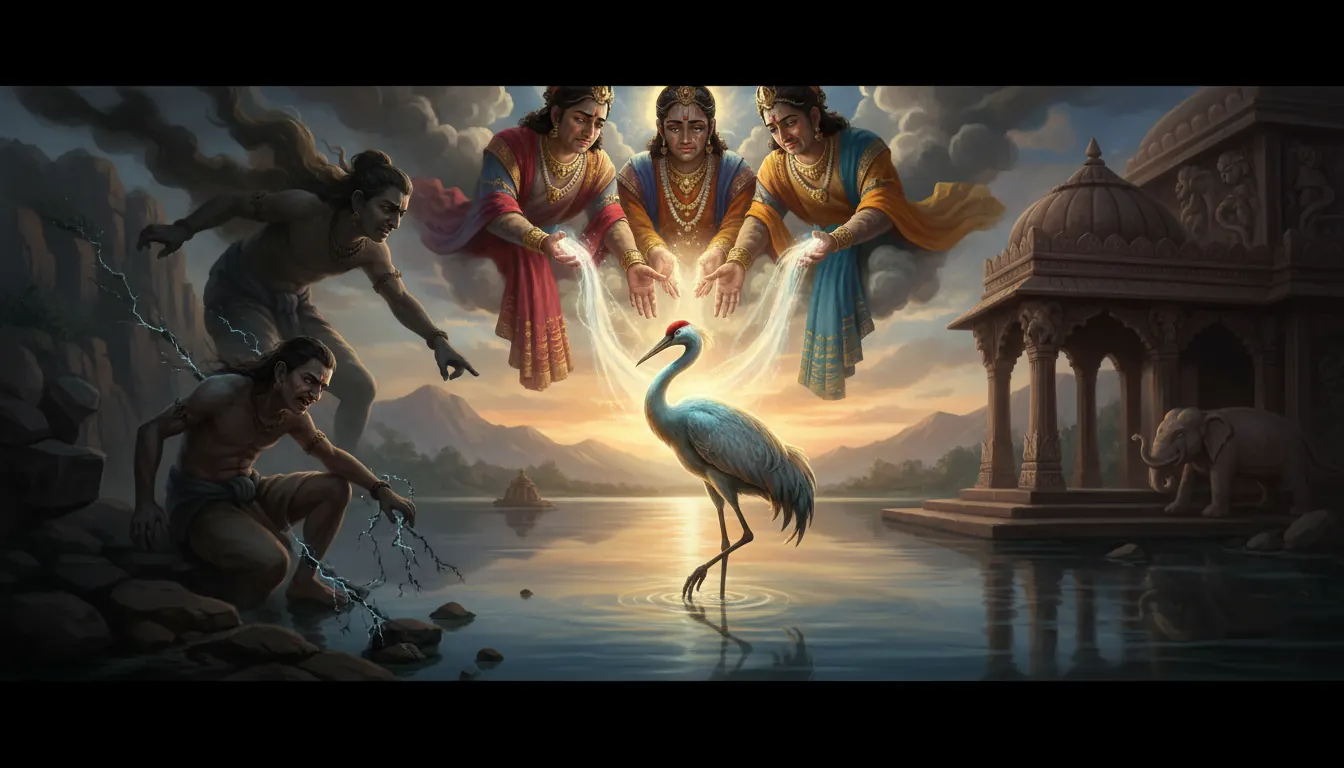
Every day, like the other robbers who lived there, Gautama went into the woods and killed wild cranes in great numbers.
Killing living creatures day after day, he became very skilled at it and soon said farewell to compassion. That is Bhishma's phrase for it, and the order matters: the skill came first and the compassion went afterwards, quietly, without his noticing. Living so closely with robbers, he became like one of them.
He lived happily there for many months, and large was the number of cranes he slew.
One day another brahmana came to that village. He wore rags and deerskins and his hair was matted. He was pure in conduct, humble, sparing in what he ate, deeply learned in the Vedas, and faithful to the vows of brahmacharya. He had been a dear friend of Gautama, and he came from that same part of the middle country that Gautama had left.
He would not accept food from a shudra, and so he searched a village crowded with robber families for the house of a brahmana where a traveller could properly be received.
At last he came to the house owned by Gautama, and just at that moment Gautama was coming home from the woods.
Armed with bow and sword, he bore on his shoulders a load of slaughtered cranes, and his body was smeared with the blood that trickled down from the bag. The guest looked at the man entering that door, who then resembled a cannibal, and recognised him.
"What folly is this that you are committing here? You are a brahmana, born to carry on a brahmana family. You come of a respected family of the middle country: how have you fallen into a robber's ways? Remember your famous kinsmen of earlier times, twice-born friend, every one of them learned in the Vedas. You were born into their line, and alas, you have become a stain on it. Rouse yourself by your own effort. Remember the energy, the conduct, the learning, the self-restraint and the compassion that are yours by birth, and leave this place."
Gautama answered him in great affliction of heart.
"Best of brahmanas, I am poor. I know nothing of the Vedas. Understand, my friend, that I came to live here for wealth and nothing else. But seeing you today, I am blessed. Tomorrow we will leave this place together. Spend the night here with me."
Compassionate as he was, the friend spent the night in that house, but he would not touch anything there. He was hungry, and they pressed him again and again, and still he would not eat.
Dharma Lesson
Bhishma's two lists are not about who is useful but about who does not change. The friend worth keeping is the one who is content with what you could give, who does not sharpen a small and unmeant injury into a quarrel, and who holds his colour like dyed wool through years of ordinary wear. And the fault he calls the vilest is not cruelty or greed but ingratitude, because a man who forgets what was done for him has already stopped being able to see the person who did it.