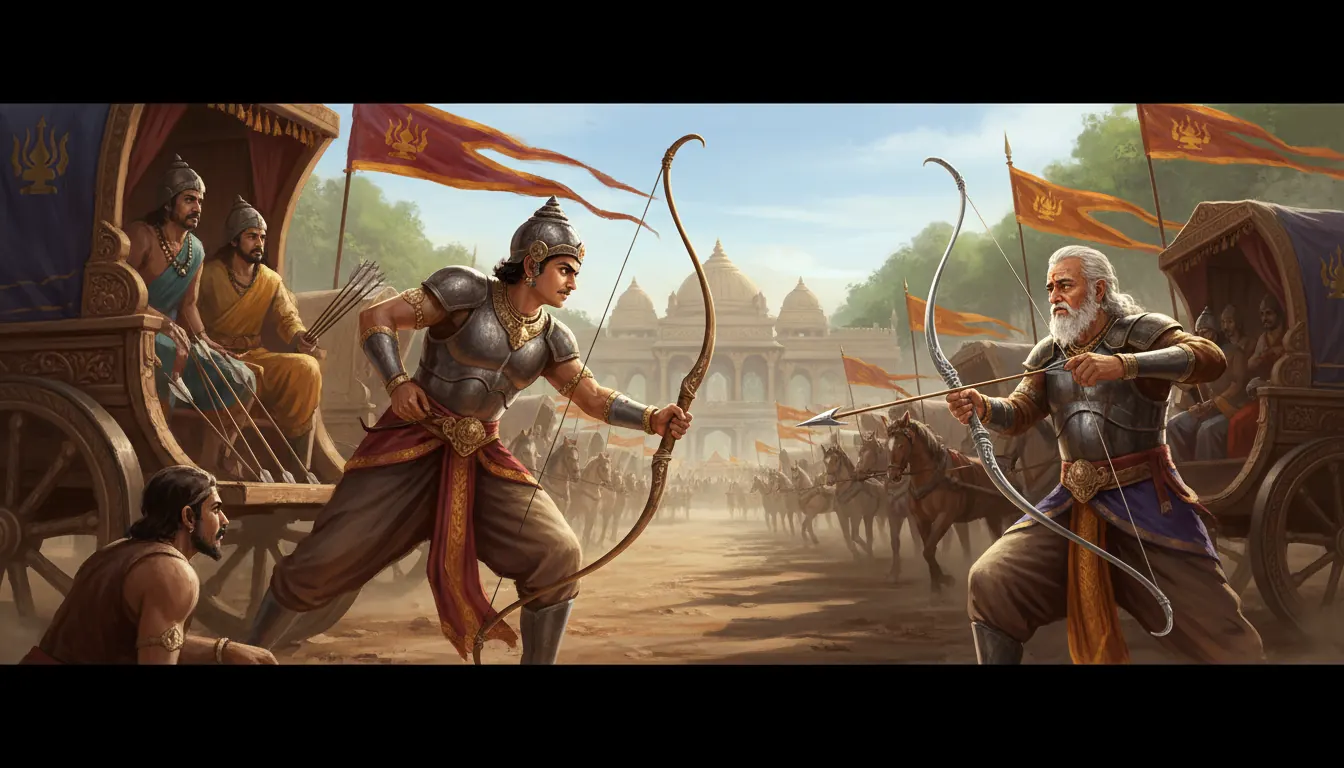
The Mouth of the Garuda
Drona draws his host as a bird and comes for Yudhishthira on the twelfth morning
In short
With Arjuna called away by the Samsaptakas, Drona arrays the Kaurava host in the form of a Garuda and moves to take Yudhishthira alive. Dhrishtadyumna vows to stop him and is locked up instead by Duryodhana's brother Durmukha, and Drona breaks division after division, killing king Kshema and a nameless prince of the Panchalas in the middle of a ring of champions. Watching the Pandavas run, Duryodhana laughs and tells Karna the war is finished, and Karna tells him what Bhima is remembering.
Told in the Drona ParvaSet in Kurukshetra21 min read
I Am Yours
The eleventh day had ended with a promise still standing. Bhishma was down on his bed of arrows, Drona had the command of the Kaurava host, and Duryodhana had asked his old teacher for one thing only: bring me Yudhishthira alive. Drona had answered that it could be done, and had added the condition that made the whole rest of the war: it could be done on any day when Arjuna was not on the field.
So Drona spent a night arranging for Arjuna not to be on the field.
"When the night had passed," Sanjaya said, telling it afterwards to a blind king in a hall at Hastinapura, "that mighty chariot-warrior, Bharadwaja's son, said to Suyodhana, I am yours. I have arranged for Partha to fight the Samsaptakas."
Two sentences at dawn, and the twelfth day was decided.
The Samsaptakas were the sworn ones, the warriors of Trigarta under Susharma who had stood at the fire and taken an oath that they would kill Arjuna or not come back, and who had discovered the one weakness in the greatest bowman alive. They did not have to defeat him. They only had to call him. Arjuna had never in his life refused a man who challenged him by name, and they were willing to spend themselves by thousands on that fact.
They called him again that morning, from the far southern end of the field, and Arjuna turned to Vasudeva and asked to be driven towards them, and the white horses took him away out of sight.
That left the thing Drona had been waiting for. At the head of his troops drawn up for battle, the teacher set out, chief of the Bharatas, to seize king Yudhishthira the just.
The eldest son of Pandu was going to spend that day being hunted by his own teacher, and the only man on earth who could reliably stop that teacher was a long way off, killing volunteers.
The Bird Drawn Up on the Field
Drona arrayed his forces that morning in the form of a Garuda, the great bird that carries Vishnu, and it was drawn out on the plain limb by limb so that every man in it knew what part of the creature he was.
In the mouth was Drona himself.
The head was king Duryodhana, surrounded by his brothers born of the same mother. Kritavarma and the illustrious Kripa formed the two eyes. At the neck stood Bhutasarman and Kshemasarman and the valiant Karakaksha, and with them the Kalingas, the Singhalas, the Easterners, the Shudras, the Abhiras, the Daserakas, the Sakas, the Yavanas, the Kambojas, the Hangsapadas, the Surasenas, the Daradas, the Madras and the Kalikeyas, with hundreds and thousands of elephants and horses and chariots and foot-soldiers behind them.
Bhurishravas and Shalya and Somadatta and Bahlika took the right wing with a full akshauhini at their backs. Vinda and Anuvinda of Avanti and Sudakshina the ruler of the Kambojas took the left, stationed at the head of Drona's son Ashwatthama. In the back were the Ambashthas and the Magadhas and the Paundras, the Madrakas, the Gandharas, the Sakunas, the mountaineers and the Vasatis. In the tail stood Vikartana's son Karna with his sons and kinsmen and friends and a host raised out of many realms.
And in the heart of the bird, keeping the region of Brahma before their eyes, which is to say having already settled with themselves that they would not be coming out, stood Jayadratha and Bhimaratha and Sampati, the Jayas and the Bhojas, Bhuminjaya and Vrisha and Kratha, and the mighty ruler of the Nishadhas.
With its foot-soldiers and horses and chariots and elephants, that array seemed to surge like the tempest-tossed ocean as it advanced, and warriors kept starting out from its wings and sides like roaring clouds charged with lightning rushing from every quarter of the sky in summer.
In the midst of it Bhagadatta, the old king of Pragjyotisha in the far east, sat on his war elephant like the rising sun. He wore garlands of flowers and a white umbrella was held over his head, so that he looked like the full moon in conjunction with the constellation Krittika, and his elephant, blind with the wine-like exudation running down its temples, looked like a mass of black antimony, like a huge mountain washed by mighty clouds.
Yudhishthira looked at all of this and drew his own troops up in a semi-circle facing it, which is the shape a man makes when he expects to be closed on from both ends.
Let Me Not Be Taken
Then Yudhishthira, seeing that superhuman array, which no enemy could defeat in battle, turned to the son of Prishata's line and said the thing a king does not usually say out loud.
"My lord, you whose horses are white as pigeons, let such measures be taken that I am not taken prisoner by the brahmana."
Not killed. Taken. That was the shape of the danger, and everyone in the Pandava host understood it. Drona had no wish to burn Yudhishthira out of existence; he wanted him whole and in a tent, because a captured king ends a war without another arrow being shot, and because Duryodhana had asked for him that way.
The man Yudhishthira asked was Dhrishtadyumna, son of Drupada, the prince who had come out of a sacrificial fire in Panchala for one purpose, born with armour on and a bow in his hand, and whose purpose was the death of Drona. He was the commander of the Pandava army. He had also, at the beginning of all this, formally taken Drona as the victim allotted to his own share.
"You of excellent vows," Dhrishtadyumna said, "you will never fall into Drona's power, however hard he may try. I myself will hold back Drona today with all his followers. As long as I am alive, son of Kuru's line, you have no cause for any anxiety. Under no circumstances will Drona be able to defeat me in battle."
With that, the mighty son of Drupada, whose horses were the colour of pigeons, scattered his shafts and rushed at Drona himself.
And Drona, who had faced every great bowman on that field without changing colour, looked up and saw that particular man coming at him out of the dust.
Seeing that evil omen, Dhrishtadyumna, standing before him, Sanjaya said, Drona soon became deeply downcast.
He had known since the fire in Drupada's courtyard what that child had been made for. Here it was, on its own feet, with a bow.
Durmukha Steps In
It was one of Dhritarashtra's sons who saw the teacher's face and understood what he was looking at.
Durmukha was not among the famous Kaurava brothers. He appears in the war the way most of the hundred appear, as a name that comes forward at a bad moment and does something creditable and is not heard of again for a while. Wanting to do Drona a service, he put his chariot between the teacher and the man born to kill him.
Then a terrible and fierce battle took place, Bharata, between the brave son of Prishata and your son Durmukha.
Dhrishtadyumna tried to fight both of them at once. He covered Durmukha quickly with a shower of arrows and at the same time checked Bharadwaja's son with a thick downpour of arrows, holding the son off with one hand and the father-figure of the whole Kuru host off with the other. For a few moments it worked. Seeing Drona held back, Durmukha rushed in closer and confounded the Panchala prince with clouds of arrows of every kind, and the two of them locked together, and neither could leave.
That was the whole of Durmukha's service, and it was enough. While the prince of the Panchalas and that Kuru warrior were locked together, Drona was free, and Drona used it.
He consumed many sections of Yudhishthira's host. As a mass of clouds is dispersed in different directions by the wind, so was Yudhishthira's host, in many parts of the field, scattered by Drona.
The vow that had been made to the king a quarter of an hour earlier was already, through no fault of the man who made it, impossible to keep. Dhrishtadyumna had promised to check Drona, and he had been checked instead, by a brother nobody counted, and the teacher was loose in the middle of the Pandava line with nothing in front of him.
For only a short while after that did the battle look like an ordinary combat.
Fought by Watchwords
Then, king, it became a clash of enraged men in which no one showed regard for anyone.
The combatants could no longer distinguish their own men from the foe. The battle raged on with the warriors guided by guesswork and watchwords, which is to say that by mid-morning men were killing on the strength of a password and a guess. Upon the gems on their headgears, upon their necklaces and their other ornaments, upon their coats of mail, rays of light like those of the sun seemed to fall and play, and the chariots and elephants and horses with their streaming banners looked like masses of cloud with flocks of cranes flying beneath them.
Men slew men. Fiery horses slew horses. Chariot-warriors slew chariot-warriors and elephants slew elephants.
The worst of it was among the great beasts. Elephants rushed together and rubbed their bodies against hostile compeers and tore at one another with their tusks, and from the friction of countless tusks against tusks fires mixed with smoke were generated on that field. Shorn of the standards on their backs, those elephants with fire at their tusks looked like clouds in the sky charged with lightning. Some, wounded with lances and shafts, became panic-stricken and left the field crying out. Some, struck by others of their own kind, uttered yells of distress that sounded like the roll of the all-destroying clouds at the end of the Yuga. Some, turned back by huge antagonists, were driven at the charge again by sharp hooks, and crushed whatever came in their way without caring whose it was. Drivers, shot through the breast with broad-headed shafts, fell from their beasts with the lances and hooks loosening out of their hands, and the riderless animals wandered singly in all directions like clouds torn away from mightier masses, and then fell down where they collided.
The earth, suddenly struck by those falling bodies, huge as hills, trembled and made a sound.
Covered with the bodies of elephants and horses and chariot-warriors, the ground became a mire of flesh and blood, and men sank ankle-deep in the bloody mud and looked like tall trees whose lower parts have been swallowed up in a blazing forest fire. Robes and mail and umbrellas and standards were all dyed one colour. And there father slew son, and son slew father, for the battle was terribly fierce and nothing could be made out.
In that fierce and awful battle, confounding the senses of his foes, Drona at last rushed at Yudhishthira.
The River Drona Made
He did not reach him. Two men stood in front of the teacher that morning and both of them paid the price of it.
Satyajit of Panchala, whose prowess could not be checked, came in first and fought Drona as Indra fought Vali, cutting his standard, striking his charioteer senseless with five arrows fatal as snake-poison, piercing his horses and both his Parshni drivers, wheeling at the head of his troops in a circle while the Pandavas shouted and waved their garments in the air. Vrika, coming to help him, pierced Drona in the centre of the chest with sixty arrows, and that feat, said Sanjaya, seemed truly wonderful. Then Drona opened his eyes wide and gathered all his strength, and after that it took him six shafts to kill Vrika with his charioteer and his horses, and one crescent-shaped arrow to take off Satyajit's head.
Yudhishthira, from fear of Drona, fled away, borne by fleet horses.
Satanika, the younger brother of the ruler of the Matsyas, came in next, put six shafts bright as sunbeams into Drona and his driver and his horses, and shouted. Drona cut his head, decked with earrings, from his trunk with an arrow sharp as a razor, and the Matsyas ran.
After that there was nothing organised in front of him at all, and the teacher of both armies, eighty-five years old and in a golden chariot, began to do to the Pandava host what fire does to heaped cotton.
The twang of his bowstring was heard in every direction at once. His gold-decked bow was seen in all quarters like lightning inside cloud, and the beautiful altar on his banner went by like a crest of Himavat.
And Sanjaya, who was watching all this with the eyes Vyasa had given him, said that Drona caused a river to flow there.
Coats of mail formed its waves and standards its eddies. Elephants and horses were its alligators and swords were its fishes. The bones of brave warriors made its pebbles, drums and cymbals its tortoises, shields and armour its boats, and the hair of warriors its floating moss and weeds. Arrows were its wavelets and bows its current, and the arms of men were the snakes in it. Heads made its stones and thighs its fishes, maces were the rafts by which some tried to cross, head-gear was the foam on its surface, and blood and flesh were the mire at its bottom. Standards stood along it like trees on a bank.
Thousands of kshatriyas sank in that river, and it ran towards the abode of Yama.
Nine Arrows for King Kshema
Then the Pandava warriors stopped trying to hold a line and simply went at him. Led by Kunti's son, rushing at that mighty chariot-warrior who was devouring their divisions like Death himself, they surrounded him on all sides, and the kings and princes of the Kaurava army came up with weapons raised to keep them off him, and the fight closed into a ring.
Sanjaya counted the arrows, because that is how the honour of it was reckoned.
Shikhandi pierced Drona with five straight arrows. Kshatradharman with twenty. Vasudana with five, Uttamaujas with three, Kshatradeva with five. Satyaki pierced him with a hundred, and Yudhamanyu with eight. Yudhishthira put in a dozen shafts. Dhrishtadyumna, who had got free of Durmukha by then, put in ten. Chekitana put in three.
Ten of the best bowmen in the world, and the old man in the middle of them was not slowed.
Drona, whose aim never failed, like an elephant with split temples, broke clean through the whole chariot division of the Pandavas and overthrew Dridhasena as he went.
And then, approaching king Kshema, who was battling fearlessly, he struck him with nine arrows, and Kshema fell lifeless from his chariot.
That is the entire record of that king. He is named once, he is described in three words as fighting without fear, he is given nine arrows, and he is gone. He had brought his men to that field from some kingdom the epic does not stop to identify, and he did not run when the river came at him, and Sanjaya, listing the dead of a single morning for a blind man who wanted to hear about his own sons, gave him one line.
Getting then into the very midst of the hostile troops, Drona careered in all directions, protecting others but himself in no need of protection.
The Prince Who Fell Like a Star
Then he paid the ring back, name by name, in the same currency they had used on him.
He pierced Shikhandi with twelve arrows and Uttamaujas with twenty. He sent Vasudana, a Panchala warrior, to the home of Yama with a single broad-headed shaft. He pierced Kshatravarman with eighty arrows and Sudakshina with twenty-six. He knocked Kshatradeva out of his place in the chariot with a broad-headed arrow. He put sixty-four arrows into Yudhamanyu and thirty into Satyaki.
Then, having cleared the ground around him, Drona of the golden chariot turned and went for Yudhishthira again, and Yudhishthira, that best of kings, again fled from his teacher, carried off by his swift horses. Twice in one morning the eldest Pandava had been made to run in front of his own army, and both times it was the right thing to do, and both times everyone watched him do it.
Then a prince of the Panchalas rushed at Drona.
Sanjaya does not give him a name. He gives him a lineage and a death. Drona slew the prince, cutting through his bow and felling his horses and his charioteer with him, and the prince fell lifeless from his chariot to the earth like a star shaken loose from the sky.
Upon the fall of that illustrious prince of the Panchalas, loud cries were heard on that part of the field, and they were not cries of grief.
"Slay Drona! Slay Drona!"
It was the first time that day the whole shout had gone up together, and it was the shout that would eventually be answered, three days later, by a lie about an elephant. On the twelfth morning it answered nothing. The mighty Drona began to crush and mangle the Panchalas, the Matsyas, the Kaikeyas, the Srinjayas and the Pandavas, all of them excited with rage and none of them able to stand, and supported by the Kurus he vanquished Satyaki, and Chekitana, and Senavindu, and Suvarchas, and numerous other kings besides.
The Kaurava warriors, now victorious, killed the Pandava soldiers as they fled in every direction. And the Panchalas and the Kaikeyas and the Matsyas, slaughtered on all sides like the Danavas by Indra, began to tremble.
The King Laughing in the Middle of His Army
In the hall at Hastinapura the blind king interrupted his charioteer here, because something in the account had reached him.
"When the Pandavas were broken by Bharadwaja's son in that dreadful battle," Dhritarashtra said, "and the Panchalas too, did anyone come forward to fight Drona? Seeing him standing in battle like a yawning tiger, or an elephant with split temples, ready to lay down his life, well armed, skilled in every kind of fighting, that great bowman, that tiger among men, grateful, devoted to truth, always eager to serve Duryodhana, seeing him at the head of his troops, was there no man who could go against him with a worthy resolve to fight, the kind of resolve that adds to the fame of kshatriyas and that mean-spirited men can never form? Tell me, Sanjaya, who those heroes were."
Sanjaya said that the Pandavas and the Panchalas and the Matsyas and the Srinjayas and the Chedis and the Kalikeyas were at that hour going off the field like vessels sent adrift by the waves of a tempest-tossed ocean, with the Kauravas after them on every side, roaring, sounding every instrument they had.
And that in the middle of his own forces, encompassed by his relatives and his kinsmen, Duryodhana was filled with joy, and laughed while he spoke to Karna.
"Look, son of Radha, at the Panchalas broken by that steady bowman with his shafts, like a herd of wild deer frightened by a lion. I do not think these will come back to battle. Drona has broken them like mighty trees in a storm. Struck by that great-souled warrior with his gold-winged shafts, they are running away, and no two of them are together. They seem to be swept round in eddies all over the field. Held back by the Kauravas and by great-souled Drona, they are huddling close together like a herd of elephants in the middle of a forest fire. Like blossoming trees swarming with bees, these warriors, pierced by Drona's sharp shafts, are huddling together as they flee.
"And there, Karna, is the thing that delights me most. The furious Bhima, abandoned by the Pandavas and the Srinjayas, surrounded by my warriors. That wicked wretch plainly sees the whole world today as full of Drona. Without doubt that son of Pandu has today given up hope of life and kingdom."
Karna had been standing in the tail of the Garuda all morning, watching the same field.
What Karna Saw Instead
"That mighty-armed warrior will certainly not leave the battle as long as he is alive," Karna said. "Nor, tiger among men, will he put up with these lion-like shouts of ours. Nor, I think, will the Pandavas be defeated in battle."
Then he told the king why, and the reasons he gave were not military.
"They are brave, very strong, skilled in weapons and hard to resist. Remembering the suffering we caused them by trying to poison them and burn them, and the suffering that came from the game of dice, and bearing in mind their exile in the woods too, the Pandavas, I think, will not give up the fight."
That is the whole argument, and it is strange coming from the man who did as much as anybody to put those memories there. Karna was not counting chariots. He was counting the number of things the sons of Pandu had to remember, and he had concluded that an army with that much stored up in it does not stop because it has had a bad morning.
"Mighty-armed Vrikodara, whose energy has no measure, has already turned back to fight. The son of Kunti will certainly kill many of our best chariot-warriors. With sword and bow and dart, with horses and elephants and men and chariots, with his iron mace, he will kill crowds of our soldiers. Other chariot-warriors, led by Satyaki, with the Panchalas, the Kekayas, the Matsyas and above all the Pandavas, are following him. They are all brave, and of great strength and prowess. Mighty chariot-warriors, they are once again led by Bhima in his fury.
"Those bulls of the Bharata line, surrounding Vrikodara on every side like clouds around the sun, are beginning to close on Drona from all sides. Fixed on a single aim, they will certainly harass Drona, who has no one guarding him, like insects about to die flying into a blazing lamp. Skilled in weapons, they are certainly able to hold him off. A heavy burden, I think, now rests on Bharadwaja's son.
"Let us go quickly, then, to where Drona is. Do not let those men of disciplined vows kill him like wolves killing a mighty elephant."
Duryodhana stopped laughing and went. With his brothers he made for Drona's chariot, and behind them, said Sanjaya, the noise was deafening: the Pandava warriors coming back onto the field they had just been driven off, in chariots drawn by fine horses of every colour, every one of them driven by the wish to kill one man.
The morning had belonged to Drona. Karna was the only man on that side who had noticed that a morning is not a day.
Dharma Lesson
Duryodhana reads a rout as a verdict, because he has always mistaken the state of a field for the state of the men on it. Karna, who has spent his life being hated and knows exactly what a man carries out of a humiliation, reads the same field and sees an interval. The Pandavas are not fleeing from Drona, they are turning round, and what turns them round is not strategy but thirteen years of memory. A commander can win every exchange in a morning and still lose the day, if the men he scatters have something to remember.