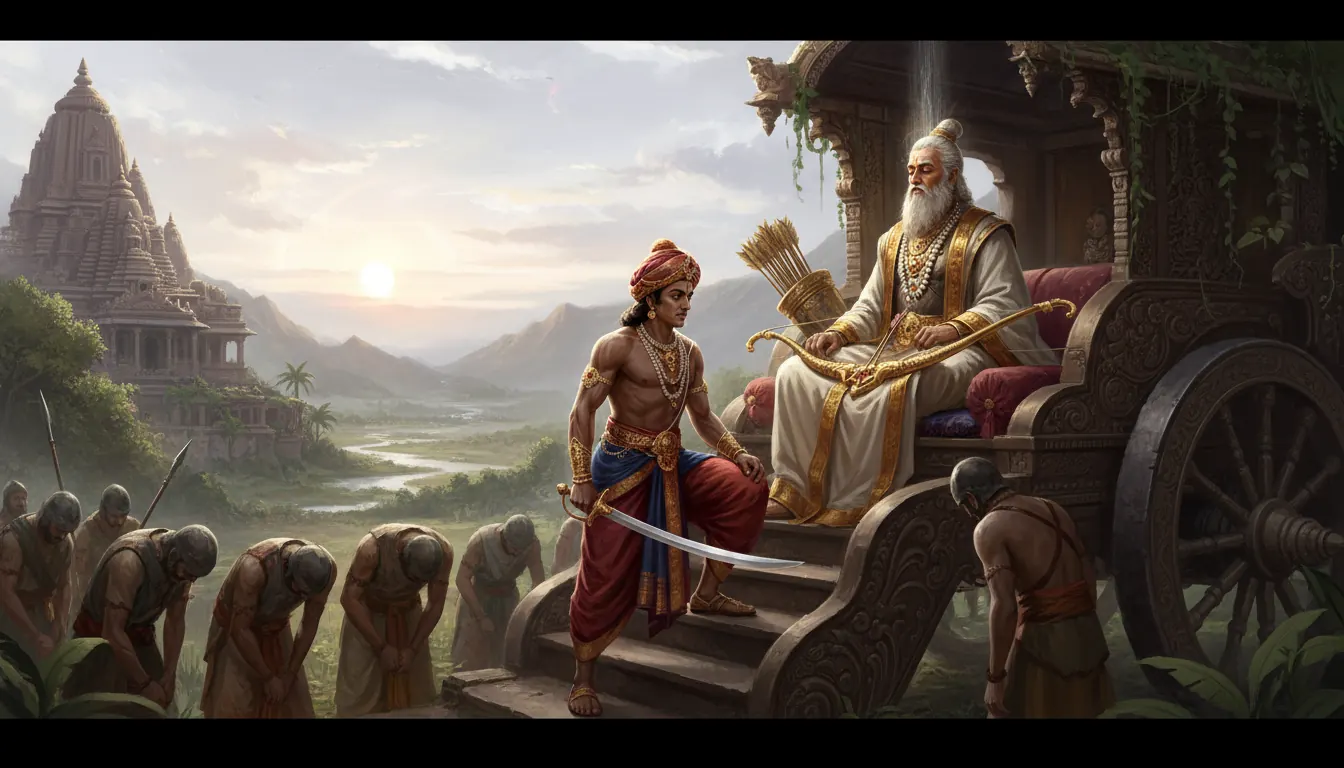
The King Falls Out of His Seat
Dhritarashtra hears that Drona is dead, faints in his hall, and wakes to ask who was supposed to be guarding him
In short
When Sanjaya reports the death of Drona, Dhritarashtra refuses to believe that nothing went wrong, and searches for a broken wheel, a snapped bowstring, a moment of carelessness, anything but destiny. Finding none, he falls senseless from his seat and is lifted back onto it by the weeping women of the house. Waking, he begins again, naming every Pandava warrior who came at Drona that day and demanding to know which man of his own stood in the way.
Told in the Drona ParvaSet in Hastinapura and Kurukshetra20 min read
The Question After the News
Sanjaya had finished. He had told the whole of it in one breath, the way a man tells the worst thing he has to say before his courage fails him: that Drona had killed more than two akshauhinis of brave and unreturning warriors, that he had scorched the world like the sun rising at the end of the yuga, and that at the last Dhrishtadyumna had killed him, and that when the teacher fell there went up in the sky a cry from all creatures, a loud "Shame!" resounding through heaven and earth and the space between them.
He was speaking in a hall in Hastinapura to a king who could not see him. Sanjaya was the son of Gavalgana, of the suta caste, charioteer and counsellor, and Vyasa had given him the sight by which he watched the field from a hundred and fifty miles away and reported it. For fifteen days he had been bringing this old man the deaths of his hopes one at a time.
Dhritarashtra did not ask what happened next. He asked how it could have happened at all.
"How did the Pandavas and the Srinjayas kill Drona in battle," he said, "Drona, the most accomplished in weapons of all who bear arms?"
Then the questions came out of him in the order a man asks them when he is looking for an accident to blame.
"Did his chariot break in the course of the fight? Did his bow break while he was striking the enemy? Or was Drona careless at the moment he received his death-blow?"
Because there had to be a mechanical reason. A wheel, a string, a moment of inattention. Something that could be pointed at and understood. The alternative, which the old king would arrive at before he finished speaking, was that nothing had gone wrong at all, and that Drona had been killed simply because it was time for him to be killed.
"How, child, could Prishata's son, the prince of the Panchalas, kill that hero, whom no enemy could ever humble?"
Destiny Is Stronger Than Effort
He went on describing the dead man, and the description was itself the argument.
Here was a man who scattered thick showers of gold-winged arrows, very quick of hand, the greatest of brahmanas, accomplished in everything, versed in every mode of warfare, able to shoot his arrows a great distance, and self-restrained. A man of great skill with weapons, armed with celestial weapons. A mighty warrior of unfading glory, who was always careful.
Always careful. Dhritarashtra put that word in deliberately, because it closed off the third of his own three explanations. Drona had not been careless. There was no lapse to find.
So he found the only thing that was left.
"It seems plain to me that destiny is stronger than effort, since even brave Drona, that hero who had mastered the four kinds of weapons, has been killed by the high-souled son of Prishata. Alas, you tell me that Drona, that teacher of bowmanship, is dead."
He tried to hold the picture of the man in front of him and could not put it down.
"Now that I have heard of the killing of that hero who used to ride his bright chariot covered with tiger skins and adorned with pure gold, I cannot drive away my grief."
Then he said a thing about himself that nobody else in that hall would have dared to say about him.
"There is no doubt, Sanjaya, that no one dies of grief at another's calamity, since, wretch that I am, I am still alive although I have heard of Drona's death. I believe destiny is all-powerful, and effort is fruitless. Surely my heart, hard as it is, is made of adamant, since it does not break into a hundred pieces, although I have heard of Drona's death."
It is the complaint of a man who has discovered that grief does not kill, and who resents the discovery. He had said something very like it about Bhishma. He would say it again about Karna. Each time he was a little more certain that the fault of surviving was his own.
The Drying Up of the Ocean
The king reached for images large enough to hold the loss, and each one he chose was a thing that cannot happen.
"He was waited on by brahmanas and princes who wanted to learn the Vedas and divination and bowmanship. Alas, how could Death take him away? I cannot bear the overthrow of Drona. It is like the drying up of the ocean, or Meru moved from its place, or the sun fallen from the sky."
Not a defeat. A violation of the order of the world. The ocean does not dry. The mountain at the centre of the earth does not move. The sun does not come down out of the sky. Dhritarashtra was saying that he had lived to see one of those.
Then he began the list of what the man had been, and it is worth noticing what he praises.
"He was a restrainer of the wicked and a protector of the righteous."
That is a strange sentence in the mouth of the father of Duryodhana, and the king knew it, because he went straight from it to the thing that made it unbearable.
"That scorcher of foes has given up his life for the wretched Duryodhana. My wicked sons rested their hope of victory on his prowess. He was equal to Brihaspati or Ushanas himself in intelligence. Alas, how was he slain?"
Brihaspati is the teacher of the gods. Ushanas, whom the epic also calls Shukra, is the teacher of the asuras. Between them they are the whole of teaching, on both sides of every war ever fought, and Dhritarashtra reached for both names at once because one would not do.
And in the same breath he called his own son wretched, and his other sons wicked, and admitted that Drona had spent his life on them anyway.
A blind man in a hall, with the news three hours old, telling the truth about his children for as long as the shock lasted.
The Red Horses of the Sindhu Breed
Then, because he could not get at the man, he began to interrogate the horses.
It is the oddest passage in the whole lament and the most human. Dhritarashtra had never seen Drona's chariot. He had heard it described, year after year, by people who had, and he had built it in his head out of their words, and now he took the thing apart piece by piece and asked whether each piece had failed.
"His big red horses, covered with nets of gold, swift as the wind, that no weapon could strike in battle, horses of great strength, neighing cheerfully, well trained and of the Sindhu breed, yoked to his chariot and drawing it superbly, always tireless in the thick of battle: did they grow weak and faint?"
He was not finished with them.
"They bore the roar of elephants coolly in battle, while those huge creatures trumpeted at the blare of conches and the beat of drums. They were unmoved by the twang of bows and by showers of arrows and other weapons. The very sight of them foretold the defeat of the enemy. They never panted from toil, and were above all fatigue and pain. How were those swift horses that drew the chariot of Bharadwaja's son so soon overpowered?"
And then, having asked it, he answered himself twice over, insisting on the horses as though Sanjaya had contradicted him.
"Such were the horses yoked to his golden chariot. Such were the horses that greatest of human heroes yoked to it."
"Mounted on his own fine chariot decked with pure gold, why, son, could he not cross the sea of the Pandava army?"
The sea of the Pandava army. That is the first time in the speech that the king allows the enemy to be a size rather than a name. He had been asking what broke. He was beginning to suspect that nothing broke, and that the ocean was simply wider than the horses were fast.
Ants Pressing Upon a Snake
Having failed to find an accident, he went looking for a crime.
"What feats did Bharadwaja's son achieve in battle, that warrior who always drew tears from other heroes, whose knowledge of weapons all the bowmen of the world rely on? Firm in truth and mighty as he was, what did Drona do in battle? Who were the chariot warriors who met that doer of fierce deeds, who was like Shakra himself in heaven? Did the Pandavas run away at the sight of him in his golden chariot?"
Then he reconstructed it, and his reconstruction is close enough to what happened that it is uncomfortable to read.
"Or did King Yudhishthira the just, with his younger brothers, and with the prince of Panchala as his binding chord, attack Drona and surround him with his troops on all sides? Surely Partha must have held back all the other chariot warriors with his straight arrows, and then Prishata's son, the doer of sinful deeds, must have surrounded Drona. I can see no other warrior but the fierce Dhrishtadyumna, protected by Arjuna, who could have brought about the death of that mighty hero."
His binding chord. The king's word for Dhrishtadyumna is a word for a harness or tether, and he means that Yudhishthira brought the rope and Arjuna kept the field clear while it was used.
"It seems that when those heroes, the Kekayas, the Chedis, the Karushas, the Matsyas and the other kings, surrounded the teacher and pressed hard on him, like ants pressing on a snake, while he was busy with some difficult feat, the wretched Dhrishtadyumna must have killed him then. That is what I think."
Ants on a snake. It is the picture of a thing killed by number rather than by strength, and it is the nearest the old king came to naming what actually happened at that hour of the fifteenth day, which was not a duel and not an accident, but a lie told to an honest man and a sword brought up while his hands were empty.
The Brahmana at the Edge of a Weapon
Then Dhritarashtra said the thing that had been under the whole speech, which is that Drona should never have been on that field at all.
"He studied the four Vedas with their branches, and the histories that make the fifth, and became the refuge of the brahmanas as the ocean is the refuge of rivers. That scorcher of foes lived both as a brahmana and as a kshatriya. Alas, how could that brahmana, venerable in years, meet his end at the edge of a weapon?"
A brahmana who lived as a kshatriya. The double life is stated without excuse and without apology, because the whole court knew the history: the poor teacher, the old friendship with Drupada that went wrong, the half of a kingdom taken by force through his students, and the pupils of both houses who had learned everything they knew from him and were now using it.
And then a sentence that costs the speaker something.
"Proud as he was, he was often humiliated and had to suffer pain because of me. However little he deserved it, he still received from Kunti's son the fruit of his own conduct."
Read the two halves against each other. The humiliations were mine, says the king. The end was his own doing. Dhritarashtra takes the shame of the years in Hastinapura onto himself and hands the death back to Drona, and both halves are true, and the second half is the reason the first half never mattered.
"All the bowmen in the world depend on his feats. Alas, how could that hero, so firm in truth and so skilled, be slain by men greedy for wealth? He was first in the world as Shakra is in heaven. Alas, how could he be slain by the Parthas, like a whale by smaller fish?"
"While he lived, two sounds never left him: the sound of the Vedas recited by those who longed for Vedic learning, and the twang of bows drawn by those who longed for skill in bowmanship."
Two sounds, in one house, for a lifetime. That is Drona's whole biography in a line, and the old king found it while he was grieving.
Who Stood at the Wheels
Then he turned from the dead man to the living, and asked the question that would decide who was to be blamed in his own camp.
"How could Prishata's son, in sight of the greatest of men, kill in battle that invincible warrior whose might was never humbled and whose fame was never tarnished? Who fought in Drona's van, protecting him, standing by his side? Who went in his rear and reached that end which is so hard to reach? Who were the high-souled warriors who protected Drona's right and left wheels?"
The van, the rear, the right wheel, the left wheel. That is not a poetic sequence. It is the standing order for the protection of a commander, four assignments given to four named men every morning of a war, and Dhritarashtra was going down the roster in his mind and asking who had been where.
"Who were in that hero's van while he struggled in battle? Who, careless of their lives that day, met the death that stood face to face with them? Who were the heroes who went on the last journey in Drona's battle?"
And then the accusation, put as a question, which is how a king puts an accusation when he is afraid of the answer.
"Did any of the kshatriyas assigned to protect Drona prove false and abandon that hero in battle? Was he deserted like that, and killed by the enemy while he was alone? Drona would never show his back in battle out of fear, however great the danger. How then did the enemy kill him? Even in great distress, Sanjaya, an illustrious man should do this: put forth his prowess to the full measure of his might. All this was in Drona."
Then the voice stopped.
"Child, I am losing my senses. Let us stop this talk for a while. When I have recovered my senses I will ask you again, Sanjaya."
He had asked to be given a moment. He did not get one.
The Women Who Lifted Him
Here Sanjaya is not the narrator. The frame opens outward for a moment and it is Vaishampayana, reciting the whole epic years later to king Janamejaya, who tells what the blind man's hall looked like from outside.
"When he had spoken to the suta's son in this way, Dhritarashtra, overcome with grief and without hope of his son's victory, fell down on the ground."
Not a faint that was noticed after the fact. He was in the middle of speaking, and then he was on the floor.
"Seeing him senseless on the ground, his attendants sprinkled him with cold, perfumed water, fanning him all the while. Seeing him fallen, the Bharata ladies, king, surrounded him on all sides and gently rubbed him with their hands. And slowly raising the king from the ground, those royal ladies, their voices choked with tears, seated him on his seat."
The women of the house came in and took hold of him. They chafed his hands and his arms, and they lifted him between them off the ground, and they were crying while they did it, and they put him back on the seat he had fallen out of. Nobody in that room needed to be told what the news was. The women who lifted him had sons on that field, and they knew what it meant that Drona was gone before Karna had even been given the command.
"Seated there, the king stayed in that swoon. He remained perfectly still while they stood around him, fanning him."
That is the picture the epic stops on. A circle of weeping women fanning a motionless blind man on a throne, in a palace, while a hundred and fifty miles away the field is being cleared for the sixteenth morning.
"Then a tremor passed over the king's body and he slowly regained his senses. And once more he began to question Gavalgana's son, of the suta caste, about what had happened in the battle."
He had come back only to ask again.
Who Surrounded the Sons of Pandu
What came out of him the second time was not a lament. It was a roll call, and every entry in it has the same shape: here is a Pandava warrior, here is everything that is terrible about him, and now tell me the name of the man of mine who stood in front of him.
He began with Yudhishthira, whom he calls Ajatashatru, the one with no enemy born.
"He drives away darkness by his own light, like the risen sun, and rushes at an enemy like a swift, angry elephant with rent temples. Oh, what warriors of my army stood against that Ajatashatru as he came, to keep him away from Drona? That hero can burn up the whole of Duryodhana's army alone, with nothing but his terrible glances. Oh, who were the heroes of my army who surrounded that warrior who kills with a look?"
Then Bhima, who in strength is equal to ten thousand elephants, and who came at Drona with great speed: what brave fighters of my army surrounded him as he rushed at my host?
Then Arjuna, and here the sentence runs away from the speaker and does not come back for half a page. Bibhatsu, looking like a mass of clouds, hurling thunderbolts like the clouds themselves, shooting showers of arrows like Indra pouring rain, making all the points of the compass ring with the slaps of his palms and the rattle of his chariot wheels, whose bow was like the lightning's flash, who like Death himself drenches every point of the compass in human blood, who pours on my warriors, with Duryodhana at their head, shafts whetted on stone and fletched with vultures' feathers.
"When that hero of great intelligence came at you, what state were your minds in? When that warrior with the huge ape on his banner came, blotting out the sky with dense showers of arrows, what state were your minds in at the sight of that Partha?"
Then he stopped asking about his own men and stated a fact.
"My troops cannot bear the charge of that warrior with white horses yoked to his chariot, or the twang of Gandiva, like the roll of the clouds themselves. That chariot, with Vishnu himself for its driver and Dhananjaya for its warrior, I believe the gods and the asuras together could never defeat."
"In that battle in which the troops trembled and even heroes were struck with fear, who were they that did not desert Drona, and who were those cowards that abandoned him from fear?"
The Whole List, and the Name at the End of It
Then he went through the rest of the Pandava host, name by name, a blind man reciting from memory an army he had never seen.
Nakula, delicate and young and brave and very handsome of face, rushing at Drona with a loud noise: what heroes of my army surrounded him? Sahadeva, who is like an angry snake of deadly poison, who keeps praiseworthy vows and has never been defeated: what heroes surrounded him?
Satyaki of the Satvata race, in whom are always truth and firmness and bravery and brahmacharya, who through Arjuna's instruction has become foremost in the use of arrows and is regarded as Krishna's second self: what warrior of my army resisted him?
Uttamaujas of the Panchalas, always devoted to Arjuna's welfare, born only for my evil. Dhrishtaketu, the one man among the Chedis who deserted them for the Pandavas. Ketumat, who slew prince Durjaya in Girivraja. Shikhandi, son of Yajnasena, who knows in his own person the merits and demerits of manhood and of womanhood, and who became the cause of Bhishma's death. Abhimanyu, whom the old king still names among the living. The sons of Draupadi, rushing at Drona like rivers rushing towards the sea. The four sons of Dhrishtadyumna, children who gave up all sport for twelve years and waited upon Bhishma for the sake of weapons. Chekitana, whom the Vrishnis reckoned superior to a hundred chariot warriors. The five Kekaya brothers, red of mail and weapon and banner. Yuyutsu, his own son. Dhrishtadyumna, the chief counsellor of the Pandavas, who was created for Drona's destruction. Saivya, grandson of Usinara's son. Virata of the Matsyas. And Ghatotkacha, born of Bhima in the course of a single day, that thorn in the side of my sons, whom I fear very greatly.
Then he put the list down.
"What can remain unconquered, Srinjaya, by those for whose sake these men and many others are ready to lay down their lives in battle? How can the sons of Pritha be defeated, when they have the greatest of all beings, the wielder of the bow called Sarnga, for their refuge and benefactor?"
"Vasudeva is, indeed, the great Master of all the worlds, the Lord of all, and Eternal. Of celestial soul and infinite power, Narayana is the refuge of men in battle. The wise recite his celestial feats. I too will recite them with devotion, to recover my firmness."
He had begun by asking how a wheel could have broken. He ended by naming the reason the war was lost, and then asked only to be allowed to go on speaking of Krishna until he could sit upright again.
Dharma Lesson
Dhritarashtra asks after the wheel, the bowstring, the horses, the moment of carelessness, because a mechanical failure could have been prevented and a destiny cannot. When every part of the chariot proves sound he is left with the answer he already knew, which is that the war he permitted has been eating the men he loved in the order of their greatness. Grief that spends itself hunting for a smaller cause is grief refusing to look at itself. He recovers only when he stops asking who failed Drona and begins naming, out loud, what the other side actually had.