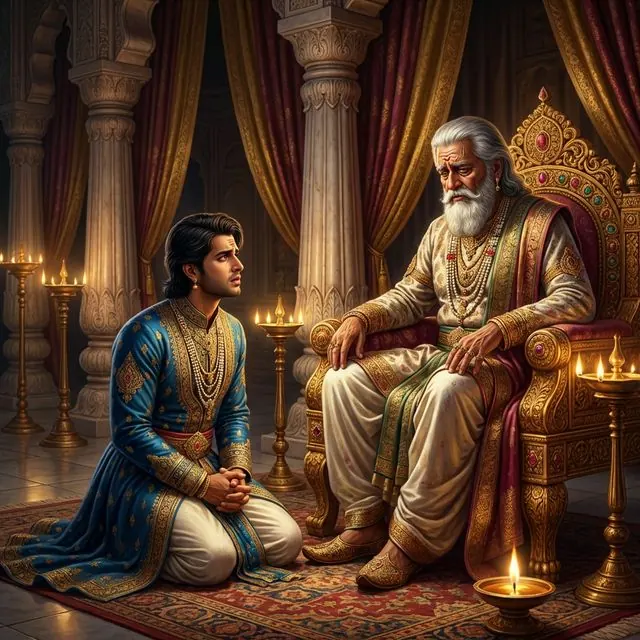
The Vow of Brahmacharya
Bhishma on the rules of abstention, and the duct called Manovaha
In short
Asked how the senses are to be conquered, Bhishma sets out the vow of Brahmacharya: what it is, what it is not, and the graded rewards of practising it wholly, half, or indifferently. He gives the plain household rules of the vow and the expiations for breaking it, including the one for desire that comes in a dream. Then he opens the body up and describes the ten ducts, the duct called Manovaha that leads to the heart, and the three causes by which the vital seed is formed.
Told in the Shanti ParvaSet in Kurukshetra12 min read
The Blind Man Without a Guide
Bhishma was recounting an old discourse on Emancipation between a teacher and his disciple, and in the teacher's words he had just finished telling the king how a soul is drawn into a body: how thirst binds it, how wrath and desire and pride follow one another down like a chain of buckets, and how the whole apparatus ends in a residence within the womb. He had said that the embodied Soul escapes rebirth by making its senses weak. Yudhishthira had not asked how that was done, but the old man on the arrows could hear the question sitting there unspoken, and he answered it.
"Now I will tell you what the means are," said Bhishma, "as seen with the eye of the scriptures. A person, king, will reach the highest end with the help of such knowledge and by shaping his conduct by it."
Then, before the means, he gave the ladder, because he wanted the king to see where a man is standing when he begins.
Among all living creatures, man is said to be the highest. Among men, the twice-born have been called the highest. And among the twice-born, those who know the Vedas, and these last are regarded as the souls of all living creatures. The brahmanas who know the Vedas are spoken of as all-seeing and all-knowing, for they are people who have come to know Brahma.
"As a blind man without a guide meets many difficulties on a road," Bhishma said, "so a person without knowledge meets many obstacles in the world. That is why those who have knowledge are regarded as superior to the rest."
It is a plain image and he did not decorate it. The man without knowledge is not wicked. He is simply out on a road he cannot see, taking every rut and every ditch in turn, and arriving nowhere in particular after a great deal of work.
And a great deal of work was exactly what Bhishma turned to next, because there are men who do all the work and still do not arrive.
The Religion That Is Only Heard as a Word
Those who want to win virtue practise many kinds of rites as the scriptures direct. But they do not succeed in reaching Emancipation. Bhishma said it flatly, and then he said what such men do get, because he did not want the king to think their labour was wasted.
They gain the good qualities. Purity of speech, purity of body, purity of mind, forgiveness, truth, steadiness, and intelligence. These are the seven things shown by righteous people who keep both kinds of religion, the religion of works and the religion of abstention, and they are worth having. They are simply not the same thing as release.
"That which is called Brahmacharya," said Bhishma, "is regarded as the means of reaching Brahma. That is the highest of all religions. It is by practising that religion that one reaches the highest end."
Then he defined it, and the definition is made almost entirely of subtractions.
Brahmacharya is divested of all connection with the five vital breaths. It is divested of connection with the mind and with the understanding. It is divested of connection with the five senses of perception and the five senses of action. It is on that account free from all the perceptions that the senses give. It is heard only as a word, and its form, without being seen, can only be conceived. It is a state of existence depending only on the mind, free from all connection with the senses, and that sinless state should be attained to by the understanding alone.
Nothing in that list can be pointed at. A man cannot be shown Brahmacharya the way he can be shown a fire altar or a ladle.
Bhishma then graded the practice, as the scriptures grade everything.
He who practises it fully reaches Brahma. He who practises it by halves reaches the state of the gods. He who practises it carelessly is born among brahmanas, and, being learned, rises to eminence.
"Brahmacharya is exceedingly difficult to practise," he said. "Listen now to the means."
Three Days in Water
The instruction that followed was not lofty. It was a set of household rules for a man under a vow, and Bhishma delivered it in the order in which a man actually meets his difficulty.
The twice-born man who takes up the vow should subdue the quality of Passion as soon as it begins to show itself, or as soon as it begins to grow strong. That is the first rule and it is a rule about timing. The moment to act is at the beginning, when the thing is small, because there is a later moment when it is not small and there is nothing to be done.
One that has betaken oneself to that vow should not speak with women. He should never cast his eyes on an undressed woman.
"The sight of women, even in ordinary circumstances," said Bhishma, "fills all weak-minded men with Passion."
The reason is stated as a fact about the weak-minded man and not as a fact about the woman, and the burden of the rule falls entirely on the one who has taken the vow. He is the one who must look away. Nothing is asked of anybody else.
Then the expiations, which are the interesting part, because they concede at the outset that the vow will be broken.
If a person, while observing this vow, feels a desire for woman rising in his heart, he should as an expiation observe the vow called Krichcchra, and also pass three days in water. Krichcchra is the penance of graded fasting, a measured hunger paid out over days, and the three days in water are exactly what they sound like.
And if desire is entertained in the course of a dream, where no rule can reach and no vigilance can help, there is a remedy for that too. One should dive in water and mentally repeat, three times, the three Riks by Aghamarshana, the verses whose whole subject is the washing away of sin.
That wise man who has betaken himself to the practice of this vow should, with an extended and enlightened mind, burn the sins in his mind which are all due to the quality of Passion.
Having given the rules, Bhishma did something unusual. He opened the body up and showed the king the machinery the rules were written for.
The Rivers Inside a Man
He began with a comparison that is deliberately unpleasant.
As the duct that bears away the refuse of the body is very closely connected with the body, even so is the embodied Soul very closely connected with the body that confines it. Not loosely attached. Not lodged in it like a lamp in a niche. Plumbed into it, as intimately as the channel that carries away what the body is finished with.
Then the description proper.
The different kinds of juices, passing through the network of arteries, nourish men's wind and bile and phlegm, blood and skin and flesh, intestines and bones and marrow, and the whole body. Everything a man is made of is on that list, and every item on it is fed from the same source, by the same road, out of what he ate.
"Know that there are ten principal ducts," said Bhishma. "These assist the functions of the five senses. From those ten branch out thousands of other, finer ducts."
Ten trunks, and out of them thousands of finer channels running everywhere, so that there is no part of a man that is not reached.
"Like rivers filling the ocean at the proper season, all these ducts, containing juices, nourish the body."
That is the image to hold, because it governs everything that follows. The body is a delta. The rain falls somewhere far up in a man's habits, in what he eats and what he looks at and what he lets himself think, and the water comes down through channels he cannot see and arrives, at the proper season, at the sea.
A man watching a river in flood cannot stop it at the mouth. If he means to do anything at all about it he must go up the channel, and Bhishma was about to name the one channel that mattered.
Manovaha, the Duct That Bears the Mind
"Leading to the heart there is a duct called Manovaha," said Bhishma. "It draws from every part of the human body the vital seed which is born of desire."
The name means the carrier of mind, and it is placed at the heart, and its work is collection. It gathers from every part. Numerous other ducts branch out from that principal one and extend into every part of the body, and bearing the element of heat they cause the sense of vision and the rest, so that the same system which makes a man able to see is the system that answers to what he sees.
Then the simile, which is a kitchen simile and all the better for it.
As the butter that lies within milk is churned up by churning rods, even so the desires that are generated in the mind draw together the vital seed that lies within the body.
The butter is already in the milk. Nothing is added by the churning. The rods only work the vessel until what was dispersed through the whole of it collects and comes up, and this is what a thought does when it is turned over and over. The desire does not create anything. It gathers what was already distributed everywhere and brings it to one place.
Which is why the rule about dreams had been necessary, and Bhishma now explained it.
Even in the middle of our dreams, passion born of imagination attacks the mind, and so the duct already named, Manovaha, throws out the vital seed born of desire. The churning goes on while the man is asleep and not consenting to anything. The mechanism does not require his permission. It requires only imagination.
"The great and divine rishi Atri," said Bhishma, naming the sage who is counted among the mind-born sons of Brahma, "knows well how the vital seed is generated."
And Atri's account has three causes and no more. The juices that are yielded by food. The duct called Manovaha. And the desire that is born of imagination. These three originate the vital seed, which has Indra for its presiding deity, and the passion that aids in its emission is therefore called Indriya.
The word for the senses, Bhishma had just shown the king, is built out of the name of the god who presides over that fluid. Nobody had hidden this. It had been standing in the language the whole time.
The Traveller and the Nectar
"Those persons who know that the course of the vital seed is the cause of that sinful state of things called intermixture of castes," said Bhishma, "are men of restrained passions. Their sins are held to have been burned away, and they are never subject to rebirth."
Knowing, here, is not information. A man who has followed the channel up from its mouth to its source, and has seen that it begins in a thought, holds his own body differently afterwards.
Then Bhishma described the death of such a man, and it is the most technical sentence in the whole discourse and the most practical. He that betakes himself to action simply for the purposes of sustaining his body, reducing with the aid of the mind the three attributes of Goodness and Passion and Darkness into a state of uniformity, and who brings at his last moments the vital breaths to the duct called Manovaha, escapes the obligation of rebirth.
The same channel that carries desire out of a man carries the man out at the end. He has spent a lifetime learning the road, and at the last moment he uses it.
"The Mind is sure to gain Knowledge," said Bhishma. "It is the Mind that takes the form of all things."
That is the whole reason the discourse had gone down into the ducts and the juices and the churning rods. The mind is not a spectator sitting above the body's plumbing. It is the thing that takes the form of whatever it attends to, and the minds of all high-souled persons, attaining to success through meditation, become freed from desire, eternal, and luminous. Therefore, for destroying the mind as mind, one should do only sinless deeds, and freeing oneself from the attributes of Passion and Darkness one is sure to attain to an end that is very desirable.
He ended with the one concession an old man on a bed of arrows was entitled to make.
Knowledge acquired in younger days becomes weakened with decrepitude. The memory goes. The sharpness goes. A person, however, of ripe understanding succeeds, through the auspicious effects of past lives, in destroying his desires, and what is lost with age is not the thing that mattered.
"Such a person," said Bhishma, "by rising above the bonds of the body and the senses, like a traveller crossing a path full of obstacles, and passing beyond all the faults he sees, succeeds in tasting the nectar."
A traveller, not a conqueror. He does not clear the road. He crosses it, obstacle by obstacle, and gets to the other side.
Dharma Lesson
Bhishma does not treat continence as a matter of willpower alone. He describes it as plumbing: ten ducts, thousands of finer channels, and one at the heart that gathers from everywhere what a thought has set in motion, the way churning rods gather butter that was already scattered through the milk. The rules he gives are therefore rules about the beginning of things, about subduing Passion while it is still small and looking away before there is anything to resist, because a river is not stopped at its mouth. And the expiation prescribed for a dream concedes what the whole teaching rests on, that a man is answerable for the channel he has dug even where his consent no longer reaches.