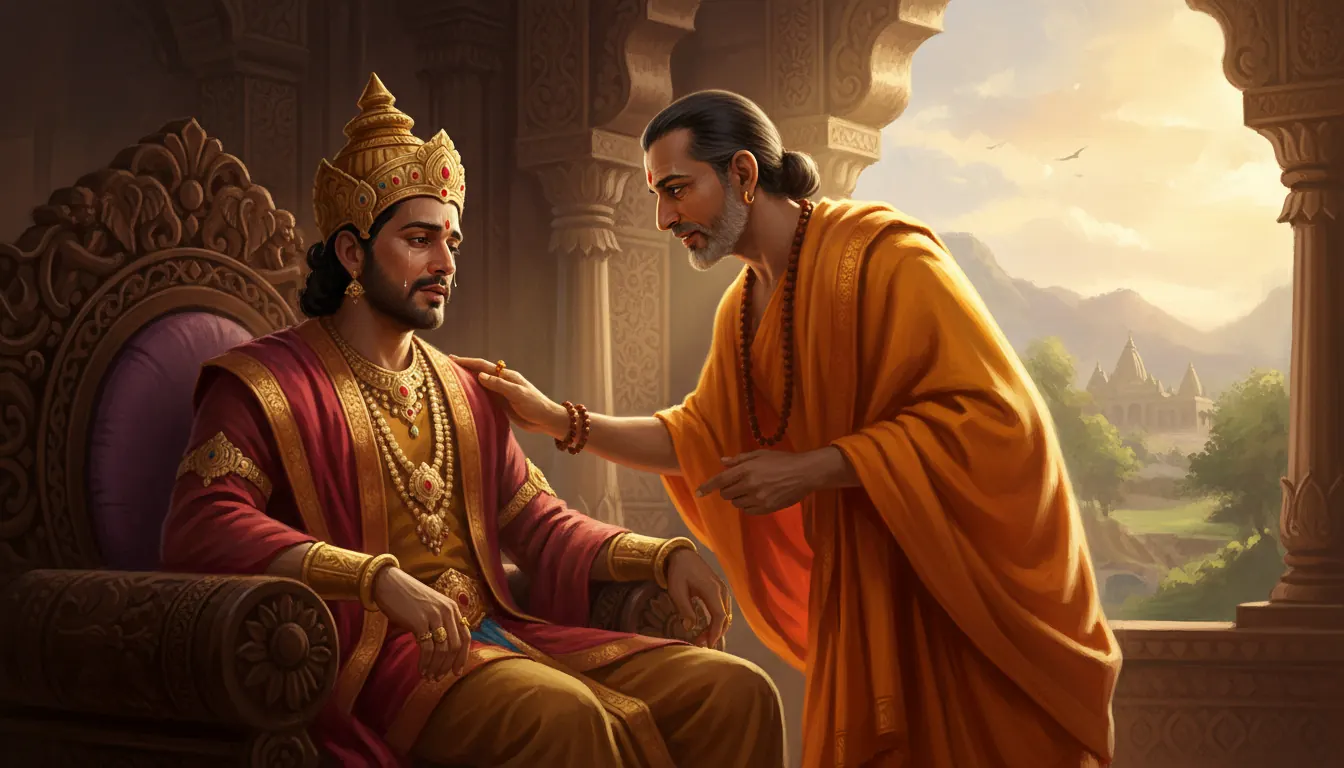
The Cheerful Ascetic
Narada asks Samanga why he is never sorry, and gets an answer about acts and their fruits
In short
Yudhishthira asks Bhishma how sorrow and death may be prevented from occurring at all. Bhishma answers with an old discourse between the rishi Narada and an ascetic named Samanga, who prostrated himself full length before his superiors and was always cheerful. Samanga explains that he knows how acts begin and how their fruits arrive, that the blind and the rich and the gods all live by the same law, and that grief and joy alike are things that stop. He does not claim that sorrow has left him, only that it no longer succeeds in afflicting him.
Told in the Shanti ParvaSet in Kurukshetra and Forest Hermitage16 min read
The Fear That Stands Behind Every Other
The war was over and the teaching was still going on. Bhishma lay where the arrows had put him, with the Pandavas sitting around the bed and Krishna beside them, and the questions came at him in the order a man asks them when he has been given a great teacher and a fixed number of days.
That morning Yudhishthira did not ask about kings or sacrifices or the nature of the soul. He asked about the thing underneath all of it.
"Living creatures always live in fear of sorrow and death," he said. "Tell me, grandfather, how the occurrence of these two may be prevented."
Read the question again, because the wording is exact and it is asking for something impossible. He does not ask how sorrow and death may be borne. He does not ask how a man may be consoled after they arrive. He asks how their occurrence may be prevented, which is to say he is asking his grandfather, who is lying on a bed of arrows in the process of dying, to tell him how dying and grieving may be stopped from happening at all.
Yudhishthira had reason to want that answer. He had come out of Kurukshetra as the king of a country whose men were dead, and the fear he is describing is not an abstraction he had read about. It is the thing that had been sitting on his chest since the eighteenth day.
Bhishma did not correct the question, and he did not answer it out of his own mouth either.
"On this, Bharata," he said, "people tell the old story of the conversation between Narada and Samanga."
That is the whole of the introduction. No setting is given, no occasion, no reason for the meeting. Two men are placed in front of Yudhishthira, one of whom he would have known all his life, since Narada came and went from every court in the world and had walked into his own hall at Indraprastha to audit him before the Rajasuya. The other is a stranger, and the epic tells us nothing about him anywhere else. He is simply an ascetic named Samanga, and he was cheerful.
A Man Who Bowed With His Whole Body
Narada speaks first, and what he says is not a question. It is a description of a man he has been watching, delivered to the man's face.
"You greet your superiors by throwing yourself down on the ground until your chest touches the earth."
Other men, Narada notes, salute their superiors by a bend of the head. That is the ordinary courtesy and nobody thinks less of a man for it. Samanga went down full length, every time, until his chest was in the dust. Narada had evidently seen him do it more than once, and had begun to find it remarkable rather than excessive.
"You seem to be crossing the river of life with your own two hands."
That is the image Narada reaches for, and it is worth holding still for a moment. A man who goes down flat and comes up and goes down flat again looks, if you watch him long enough, like a swimmer. The arms go out, the body follows, the arms go out again. Everyone in the story agrees that this world is a river that has to be got across. Most men look for a raft, or a ford, or a boat with somebody else rowing. Samanga was swimming, and he was doing it with the only two things he owned.
Then Narada names what he cannot account for.
"You seem always free from sorrow and very cheerful. I do not see that you have the least anxiety. You are always content and happy, and you seem to play in happiness like a child."
There is no rebuke anywhere in that. Narada is a celestial rishi who has seen every kind of ascetic there is, the ones burning with penance and the ones burning with pride in their penance, and he had never seen this. A grown man under vows, in a world made of loss, playing like a child.
He wanted to know how it was done, and he was honest enough to say so by simply describing what he saw and stopping.
The Truth About Past, Present and Future
Samanga answered him with a courtesy of his own, and then with two sentences that contain the whole of his position.
"Giver of honours, I know the truth about the Past, the Present, and the Future. That is why I am never cheerless."
This is not the claim it sounds like at first hearing. He is not saying that he can see next week. He says so himself in the very next breath, and the second sentence explains the first.
"I know too how acts begin in this world, how their fruits arrive, and how varied those fruits are. That is why I never give way to sorrow."
What he knows is the machinery. Acts begin somewhere. Fruits arrive afterwards, on a schedule not set by the man who is waiting for them, and they arrive in an enormous variety of forms, which is why nobody can look at a fruit and read backwards from it to the deed. That is what the three tenses mean in his mouth. The past is where acts were done. The present is where the fruits are being handed out. The future is where what is being done now will be paid.
A man who holds that steadily has been relieved of a particular kind of suffering, and it is the kind that does most of the damage. He is never obliged to ask why this has happened to me. He is never obliged to think that the world has singled him out, or that it has gone wrong, or that some accounting has been mislaid. Grief he may still feel. Bewilderment he cannot, because there is nothing in his life for which he lacks an explanation.
Yudhishthira, listening to this from a man on a bed of arrows, was a king who had spent thirteen years asking why this has happened to me and had received no answer he could use. Bhishma had set in front of him an ascetic who never asked the question at all.
Samanga was not finished. Having stated the principle, he turned to the evidence, and the evidence was everybody.
The Blind, the Idiots, and Ourselves Too
"Look, Narada: the illiterate, the destitute, the prosperous, the blind, idiots and madmen, and ourselves too, all live."
It is a strange list and it is meant to be. He does not gather up the fortunate on one side and the wretched on the other. He puts them all in one line and says the same two words about the whole line. All live. The man who cannot read and the man with money and the man who cannot see and the man who has lost his reason and the two ascetics standing there having this conversation, all of them are doing the one thing, which is going on.
Then he says why.
"They live by the power of their acts in past lives. The gods themselves, who are free of disease, are in that state by the power of their past acts. The strong and the weak, all of them, live by the power of past acts."
Notice that the gods are inside the list and not above it. Their freedom from disease is not a privilege of rank. It is a fruit, exactly like the blindness of the blind man, drawn from the same store and issued by the same rule. There is nothing in the whole range of visible fortune, from the madman in the road to the deities in heaven, that stands outside the accounting.
And then the line that turns the argument into something more uncomfortable than a doctrine.
"So it is fitting that you should hold us in esteem."
He says it to Narada, who had just praised him. It is not a request for compliments. Having placed himself in a list with idiots and madmen and shown that every member of it lives by the same law, he is pointing out that the esteem Narada feels for his cheerfulness is owed, if it is owed at all, to everyone in the line. The cheerful ascetic is not a special case. He is only somebody who has noticed what the ordinary case is.
Look, We Too Are Living
He said the same thing again, in the plainest form he could find for it, and this time he counted money.
"Those who own thousands live. Those who own hundreds live too. Those who are overwhelmed with sorrow live. Look, we too are living!"
Four clauses, and the same verb in every one. A man with a thousand, a man with a hundred, a man with nothing but grief, and two ascetics on a road. What separates them is enormous and what they are all doing is identical. Samanga is not saying that wealth is worthless or that sorrow does not hurt. He is saying that if you stand far enough back to see the whole field, the differences that consume everybody's attention do not change the one fact that every figure in the field has in common.
Then he draws the conclusion, and it is startling coming from an ascetic.
"When we, Narada, do not give way to grief, what can the practice of religious duties or the keeping of religious rites do for us?"
This is a man under vows asking what his vows are for. Religious observance, in the ordinary way, is a remedy. It is undertaken to buy something, or to ward something off, or to clean something that has been dirtied. Samanga is pointing out that a remedy is only meaningful to somebody with the disease. He is not resisting grief with his practices. Grief has stopped arriving in the form that practices are meant to treat, and a man in that condition has to be honest about what his observances are now doing for him, which is nothing.
And the reason grief has stopped arriving is the last thing he says in this part of the argument.
"And since no joy and no sorrow lasts for ever, they cannot disturb us at all."
Not because they are unreal. Because they stop. Everything that arrives will go, including the good, and a man who has genuinely taken that in has nothing left for either of them to get hold of.
The Root of Wisdom
Samanga then does something that the wisdom books do not always trouble to do. He names the single thing that wisdom consists of, and he does not hedge it.
"What men are called wise for, the very root of wisdom, is that the senses are free from error. It is the senses that give way to error and grief. A man whose senses are subject to error can never be said to have reached wisdom."
The senses are where the mistake is made. Not in the doctrines a man holds, not in the texts he has memorised, not in the vows he keeps. The eye reports that this is worth having, the tongue reports that this is worth keeping, and the man believes the report and builds his life on it, and every grief he suffers afterwards is the invoice for that belief.
Then he takes pride, which is the vice an ascetic is most in danger of, and refuses to treat it as a separate fault at all.
"The pride that a man subject to error indulges in is only one form of the error he is subject to."
Pride is not an additional sin laid on top of a mistake. It is the mistake, wearing a face. And of the man who lives in that condition Samanga says the coldest sentence in the discourse: "As for the man of error, he has neither this world nor the next." He does not merely lose the reward later. He does not have the thing he thinks he is holding now.
"It should be remembered that griefs do not last for ever and that happiness cannot be had always."
From that he draws his own manner of living, and states it without recommending it to anybody.
"Someone like me would never take up worldly life, with all its ups and downs and painful events. Such a man would not care for the things people enjoy, and would not think at all of the happiness owning them might bring, or of the griefs that come along. A man able to rest on his own self would never covet what others own; would not think about gains he has not made; would not be delighted at winning even enormous wealth; and would not give way to sorrow at losing it."
Resting on his own self. That is the whole equipment, and it is the only piece of it that cannot be taken away.
What Cannot Rescue a Man
Having said what he rests on, Samanga lists what will not hold. It is a short list and every item on it is something a man would ordinarily be proud of.
"Neither friends, nor wealth, nor high birth, nor scriptural learning, nor mantras, nor energy, can rescue a man from sorrow in the next world."
Six things, and the ascetic's own possessions are among them. Scriptural learning is on the list. Mantras are on the list. He is not merely telling a rich man that his money will not travel with him, which anybody can be got to admit; he is telling a learned man that his learning will not travel either, and Narada, who was the most learned being in that conversation, was standing there while he said it.
"Only by conduct can a man reach happiness there."
Conduct. Not what a man knows, not what he was born to, not what he can recite. What he has actually done, day after day, which is the only one of the six that is made out of him rather than attached to him.
Then he adds the discipline that makes such conduct possible, and again he states it as a plain limit rather than a promise.
"The Understanding of a man who does not know Yoga can never be turned toward Emancipation. A man who does not know Yoga can never be happy. Patience and the resolution to cast off sorrow: these two show that happiness is coming."
Patience and the resolution to cast off sorrow. Those are not feelings that come over a man. They are two decisions, and Samanga treats them as the first sign that happiness is on its way, not as its consequence.
And then, in four short steps, he explains why he keeps his distance from things that are perfectly pleasant.
"Anything agreeable leads to pleasure. Pleasure leads to pride. Pride, in turn, produces sorrow. That is why I avoid them all."
The chain begins with something nobody would think to guard against. It is agreeable. That is all. It becomes pleasure, and pleasure quietly becomes the sense of being a man to whom good things happen, and that sense is the thing that breaks when the good things stop. He is not avoiding sorrow. He is avoiding the first link of it, which arrives smiling.
Like One Who Has Drunk Nectar
What Samanga says last is the description of how he actually spends his days, and it is the only place in the discourse where he speaks about himself without generalising.
"Grief, Fear, Pride, the things that stupefy the heart, and Pleasure and Pain too, I watch as an unconcerned witness, since my body is alive and moves about."
He does not claim that these have stopped occurring in him. Grief comes. Fear comes. Pleasure and pain come, as long as the body is alive and walking about, and he expects them to keep coming for exactly that long. What has changed is where he is standing. He watches them arrive in him the way a man watches weather cross a field he is not obliged to be out in.
"I have cast off wealth and pleasure, and thirst and error, and I wander over the earth, free of grief and every kind of anxiety of heart."
Four things put down: wealth, pleasure, thirst, error. The first two are possessions and the second two are conditions, and it is the second pair that took the work.
"Like one who has drunk nectar, I have no fear, here or hereafter, of death, or wickedness, or greed, or anything of that kind."
That is the answer to Yudhishthira's question, arriving out of an old conversation and by a route the king had not expected. He had asked how sorrow and death might be prevented from occurring. Samanga does not prevent them. He has drunk something that makes their occurrence a matter of no consequence, and the man who has drunk amrita is not a man who has escaped death by hiding from it.
He is careful, at the very end, to say where it came from, and he does not pretend it was easy or cheap.
"I have won this knowledge, brahmana, as the fruit of my severe and unfailing penances. That is why, Narada, grief, even when it comes to me, cannot afflict me."
Even when it comes to me. He keeps the grief in the sentence.
Narada is given no reply. The old discourse simply stops there, with the cheerful man having explained himself and the celestial rishi having nothing to add, and Bhishma let it stop there too, in front of a king who had asked how to prevent sorrow and had been handed instead a man who had stopped being wrecked by it.
Dharma Lesson
Samanga is not cheerful because his life has been kind to him. He is cheerful because he has stopped expecting the world to explain itself, having understood that every condition he can see, his own included, is a fruit arriving on a schedule he did not set. The teaching does not promise that grief will stop coming. It says only that a man who has taken in that joys and sorrows both end has given grief nothing to hold on to, and that of everything a man might rely on, his friends, his money, his birth, his learning, only his conduct goes with him.