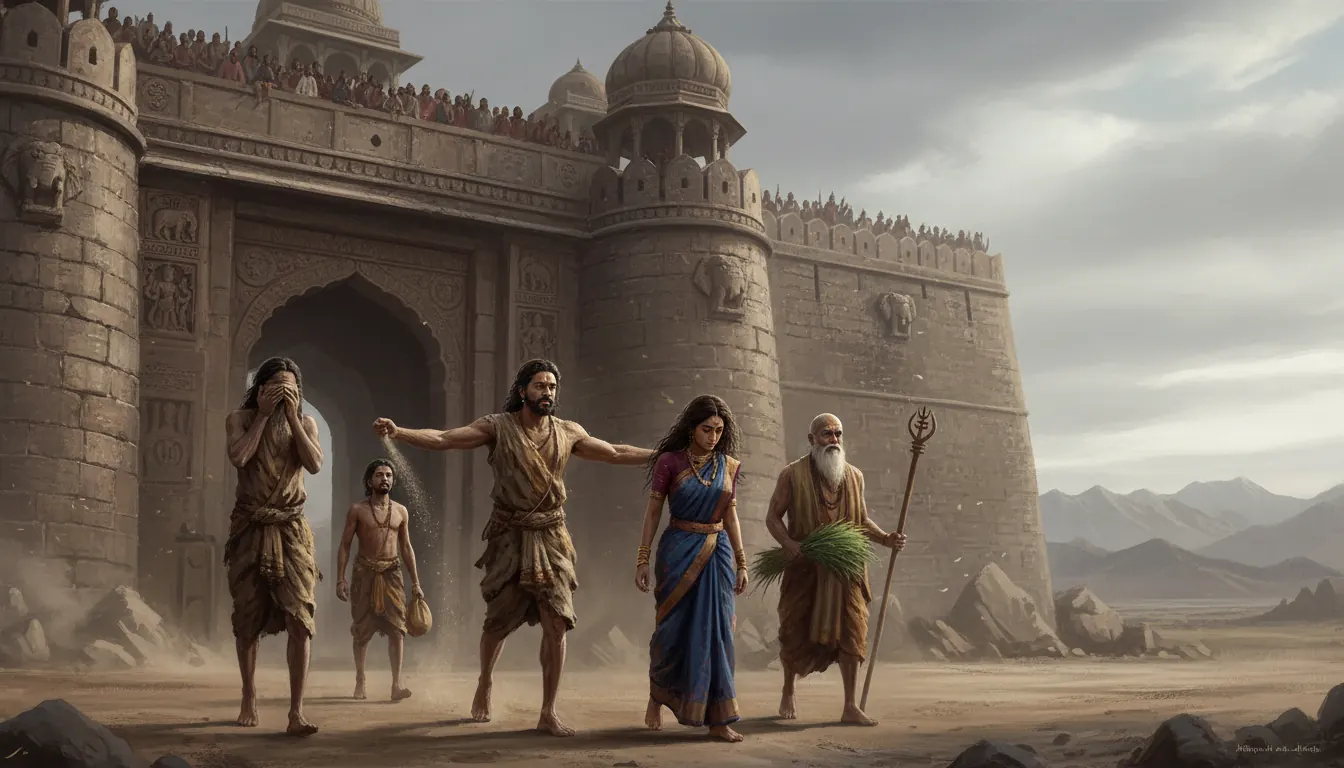
The Vows Sworn Before Exile
Four brothers name their killings on the way out of the dice hall
In short
Dressed in deer-skins and mocked by Dushasana as they leave the assembly, Bhima, Arjuna, Sahadeva and Nakula each swear aloud how and whom they will kill, and nobody in the hall answers them. Vidura asks to keep Kunti in his own house and sends Yudhishthira into the forest with a blessing shaped like an inventory of what he still owns. Kunti gives Draupadi one charge before she goes, and then breaks down in the road before her sons. Behind them, a celestial rishi appears in the assembly to name the year the Kurus will end.
Told in the Sabha ParvaSet in Hastinapura23 min read
Deer-Skins in the Hall
Vaishampayana was telling it to Janamejaya, and he had come to the part that everyone waits for and nobody enjoys.
Shakuni had cast the dice one last time and said, "Look, I have won," and the stake that time had not been cattle or gold or brothers. It had been twelve years in the woods and a thirteenth year lived unrecognised among men, and if they were recognised in that year, another twelve.
So the defeated sons of Pritha made ready for their exile in the woods. They did it in front of the whole assembly, because the assembly is where it had been lost. One after another, in due order, they took off their royal robes, and each of them put on the skin of a deer, which is the dress of a man who has no house and no fire and no claim on anything. Bhishma was there, and Drona, and Kripa, and every king who had come to see the Kurus play. Not one of them had stopped the game. Now they sat and watched five men change their clothes.
Dushasana could not keep still. He had been the one who dragged Draupadi into that hall by the hair a short while before, and nothing had happened to him for it, and a man who has done such a thing and gone unpunished acquires a certain confidence. He got to his feet while the Pandavas were still dressing.
"The absolute rule of the illustrious King Duryodhana has begun. We have plunged the sons of Pritha into everlasting hell. Let them take off their many-coloured mail and their shining robes of celestial make and dress in deer-skins, as the stake they accepted from the son of Subala requires. They always used to boast that they had no equal in all the world. Now, in this disaster, they will see themselves as sesame seeds with no kernel."
Then he turned to the woman standing at the edge of the hall in a single piece of cloth stained with blood, with her hair still hanging loose where his hand had left it.
"Yajnaseni, what joy will you have, seeing these husbands of yours in the woods, dressed in skins and threadbare rags? Choose a husband, whoever you like, from among all those here. These assembled Kurus are all patient and self-controlled, and very wealthy. Why go on serving the fallen sons of Pandu? It is wasted labour to press a sesame seed with no kernel."
He said all of it in the hearing of the Pandavas. That was the point of saying it.
The Lion and the Jackal
Bhima was not a forbearing man, and he had been forbearing all afternoon, which is a different thing and costs more.
He came at Dushasana the way a Himalayan lion comes at a jackal, and Vaishampayana uses exactly that comparison, and the hall saw a man in a deer-skin cross the floor with nothing in his hands.
"You wicked-minded villain," Bhima said, "do you rave like this, in words only the sinful use? Do you boast like this among kings, raised up as you are by the tricks of the king of Gandhara? Just as you pierce our hearts here with these arrows of words, so I will pierce your heart in battle, and remind you of all this as I do it. And those who walk behind you as your protectors, out of anger or greed, I will send them too to the house of Yama, with their children and their kin."
He did nothing else. He could not. He was bound by a stake his eldest brother had accepted, and to lay a hand on Dushasana in that hall would have been to break the terms in front of the men who had set them, and Bhima, who is usually described as the brother without patience, would not stray from the path of virtue.
Dushasana understood that perfectly. He threw off all shame and began to dance.
He danced around the assembled Kurus, in front of Bhishma and Drona and the kings, in front of Draupadi, and while he danced he called out one word at Bhima again and again.
"Cow! Cow!"
Bhima stood where he was and let him do it.
"Wretch," he said when the noise stopped. "Do you dare, Dushasana, to use words as harsh as these? Who has any right to boast after winning wealth by foul means? I tell you this: if Vrikodara, son of Pritha, does not tear open your chest in battle and drink your life-blood, may he never reach the blessed regions. I tell you truly that I will kill the sons of Dhritarashtra in battle, before the eyes of all the warriors, and soon enough I will quench this anger of mine."
Thirteen years later, on a field at Kurukshetra, men who had been in that hall would remember that he had named the place, the wound and the drink, and had left nothing out.
The King Who Walked Like Bhima
They began to leave, five men in deer-skins going down the length of a hall they had walked into as an emperor and his brothers. And Duryodhana, in his glee, got up and walked behind Bhima, copying with his own steps the easy, lion-like stride of the man in front of him.
It is a boy's trick, and Duryodhana was not a boy but a king who had just won the world, and he did it in front of the court with his father's counsellors watching.
Bhima half turned. "Do not think, you fool, that this gives you any advantage over me. I will soon kill you and all your followers, and answer you then, and remind you of all this."
Then he held down his rising rage, because Yudhishthira was still walking and Bhima's whole discipline that day consisted of following his brother's steps, and as he went out of the Kaurava court he made the vow aloud, in the assembly, so that it would be witnessed.
"I will kill Duryodhana, and Dhananjaya will kill Karna, and Sahadeva will kill Shakuni, that gambler with dice. And I repeat these proud words here in this assembly, and the gods will surely make them good. If ever we meet the Kurus in battle, I will strike down this wretched Duryodhana with my mace, and when he lies on the ground I will set my foot on his head. And as for this other wicked man, Dushasana, so bold in his speech, I will drink his blood like a lion."
He had assigned three deaths, and two of them were not his to assign, and neither of the men he named contradicted him.
Arjuna had not spoken since he put on the deer-skin. When he did speak it was to correct his brother's manner and not his purpose. "Bhima, the resolves of great men are not known by words alone. In the fourteenth year from today, they will see what happens."
Then Arjuna said it again himself, shorter, and this time he put a fourth name in it. "The earth will drink the blood of Duryodhana, and Karna, and wicked Shakuni, and Dushasana, the fourth."
The mace, the foot set on the head, the blood. Everything Bhima ever did afterwards that shocked the world was announced in that hall, in advance, in front of the elders who were letting it happen.
In the Fourteenth Year From Today
Arjuna went straight on and gave his own word, as a service to his brother rather than as a claim of his own.
"Bhima, as you direct, I will kill this Karna in battle, so spiteful and jealous, so harsh of speech and vain. To do what pleases Bhima, Arjuna vows that he will kill this Karna in battle with his arrows, along with all his followers. And I will send to Yama's realm all those other kings who are foolish enough to fight against me."
Then the three impossibilities.
"The mountains of Himavat might be moved from where they stand, the maker of the day might lose his brightness and the moon its coolness, but I will hold to this vow for ever."
He was a careful man even in fury, and he closed with the one condition that could still cancel everything.
"And all this will surely happen if, in the fourteenth year from now, Duryodhana does not give us back our kingdom with proper respect."
That clause hung in the air of the hall and was heard by Duryodhana and by Karna and by Bhishma and by the blind king's counsellors, and it stayed open for thirteen years and one year more. Krishna himself would come to Hastinapura at the end of that time to ask for it to be honoured, and would be refused, and everything Arjuna had just promised would then become obligatory.
The twins are the brothers the epic usually lets pass without a speech. Not here.
Sahadeva, the handsome son of Madri, a man of great energy, wanted Shakuni. He waved his mighty arms and hissed like a snake, and his eyes were red with anger, and he spoke past Duryodhana entirely to the man from Gandhara who had thrown the dice.
"You disgrace to the kings of Gandhara, the men you think you have beaten are not beaten at all. They are sharp-pointed arrows whose wounds you have already risked in battle. I will certainly do everything Bhima has said about you and all your followers. So if you have anything to do, do it before that day comes. I will surely kill you in battle soon enough, with all your followers, son of Subala, if you stand and fight as a kshatriya should."
That last clause is the sharpest thing in it. The Pandavas had not been beaten by arrows but by ivory cubes on a floor, and Sahadeva was telling the winner that the account was still open in the only currency a kshatriya recognises, and that he was not sure the winner would stand and settle it.
The Vow Nakula Made for Somebody Else
Then Nakula, the handsomest of men, who had been dressed in a deer-skin for less than an hour, made the fourth vow, and his was the only one made entirely on behalf of another person.
"I will certainly send to the house of Yama all those wicked sons of Dhritarashtra who, longing for death and driven by Fate, and wanting to please Duryodhana, spoke harsh and insulting words to this daughter of Yajnasena at the dice game. Soon enough, at Yudhishthira's command and remembering the wrongs done to Draupadi, I will rid the earth of the sons of Dhritarashtra."
Nothing in it is about Nakula. Bhima had named his own enemy, Arjuna had named his, Sahadeva had named the man who threw the dice. Nakula named a hundred men and gave one reason for all of them, which was what had been said in that hall to his brothers' wife while she stood in a single stained cloth with her hair down.
And even in that sentence he asked permission first. At Yudhishthira's command: the twin who intended to empty a dynasty put his eldest brother's authority in front of his own anger, and would in fact wait thirteen years for the order.
Four brothers had now pledged themselves. The fifth, the one who had staked them all and lost them all, said nothing whatever about killing anybody, and nobody in the hall seems to have expected him to.
Dushasana had been dancing a few moments before, calling out "Cow" at a man who had just described how he would open his chest. Duryodhana had been walking like a lion behind a man who had just described the mace and the foot on the head. Shakuni had heard his own death named twice, by two different brothers, with the manner and the condition attached. Karna had been named by Arjuna in front of every king on earth.
Not one of the four of them answered a word.
And those tigers among men, all long-armed, having pledged themselves to these righteous promises, turned away from the men they had promised and walked up to the throne where the blind king was sitting, to take their leave of him properly, because that is what the order of a departure requires.
What Vidura Asked to Keep
Yudhishthira took his leave of every man in that hall by name, and nobody answered him, and that silence belongs to another telling. What happened next was that one man in the room found something practical to say.
Vidura was the son of a serving woman, half-brother to the blind king and to Pandu, called Kshatta by the court, the counsellor who had told Dhritarashtra the truth at every stage of the game and been ignored at every stage. He did not offer sympathy. He asked for custody of an old woman.
"The revered Pritha is a princess by birth. It is not right for her to go into the woods. She is delicate and old and has always known comfort, and the blessed lady will live in my house, honoured by me. Know this, sons of Pandu. And may you always be safe."
Kunti was to stay in Hastinapura, in the house of the one Kuru who could be trusted with her, and the Pandavas agreed at once. "You are our uncle, and so you are like a father to us. Tell us whatever else remains to be done."
So he ordered the rest of it, and it turned out to be a blessing shaped like an inventory. A man defeated by sinful means, he said, need not be pained by that defeat. Then he went round the party and named what each of them was still worth. Yudhishthira knew every rule of morality. Dhananjaya was always victorious in battle. Bhimasena was the slayer of foes. Nakula was the gatherer of wealth. Sahadeva had a gift for administration. Dhaumya, their priest, was the foremost of all who knew the Vedas. The well-behaved Draupadi understood both virtue and the management of a household.
"You are devoted to one another and delight in the sight of one another, enemies cannot separate you, and you are content. So who would not envy you? This patient withdrawal from the possessions of the world will do you great good. No foe, even one equal to Shakra himself, will be able to stand against it."
That is the argument in one line. They had not been robbed of anything that made them dangerous.
Take These From the Elements
Then Vidura did the thing that shows what kind of man was talking. He reminded a king going into exile of every teacher he had ever had, in order, with the place of instruction attached to each: Meru Savarni on the mountains of Himavat, Krishna Dvaipayana in the town of Varanavata, Rama on the cliff of Bhrigu, Shambhu himself on the banks of the Drishadvati, the great rishi Asita on the hills of Anjana, and Bhrigu on the banks of the Kalmashi, whose disciple he had become.
"Narada and Dhaumya, your priest here, will now be your teachers. For the sake of the next world, son of Pandu, do not abandon the excellent lessons you have had from the rishis. You surpass even Pururavas, son of Ila, in intelligence; all other kings in strength; and even the rishis in virtue."
A man walking into twelve years of forest was being handed his own history, because Vidura knew that what a man is likeliest to lose in the woods is not his kingdom but his sense of who he was before he lost it.
And then the last part, which reads like a list of provisions.
"So set your heart firmly on winning victory, which belongs to Indra; on mastering your anger, which belongs to Yama; on giving in charity, which belongs to Kubera; and on mastering all your passions, which belongs to Varuna. Take from the moon the power to gladden, from water the power to sustain all things, from the earth forbearance, from the whole disc of the sun energy, from the winds strength, and from the other elements abundance."
He was sending a man out with nothing, and so he told him where the rest of it was kept. Ten things, and every one of them available in a forest to a man who has just been stripped of a treasury.
"May you be well and free from illness. I hope to see you return. And Yudhishthira, act rightly and properly at all times, in distress, in difficulty, in everything. Go now, son of Kunti, with our leave. Blessings on you. No one can say that you have ever done anything sinful."
When he had finished, Yudhishthira the son of Pandu, whose prowess could never be checked, said, "So be it." He bowed low to Bhishma and Drona, and went away.
Keep an Eye on Sahadeva
Inside the women's apartments, Draupadi was taking her leave. She went first to Pritha, who is Kunti, and asked her permission to go, and then asked leave of the other ladies of the household, all of whom were sunk in grief. And a loud wail of sorrow rose up in the inner apartments of the Pandavas.
Kunti was terribly distressed at the sight of her, and what she said came out in a voice choked with grief, and it is not what anyone would expect a mother-in-law to say at such a moment.
"Child, do not grieve that this great disaster has come upon you. You know the duties of women well, and your behaviour and conduct are just as they should be. It is not for me, you of the sweet smiles, to teach you your duties towards your husbands."
She refused, in other words, to give the standard speech. Then she said the sentence the Kurus should have written on their walls.
"You are chaste and accomplished, and your qualities have adorned both the family you were born into and the family you married into. The Kauravas are lucky that they have not been burnt up by your anger."
That is Kunti's verdict on the day. Not that Draupadi had been wronged, which everyone knew, but that Draupadi had been wronged and had not yet destroyed them, and that this was luck, and that the luck would not hold.
"Child, go safely, blessed by my prayers. Good women never let their hearts be stung by what cannot be avoided. Protected by virtue, which is greater than everything, you will soon find good fortune."
And then, at the end, the real charge. Kunti had five sons walking into a forest and she asked for one of them.
"While you live in the woods, keep an eye on my child Sahadeva. See that his heart does not sink under this great disaster."
Sahadeva was the youngest, and he was not her own son but Madri's, and Madri was dead, and Kunti had raised him. Of all the men going out that gate, the four with vows in their mouths and the one with his face covered, the mother worried about the quiet one.
"So be it," said Draupadi.
Then the princess of Panchala, bathed in tears, dressed in one piece of cloth stained with blood, her hair dishevelled, left her mother-in-law and walked out weeping. And Pritha, in grief, followed her.
Shame on My Wish to Live
She had not gone far when she saw her sons.
They were stripped of their ornaments and their robes, their bodies dressed in deer-skins, their heads down with shame, and they were surrounded by gloating foes and pitied by friends. Kunti embraced them all, and in a voice choked with sorrow she made one of the longest speeches she is given anywhere in the epic.
"You are virtuous and well-mannered, and graced with every fine quality. You are all high-minded, devoted to serving your elders and to the gods. Why, then, has this disaster come upon you? I cannot see whose wickedness has brought this sin upon you. Alas, I gave birth to you. All this must be due to my ill fortune."
She went back over her own choices and found the one she thought had done it.
"If I had known that you were fated to live in the woods, I would not have come from the mountains of Shatashringa to Hastinapura when Pandu died. Your father was fortunate, for he truly reaped the fruit of his asceticism, and he wished to rise to heaven without ever having to feel any pain over his sons. Fortunate too was the virtuous Madri, who knew beforehand what would happen. Oh, shame on my wish to live, which has brought me all this sorrow."
Then she called on the one person she could think of who was not in that city.
"Krishna, you who live in Dwaraka, where are you? Why do you not rescue me, and these best of men too, from such sorrow? They say that you, who are without beginning and without end, rescue those who think of you. Why is that saying proving untrue?"
And then the elders, by name, because they were standing within earshot.
"Alas, when our family has elders like Bhishma and Drona and Kripa, all of them versed in morality, how could such a disaster come about at all? Pandu, my king, where are you? Why do you quietly let your good children be sent into exile like this, defeated at dice?"
Last of all she asked for the boy.
"Sahadeva, do not go. You are my dearest child, son of Madri, dearer to me than my own body. Do not leave me. Let these brothers of yours go, bound by the ties of virtue. But you, earn the virtue that comes from looking after me."
He went with his brothers. They comforted their weeping mother, and with hearts sunk in grief they set out for the woods. And Vidura, himself deeply distressed, comforted the grieving Kunti with reasoned words, and led her slowly to his house.
The Rishi Who Came Down Into the Hall
In the city the women wept and condemned the Kurus. Dhritarashtra sent for Vidura and asked how the Pandavas had left the city, and Vidura read their departure back to him sign by sign. That reading belongs to its own telling. What concerns this one is what happened in the hall while they talked.
The best of the celestial rishis appeared in that assembly. He stood in front of the men who had won the game and spoke these terrible words.
"In the fourteenth year from now, because of Duryodhana's fault, the Kauravas will all be destroyed by the might of Bhima and Arjuna."
And having said this, that rishi, radiant with surpassing Vedic grace, passed through the sky and disappeared.
Bhima had said the same thing an hour earlier and had been danced at. Now the sky had said it, and the room believed it.
Duryodhana and Karna and Shakuni turned to the one man they thought could stand between them and that sentence, and offered the kingdom to Drona. Drona took the duty and refused the comfort.
"The sons of Dhritarashtra have sought my protection, and I will look after them as well as I can. Destiny is supreme. I cannot abandon them. But the sons of Pandu are going into exile to keep their promise, and after living the life of brahmacharya they will come back in anger and, to our great grief, take the fullest vengeance on their foes."
Then he spoke about his own death, in public, to his own students. He had once deprived Drupada of his kingdom, and Drupada had gone home and performed a sacrifice for a son who would kill him, and out of that fire had risen Dhrishtadyumna, and with him his sister Krishna, who is Draupadi.
"I am a mortal being. It is known all over the world that he was born to kill me. What grief could be greater for me than this? For your sake, Duryodhana, that terrible season of destruction has almost come. Do not think that everything has been settled by sending the Pandavas into exile. This happiness of yours will last only a moment, like the shadow of a palm tree's crown in winter, which rests at its foot for only a short while. In the fourteenth year from now, a great disaster will overwhelm you."
Dhritarashtra heard him out, and said the words that had been available to him all day.
"Kshatta, the teacher has spoken the truth. Go and bring back the Pandavas. If they will not come back, let them go with respect and affection."
They were already on the road, and they did not come back.
Dharma Lesson
A vow made in public is a debt the world collects. The four brothers say exactly what they will do, and thirteen years later they do all of it, down to the mace, the foot on the head and the blood, so that the war is less a decision than a payment falling due. Vidura's answer to the same hour is the harder one: he does not curse anybody, he takes an old woman into his house and reminds a ruined king of the teachers he studied under and the qualities his brothers still have. Both responses are faithful, and only one of them leaves the man who makes it free.