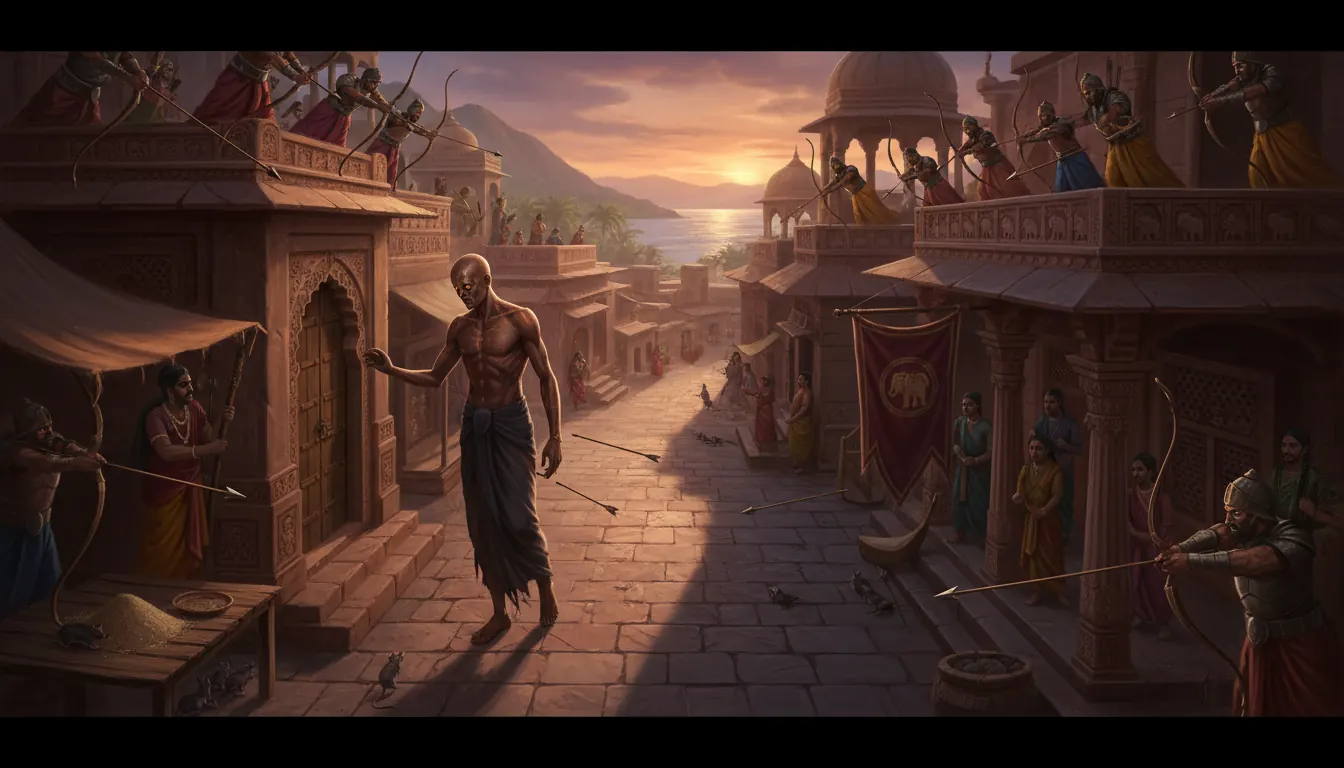
Uddhava Takes His Leave
The one Yadava who left Prabhasa before the grass turned to iron
In short
Warned by dreams and by the flight of Krishna's own discus and chariot, the Vrishnis and Andhakas set out for the sea-shore at Prabhasa with wine and meat packed for a pilgrimage. Uddhava, wisest of men and versed in Yoga, comes to the camp only to take his leave, and Krishna, knowing what is coming, salutes him with joined hands and lets him go out of the world. What follows on that shore is a drinking party, an old quarrel about men killed in their sleep, and a handful of Eraka grass that turns to iron in Krishna's hand.
Told in the Mausala ParvaSet in Prabhasa and Dwaraka12 min read
The Dreams That Came Before
Vaishampayana was telling Janamejaya how the people of Krishna came to their end, and he began not with the killing but with the sleeping.
At that time the Vrishni ladies dreamed every night the same dream. A woman of black complexion and white teeth entered their abodes, laughed aloud, and ran through Dwaraka snatching from their wrists the auspicious threads that a married woman wears while her husband lives. The men dreamt otherwise. They dreamt that terrible vultures came into their houses and into their fire-chambers, where the household fire is kept, and gorged themselves upon their bodies. Their ornaments and their umbrellas and their standards and their armour were seen to be carried away by terrible rakshasas.
Then the waking things began, and they were worse, because there was nobody to be woken from them.
In full sight of the Vrishnis, Krishna's discus, which Agni had given him, made of iron with its hub of the hardest adamant, rose of itself into the sky and went away. Daruka was Krishna's charioteer, the man who had held those reins for a lifetime, and before Daruka's very eyes the splendid chariot of Vasudeva's son, bright as the sun and fully equipped, was carried off by the horses yoked to it. Saivya, Sugriva, Meghapushpa and Valahaka, those four finest of horses, swift as thought, fled away dragging the chariot after them over the surface of the ocean, and the man whose work it was to drive them stood and watched them go.
The two great standards went last. The standard of Krishna's chariot with the device of Garuda, and the standard of Balarama's chariot bearing the device of the palmyra, both of them reverently worshipped by those two heroes, were carried off by apsaras.
And the apsaras, day and night, called upon the Vrishnis and the Andhakas to set out on a pilgrimage to some sacred water.
The Provisions They Packed
Krishna had already read the calendar. He had seen that the day of the new moon had fallen upon the thirteenth and the fourteenth lunation together, exactly as it had fallen before the great battle of the Bharatas, and he had understood that the thirty-sixth year had come and that what Gandhari had said in her grief was about to happen. It was he who had commanded the Vrishnis to go and bathe in the sacred waters of the ocean. The messengers had gone through Dwaraka proclaiming it.
So when these omens were seen and heard, those leading men, the mighty chariot-warriors of the Vrishnis and the Andhakas, decided to set out, with their whole families, on a pilgrimage to some sacred water.
And here the account pauses over what they took with them, and the pause is the whole of the story that follows.
They prepared many kinds of dishes and food. They prepared many kinds of wines. They prepared meat.
A pilgrimage to a tirtha is a penitential thing. Men go to such a place fasting, or on plain food, to wash off what they have done. These men packed a feast and a cellar. Nobody stopped them, and nobody appears to have thought it strange, and the wine went into the carts along with the umbrellas and the ornaments that they had all dreamed of losing.
Then the troops of the Vrishnis and the Andhakas, blazing with beauty and full of fierce energy, set out from the city in chariots and on horses and elephants.
They went with their wives. They came to Prabhasa, where the land runs out into the western sea, and they settled there, each in the temporary lodging that was assigned to him, and every one of them had plenty of food and drink.
The assignments were made in order, as they would have been made for an army in camp. Then they waited on that shore for whatever a pilgrimage was supposed to bring them.
Uddhava Takes His Leave
One man had not travelled with them.
Uddhava was a Yadava himself, of Krishna's own kindred, and he is described in two clauses that are all the introduction he gets and all he needs. He was the wisest of men. He was, besides, well-versed in Yoga.
He was not at Prabhasa when the camp was pitched. He heard that they had settled on the sea-coast, and hearing it, he understood what the camp was for. Then he went there, and he came to Krishna, and he took his leave.
Not leave to go home. Leave for departing, which in the case of a man well-versed in Yoga means one thing only, and everyone standing there knew which thing it meant. He had come to the shore to say goodbye and then to go out of the world by the door that his discipline had given him the key to, before the door that was coming for everyone else was opened.
And Krishna, with joined hands, saluted Uddhava.
That is the gesture of a man greeting a superior, or of a suppliant, or of one who honours. It was made by Krishna, at Prabhasa, to a kinsman who was walking out on the family in its last hour, and it was made with both palms together.
Seeing him set on leaving the world, and knowing that the destruction of the Vrishnis was at hand, Krishna had no wish to prevent him.
He could have prevented him. He had prevented larger things than one man's yoga. He looked at Uddhava, and he knew what was standing behind Uddhava on that beach, and he let him go.
Then the mighty chariot-warriors among the Vrishnis and the Andhakas, whose hour had come, saw Uddhava set out on his great journey, filling the whole sky with his splendour.
They watched him go up. They were all there on the sand with their wine and their meat and their wives, the whole strength of the Vrishnis and the Andhakas, and they saw the sky fill with the light of one of their own leaving it, and not one of them asked what he had seen that they had not.
The Food Given to the Monkeys
The first thing they did after Uddhava went up was to insult the brahmanas.
Food had been cooked for great-souled brahmanas, as it is cooked at any tirtha, and it was the one part of the provisioning that had been done rightly. The Vrishnis mixed wine into that food. Then they gave it away to monkeys and apes.
There were brahmanas who had cursed them already. That curse was the whole reason the thirty-sixth year had teeth in it. And on the shore at Prabhasa, with the pilgrimage barely begun, the Yadavas took the food meant for brahmanas, spoiled it in a way that made it unfit for any twice-born man to touch, and set it down in front of the animals.
Those heroes of fierce energy then began their high revels, of which drinking formed the chief feature.
The entire field echoed with the blare of hundreds of trumpets. It abounded with actors and dancers plying their vocations. It was, for one afternoon, exactly the kind of gathering the Yadavas had been famous for in the good years, a shore full of music and hired performers and a great many cups.
In the very sight of Krishna, Rama began to drink.
Balarama, whom the text calls Rama here, the elder brother, the man with the plough and the mace, sat down to it with Kritavarma and Yuyudhana and Gada beside him, and Vabhru also did the same, and Krishna sat where he could see all of them.
Kritavarma of the Bhojas and Yuyudhana, who is Satyaki, grandson of Shini, had spent the war on opposite sides. Kritavarma had ridden with Duryodhana. Satyaki had ridden with the Pandavas. They had come home to the same city afterwards and had lived in it for thirty-six years without settling anything.
Then Yuyudhana, inebriated with wine, laughed at Kritavarma across that assembly.
"What kshatriya is there," he said, "who, armed with weapons, will kill men locked in the embrace of sleep and so already dead? That is why, son of Hridika, the Yadavas will never tolerate what you have done."
And Pradyumna, that greatest of chariot-warriors, Krishna's own son, applauded the words, and made his contempt for the son of Hridika plain to the whole company.
The Sword in the Sight of Krishna
Kritavarma did not answer with his voice first. He pointed at Satyaki with his left hand, which is the hand a man uses when he wishes the gesture itself to be an insult, and then he spoke.
"You call yourself a hero. How could you so cruelly kill the one-armed Bhurishravas, who sat in praya on the field of battle?"
The charge was true, and everyone on that shore had heard it before. Bhurishravas had put down his weapons and seated himself in praya, the fast unto death, with his arm already cut off, and Satyaki had killed him where he sat. Kritavarma's own crime was true as well. He had stood at the gate of the sleeping camp with Kripa on the last night while Ashwatthama went in, and had let nobody out alive.
Hearing these words, Keshava, that slayer of enemy heroes, gave way to anger and cast an angry glance at Kritavarma.
Then Satyaki, who saw the glance, put fuel under it. He told Krishna how Kritavarma had behaved towards Satrajit in the matter of the celebrated gem Syamantaka, and Satrajit was Satyabhama's father, and Satyabhama was sitting within hearing.
Hearing the narrative, Satyabhama gave way to wrath and tears. She came to Keshava and sat upon his lap, and by sitting there she enhanced his anger against Kritavarma, and the last restraint on that shore was gone.
Then Satyaki rose up in a rage.
"I swear to you by Truth," he said, "that I will soon make this man follow the five sons of Draupadi, and Dhrishtadyumna and Shikhandi, whom this sinful wretch killed while they were asleep, with the help of Drona's son. Slender-waisted one, Kritavarma's span of life and his fame have come to their end."
With these words, Satyaki rushed at Kritavarma and cut off his head with a sword in full sight of Keshava.
He did not stop. Yuyudhana, having done this, began to strike down others who were there, and Hrishikesha ran to stop him from doing more harm.
But the Bhojas and the Andhakas, impelled by the perverseness of the hour that had come upon them, all became as one man and surrounded the son of Shini.
Every Blade of Grass
Janardana of mighty energy knew the character of the hour. He stood unmoved, without giving way to anger, at the sight of those heroes rushing in wrath at Satyaki from every side.
Urged by fate and inebriated with drink, they began to strike Yuyudhana with the pots from which they had been eating. Pradyumna, seeing it, became highly enraged and rushed forward to rescue him. Those two exerted themselves with great courage, being men of might and of energy both, but the odds were overwhelming, and both of them were slain in the very sight of Krishna.
The delight of the Yadus, seeing his own son killed, and the son of Shini too, angrily took up a handful of the Eraka grass that grew there.
That handful of grass became a terrible bolt of iron with the power of the thunderbolt, and with it Krishna killed everyone who came before him.
Then the thing spread. The Andhakas and the Bhojas, the Saineyas and the Vrishnis, urged by Time, struck one another in that fearful melee, and whoever among them took up in wrath a few blades of the Eraka grass found them converted in his hands into a thunderbolt. Every blade of grass upon that shore was seen to become a terrible iron bolt. A man hurled a blade of grass and it pierced through even such things as were utterly impenetrable. All this, it must be understood, was due to the curse pronounced by brahmanas, and the grass had been growing there under their feet all afternoon while they drank.
Son killed father, and father killed son. Drunk with wine, they rushed at one another and fell on one another. The Kukuras and the Andhakas were destroyed like insects rushing at a blazing fire, and as they were being slaughtered not one of them thought of escaping by flight.
Knowing that the hour of destruction had come, the mighty-armed Keshava stood there, watching everything, holding a bolt of iron made from a blade of grass.
Then he saw that Samba was slain, and Charudeshna, and Pradyumna, and Aniruddha, his sons and his grandson. He saw Gada lying dead upon the ground. And Madhava, filled with rage, the wielder of the Sarnga and the discus and the mace, exterminated the Vrishnis and the Andhakas himself.
When it was over, Vabhru of mighty energy and Daruka the charioteer came to him and said what nobody else was left to say.
"Holy one, you have killed a very great number of men. Turn now to where Rama has gone. We want to go where he has gone."
Dharma Lesson
Uddhava sees exactly what every other Vrishni on that shore could have seen, and he is the only one who acts on it. The omens were public property; the dreams were shared; the discus went up into the sky in the sight of them all. What separated him was not information but the willingness to walk away from a feast before it began and settle his account. Krishna's joined hands are the epic's verdict on that choice, and they are offered to a man who is walking away rather than to any of the heroes who stayed to drink.