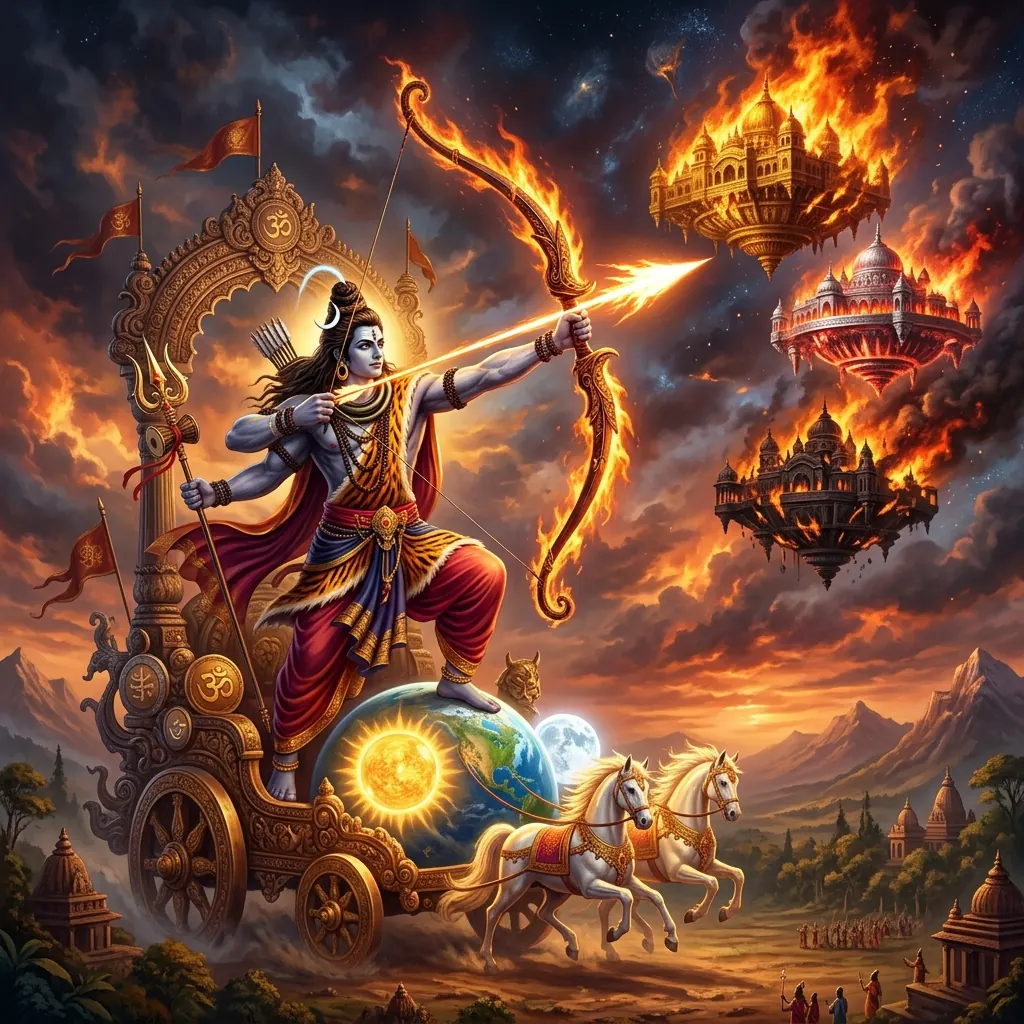
Upamanyu's Penance
The boy who refused every god but Shiva, and the god who came disguised as Indra to hear him do it
In short
Krishna, asked at Kurukshetra to recite the names of Mahadeva, tells first how he came to see that god. Flying to Himavat for a son, he found the hermitage of Upamanyu, who had been refused milk as a child and had answered it with ages of penance. When Shakra came with the thunderbolt and offered him any boon he wished, the boy refused heaven, the sovereignty of the three worlds and even Emancipation, and asked for nothing but to be Hara's slave. The rider on the white elephant was Mahadeva himself, come to find out.
Told in the Anushasana ParvaSet in Himavat, Kurukshetra and Forest Hermitage23 min read
The Names Yudhishthira Asked For
Yudhishthira had spent the morning on smaller questions, on the three sins of the body and the four of speech and the three of the mind, and when the grandsire had finished with those the king asked for something larger.
"Son of the River Ganga," he said, "tell us all the names given to Him who is called Isha and Shambhu, Him whose form is the universe, the illustrious teacher of the gods and the Asuras, the self-created one, the cause of the birth and the dissolution of the universe. Tell us also of the power of Mahadeva."
Bhishma had answered every question put to him since he fell, on kings and gifts and fasting and the feeding of the fathers, and this was the first one he refused.
"I am not able to recite the virtues of Mahadeva," he said. "He pervades all things and yet is not seen anywhere. All the gods, from Brahma down to the Pishachas, worship him. Man is subject to conception in the womb, to birth, to old age and to death. Being what he is, what man like me could understand Bhava? Only Narayana, who bears the discus and the mace, can comprehend Mahadeva."
Then the old man turned his head on the arrows and looked at the dark man standing among the listeners, and Vaishampayana, telling this afterwards, says that Bhishma addressed Vasudeva directly.
"You are Vishnu, because you pervade the whole universe. Long ago the rishi Tandin, sprung from Brahma, recited the thousand names of Mahadeva in Brahma's own region, before Brahma himself. Recite those names before this gathering, so that these rishis, who keep high vows, may hear you."
Krishna began by refusing as well, which is the proper way to begin.
"Even the gods with Indra at their head, and Brahma the Grandsire, cannot understand the course of Mahadeva's acts. Even the Adityas, with their subtle sight, cannot see where he dwells. How then can a mere man succeed in understanding Him? So I will recite only some of his attributes."
He touched water to purify himself. Then, instead of starting on the names, he said that he would first tell them how he had come by his own sight of that god, and for whose sake, and how difficult a thing it had been to obtain.
The Retreat on the Breast of Himavat
Twelve years after Pradyumna had slain the Asura Shambara, Krishna said, his wife Jambavati came to him wanting a son.
She was the daughter of the prince of apes, and she had been watching Rukmini's boys grow up around her, Charudeshna and Sucharu and Charusravas, and she asked for one like them. "There is nothing in the three worlds you cannot attain," she said. He told her the truth, which was that he had won Rukmini's sons by keeping a vow for twelve years and worshipping the Lord of all creatures, and that he would have to leave her to do it again. She gave him her permission and a blessing that took in Brahma and Shiva and Kashyapa, the rivers, the oceans, the seasons and the year down to its Kshanas and Nimeshas.
He took leave of his father and mother, of the king, and of Gada and Rama, who told him cheerfully to let his penances grow without hindrance. Then he thought of Garuda, and Garuda came, and carried him to Himavat and was dismissed there.
What he found on that mountain was a hermitage, and he describes it the way a man describes a place he was not expecting. It was planted with Dhavas and Kadambas and Ketakas, with banians and Bilwas and Salas and palmyras, with Punnagas and Asokas and Champakas, all bearing fruit and flower at once. Heaps of ash from the sacrificial fires lay in their proper places. Deer and peacocks and apes moved through it, and tigers and bears, and the Ganga ran clear through the middle of it. And the mongoose played there with the snake and the tiger with the deer, like friends, having forgotten their natural enmity in the presence of ascetics whose penances blazed.
The ascetics were the strangest sight in it. Some lived on air and some on water, some on smoke and some on fire and some on milk. Some had taken the vow of eating like cows, giving up the use of their hands altogether. Some husked their grain with two stones and some with their teeth only. Some drank the rays of the moon and some drank froth.
In the middle of them Krishna saw a rishi with matted locks, dressed in rags, blazing like fire, and young in the face.
"Welcome, lotus-eyed one," the rishi said. "Today, by this visit of yours, we see that our penances have borne fruit. You are worthy of our worship, and yet you worship us. You are worth seeing, and yet you want to see me."
His name was Upamanyu, and he was a descendant of Vyaghrapada.
What His Mother Told Him About Bhava
"You will have a son like yourself," Upamanyu told him. "Take up severe penances and win the favour of Ishana, the Lord of all creatures. That divine Master plays here with his wife beside him, and it was here, long ago, that the gods and the rishis pleased him and saw many high desires fulfilled."
Krishna asked him how he knew, and Upamanyu went back to the beginning.
In the Krita age there was a rishi named Vyaghrapada, famous for his mastery of the Vedas, and Upamanyu was born his son, with Dhaumya for a younger brother. His childhood comes down to one incident. He had tasted milk once, from a celestial cow at a sacrifice; and afterwards, at home, he asked for food made with milk, and there was none, and his mother boiled a cake of rice in water until the water went white and called it milk. He knew at the first mouthful that it was not. She wept and told him why: that milk and every other thing worth enjoying come from Sthanu, the giver of boons, and from nowhere else.
So the boy asked the questions that turned the rest of his life.
"Mother, who is this Mahadeva? How can one please him? Where does that god live? What does Sarva look like? If he is pleased, will he show himself to me?"
She smelt his head, her eyes full of tears, and answered at length, and it is her answer that he repeated to Krishna word for word after all those years.
Mahadeva, she said, is very hard to know for those whose souls are not cleansed. Wise men say that his forms are many, and many are the places where he lives. He takes the forms of Brahma and Vishnu and the chief of the gods, of the Rudras and the Adityas. He takes the forms of men and women, of Pretas and Pishachas, of Kiratas and Savaras, of every creature that lives in water or in a hole. He is the tiger and the deer, the owl and the jackal, cows and elephants and horses. He is sometimes six-faced, sometimes three-eyed, sometimes has a million legs.
"He has snakes for his belt," she said, "and snakes for the sacred thread he wears, and an elephant skin for his upper garment. He laughs and sings and dances most beautifully. He wanders over cremation grounds. He is entirely naked, for the horizon is his clothing. He lives in the hearts of all creatures, and knows the desire of every one of his worshippers. Devote yourself to him, son, and take him as your refuge."
One Thousand Years on His Toes
From that day, Upamanyu said, his devotion was turned to Mahadeva and to nothing else.
The penance he then undertook is set down as a bare accounting, and it is better read slowly than quickly. For one thousand years of the gods he stood on the tips of his toes. After that he spent a hundred years living only on fruit. The next hundred years he lived on the fallen leaves of trees. The next hundred he lived on water only. After that he spent seven hundred years living on air alone.
And at the end of it the god was pleased with him. But before he would show himself, he wanted to know whether the boy who had been refused milk was devoted to him alone, or merely devoted.
So he came in the shape of another god.
What Upamanyu saw coming towards him through the air was Shakra, the chief of the gods, with a thousand eyes upon his body and the thunderbolt in his hand. He rode an elephant of the purest white, with red eyes and folded ears and the rut-fluid trickling down its cheeks, its trunk curled, terrible to look at, and with four tusks. A white umbrella was held above the rider's head. He wore a beautiful crown, garlands round his neck, bracelets round his arms. Apsaras waited upon him and Gandharvas sang his praise, and all the gods came behind him, so that the sky over that one starved ascetic was as full as the sky ever gets.
Then the visitor spoke, and what he said was the thing every man who has ever undertaken a penance is waiting to hear.
"Best of the twice-born, I am pleased with you. Ask me for whatever boon you desire."
All those ages of standing and starving had just been declared successful by the king of heaven in front of witnesses, with the whole apparatus of reward assembled and hovering, and the boon left open and unnamed so that the man could have anything at all.
"When I heard these words of Shakra," Upamanyu said, "I was not glad."
I Would Rather Be a Worm
He answered the chief of the gods, and he did not soften it.
"I do not want any boon from you, or from any other god. Gentle god, I tell you truly, it is only from Mahadeva that I have boons to ask. It is true, true, Shakra, these words I say to you are true. No words please me at all except those that concern Maheshvara."
Then he began to name the things he would rather have, and the list is not a list of renunciations. It is a list of humiliations chosen deliberately over honours.
"At Pashupati's command I am ready to become a worm, or a tree with many branches. Unless it came through the grace that Mahadeva's boons stand for, even sovereignty over the three worlds would mean nothing to me. Let me be born among the Chandalas, so long as I am still devoted to the feet of Hara. Without devotion to that Lord of all creatures, I would not want to be born in the palace of Indra himself. At Hara's word I would become even a dog. In fact, that would be my highest wish."
He was saying this to Indra, in Indra's palace's own hearing, on the subject of Indra's palace.
"I do not want this dominion of the heavens. I do not want sovereignty over the gods. I do not want the region of Brahma. I do not even want that ending of individual existence which is called Emancipation, the complete merging with Brahma. What I want is to become the slave of Hara."
That is the sentence that goes furthest. Men who refuse heaven are common enough in these histories; a man who refuses Emancipation is refusing the last thing there is to want. He was declining the exit and asking to stay in, on condition of belonging to one master.
"Until that Lord of all creatures, with the crown on his head and his body as pure white as the disc of the moon, is pleased with me, I will cheerfully bear all the afflictions that fall to embodied beings, a hundred rounds of old age and death and birth. And if my faults bring me rebirths, in those new births too I will devote myself to Bhava alone."
The god on the white elephant heard him out and then asked the one question that had not yet been asked.
What Reason Can You Give
"What reason can you give," Indra said, "for the existence of a Supreme Being, or for His being the cause of all causes?"
It is a fair question, and it is asked in the manner of a man who expects a boy raised in a forest to be unable to answer it. What Upamanyu gave back was an argument, not a hymn.
"I ask boons of Him whom those who speak of Brahma have described as existent and non-existent, manifest and unmanifest, eternal, one and many. I ask boons of Him who has no beginning, middle or end. I ask boons of Him who, though he himself springs from no seed, is the seed of everything in the universe."
Then he came down out of the abstractions and began asking questions back.
"The wise say that Brahma the Grandsire is the creator of this universe. But Brahma gained his great power by worshipping and pleasing Mahadeva. Who but that Supreme Lord could be the creator of Fire, Water, Wind, Earth, Space, Mind and what is called Mahat? Who else could create Understanding, Consciousness, the Tanmatras and the senses? The points of the horizon, Time, the Sun, the planets and the constellations: know that these come from Mahadeva. Who else could create Sacrifice and destroy Tripura? Who else is praised as wearing only the horizon for his clothing? Who else has half his body taken up by his beloved wife? Who else has subdued Kama, the god of desire? Who else plays in the cremation ground?"
And then he put the proof that a child could check.
"Brahma's sign is the lotus. Vishnu's is the discus. Yours, Indra, is the thunderbolt. But the creatures of the world bear none of the signs that mark these gods. All creatures bear the signs that mark Mahadeva and his wife. Every being with the mark of the male sex should be known to belong to Ishana, and every being with the mark of the female sex to Uma."
"My mother told me long ago that he is the one cause of everything. There is none higher than Isha, Shakra. It is from Mahadeva that I want my boons. If I fail in this, I would rather perish. Go or stay, slayer of Vala, as you like. I want boons or curses from Mahadeva. I will never acknowledge any other god."
Having said it, he stopped, and grief came over him, because for all his fine speaking the god he wanted had still not come.
The Elephant Becomes a Bull
In the blink of an eye, while he was still standing there overwhelmed at the thought that his austerities had failed, the celestial elephant in front of him changed.
It became a bull, and the description of that bull is the most loving passage in the whole account. It was white as a swan, or as a lotus stalk, or as silver, or as the ocean of milk. Its body was huge and the hair of its tail was black. Its eyes were tawny, like honey. Its horns were hard as adamant and the colour of gold, and with their sharp, softly reddened tips the bull seemed to be tearing at the earth. It was adorned all over with ornaments of the purest gold, and its hump shone and seemed to fill the whole of its shoulder, and the animal looked like the summit of a mountain of snow, or a cliff of white cloud standing in the sky.
On the back of that animal sat Mahadeva, and beside him his wife Uma.
Then the light came. The fire born of the god's energy was like lightning flashing among clouds, and it seemed as if a thousand suns had risen at once, filling every side with a dazzling splendour. It looked, Upamanyu said, like the Samvartaka fire that destroys all creatures at the end of the Yuga. With that fire spread over it, the horizon vanished, so that he could see nothing on any side, and he stood in the blaze wondering what it could mean, and then, through the illusion of that god of gods, the air cleared.
And he saw him plainly, seated on the back of his bull, blessed and gracious to look at, like a smokeless fire.
He was blue-throated. He had eighteen arms and was adorned with every kind of ornament. He was dressed in white and wore white garlands, and white unguents were smeared on his limbs, and his banner, irresistible in the universe, was white, and the sacred thread across his body was white. A pale crescent moon formed his crown, and on his forehead it looked like the moon rising in the autumn sky. He dazzled with his three eyes, which were like three suns. Parvati of the flawless features sat beside him, and all round him were his attendants, every one as mighty as he, singing or dancing or playing on instruments.
The boy who had once been given whitened water and told it was milk was looking at a bull the colour of the ocean of milk, with god on its back.
The Weapons in Their Embodied Forms
He looked next at what the god was carrying, and here the account slows down, because Upamanyu was seeing weapons the rest of the epic only hears about.
The bow first. Its colours were those of the rainbow, and it is famous under the name of the Pinaka, and it is in reality a mighty snake with seven heads and a vast body, sharp fangs and deadly poison, wound about with the cord that served it as a bowstring.
Then the arrow on the string, which shone like the fire that appears at the end of the Yuga. That was the Pashupata, the terrible weapon without a second. It had one foot, and large teeth, and a thousand heads and a thousand stomachs, a thousand arms and a thousand tongues and a thousand eyes, and it seemed to vomit fire without ceasing. It is greater than the Brahma weapon, the Narayana, the Aindra, the Agneya and the Varuna weapons, and can cancel every other weapon in the universe. It was with that single arrow that Mahadeva had burnt the triple city of the Asuras in a moment.
Then the Shula, which may be greater still. Hurled by the god, it can split the earth, or dry up the ocean, or wipe out the universe. It was this that the rakshasa Lavana obtained from Shiva, and with it he destroyed Yuvanaswa's son, King Mandhatri, together with all his troops. Upamanyu saw it as if roaring with rage, its forehead drawn into three wrinkles, its handle made of a mighty snake.
And on the god's shoulder hung the sharp-edged battle-axe given long ago to Rama of Bhrigu's line, with which he killed Kartavirya and wiped out the kshatriyas twenty-one times.
Nor was the god alone. On his left stood Brahma the Grandsire, on a chariot drawn by swans as swift as thought. Near him was Narayana, seated on the son of Vinata, bearing the conch and the discus and the mace. Close to the goddess Uma sat Skanda on his peacock, like a second Agni. In front of Mahadeva stood Nandi, his attendant, armed with a Shula.
The Munis led by the Self-born Manu came, and the rishis led by Bhrigu, and the gods led by Shakra. Brahma praised Mahadeva by singing a Rathantara. Narayana sang the Jyestha Saman. Shakra used the Shata-Rudriya, the foremost of Vedic Mantras. The three shone there like three sacrificial fires, and in their midst the god shone like the sun in the middle of its corona.
And Upamanyu, alone of everyone present, had not yet said anything.
Salutations to You Who Wear the Form of Shakra
Then he praised him, and the first thing he said was about the disguise.
"Salutations to you, illustrious one, refuge of all things, you who are called Mahadeva. Salutations to you who take the form of Shakra, who are Shakra, and who disguise yourself in the form and the dress of Shakra."
He had worked it out. The thousand-eyed rider on the four-tusked elephant had never been Indra at all. Every boon Upamanyu had refused had been offered to him by the one he was refusing them for.
After that the hymn opened out. Salutations to you who are armed with the thunder and always armed with the Pinaka. Salutations to you who are dressed in black, with dark curly hair and a dark deer-skin for your upper garment. Salutations to you who are white of skin, dressed in white robes, your limbs smeared with white ash, always doing white deeds. Salutations to you who are red, with red banner and red flags and red garlands. Salutations to you whose face is like the sun. Salutations to you who are Soma, as gentle as Soma, who bear the disc of the moon. Salutations to you whose form is half male and half female. Salutations to you who have a bull for your mount, who have the universe for your home, who make a happy home of whatever place you happen to be in for the moment.
Then he came to the end of it and apologised for the only fault he could find in himself.
"Be pleased with me, your worshipper, who am so wretched and helpless. Please forgive all the wrongs I have done. I was bewildered by you, Lord of all the gods, because of the disguise in which you showed yourself to me. Maheshvara, I did not give you the Arghya, or water to wash your feet."
He had spent that interview refusing the sovereignty of the three worlds, and what he asked forgiveness for was a lapse in hospitality.
Then he gave him water for his feet and the offerings of the Arghya, and with joined hands gave himself up, ready to do whatever he was told. A shower of flowers of heavenly fragrance fell on his head. The celestial musicians struck up their kettle-drums. A delicious breeze passed across that mountain.
And Mahadeva turned to the assembled gods and said: "Look, gods, at the devotion of the great-souled Upamanyu. Truly, that devotion is steady and great, and wholly unchanging, for it endures without alteration."
The Ocean of Milk, Wherever He Wants It
The gods bowed and asked, on his behalf, that this best of the twice-born might have all his desires fulfilled. And Shankara, smiling, spoke to him.
"Dear Upamanyu, I am pleased with you. Look at me. You are firmly devoted to me, and I have tested you well. Today I will fulfil whatever desires you have in your heart."
Tears came into his eyes and the hair stood up on his body, and he knelt and bowed and bowed again, and said with a voice choked with delight that it seemed to him he had been dead until that day and had only now been born. Then he asked for four things, and the order of them is worth noticing.
"If you would grant me boons, Lord of all the gods, let this be the boon: that my devotion to you may never change. Let me, by your grace, know the Present, the Past and the Future. Let me also, with all my kinsmen and friends, always eat food mixed with milk. And let your illustrious self be present for ever at our retreat."
The devotion first, and the milk third, and the milk not for himself alone.
"Be free of every misery and pain," the god answered, "and be beyond old age and death. Have fame, and let spiritual knowledge be yours. Let unfading youth be yours, and let your energy be like fire. Wherever you want the ocean of milk that you love so much, that ocean will appear before you. With your friends you will always have food made with milk, with celestial nectar mixed into it as well. When a Kalpa has run its course you will be my companion, and I will always be present at your hermitage. Think of me, and I will let you see me again."
Having said this and granted these boons, Ishana, blazing with the brilliance of millions of suns, vanished on the spot.
"That is how I saw the God of gods, Krishna," Upamanyu said, "with the help of austere penances. Look at the Siddhas who live here, and these rishis and Yakshas and Gandharvas, and these trees bearing the flowers of every season. All of them have taken on a celestial nature through the grace of that Supreme Lord."
Krishna asked whether Shankara would grant him a sight of himself as well; and Upamanyu, who could now see the three times, told him that he would, in the sixth month, and gave him the Mantras, and began his initiation eight days later.
Dharma Lesson
A test is not made of temptations you despise; it is made of the exact thing you have been starving for, offered by an authority you have no reason to doubt. Upamanyu had asked for milk and been given whitened water, and the king of heaven arrived with every reward in the universe held open and unnamed, and the boy said no to all of it, including release itself, because none of it came from the hand he wanted it from. What the story insists on is that the tester and the sought god were one person the whole time: the devotion was not being measured against Shiva, it was being measured by him.