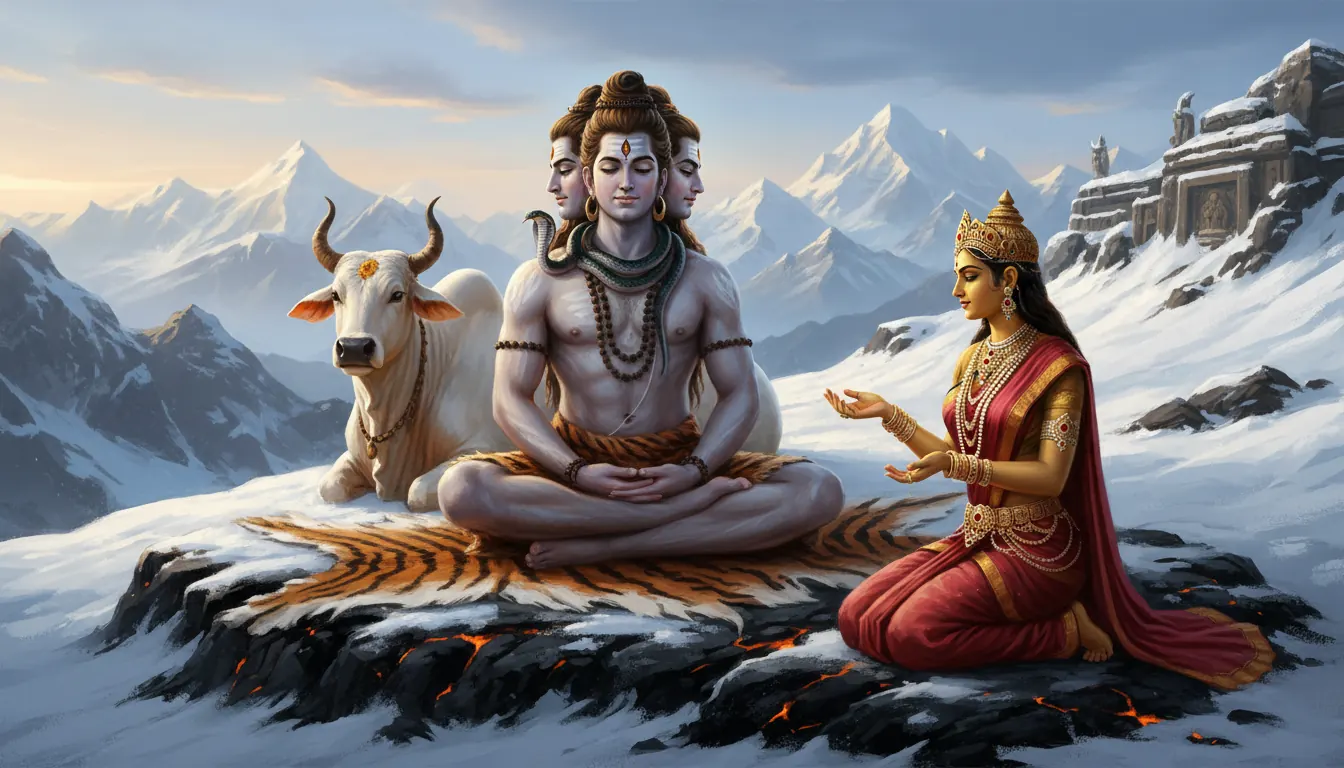
Tandi and the Ten Thousand Years
A rishi meditates for a hundred centuries, sees Mahadeva, and hymns him as the end of all five roads
In short
Upamanyu, having heard Krishna describe his own vision of Shiva, tells him of the rishi Tandi, who adored the great God by Yoga-meditation for ten thousand years in the Krita age. Tandi saw Mahadeva, then returned to his penances to find the same one hidden in his own heart, and praised him in a hymn that names him Truth and Falsehood, the calendar and the pole-star, and the single end toward which all five kinds of men are travelling. Offered any boon he liked, Tandi asked only that his devotion be steady. The names he brought down from that meeting became the thousand names of Shiva.
Told in the Anushasana ParvaSet in Forest Hermitage and Kurukshetra19 min read
The Question Bhishma Handed On
The question had been Yudhishthira's, and Bhishma had refused it.
He was lying on the bed of arrows on the field at Kurukshetra with the war finished and his own death still some weeks off, and the king had asked him about Mahadeva, and the grandsire had said that a mouth in his condition was not the right mouth for that subject, and had turned and asked Krishna to answer instead. Krishna answered. He told them about the ashram of the rishi Upamanyu, and the vow he took there, and what he was shown at the end of it, and the boons that Mahadeva and Uma gave him in their own voices before they vanished with all their Ganas.
Then he told them what happened afterwards, which was the part he had not yet come to.
"I told all these wonders, in full, to that brahmana of great energy," Krishna said. Upamanyu was the man who had given him the Diksha, the initiation, before he began to adore Mahadeva at all, and it was proper that the teacher should hear the whole of it. Upamanyu heard him out. Then he bowed down in the direction the god had gone, and said the four sentences that were his entire theology.
"There is no god like Sarva. There is no goal and no refuge like Sarva. No one can give boons so many or so great. No one is his equal in battle."
And having said it, he did what teachers do when a student comes back from a great experience and has to be told, gently, that he is not the first. He began a story.
"In the Krita age, my lord, there was a famous rishi named Tandi."
So Yudhishthira, sitting on the field, listened to Krishna repeating the words of an ascetic on the slopes of Himavat, about a rishi of an older age still.
Ten Thousand Years in the Krita Age
The Krita age is the first of the four, the age in which the ox of dharma still stands on all four legs, and the men who lived in it had lifespans that make the arithmetic of what Tandi did possible to state.
"With deep devotion of heart, and through Yoga-meditation, he worshipped the great God for ten thousand years."
That is the whole account of the penance. Upamanyu gives it one sentence and does not decorate it. There is no description of the forest Tandi sat in, no list of the seasons that went over him, no anthill grown up around his body, none of the furniture that usually comes with a long austerity in these stories. There is a number, and the number is ten thousand, and the method is named. Not fasting, not standing on one leg, not the five fires. Yoga-meditation, which is the mind held on one object without wandering, for a hundred centuries.
"Listen, and I will tell you what reward he reaped from such extraordinary devotion. He was granted the sight of Mahadeva, and he praised him with hymns."
The order of those clauses matters. He saw first and praised after. But before the seeing there was a thinking, and Upamanyu describes it. Tandi was thinking, with the aid of his penances, of Him who is the supreme Soul, unchanging and undecaying, and what came over him while he thought was not certainty. It was wonder. He became filled with wonder, and out of the wonder he said something, and the something was not yet praise. It was a man asking for shelter.
"I take refuge in Him whom the Sankhyas describe and the Yogins meditate on as the Supreme, the First, the Purusha, who pervades all things and is Master of all that exists. I take refuge in him who, the learned say, causes both the creation and the destruction of the universe; who stands above all the gods, the Asuras and the Munis; who has nothing higher than himself; who is unborn, the Lord of all things, without beginning or end, supreme in power, highest in bliss, radiant and sinless."
Ten thousand years of silence, and the first thing he said aloud was that he wanted to be protected.
What Stood There
When he had said those words, Tandi saw him.
Upamanyu spends a long breath on what was standing there, and the whole description is built out of negatives and impossibilities, which is the only honest way to build it. That ocean of penances. That great God, unchanging and undecaying, beyond compare, beyond thought, eternal, without any change at all. Who is indivisible. Who is whole. Who is Brahma. Who both transcends all qualities and has qualities, both at once, and the sentence does not apologise for the contradiction.
Who is the highest joy of Yogins. Who is called Liberation. Who is the refuge of the Mind, and of Indra, and of Agni, and of the god of wind, and of the whole universe, and of the Grandsire Brahma himself. Whom the Mind cannot conceive. Who never changes in any way, who is pure, who can be grasped by the understanding alone, and who is as immaterial as the Mind is. Who is hard to comprehend. Who cannot be measured. Whom those whose souls are not cleansed can hardly reach. Who is the origin of the universe, and who stands beyond both the universe and the quality of darkness. Who is ancient, who is Purusha, who is radiant, and who is higher than the highest.
Then Upamanyu goes back and adds a thing that changes the shape of the story.
The rishi Tandi longed to see Him who takes on the life-breaths and dwells in what comes of them, that is, in the Jiva, as the radiance we call the Mind. For this he spent many years in the harshest austerities.
Many years, on top of the ten thousand. The first sight was not the end of the work. Having been shown the Deity who is beyond conception, Tandi went back to his seat and sat down again, wanting now to find the same one in the place where he actually lives, which is inside the man who is looking for him, as the light that the mind is made of.
And when those penances had won him that sight, he praised the great God.
Holiest of Holies
"You are the holiest of holies," Tandi said, "and the refuge of all, first of all beings who have intelligence.
"You are the fiercest of all energies. You are the hardest of all penances. Mighty one, you give blessings freely. You are the supreme Truth. I bow to you, lord of a thousand rays, refuge of all bliss. You give that Nirvana which Yatis, in their fear of birth and death, strive so hard to reach."
Then, having opened, he did the thing every honest hymn has to do somewhere near the beginning, which is to admit that it cannot work.
"The Grandsire Brahma, Indra of the hundred sacrifices, Vishnu, the Viswadevas and the great rishis cannot grasp you or your true nature. How then can people like us hope to grasp you?"
A man who has spent ten thousand years on one object is entitled to claim some expertise, and the first claim he makes is that the highest orders of being in the universe have all failed at this and that he stands below every one of them. Everything he says afterwards is said inside that admission.
"Everything flows from you. Everything rests on you. You are called Kala, you are called Purusha, you are called Brahma. The heavenly rishis who know the Puranas say that you have three bodies, those of Kala, of Purusha and of Brahma, or the three forms of Brahma, Vishnu and Rudra. You are Adhi-Purusha, you are Adhyatma, you are Adhibhuta, you are Adhi-Daivata, you are Adhi-loka, you are Adhi-Vijnanam, and you are Adhi-Yajna.
"When the wise come to know you, who dwell within them and whom even the gods cannot know, they are freed from every bond and pass into a state beyond all sorrow. Those who do not wish to know you must go through birth and death again and again, without number."
That is the hinge of the hymn and it is set early. The one who cannot be known by the gods can be known by a man, and the reason is not that the man is greater. It is that the man is nearer. He is residing in the creature that is trying to know him, and the gods, looking outward from their heavens, are searching in the wrong direction.
Truth and Falsehood, Both
"You are the door to heaven and to Liberation," Tandi said, and then he began going through the world naming it.
This is the stretch of such a hymn that a reader is tempted to skim, and it should not be skimmed, because Tandi is not piling up compliments. He is walking through every division the mind makes and putting the same name on both halves of each.
"You send all beings out into existence and draw them back into yourself. You are the great giver. You are heaven, you are Liberation, you are desire, the seed of action. You are the anger that drives creatures. You are Sattwa, you are Rajas, you are Tamas. You are the worlds below and the worlds above.
"You are the Grandsire Brahma, you are Bhava, you are Vishnu, you are Skanda, you are Indra, you are Savitri, you are Yama, you are Varuna, you are Soma, you are Dhatri, you are Manu, you are Vidhatri, and you are Kubera, the Lord of treasures.
"You are Earth, you are Wind, you are Water, you are Agni, you are Space, you are Speech, you are Understanding, you are Steadiness, you are Intelligence, you are the deeds that creatures do.
"You are Truth, you are Falsehood, you are what exists and you are what does not exist."
The list has been climbing down all this while, from the gods to the elements to the faculties to the deeds men perform, and it arrives at that last pair, and the pair is not a slip of the tongue. Everything that is the case and everything that is not the case are both being addressed as one person.
"You are the senses, you are what lies beyond Prakriti, you are unchanging. You stand above the universe of things that exist, and above the universe of things that do not. You can be conceived, and you cannot be conceived. The supreme Brahman, the highest reality, the goal of both the Sankhyas and the Yogins, is, beyond any doubt, one with you."
Then Tandi stopped naming the world and spoke about himself, and the voice changed.
"Today you have rewarded me, for you have let me see your form. I have reached the goal that only the righteous reach. I have been given the goal sought by those whose minds have been cleansed by Knowledge."
Hidden in the Cave of the Heart
"Alas, for so long I was sunk in Ignorance. All that time I was a senseless fool, for I did not know you."
Ten thousand years of unbroken meditation, and the man calls the whole stretch of it foolishness, because it was time spent not knowing. He does not say the penance was wasted. He says that until the moment of seeing there was nothing in him worth calling knowledge, and that what came at the end of it was not wages.
"Over countless lives I have at last won the Devotion to you that has made you show yourself to me, you who are always ready to show grace to those devoted to you. Whoever comes to know you will enjoy immortality."
Then he says where the difficulty lies, and it is not where a man would expect it.
"You are the mystery that the gods, the Asuras and the ascetics can never solve. Brahman is hidden in the cave of the heart. Even the ascetics cannot see Him or know Him. Brahma and the Siddhas who expound the mantras have hidden you in a cave, so that gods and Asuras and men should not see you. Though you dwell in the heart, you are hidden. So, bewildered by you, gods and Asuras and men alike cannot understand you, Bhava, truly and in full."
The hiding place is the heart. Not a mountain, not a heaven, not a distance that austerity is built to cross. He is inside every creature that is hunting for him, and the concealment is not an accident of the creature's dullness. It is an arrangement, made on purpose, so that nobody takes him by searching.
Which leaves exactly one way in, and Tandi names it.
"To those who have cleansed themselves by devotion and come to you, you show yourself of your own accord, you who dwell in every heart. To know you is to escape both death and rebirth. You are the highest thing there is to know. Once a man knows you, there is nothing higher left for him to know. You are the greatest prize there is, and the truly wise man who wins you knows there is no greater prize to win. By reaching you, who are so very subtle, the wise man becomes immortal and unchanging."
The Year Laid Over a Body
From the heart the hymn turned outward again, and Tandi began to describe how the same god is approached by the men who do not sit alone in forests. By the schools, by the priests, by each of the four Vedas in its own dialect.
"The followers of the Sankhya system, who know their own philosophy well and understand the qualities and what are called the topics of enquiry, free themselves from every bond by knowing you. Those who know the Vedas see you as the one thing to be known, the one set out in the Vedantas. These men, devoted to the control of the breath, meditate on you always and at last enter into you as their highest goal. Riding in the chariot made of Om, those men enter into Maheshvara.
"Long ago the Grandsire Brahma sang your praises, you who are called Nilarohita, the blue and the red, reciting many hymns and urging you to create living creatures. Brahmanas who know the Richs praise you with Richs, seeing you as free of all attachment and without any form. The Adhwaryus at sacrifices pour libations in your honour, reciting Yajushes as they do. Men of cleansed minds who know the Samans sing to you with Samans. Those twice-born men who know the Atharvans hymn you as Rita, as Truth, as the Highest, and as Brahma. You are the highest cause, from which Sacrifice itself has flowed."
Then he took the calendar and laid it over the body of the god, joint by joint.
"Night and day are your hearing and your sight. The fortnights and the months are your head and arms. The seasons are your energy, penances are your patience, and the year is your thighs and feet. You are Mrityu, you are Yama, you are Hutasana, you are Kala. You are swift to destroy, you are the first cause of Time, and you are Time eternal.
"You are Chandramas and Aditya, with all the stars and planets and the air that fills space. You are the pole-star. You are the constellation called the Seven Rishis. You are the seven worlds beginning with Bhu. You are Pradhana and Mahat, you are the Unmanifest, and you are this world. You are the universe from Brahman down to the lowest plants. You are the eight Prakritis, and you are above the eight Prakritis.
"Everything that exists is a portion of your divine Self."
The Five Ends
The hymn had one thing left to do, and it did it by sorting the whole of mankind into five columns and writing the same name at the foot of every one.
Tandi had already called him the highest Kashtha and the highest Kala, the highest Success, the highest Refuge, the highest Tranquillity, the highest cessation of Existence. Now he took the ends that men actually work for, the goals that get people out of bed to do difficult things, and he named the five in order.
"Beyond any doubt, you are the End that men have in view who are devoted to sacrifices, who pour libations out of particular desires, and who give lavish gifts on those occasions.
"You are the high End sought by those who waste and scorch their bodies with severe penances, with ceaseless recitation, with the strict vows and fasts that belong to their quiet lives, and with other ways of mortifying the flesh.
"Eternal one, you are the End of those who are attached to nothing and have given up all action.
"Eternal one, you are the End of those who long for Liberation from rebirth, who live apart from every pleasure, and who seek the dissolution of the elements of Prakriti.
"Illustrious one, you are the high End, beyond words, stainless and unchanging, of those who are devoted to knowledge and science.
"These are the five Ends that have been declared in the Vedas and the Scriptures and the Puranas."
The man who sacrifices for a son. The man starving himself on a riverbank. The man who has let go of everything and does nothing. The man who wants out of birth altogether. The man who wants only to understand. Five roads whose travellers do not agree with each other and have argued for ages over which is the true one, and Tandi tells them that the far end of all five is the same person.
Then he added the sentence that takes the whole business out of the traveller's hands.
"It is by your grace that people reach those Ends, and if they fail to reach them, it is because your grace has been withheld."
It was thus that Tandi, who was a vast heap of penances, praised Isana. And he sang also that high Brahman which in ancient days was sung by the Creator himself.
The Boon He Asked For
Mahadeva had been listening the whole time, and Uma was beside him.
Of everything Tandi said, Upamanyu names the one sentence that pleased him, and it is not one of the great cosmological ones. It was the confession of failure near the beginning: that neither Brahma nor Indra nor Vishnu nor the Viswedevas nor the great rishis know you. Pleased by that, the holy one spoke.
"You will be indestructible and eternal. You will be free of all sorrow. Great fame will be yours. You will be full of energy. Spiritual knowledge will be yours. All the rishis will seek you out, and by my grace your son will become an author of Sutras, first among the twice-born."
Then, having given six things unasked, he asked.
"What wishes shall I grant you today? Tell me, my son, what it is you want."
This is the place in these stories where men ask for sons, or for kingdoms, or for the strength to burn their enemies. Here is what a man asks for when he has been sitting still for ten thousand years and the Lord of all creatures has just opened a hand in front of him. Tandi joined his palms.
"Lord, let my devotion to you be steady."
He asked for the thing he already had. Not for more of it, and not for anything it might buy. He had said in the hymn that it took him innumerable lives to acquire that devotion, and he knew what it had cost and how easily a man mislays it, and with the whole of the possible spread out in front of him he asked that it hold.
When he had given Tandi those boons and received the worship of the gods and rishis who had gathered to watch, the great God vanished there and then with all his followers. And the rishi rose from the place where he had spent ten thousand years, and came down out of it to the hermitage of Upamanyu, and told him everything that had happened.
"The Grandsire had at one time recited ten thousand names that apply to Mahadeva," Upamanyu said to Krishna. "In the scriptures, a thousand names occur of that illustrious deity. These names are not known to all. Having acquired them through the grace of the Grandsire, Tandi communicated them to me."
A year of penance for every name, and then he gave them away to a man in a forest, who gave them to Krishna, who was giving them now to Yudhishthira on the field at Kurukshetra, where Bhishma lay on the arrows and listened to a hymn older than his house.
Dharma Lesson
Tandi spends ten thousand years reaching for something that was never further off than his own heart, and when he finally sees it he calls all that time a period of foolishness, not because the penance was wasted but because it bought him nothing he could take credit for. His hymn refuses to let any road claim the destination: the man buying heaven with sacrifices, the man scorching his body, the man who has relinquished all acts, the man who wants no more births, and the man who wants only to understand are walking toward one place, and none of them arrives by walking. What is left, when the roads are levelled and the arrival is called grace, is the single thing he asks for when he is offered anything at all. He does not ask for the fruit of devotion. He asks that the devotion hold.