The Guest Nobody Could See
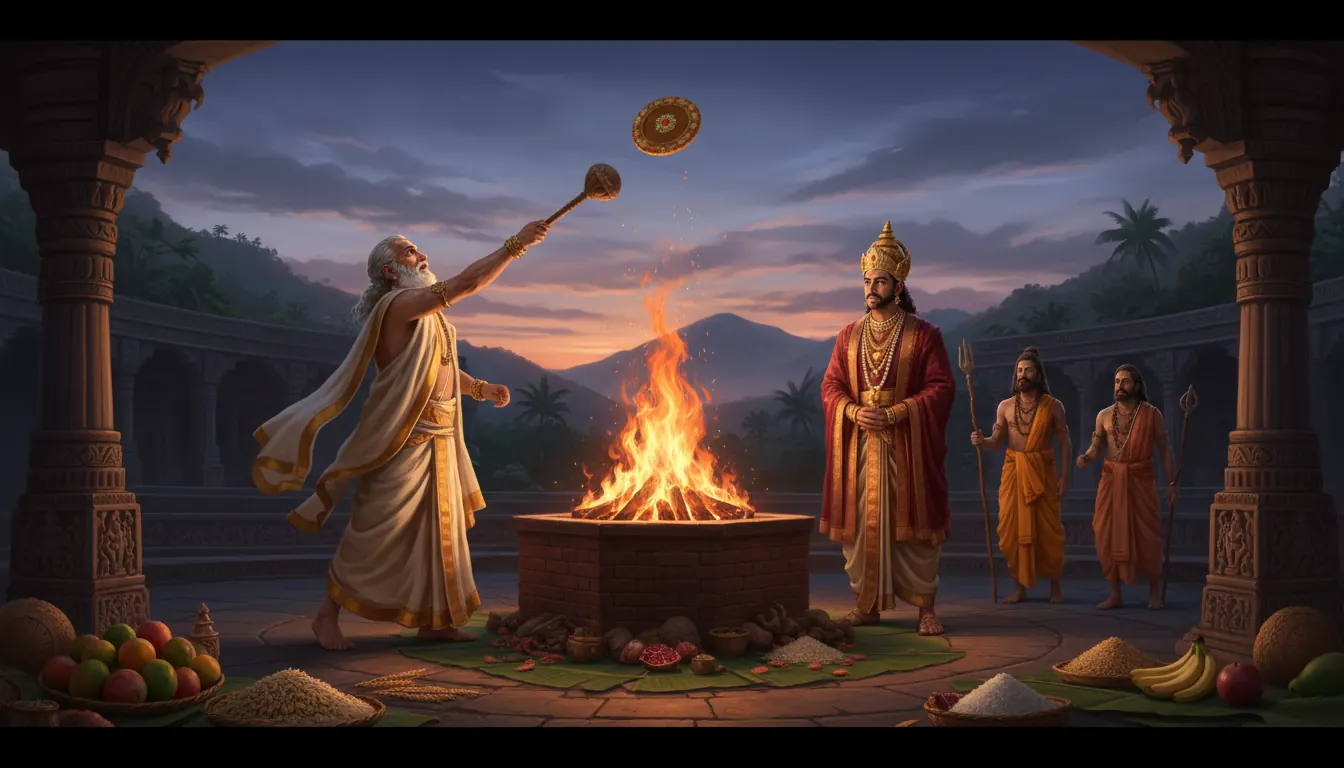
Brihaspati throws down the ladle at a sacrifice where no animal was killed
In short
King Uparichara Vasu holds a horse-sacrifice in which nothing is slain and every requisite comes from the wilderness, and Hari takes his portion by its scent, visible to the king alone. Brihaspati, the officiating priest, hurls the ladle at the sky and weeps. Ekata, Dvita and Trita answer him with what their own thousands of years on the shore of the Ocean of Milk had earned them, which was also nothing.
Told in the Shanti ParvaSet in Kurukshetra, Chedi and Kshira Sagara18 min read
The Priest Born in the Race of Angiras
"Then, upon the expiration of the great Kalpa," Bhishma said, "when the celestial Purohita Brihaspati was born in the race of Angiras, all the deities became very happy."
He was lying where he had been lying since the tenth day, and the son of Dharma was sitting in the sand beside him, and the question on the table that morning was about worship: who gets seen, and who does not, and why.
"The words Vrihat, Brahma and Mahat all mean the same thing," the old man said. "The heavenly Purohita came to be called Brihaspati because he had all these qualities. Now there was a king, Uparichara, also called Vasu, who became a disciple of Brihaspati, and he soon became the foremost of his disciples."
That is a considerable sentence. The priest of the gods took pupils, and the best of them was not a god or a rishi but a king with a kingdom to run at Chedi.
"Once accepted, he began to study at his teacher's feet the science composed by the seven rishis known as the Chitrasikhandins. His soul cleansed of every kind of evil by sacrifices and other religious rites, he ruled the Earth as Indra rules Heaven."
Yudhishthira did not interrupt. He had been listening to a great deal about how to rule the earth that season, most of it about spies and revenue and the correct treatment of a defeated enemy, and this was the first time in a long while that the answer had begun with a school.
Sixteen Men in the Enclosure
The illustrious king performed a great Horse-sacrifice, and his teacher Brihaspati acted as its Hota.
The sadasyas, the men who sit and watch and rule on whether a rite has been done rightly, were not ordinary men either. The sons of Prajapati themselves, Ekata, Dvita and Trita, took those seats. And there were others, and the text names every one of them, in the way a man names guests he was proud to have had under his roof.
Dhanusha. Raibhya. Arvavasu and Parvavasu. The rishi Medhatithi. The great rishi Tandya. The blessed rishi Santi, who was otherwise called Vedasiras. Kapila, foremost of rishis, who was the grandfather of Salihotra. Katha, the first of that name. Tittiri, the elder brother of Vaishampayana. Kanva. Devahotra.
Sixteen in all, counting the three sons of Brahman among them.
In that great sacrifice all the requisite articles were collected, and they were collected in a particular way, and that particular way is the whole reason this story is remembered rather than merely recorded. The king had a rule for his sacrifice, and the rule was this.
No animals were slain in it.
The king had ordained it so. He was full of compassion, pure and generous of mind, he had cast off all desires, and he knew every rite thoroughly, which matters, because a man who does not know the rites cannot depart from them safely. Everything used in that sacrifice came from the wild. Whatever was poured and offered and burned had been gathered from what grows, and not taken out of anything that had been breathing that morning.
A horse-sacrifice in which no horse dies is a strange object. It is the largest and bloodiest of the royal rites and the king of Chedi performed it as a thing made entirely out of grain and root and fruit and forest gum, and did not think he had performed anything less.
The Portion That Was Taken
The ancient God of gods was deeply pleased with the king for that sacrifice.
And here the account does something careful with its verbs, and it is worth going slowly, because everything that follows turns on it.
Hari came. The great God, whom no one else can see, showed himself to his worshipper. He accepted the share offered to him by taking in its scent, which is how a god eats. And he himself took up the Purodasa, the cake of offering, with his own hand.
The great God took up the offerings without being seen by anyone.
So the god was present, the god was pleased, the god had shown himself, and the god had physically lifted the cake off the altar in front of a full enclosure of the most accomplished ritualists then alive, and not one of them saw a thing except the space where the cake had been.
There is nothing hidden in this. It is not a trick and it is not a test. It is simply the case that Narayana cannot be seen by anyone to whom he does not choose to be visible, and on that morning he chose one man in the enclosure, and the one he chose was the king, who was neither the officiating priest nor a son of Brahman nor any of the other great rishis sitting in judgment on the rite.
The king said nothing about it. Kings at their own sacrifices generally do not talk.
The Hota, however, was standing at the fire with the ladle in his hand, and the Hota had watched a portion of his own offering leave the altar without a hand on it.
Brihaspati Throws the Ladle at the Sky
At this, Brihaspati became angry.
Taking up the ladle, he hurled it with violence at the sky, and began to shed tears in wrath.
It is one of the few completely undignified moments granted to a great being in this entire book, and nobody in the telling apologises for it. The teacher of the gods, the man for whom a planet is named, who had taught this king everything the king knew about how to conduct exactly this rite, threw his instrument up into the air like a child and stood at his own fire crying with rage.
And then he spoke, and what he said is worse than the throwing, because it is deliberate.
"Here," he said to King Uparichara, "I set this down as Narayana's share of the offerings. Beyond doubt he will take it before my eyes."
That is not a prayer. That is a man setting out food and standing over it with his arms folded. He had gone from officiating at a sacrifice to laying a condition on a god, and the condition was that the god be looked at.
On the field at Kurukshetra, Yudhishthira stopped his grandsire there and put in the question that any listener would have.
"At Uparichara's great sacrifice," the king said, "all the gods appeared in their own forms to take their shares of the offerings, and everyone saw them. Why did the mighty Hari alone behave differently, and take his share unseen?"
Which is precisely Brihaspati's grievance, stated politely, by a man lying at a safe distance of many thousand years from the fire in question. Everyone else had come and been looked at. Only one guest had refused to be a guest in the ordinary way.
Cool Heads Around a Burning Priest
When Brihaspati gave way to anger, Bhishma said, the great king Vasu and all his Sadasyas tried to calm the great rishi.
They did not do it by agreeing with him and they did not do it by scolding him. With cool heads, all of them spoke to him, and what they said has three parts, and each of the three takes something away from him.
"You must not give way to anger. In this Krita age, the anger you have given way to should be found in no one."
That is the first part, and it is an appeal to the calendar. This is the Krita age, the first and best of the four. Wrath is not yet a normal feature of the world. What Brihaspati has just done at the altar is, in the strictest sense, out of period.
"The great god for whom you set aside the share of the offerings is himself free from anger."
That is the second, and it is the sharper one. You are standing here in a fury at a being who has none, holding a portion out toward him as a challenge. Whatever the two of you are doing, only one of you is doing it.
"Neither we nor you can see him, Brihaspati. Only the one to whom He shows His grace can see Him."
And that is the third, and it removes the whole ground of the complaint. The priest's outrage rested on an assumption he had never examined, which was that seeing is a thing a qualified person is owed. It is not. It is a thing that is given. Nobody in that enclosure had earned it, including the other rishis and the three sons of Brahman, and the king who did receive it had not earned it either; he had simply been the one to whom the god chose to become gracious.
That argument might have ended it. It did not, because arguments of that shape rarely persuade a man who is crying. What ended it was three men standing up and telling him where they had been.
Ekata, Dvita and Trita Tell Where They Went
Then the rishis Ekata, Dvita and Trita, who were deeply versed in the science of morality and duty compiled by the seven rishis, spoke to the assembly.
"We are the sons of Brahman," they began, "born by a mere act of his will, and not in the ordinary way."
They were, in other words, the three men in the enclosure with the least excuse for being refused anything.
"Once we went to the north to seek our highest good. We performed penances for thousands of years and won great ascetic merit, and then again we stood on only one foot, like stakes of wood fixed in the ground."
Note the again. The thousands of years were the preparation. The standing on one foot came after.
"The country where we performed those hardest of penances lies to the north of the Meru mountains, on the shores of the Ocean of Milk. What we sought was a way to see the divine Narayana in his own form."
So the whole enormous labour had exactly the aim that Brihaspati had just tried to obtain with a ladle.
"When our penances were complete and we had performed the final ablutions, mighty Brihaspati, we heard a bodiless voice, deep as the clouds and yet very sweet, filling the heart with joy. The voice said: Brahmanas, you have performed these penances well and with cheerful hearts. You are devoted to Narayana, and you want to know how you can see that mighty god.
"On the northern shore of the Ocean of Milk there is an island of great splendour called the White Island. The men who live there are as white as moonlight, and they are devoted to Narayana. They worship that foremost of all Beings with their whole souls. They all enter into that eternal and illustrious god of a thousand rays. They have no senses. They eat no food of any kind. Their eyes never blink. Their bodies always give off a fragrance. Indeed, the people of the White Island believe in and worship one God only.
"Go there, ascetics, for there I have revealed myself."
Blind on the White Island
"When we heard those bodiless words, we all went by the way we had been shown to the country described. Longing to see Him, our hearts full of Him, we came at last to that great island called the White Island.
"Arrived there, we could see nothing."
They had been sent by a voice from the sky, to a named place, with an assurance that the god had revealed himself there. They walked onto the ground he had named and their vision was blinded by the energy of the great deity, and accordingly they could not see Him.
"Then, by the grace of the great God Himself, the thought came to us that no one who had not done enough penance could quickly see Narayana."
Thousands of years, and one foot, and the stakes of wood, and it had not been sufficient. Under the influence of this idea they set themselves once more to the practice of some severe austerities, suited to the time and to the place, for a hundred years.
"When our vows were complete, we saw a number of men of auspicious appearance. They were all white, the colour of the Moon, and bore every mark of blessedness. Their hands were always joined in prayer. Some faced the North and some the East. They were silently meditating on Brahma. The Yapa of those great-souled men was performed in the mind, and not by reciting any mantras aloud.
"Because their hearts were wholly set on Him, Hari was very pleased with them. The radiance of each of those men was like the splendour Surya takes on when the time comes for the dissolution of the universe. Indeed, we thought that Island was the home of all Energy. All the people there were exactly equal in energy. No one there was higher or lower than another."
That last detail is the one to hold on to. Not one of those white men outranked another. There was no chief among them, no Hota, no sadasya, no man with a better seat.
A Thousand Suns and the Word Namas
"Then all at once we saw a light rise again, Brihaspati, which seemed to be the gathered radiance of a thousand Suns.
"The people came together and ran toward that light with hands joined in reverence, full of joy, uttering the one word Namas. Then we heard a very loud sound raised by all of them together. It seemed that those men were offering a sacrifice to the great God.
"As for us, his Energy suddenly robbed us of our senses. Without sight or strength or any of our senses, we could neither see nor feel anything."
So they stood in the middle of a crowd of worshippers at the exact moment of the arrival, with a thousand suns in front of them, and were struck deaf to everything except one thing, which was the crowd.
"We heard only a great swell of sound from the gathered people. It said: Victory to you, lotus-eyed one! Salutations to you, Creator of the universe! Salutations to you, Hrishikesha, foremost of Beings, the First-born! That was the sound we heard, spoken clearly and with correct pronunciation.
"Meanwhile a pure and fragrant breeze blew, carrying the scent of heavenly flowers and of certain herbs and plants used in the rite. Those men, full of devotion, their hearts full of reverence, versed in the rules laid down in the Pancharatra, were worshipping the great god with mind, word and deed.
"Beyond doubt Hari appeared in the place the sound came from. As for us, bewildered by His illusion, we could not see him."
Smell, they were left. Hearing, they were left. They knew where in the air he was standing, by the direction the shouting came from, and that was the whole of what a hundred years and thousands of years before it had bought them.
"When the breeze had died down and the sacrifice was over, foremost of Angira's line, our hearts were troubled with anxiety."
Nobody Looked at Them
"As we stood among those thousands of men, all of whom were of pure descent, no one honoured us with a glance or nod."
That is the coldest line in the story, and it is the one the three of them chose to say out loud in front of a full enclosure at a royal sacrifice, which cannot have been easy.
"Those ascetics, all cheerful and full of devotion, all practising the Brahma-frame of mind, showed no feeling of any kind toward us. We were utterly exhausted. Our penances had worn us thin."
Three sons of Brahman, worn to the bone, standing in a crowd on the far shore of the Ocean of Milk, and nobody turned a head.
"Then a Being without a body spoke to us from the sky and said: These white men, who are free of all outer senses, can see Narayana. Only those foremost of the twice-born whom these white men honour with a glance can see the great God."
So the glance nobody gave them was not rudeness. It was the door. The thing they had walked to the end of the world for had been in the gift of the men standing next to them, and it had not been given.
"Go back, munis, to the place you came from. That great God can never be seen by one without devotion. His dazzling radiance makes him impossible to see, and that illustrious God can be seen only by those who, over long ages, manage to devote themselves wholly and solely to Him.
"Foremost of the twice-born, you have a great duty to perform. When this Krita age has ended and the Treta age comes in the course of the Vivaswat cycle, a great calamity will fall upon the worlds. Then, munis, you will have to become the allies of the gods to drive that calamity away."
"Having heard these wonderful words, that were sweet as nectar, we soon got back to the place we desired, through the grace of that great Deity."
They had been sent home with an errand instead of a sight, and they had taken it.
The Ladle Picked Up Again
Then Ekata turned the whole account on the man it had been told for.
"Even with penances as hard as ours, and offerings devoutly made in sacrifices, we failed to see the great God: how can you expect to see Him so easily?"
So easily. At your own fire, in the middle of your own rite, in one morning, because you are the Hota and you asked.
"Narayana is a Great Being. He is the Creator of the universe. He is adorned in sacrifices with offerings of clarified butter and other food dedicated with the aid of Vedic mantras. He has no beginning and no end. He is Unmanifest. Both the Deities and the Danavas worship Him."
Moved by these words of Ekata, which his companions Dvita and Trita approved, and urged on by the other Sadasyas too, the high-minded Brihaspati completed that sacrifice, after duly offering the customary worship to the gods.
That is all the resolution there is, and it is enough. He picked the ladle up. He did not receive an explanation that satisfied him, he did not get the sight he had demanded, and the portion he had set down as a challenge is not mentioned again. He finished the work in front of him and gave every god his adorations, including the one who had already eaten without being watched.
King Uparichara completed his great sacrifice and began to rule his subjects righteously. At last he cast off his body and rose to heaven.
"And after some time," Bhishma said, "through the curse of the brahmanas, he fell from those blessed worlds and sank deep into the bowels of the Earth. King Vasu was always devoted to the true religion. Even sunk deep in the bowels of the Earth, his devotion to virtue did not weaken. Always devoted to Narayana, always reciting the sacred mantras addressed to Narayana, he rose once more to heaven by Narayana's grace. So King Vasu rose from the bowels of the Earth, and because he had reached the very highest goal, he went to a place higher even than the world of Brahman himself."
The man who had been given the sight without asking for it was also the man who went on reciting from inside the ground, where there was nothing to see at all.
Dharma Lesson
Being answered is not the same as being shown, and a priest who demands proof of the god he serves has misunderstood what service is. The sight is a gift and not a wage, and the three sons of Brahman who walked to the end of the world learned that it lay in the gift of the men standing beside them.