Three Balls of Mud
The Boar invents the rite for the dead, and has no one above him to offer it to
In short
Narada is caught performing the rites for the Pitris in the retreat of Nara and Narayana and is asked whom exactly he thinks he is worshipping. He answers, then asks why the fathers are called Pindas. He is told how the Boar, still muddy from lifting the drowned Earth, shook three balls of mud from his tusk onto spread grass at midday and found he was worshipping himself.
Told in the Shanti ParvaSet in Badarikashrama and The Ocean16 min read
Caught at the Rite
"On one occasion," said Vaishampayana, "while residing in the retreat of Nara and Narayana, Narada the son of Pramesthi finished the rites and observances in honour of the deities, and then, without pausing, set himself to perform the rites in honour of the Pitris."
Janamejaya waited for the rest, and the rest was that somebody watched him do it.
The retreat of Nara and Narayana is a quiet place high among the badari trees, where the two ancient ones have sat through more ages than there are names for, and where a visitor's smallest movement is noticed simply because so little else moves. Narada spread his grass. He took his water. He turned himself the way a man turns for the dead and not the way he turns for the gods, and he began.
When he had finished, Nara, the eldest son of Dharma, spoke to him. He did not object and he did not approve. He asked a question that is harder than it sounds.
"Whom are you worshipping, best of the twice-born, with these rites and observances for the deities and the Pitris? Tell me this as the scriptures teach it, wisest of all beings. What is it that you are doing? And what fruits do you hope for from these rites you have set yourself to perform?"
It is the question every man performing that rite ought to be asked once in his life, and almost nobody is. A son sets out the food because his father set it out, and his father because his grandfather did, and if you stop the line anywhere and ask who exactly is being fed, the answer usually comes back as a shrug and a name.
Narada, who had been asking other people difficult questions for several ages, was not going to shrug. He sat down to answer it, and Nara sat and waited, and Narayana beside him said nothing at all, which is his usual contribution and is not idleness.
You Told Me To
"You told me once before," Narada answered, "that rites and observances in honour of the deities should be performed. You said that the rites in honour of the deities are the highest sacrifice, and are the same as the worship of the eternal Supreme Soul. Taught by that teaching, I always sacrifice in honour of the eternal and immutable Vishnu, through these rites that I perform in worshipping the deities.
"So when you ask me whom I am worshipping, the answer is that I am worshipping the one you told me about, and I am doing it by the road you showed me. There are not two roads here running to two destinations. Whatever name is spoken over the water, the water goes to Narayana."
He went on, because the question had two halves and he meant to answer both.
"It was from that Supreme Deity that Brahma, the Grandsire of all the worlds, arose long ago. That Brahma, also called Prameshthi, filled with gladness, brought my father Daksha into being. And I was the son of Brahma, created before all others by an act of his will, although afterwards I had to be born as the son of Daksha, through a curse of that rishi.
"Count it if you like. I was made before my own father was made, and then I was born from him. So when I offer to the fathers, I am not standing at the bottom of a ladder looking up. I have been at both ends of that ladder, and I know that it is bent round on itself."
The Fathers Who Had to Be Taught by Their Sons
"I am performing these rites in honour of the Pitris for the sake of Narayana," said Narada, "and according to the ordinances he himself laid down. The illustrious Narayana is the father, the mother, and the grandfather of all creatures. In every sacrifice performed in honour of the Pitris, it is that Lord of the universe who is adored and worshipped.
"And there is a thing that happened once which you two know better than anyone. Once the deities, who were fathers, taught their children the Srutis. Then the fathers lost their knowledge of the Srutis, and had to learn it again from the very sons they had taught it to.
"Because of that, the sons who had to give the Mantras back to their fathers gained the status of fathers. And the fathers, because they had received the Mantras from their sons, took the status of sons."
He let that sit for a moment, because it is a strange thing to say aloud.
"Without doubt, what the deities did on that occasion is well known to you two. On that occasion sons and fathers had to worship each other. First they spread some blades of Kusa grass, and then the deities and the Pitris, who were their children, placed three Pindas on it, and in this way worshipped each other.
"Look at what that ceremony was. Gods and their children standing opposite one another, each bending to the other, each in the same instant the elder and the younger. No one of them could claim to be at the head of the line, because the line had been folded in the middle and both ends were touching. And the whole of it was performed with grass, and with three round things set down upon the grass, exactly as I performed it here this morning, and exactly as a herdsman with nothing performs it at the edge of his field.
"So I know what I am doing and I know for whom. There is only one thing I do not know, and since I have you both here I will ask it. Why is it that long ago the Pitris came to be called Pindas? Why are the fathers, who were men and gods with names of their own, called by the name of a ball of food?"
The Earth With Her Belt of Seas
Nara and Narayana answered him together, which is how they answer, and what they told him began a long way before any father or any son.
"Long ago the Earth, with her belt of seas, disappeared from sight."
That is the whole of the disaster in one line. Not shaken, not burned. Gone out of sight, with everything on her and everything round her, and the place where she had been showing only water.
"Govinda, assuming the form of a gigantic boar, raised her up with his mighty tusk."
There is a great deal in the world about that lifting, and none of it is the point of this telling. What matters here is the next line, which nobody remembers.
"When he had put the Earth back in her former place, that greatest of Purushas, his body smeared with water and mud, set about doing what the world and its creatures needed."
He did not go and be praised. He did not wash. The greatest act of rescue in the history of the worlds had just been completed, the Earth was back where she belonged with her seas round her again, and the god who had lifted her stood there in the shape of an animal, filthy to the shoulders, and started on the ordinary work of the day.
And the day, as days do, had reached a particular hour.
Noon, and the Hour for the Rites
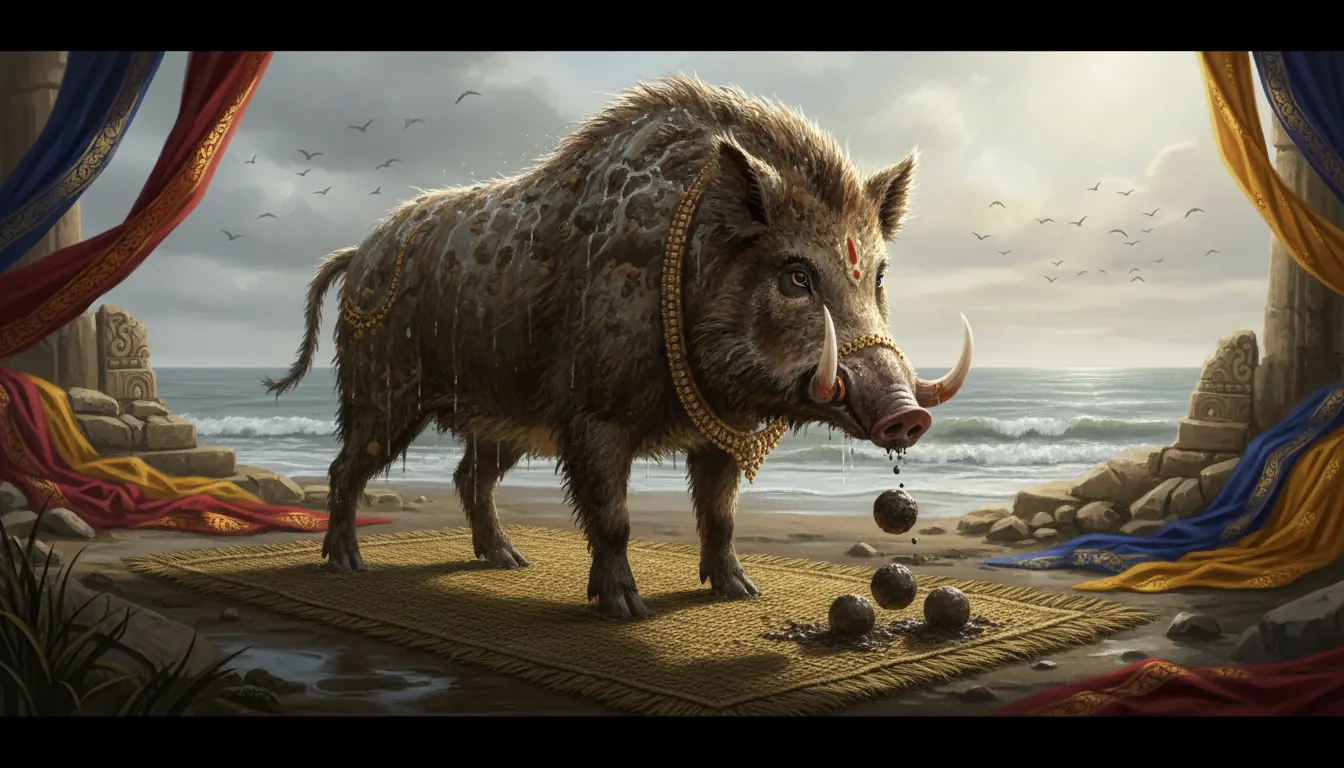
"When the sun reached the meridian," they said, "and so the hour came for the midday ablutions, the mighty Lord first spread some blades of grass on the Earth, and then, suddenly shaking three balls of mud off his tusk, placed them on it."
Read that again slowly, king, said Vaishampayana, because it is the most peculiar sentence in the whole account.
The sun had climbed to the top of the sky. The hour of the midday rites had come, and the one who should perform them had only just come up out of the water from holding up the world. So the observance was made at noon, by a god in the body of a boar, with the mud of the sea bottom still drying on him.
And he did not fetch anything. He had no rice, no cake, no vessel, no attendant, no fire. He had a tusk with three lumps of mud on it, and he had grass, and he had himself.
So he spread the grass first, which is the order of the rite and which he did not skip. Then he shook the tusk, and the three lumps came off it and fell on the spread blades.
And the mighty Vishnu dedicated those balls of mud to himself, according to the rites laid down in the eternal ordinance.
Regarding the three balls that he had shaken off his tusk as Pindas, he then performed the rite of dedication, sitting with his face turned toward the East.
Sesame Born of His Own Heat
There was one thing still wanting, because that offering is not made without sesame, and there was no sesame in the world that morning within reach of a boar standing on a wet shore.
So he made it out of himself. With sesame seeds of oily kernel that arose from the heat of his own body, he himself performed the rite of dedication.
Everything in the ceremony came out of the celebrant. The grass he spread. The Pindas were the mud off his own tusk, and the mud was the Earth he had just carried. The sesame was his own heat, thrown off by a body that had been working. There was no second party anywhere in it. Nothing had been brought from outside, and nothing needed to be.
That is worth holding onto, said Vaishampayana, because of what men do with this rite afterwards. They quarrel about the quality of the sesame. They send for the good rice. They count the brahmanas fed and compare the number with what a neighbour managed. The first performance of the whole observance was made by a filthy animal on an empty shore out of the dirt on his own face and the sweat of his own labour, and it was not defective in any particular.
Then that greatest of deities, moved by the wish to establish rules of conduct for the creatures of the three worlds, spoke. He was not speaking to anybody. There was nobody yet to speak to.
"I am the Creator of the worlds," said Vrishakapi. "I am resolved to create those that are to be called Pitris."
And having said it, he began to think of the high ordinances that should regulate the rites to be gone through in honour of the Pitris. He was composing the rule while performing the act it would govern, which is the only way the first of anything is ever done.
They Had Fallen Toward the South
While he was engaged in that thought he looked down, and he saw a thing he had not arranged.
The three balls of mud, shaken off his tusk, had fallen toward the South.
He had not aimed them. He had shaken his head and they had come off and landed where they landed, and they lay on the grass in the southern quarter, which is the quarter of the dead and was not yet the quarter of anything at all.
He then said to himself: "These balls, shaken off my tusk, have fallen on the Earth toward the southern direction of her surface. Guided by this, I declare that from now on these will be known as Pitris. Let these three, which have no particular shape and are only round, come to be regarded as Pitris in the world. In this way I create the eternal Pitris."
That is where the fathers of every household in the world come from. Not from a decree issued in a hall of light. From three lumps of dirt that happened to roll south off the jaw of an animal, and from a god who was watching closely enough to notice which way they had gone and honest enough to take the accident as the ordinance.
They have no particular shape. They are only round. He said so himself, and he said it as a definition and not as an apology. Every ball of rice that has been set out on grass since that morning, in every country, by every son who could afford rice and every son who could not, is round for that reason and for no other, and points the way it points because three lumps of mud went that way once.
And the direction, once given, never moved. The dead have lain to the south of the living ever since, in the mind of every man who has ever turned to face them.
Who Is My Father in the Universe?
Then the Boar came to the part of the rite where the celebrant names the one he offers to, and he stopped, because there was no name to say.
"I am the father, the grandfather, and the great grandfather," he said, "and I should be thought of as dwelling in these three Pindas. There is no one higher than me. Whom can I myself worship or adore with rites? Who, again, is my father in the universe? I myself am my grandfather. I am, indeed, both the Grandsire and the Father. I am the one cause of all the universe."
He was standing at the top of everything that exists, with an offering made and a rite half done, looking upward out of habit into a place where there was nothing above him to look at. Every other creature that has ever performed this ceremony has had somebody to perform it for. Some have a father remembered and named; some have only a direction and a season and a word said over water; but every one of them has had the comfort of pouring something out of himself toward a place that is not himself. He was the single exception in all of time.
And notice that he did not therefore call the rite off. He might have said that an offering with no recipient above it is a form without a meaning, and let the mud lie on the grass and gone away. He said instead that he was the father and the grandfather and the great grandfather, and that he resided in those three lumps, and he went on with the ceremony.
So he finished it the only way it could be finished. Having said those words, that God of gods, Vrishakapi by name, offered those Pindas on the breast of the Varaha mountains, with elaborate rites. He left nothing out and he shortened nothing.
By those rites He worshipped His own self. And having finished the worship, he disappeared there and then.
No one saw it. There was no one to see it. The grass lay on the ground with three balls of mud on it, facing south, on an empty morning that had already turned to afternoon.
That Is Why the Fathers Are Called Pinda
"That is why the Pitris have come to be called Pinda," said Nara and Narayana. "This is where the name comes from. And in keeping with the words Vrishakapi spoke on that occasion, the Pitris receive worship from all."
Then they told Narada what the rite is worth, and they made the list long on purpose.
"Those who sacrifice to and adore, in thought and word and deed, the Pitris, the deities, their teacher, the venerable elder who arrives at the house as a guest, cows, the best of brahmanas, the goddess Earth, and their mothers, are said to adore Vishnu himself and sacrifice to him."
Nothing in that list is grander than the rest of it. The Pitris are in it and so is the cow in the yard, and so is the man who turns up at your door at the wrong hour, and so is the ground you are standing on, and so is your mother, who is not dead and does not need a rite at all.
"Pervading the bodies of all existent creatures, the illustrious Lord is the Soul of all things. Unmoved by happiness or misery, His attitude toward all is equal. Great in himself, and great of soul, Narayana has been said to be the soul of all things in the universe."
So Narada had his answer, and it was not the answer he had gone looking for. He had asked why a word for the dead was also a word for a ball of food. He was told that the first person ever to make the offering had no dead to make it to, made it out of the mud on his own face, and discovered while making it that he was worshipping himself, because there was no one above him in the universe to worship. Every son since has been in the easier position, having somebody to offer to.
And Narada went back to his grass and his water, and continued.
Dharma Lesson
The rite that honours the dead is older than any of the dead, and the one who first performed it had no father anywhere in the universe to perform it for. He did it anyway, out of the mud on his own face and the heat of his own body, which is the answer to every man who says he lacks the means. What makes the offering is the turning toward, not the quality of what is turned.