The Earrings of Madayanti
A pupil grown old, and a bargain with a man-eating king
In short
A hundred years pass before a white hair in a load of firewood tells Utanka that he has grown old serving Gautama unnoticed. Restored to youth and sent by Ahalya for the earrings of a cannibal king's queen, he bargains for his own life, wins the jewels, loses them to a serpent, and digs at an anthill until Indra arms his staff with thunder.
Told in the Ashvamedhika ParvaSet in Forest Hermitage, Kosala and Nagaloka18 min read
The Question Janamejaya Asked
"What penances had the great-souled Utanka performed," said Janamejaya, "that he wished to lay a curse on Vishnu himself, the source of all power? A man does not stand up to that unless something has made him."
Vaishampayana said: Utanka's penances were austere, Janamejaya. He was devoted to his teacher. He had great energy in him, and he worshipped no one else at all. Among all the children of the rishis there was one wish that came up again and again: that their devotion to their teachers might be as great as Utanka's.
His teacher was Gautama, and Gautama was pleased with him and fond of him beyond measure, more than any of the many other disciples in that hermitage. He was pleased with Utanka's self-restraint, with the purity of his conduct, with his feats of prowess, and with the services he rendered.
And that was the trouble. One after another, thousands of disciples received their teacher's permission to go home when their studies were finished. Utanka did not. Gautama loved him too well to let him leave the hermitage, and so the permission was never given, and Utanka never asked for it, because asking would have been a kind of leaving.
Gradually, as time went on, old age overtook that great ascetic. He did not notice. A man who is entirely devoted to his teacher is not looking at himself.
One White Hair in a Load of Firewood
One day he set out to fetch fuel for his teacher, as he had done every few days for a hundred years, and he brought back a heavy load of it on his head.
He was toil-worn and hungry and the load was too much for him. He threw it down on the earth. And one of his matted locks, white as silver, had got entangled in the wood, and when the load went down that lock of hair went down with it and lay there on the ground in front of him.
Utanka looked at it.
Oppressed by that load, overcome by hunger, and now confronted by that sign of old age lying in the dirt among the sticks, he began to lament aloud, out of an excess of sorrow that had been a century in accumulating without his knowing it.
His teacher's daughter came out. She knew every duty, and had eyes like lotus petals, and at her father's command she went with her face lowered and tried to catch Utanka's tears in her hands.
Her hands seemed to burn where the drops fell. She could not hold them any longer and was obliged to throw them down on the earth. The Earth herself could not hold those tear-drops of Utanka either.
Gautama came out then, and his heart was gratified rather than alarmed, because he understood what he was looking at.
"Why is your mind so full of grief today, son?" he said. "Tell me calmly and quietly, learned rishi. I want to hear all of it."
A Hundred Years Without Knowing It
"With my mind wholly given to you," Utanka said, "and wholly set on doing what pleases you, with my heart turned to you and my thoughts on nothing but you, I have lived here until old age has come upon me without my knowing it at all.
"I have known no happiness either. Though I have lived with you for a hundred years, you have not given me leave to go. Many of your disciples who were younger than me have been allowed to go. Hundreds and thousands of the best of brahmanas have left this place equipped with knowledge and set themselves up as teachers. I fetched the wood for them while they packed."
"Through my love and affection for you," said Gautama, "and because of the faithful service you gave me, a long time has passed without my knowing it either, best of brahmanas. But if you now wish to leave this place, go without delay. You have my permission."
"What should I give my teacher?" Utanka said. "Tell me this, best of the twice-born. When I have brought it, I will leave with your blessing."
"The good say that the teacher's satisfaction is the final fee," Gautama answered. "I have certainly been highly pleased with your conduct. Know, son of Bhrigu's line, that I am deeply pleased with you for this. If you become a young man of sixteen today, I will give you my own daughter for your wife. No other woman but she is able to wait upon your energy."
At those words Utanka became a youth again, and took that famous maiden for his wife, and the hundred years fell off him like the load of firewood. But he had asked a question and it had not been answered to his satisfaction, and he went next to his teacher's wife.
Ahalya Names the Earrings
"What should I give you as the final fee for my teacher?" he asked her. "Command me. I want to do what pleases you and is good for you, with wealth or even with my life. Whatever gem there is in this world, however wonderful and however costly, I will bring it to you by the power of my penances. I have no doubt of this."
"I am well pleased with you, learned brahmana," said Ahalya, "and with your unfailing devotion, sinless one. This is enough. Blessings on you. Go wherever you like."
He said it again. "Command me, mother. It is right that I should do something that pleases you."
And because he would not leave it alone, she named a thing.
"Blessings on you. Bring me the celestial earrings worn by the wife of Saudasa. Then what is due to your teacher will be fully paid."
"So be it," said Utanka, and departed.
He went without any loss of time towards Saudasa, who through the curse of Vasishtha had become a cannibal, to ask him for his queen's earrings.
Gautama came looking for him later that day. "Utanka is not to be seen today," he said.
His wife told him where the young man had gone and why.
"You have not acted wisely," said Gautama. "That king, cursed by Vasishtha and turned into an eater of men, will surely kill Utanka."
"I set him this task without knowing it, holy one," Ahalya said. "But he will come to no harm. Your grace will cover him."
"Let it be so," said Gautama, which is the only kind of blessing a man can give at that distance.
And meanwhile Utanka met king Saudasa in a deserted forest.
The Sixth Hour of the Day
The king was frightful to look at, with a long beard smeared with human blood. Utanka saw him and was not shaken.
That king of great energy, who struck terror into every heart and looked like a second Yama, rose up and spoke to him.
"What luck, best of brahmanas, that you have come to me at the sixth hour of the day, when I am looking for food."
"King, I have come here in my wanderings on my teacher's errand," said Utanka. "The wise have said that a man engaged on his teacher's business must not be harmed."
"Best of brahmanas, my food has been appointed for the sixth hour of the day," said the king. "I am hungry. So I cannot let you escape today."
"Let it be so, king," said Utanka. "Let us make this agreement. When I have finished my errand for my teacher, I will come back and put myself in your power.
"I have heard that the thing I seek for my teacher is in your keeping. So I ask you for it. Every day you give many of the finest gems to worthy brahmanas. You are a giver from whom gifts may be accepted, and I too am a worthy receiver of charity, standing here in front of you. When I have received from you the thing that is in your keeping, I will come back to you as I have promised and put myself in your power. I tell you this truly. There is no falsehood in it. I have never spoken an untruth before, not even in jest. How much less on any other occasion?"
Saudasa looked at him for a while.
"If the thing you seek for your teacher is mine to put into your hands," he said, "and if I am thought fit to give a gift that may be accepted, then tell me what it is."
What the Earrings Can Do
"Saudasa, best of men, I count you a worthy person from whom gifts may be accepted," said Utanka. "So I have come to beg from you the jewelled earrings your queen wears."
"Those earrings belong to my wife, learned rishi," said Saudasa. "You should ask her for them. Ask me for something else and I will give it to you."
"If our word counts for anything, stop making this excuse," said Utanka. "Give me those jewelled earrings. Be true to your word, king."
The king did not take offence at being spoken to that way by a man he had been proposing to eat.
"Go on my word to my noble queen, best of men, and ask her, saying, Give. She is pure in her vows, and when you ask her at my command she will certainly give you her jewelled earrings."
"Where will I find your queen, king? And why do you not go to her yourself?"
"You will find her today near a fine fountain. I cannot see her today. The sixth hour of the day has come."
So Utanka left that spot, and found Madayanti, and told her his errand and whose command he came by. That lady of large eyes heard him out.
"It is so, twice-born one. But you must assure me that you are not lying. You should bring me some sign from my husband.
"These celestial earrings of mine are made of costly gems, and the gods and the yakshas and the great rishis are always watching for a chance to carry them off. If they are ever set down on the earth, the Nagas steal them. If they are worn by someone made impure by eating, the yakshas take them. If the wearer falls asleep without guarding them, the gods take them. Gods and rakshasas and Nagas can take them away whenever such chances come, if a careless person wears them.
"Day and night they produce gold. At night they shine brightly, drawing in the light of the stars and the constellations. Whoever wears them is freed from hunger and thirst and from every kind of fear, from the fear of poison and of fire and of every danger. If a short person wears them they become short, and if a tall person wears them they grow. Such are the virtues of these earrings of mine. They are praised and honoured everywhere, and they are known throughout the three worlds.
"Bring me some sign."
The Sign, and the Advice
Utanka went back to king Saudasa, who was always kind to his friends, and asked him for a sign. That prince of Ikshvaku's line gave him one, and it was not a token or a ring.
"Say this to her," said Saudasa. "My present condition is unbearable. I see no refuge. Knowing that this is my wish, give away the jewelled earrings."
Utanka carried that sentence back to the queen and repeated it. Hearing those words, she gave him the earrings without another question, because no one else in the world could have counterfeited them.
He came back to the king with them in his hand.
"King, I want to know the meaning of those mysterious words you gave me as a sign for your queen."
"Kshatriyas have honoured brahmanas from the very beginning of creation," said Saudasa. "Yet kshatriyas commit many offences against them. As for me, I always bow humbly before them. A brahmana has brought this calamity on me. With Madayanti beside me, I see no other refuge. I see no other refuge for myself, whether for reaching the gates of heaven or for living on here. A king who is hostile to brahmanas cannot go on living in this world or find happiness in the next. That is why I have given you the jewelled earrings you wanted. Now keep the agreement you made with me today."
"I will certainly keep my promise," said Utanka. "I will truly come back and put myself in your power. But there is a question I want to ask you."
"Say what is on your mind. I will answer it. I will clear away whatever doubt you have. I have no hesitation in this."
"Those who know the rules of duty say that brahmanas are restrained in speech, and that a man who wrongs his friends is as vile as a thief. You, king, have become my friend today. So give me the kind of counsel the wise approve. As for me, I have got what I wished for. You, on the other hand, are a cannibal. Is it right for me to come back to you or not?"
Saudasa did not answer quickly.
"If it is right for me to answer what you ask," he said, "then I must tell you never to come back to me. By doing so you will gain what is good for you. If you come back, learned brahmana, you will surely meet your death."
The Vilwa Tree and the Anthill
Utanka took leave of the king, who had given him counsel against himself, and set out with great speed for Gautama's hermitage, eager to do what would please his teacher's wife.
He protected the earrings in the manner Madayanti had directed, binding them within the folds of his black deer-skin, and carried them that way along the road.
After he had gone some distance he grew hungry. He saw a Vilwa tree bent down with the weight of ripe fruit, and he climbed it. He hung his deer-skin on a branch and began to pick the fruit, with his eyes on the fruit and not on the branch.
Some of the fruits fell on the deer-skin. With the strokes of them, the knot came untied. Suddenly the deer-skin fell, with the earrings in it, to the ground.
A snake was there and saw them lying loose on the earth, exactly the circumstance Madayanti had warned him of. That snake belonged to the race of Airavata. With great promptness he took the earrings up in his mouth and entered an anthill.
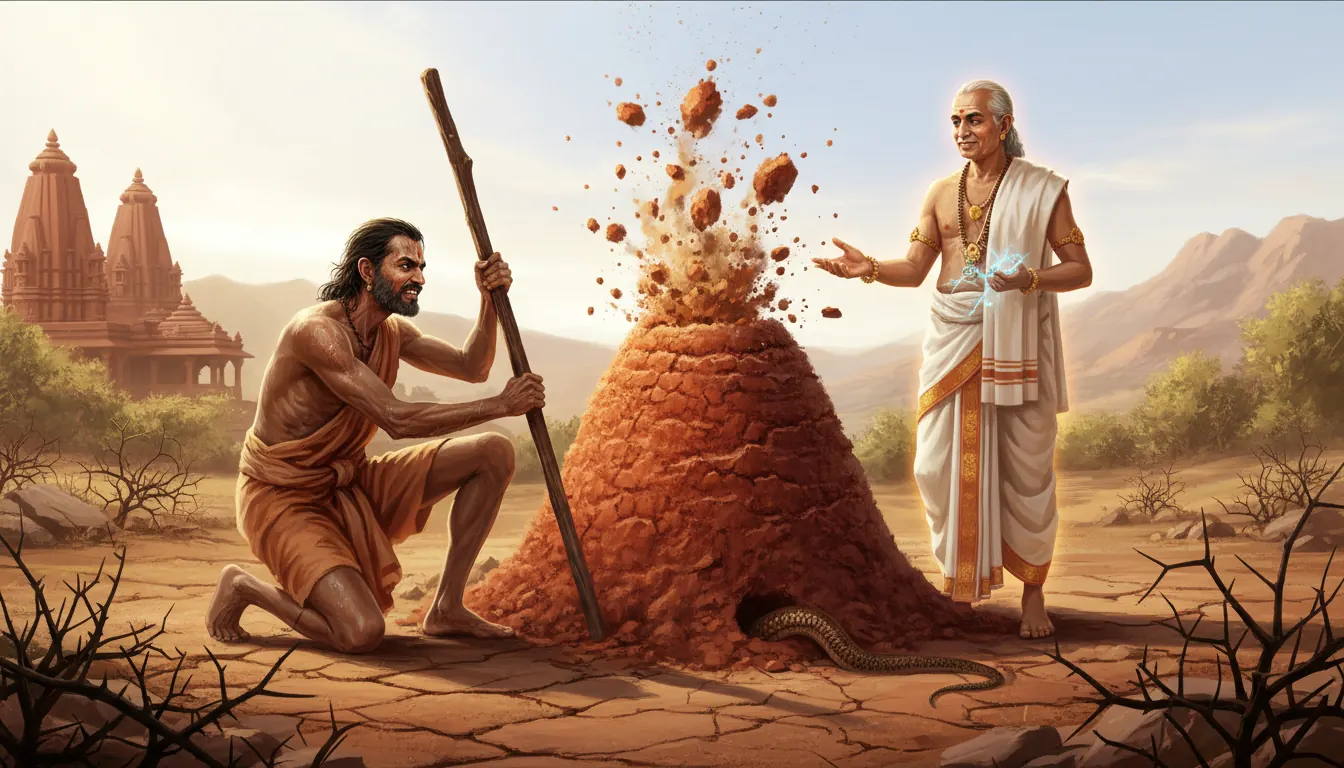
Utanka came down out of the tree full of rage and deeply anxious. He took his walking staff and began to pierce that anthill with it. Burning with anger and with the desire for revenge, he kept at that task without stopping for thirty-five days.
The goddess Earth, her body torn by that staff, grew deeply anxious, for she could not bear its force.
Then the king of the gods, the wielder of the thunderbolt, came there in his chariot drawn by green horses, and saw that great brahmana sitting and digging a hole to the nether regions with a stick.
Indra took the form of a brahmana, grieved by Utanka's sorrow, and spoke to him gently.
"What you are trying to do cannot be done. The realm of the Nagas is thousands of yojanas from here. I do not think you can do it with your walking staff."
"If I do not get the earrings back from the realm of the Nagas," said Utanka, "I will give up my life before your eyes, best of the twice-born."
When the thunder-armed Indra failed to divert him from his purpose, he stopped arguing and united that walking staff with the force of thunder. The Earth, opening under strokes that now had the thunder in them, yielded a way down.
The Black Horse in the World of Snakes
By that path Utanka entered the world of the Nagas, and saw that the region lay extended for thousands of yojanas on every side.
It was equipped with many walls made of pure gold and decked with jewels and gems. There were fine tanks of water with flights of stairs made of pure crystal going down into them, and many rivers of clear and transparent water, and many trees with diverse species of birds perching on them. The gate of that region was five yojanas high and a hundred yojanas in width.
Seeing all this, Utanka lost heart. He had come down through the earth with a stick and he despaired of ever finding the earrings in a country that size.
Then a black horse with a white tail appeared before him. His face and eyes were copper-coloured, and he seemed to blaze with energy.
"Blow into the Apana duct of my body," the horse said. "Then you will get back your earrings, which have been taken by one of Airavata's line. Do not shrink from doing what I ask, son. You did it often at Gautama's hermitage in the old days."
"How did I know you at my teacher's hermitage?" said Utanka. "I want to hear how I did then what you ask me to do now."
"Know, learned brahmana, that I am your teacher's teacher, for I am the blazing Jatavedas. You often worshipped me for your teacher's sake, child of Bhrigu's line, properly and with a pure heart and a pure body. That is why I will do what is good for you. Do what I ask without delay."
So Utanka, who had knelt at that fire every morning for a hundred years and blown it into life for another man's sake, knelt down and did it once more.
The god, pleased with him, blazed up to consume everything. From the pores of his body, by his very nature, a thick smoke poured out that threatened the world of the Nagas with terror. That vast, spreading smoke wrapped everything in darkness, until nothing could be seen any longer in all that golden country.
Cries of woe were heard throughout the mansions of the Airavatas, uttered by the Nagas with Vasuki at their head. The palaces could no longer be seen. They resembled woods and hills overwhelmed by a thick forest.
With their eyes red from that smoke, tormented by the power of the fire god, the Nagas came out of their mansions to the son of Bhrigu's line to find out what the matter was.
The Fee Delivered
They heard from that ascetic of immeasurable energy what the matter was. Then all the Nagas, with fear depicted in their eyes, offered him their worship according to the due forms. They placed the old and the young ones in front of them and bowed to him with their heads, and joined their hands.
"Be gracious to us, holy one."
When they had appeased the brahmana and offered him water to wash his feet and the Arghya to honour him, the Nagas gave him back those celestial and greatly revered earrings, and the smoke went out of their country.
Honoured by them, Utanka of great prowess walked round the fire god and set out for his teacher's hermitage.
He came quickly to Gautama's hermitage and gave the earrings to his teacher's wife, which was the only thing he had set out to do. And he told his teacher everything about Vasuki and the other Nagas, and about the agreement with the cannibal king, and about the black horse in the smoke.
That, Janamejaya, said Vaishampayana, is how the great-souled Utanka wandered through the three worlds and fetched those jewelled earrings for his teacher's wife. Such was the prowess of that ascetic, and so austere were his penances. I have told you what you asked me.
Dharma Lesson
A debt to a teacher is not discharged by obedience alone, and a hundred years of service can leave the fee still unpaid. The man who keeps his word even to a cannibal, and who once knelt to blow another man's fire into life, is the man heaven arms with thunder when a snake takes what he earned.