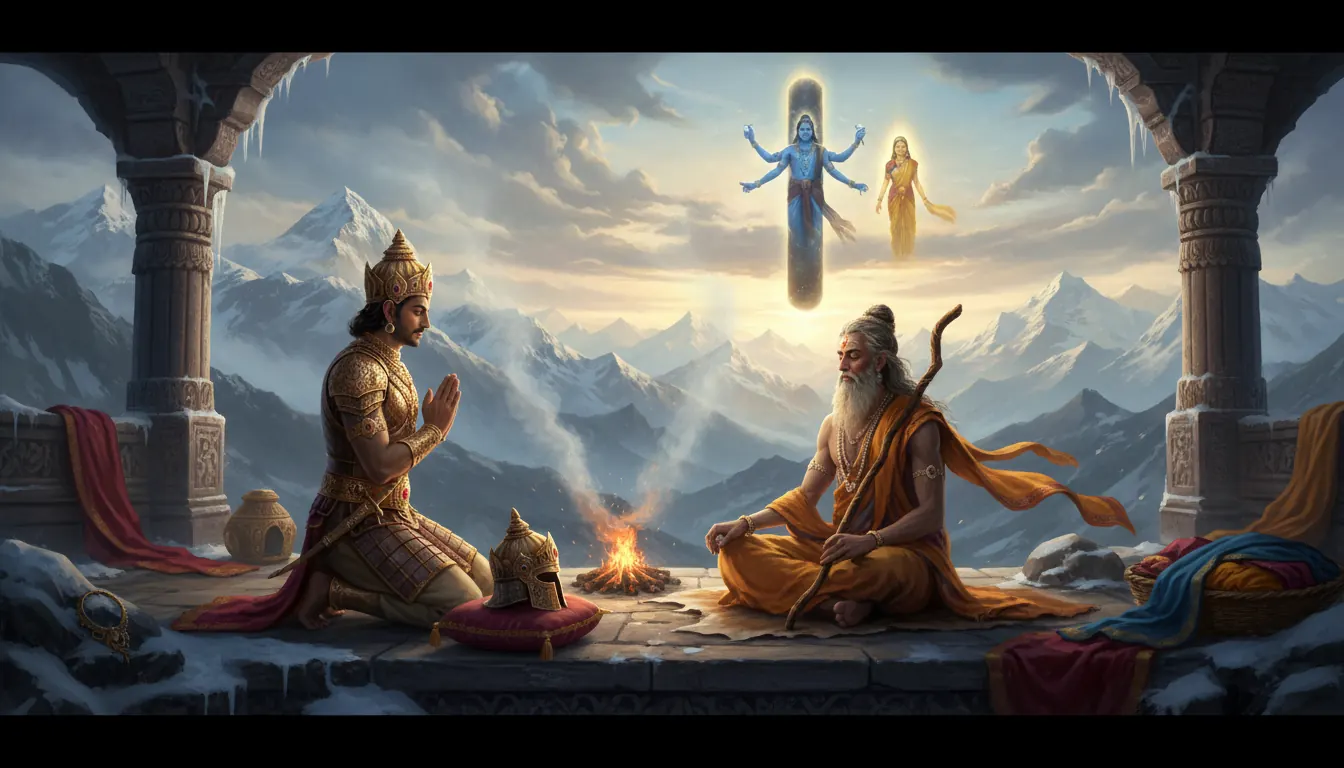
The Day the Rod Vanished
What happened to the world when Chastisement disappeared
In short
Yudhishthira asks who Chastisement is, and Bhishma gives him a face, four teeth, eight legs and a wife named Morality. Then the emperor Mandhatri climbs Munjaprishtha to put the same question to the ascetic king Vasuhoma, who tells how Brahma sneezed out a priest, how the rod went out of the world at that moment, and what Vishnu made of himself to bring it back.
Told in the Shanti ParvaSet in Kurukshetra, Munjaprishtha and Himavat19 min read
Who Is Chastisement?
"Grandsire, you have finished your teaching on the duties of kings," Yudhishthira said.
That is a mild opening for what came next. He had been listening for weeks. He had been told how a king raises revenue, how he treats a beaten enemy, how he chooses the men who will tell him things he does not want to hear, and running underneath all of it, in every third answer, had been one word that the old man kept using as if its meaning were settled.
"From what you have said, it seems that Chastisement stands very high and is lord of everything, for everything depends on Chastisement. It seems, mighty one, that Chastisement, with its great energy, present everywhere, is the foremost of all beings, among gods and rishis and great-souled Pitris, Yakshas and Rakshasas and Pishachas and Sadhyas, and every living thing in this world, beasts and birds included. You have said that the whole universe, moving and unmoving, gods, Asuras and men alike, can be seen to depend on Chastisement."
Then he stopped summarising and asked, and the questions came in a run, the way they do when a man has been holding them.
"Now, best of the Bharatas, I want to know truly who Chastisement is. What is he like? What is his form? What is his nature? What is he made of? Where does he come from? What are his features? What is his splendour? How does he stay so watchfully awake among living creatures? Who is it that stays forever awake, protecting this universe? Who, indeed, is this great being called Chastisement? What does Chastisement rest on? And what is his course?"
He had asked, in other words, for a person. Not for a policy on punishment. He wanted to know who the rod is.
The Shape of the Rod
"Listen, descendant of Kuru, and I will tell you who Chastisement is, and why he is also called Vyavahara," Bhishma said.
"That on which all things depend is called Chastisement. Chastisement is what keeps righteousness alive. And because it is Chastisement that stops men from taking what belongs to others, Chastisement has come to be called Vyavahara."
Then he quoted the oldest sentence he knew on the subject, and named its author.
"Long ago Manu first declared this truth: The man who protects all creatures, the loved and the hated equally, by wielding the lord of Chastisement without favour, is called the embodiment of righteousness. Manu spoke these words in ancient times. They stand for the lofty words of Brahman. And because they were spoken first, they are known as the first words."
The loved and the hated equally. That is the entire doctrine, and everything the old man says afterwards is commentary on those six words.
Then he gave the king what he had actually asked for, which was a face.
"Chastisement is a great god. His form is like a blazing fire. His colour is dark, like the petals of the blue lotus. He has four teeth, four arms, eight legs and many eyes. His ears are pointed like arrowheads and his hair stands on end. He has matted locks and two tongues. His face is the colour of copper, and he wears a lion's skin."
Eight legs and two tongues and a copper face. This is not a magistrate. It is something that runs.
"That irresistible god takes on this fierce shape. And he takes the form of the sword, the bow, the mace, the dart, the trident, the mallet, the arrow, the short thick club, the battle-axe, the discus, the noose, the heavy bludgeon, the rapier, the lance, every kind of weapon there is on earth, and so Chastisement moves through the world. Indeed, Chastisement moves over the earth piercing, cutting, wounding, lopping, splitting, striking, killing, rushing at its victims."
And he added, almost in passing, a household detail that changes the picture: the wife of Chastisement is Morality, who is known also by the names of Brahmana's Daughter, Lakshmi, Vriti, Saraswati, and Mother of the universe.
The Chain That Ends in Rain
"If there were no Chastisement," Bhishma said, "all creatures would have ground one another down. It is fear of Chastisement, Yudhishthira, that keeps living creatures from killing one another."
He put no gloss on that and did not soften it. The reason your neighbour does not take your field is not that he loves you.
"Subjects who are always protected by Chastisement add to the strength of their ruler, king. That is why Chastisement is held to be the greatest refuge of all. Chastisement quickly sets the world on the path of righteousness."
Then he laid out the chain, link by link, and it is the sort of argument that sounds like theology until you notice that it ends in food.
"Righteousness rests on truth, and it lives in the brahmanas. Possessed of righteousness, the best of the brahmanas gave themselves to the Vedas. From the Vedas the sacrifices flow. Sacrifices please the gods. The gods, once pleased, commend the people of the earth to Indra. For the good of the people of the earth, Indra gives them rain. The life of every creature depends on food. From food creatures get their nourishment and their growth. And Chastisement, in the form of the kshatriya ruler, stays awake among them."
So the rod stands at one end of a line that runs through study, sacrifice, the gods, the monsoon, the harvest, and the body of every living thing. Take it out and the line does not merely lose a stage. It stops.
"To serve this end, Chastisement takes the form of a kshatriya among men. He stays awake protecting men, always watchful and never fading. God himself has taken great care to send Chastisement for the kshatriya's use. There is nothing kings should honour more than Chastisement, which shows the ways of Righteousness. Brahman himself sent Chastisement down to protect the world and to fix the duties of each person."
And because he had said sent down, the next question was obvious, and Bhishma answered it before it was asked. "There is an old story people tell on this subject."
The Ascetic King on Munjaprishtha
Among the Angas there was a king of great splendour called Vasuhoma. That king was always busy with acts of piety, and together with his wife he practised the harshest penances.
He left his kingdom and went up. He went to the place called Munjaprishtha, which the Pitris and the celestial rishis hold in high honour, on a peak of Himavat near the golden mountains of Meru. The place has its name from a thing that happened there long before he came: Rama of the axe, sitting under a well-known banyan on that spot, had tied his matted locks together with munja grass, and from that time rishis of strict vows called the place Munjaprishtha. It is a favourite haunt of Rudra.
Living in that place, King Vasuhoma gained many holy qualities, won the regard of the brahmanas, and came to be thought a celestial rishi in his holiness. He was still a king. He had simply stopped being one anywhere that a king could be paid for it.
One day that crusher of foes, that friend of Shakra, the great-souled king Mandhatri, came to Vasuhoma on his mountain retreat.
Here it is worth pausing on who has walked up that mountain. Mandhatri was the emperor of the earth and a personal friend of the king of the gods. He had nothing left to conquer and nobody above him to consult. And when he reached the hermitage and saw King Vasuhoma, the great ascetic, he stood before him humbly, and waited.
Vasuhoma offered his guest water to wash his feet, and the Arghya with the usual offerings, and then, in proper order, asked after the welfare of his kingdom and its seven limbs.
Only after all of that did the host ask the visitor what he had come for.
"What can I do for you, king?"
The Emperor Comes as a Pupil
At these words Mandhatri, best of kings, was delighted, and he answered the wise Vasuhoma, who sat at his ease.
He began by establishing his host's credentials out loud, which is the courteous way to ask a hard question.
"King, you have studied all the teachings of Brihaspati. And the teachings of Ushanas, best of men, are known to you as well."
Both schools. The teacher of the gods and the teacher of the Asuras, the two great authorities on statecraft, and the man on the mountain had read both of them. Then Mandhatri asked what he had climbed for, in four questions.
"I want to know where Chastisement came from. What was awake before Chastisement? And what is said to be its end? How did Chastisement come to rest with the kshatriya? Tell me all this, wise one."
And then the emperor of the world said the sentence that gives this whole episode its shape.
"I come to you as a pupil, ready to pay you the teacher's fee."
He put himself in the posture of a boy at the start of a term, with the fee in his hand, in front of a man who had given up a kingdom smaller than his own. It is the same posture Yudhishthira had been holding in the sand at Kurukshetra for weeks, which is presumably why Bhishma chose this story out of all the stories he could have chosen.
"Listen, king," Vasuhoma said, "and I will tell you how Chastisement, the upholder of the world, came to be. It is the soul of righteousness, it is eternal, and it was created to keep all creatures properly governed."
Created. Not eternal in the sense of always having been in operation. There was a day it was made, and there was a reason, and the reason is a story about a sacrifice that went wrong.
The Sneeze That Made a Priest
"We have heard," Vasuhoma said, "that long ago the Grandsire of all the worlds, the divine Brahman, wished to perform a sacrifice but could find no priest whose qualifications matched his own."
That is the whole of the difficulty, and it is a difficulty peculiar to being first. A sacrifice requires a sacrificer and a priest, two men, one to give and one to conduct. The Grandsire had nobody in the universe of the right standing to hold the ladle for him, because there was nobody of his standing at all.
"So he conceived a child in his head and carried it there for many long years. When a thousand years had passed, the great god sneezed, and with the sneeze the child fell from his head."
A thousand years of carrying, and the delivery is a sneeze. The book does not make a joke of it and neither should anyone else, but it is a strange and homely detail to find at the origin of the world's law, and it is put down in the plainest possible words.
"The divine being born from Brahman in this way, scourge of enemies, was named Kshupa. He was a being of great power, and he became a lord of creatures. And Kshupa, king, became the priest at the great-souled Grandsire's sacrifice."
So the difficulty was solved. The Grandsire had made, out of his own head, the one being qualified to officiate for him, and the rite could begin.
And it is at the moment the rite begins that the disaster happens, and the cause of the disaster is the most unexpected thing in the whole account.
"When Brahman's sacrifice began, best of kings, Chastisement vanished, because of the visible form the Grandsire had to take for it."
To sacrifice, you must be somewhere. You must have hands and a seat and a direction you are facing. The Grandsire, in order to perform, had to take a visible form, and something went out of the world when he did, and the thing that went out was the rod.
The World With the Rod Gone
"Once Chastisement had vanished, great confusion broke out among all creatures."
What follows is a short list, and it is worth reading in the order it is given, because the order is an argument. It does not begin with murder. It begins with the loss of a distinction.
"There was no longer any distinction between what should be done and what should not."
That is the first casualty, and it is not a crime. It is the disappearance of the category that makes a crime possible.
"No one could tell clean food from unclean any more. Men stopped telling apart the drinks that were allowed and those that were not."
Still nobody has been hurt. What has gone is the small daily discrimination that a person makes without thinking about it, twenty times before noon.
"All creatures began to injure one another. There were no restraints in the matter of the union of the sexes."
Now it is bodies.
"All idea of property ceased. All creatures began to rob, and to snatch meat from one another. The strong began to slay the weak. Nobody had the slightest regard for his neighbour."
And that is the end of the list, and it is the end of the world in a paragraph, and the whole of it followed from the withdrawal of one thing that nobody had been thinking about while it was there.
Notice what the sequence claims. It claims that the rod is not the last resort of a society that has failed at everything else. It claims that the rod is what holds up the ordinary sense of clean and unclean, mine and thine, permitted and forbidden, in the mind of a man who has never in his life been near a court. Take it away and the man does not become a criminal. He becomes a creature who cannot tell what a crime would be.
"Then the Grandsire worshipped the divine and eternal Vishnu, and said to that great giver of boons: Have mercy now, Keshava. Ordain that this confusion that has broken out may come to an end."
Vishnu Makes a Body for It
At these words the greatest of the gods, armed with an enormous Sula, thought for a long time.
He did not answer at once and he did not send a decree. Vasuhoma is careful about this, and the care matters, because what was needed was not a rule. Rules had not gone missing. What had gone missing was the thing that makes a rule bite, and no further rule can supply that.
Then Vishnu made his own self into the form of Chastisement.
Out of himself. Not made from some material, not appointed from among existing beings, not delegated. The god took his own being and shaped it into the rod, which is why every list of the names of Chastisement that Bhishma had recited that morning ended where it did: Chastisement is the holy Vishnu, and he is the mighty Narayana, and because he always takes a terrible form he is called Mahapurusha.
"From that form, which has Righteousness for its legs," Vasuhoma said, "the goddess Saraswati created Danda-niti, the science of Chastisement, and it soon became famous throughout the world."
That is the second making, and it is as important as the first. The rod was a body; the goddess of speech drew a science out of it. Force came into the world first and the doctrine of how to use force came second, extracted from the thing itself by the one deity whose whole province is words. And the legs the form stands on are Righteousness, so that the science has nothing to rest on if the righteousness is taken away.
A king who has the rod without the Danda-niti has a weapon. A king who has the Danda-niti without the rod has a book. The world had just demonstrated what it looks like when it has neither.
Then the great god armed with the enormous Sula thought for a while again, and did the third thing, which was to put names to responsibilities.
The Lords Appointed
He appointed a few among the gods as the lords or rulers of their respective classes, and Vasuhoma named them to Mandhatri one after another, in the manner of a man reading out a list of offices.
It was then that he made the divine, thousand-eyed Indra ruler of the gods. Yama the son of Vivaswat was made lord of the Pitris. Kubera was made lord of treasures and of all the Rakshasas. Meru was made king of the mountains, and Ocean lord of the rivers. Mighty Varuna was given sovereignty over the waters and the Asuras. Death was made lord of life and of all living things, and Fire was made lord of everything that has energy. Mighty Isana, the great-souled, eternal, three-eyed Mahadeva, was made lord of the Rudras. Vasishtha was made lord of the brahmanas, and Jatavedas chief of the Vasus. Surya was made lord of all shining bodies, and Chandramas king of the stars and constellations. Ansumat was made lord of all herbs, and mighty twelve-armed Kumara chief of all the spirits and ghostly beings.
And Time, who holds the seeds of both destruction and growth, was made sovereign over all creatures, and over the four parts of Death, which are weapons, diseases, Yama and deeds, and last of all over grief and joy.
Read the list as a whole and its logic comes out. Nothing in it is left ownerless. The mountains have a king, the rivers have a lord, the plants have somebody answerable for them, the ghosts have a commander, and even grief and joy are on somebody's roll. The remedy for a world in which all idea of property ceased was not to abolish belonging. It was to establish, from the mountains down to the herbs, exactly whose each thing was and who would answer for it.
And then the rod itself had to be given to somebody.
The Hands the Rod Passed Through
"The rod of chastisement was given to Kshupa, the son born to Brahman afterwards, lord of all creatures and foremost of the virtuous," Vasuhoma said.
The priest of the interrupted sacrifice got it first. Then, when that sacrifice had been completed with all due rites, Mahadeva paid proper reverence and handed Chastisement, that protector of Righteousness, to Vishnu.
And from there it went down, hand to hand, and Vasuhoma traced it the way a man traces a title deed.
Vishnu gave it to Angiras. Angiras, the greatest of ascetics, handed it to Indra and to Marichi. Marichi gave it to Bhrigu. Bhrigu gave that rod, meant to protect righteousness, to all the rishis. The rishis gave it to the Regents of the world. The Regents handed it back to Kshupa. Kshupa then handed it to Manu the son of Surya. And Manu gave it to his sons, for the sake of true righteousness and wealth.
Eleven pairs of hands between the body Vishnu made of himself and the man sitting on a throne today, and not one of those transfers was a conquest. Every one of them was a handing over. What a king holds, he holds because it was given to him by somebody who had been given it, and the last man in that line is holding property that has been in trust since before there were kings.
Then Vasuhoma set out the terms of the trust, and they are short.
"Chastisement should be dealt out with discernment, guided by righteousness and not by whim. Its purpose is to restrain the wicked. Fines and forfeitures are meant to strike fear, not to fill the king's treasury. Maiming the body, or putting to death, should never be done for trivial reasons. Nor should physical pain of any kind, or hurling from mountaintops, or banishment, be inflicted for such reasons."
Not for filling the king's treasury. An emperor had climbed a mountain to hear the origin of the rod, and what he was sent home with was a rule about accounting.
"Chastisement, passing from holder to holder, stays awake and protects all creatures," Vasuhoma said. "A virtuous king should rule rightly, guided by Chastisement."
"Whoever listens to this teaching of Vasuhoma," Bhishma said to the son of Dharma from his bed of arrows, "and lives by it once he has heard it, is sure to have all his wishes fulfilled. Now, bull among men, I have told you everything about who Chastisement is, the restrainer of the universe, which is governed by righteousness."
Dharma Lesson
Punishment is not the opposite of order but its body. When the rod withdrew, men did not first turn to murder; they lost the difference between clean and unclean, mine and thine, and only then began to devour one another. And the rod reached the throne through eleven pairs of hands as a trust, which is why it is meant for striking alarm and never for filling the treasury.