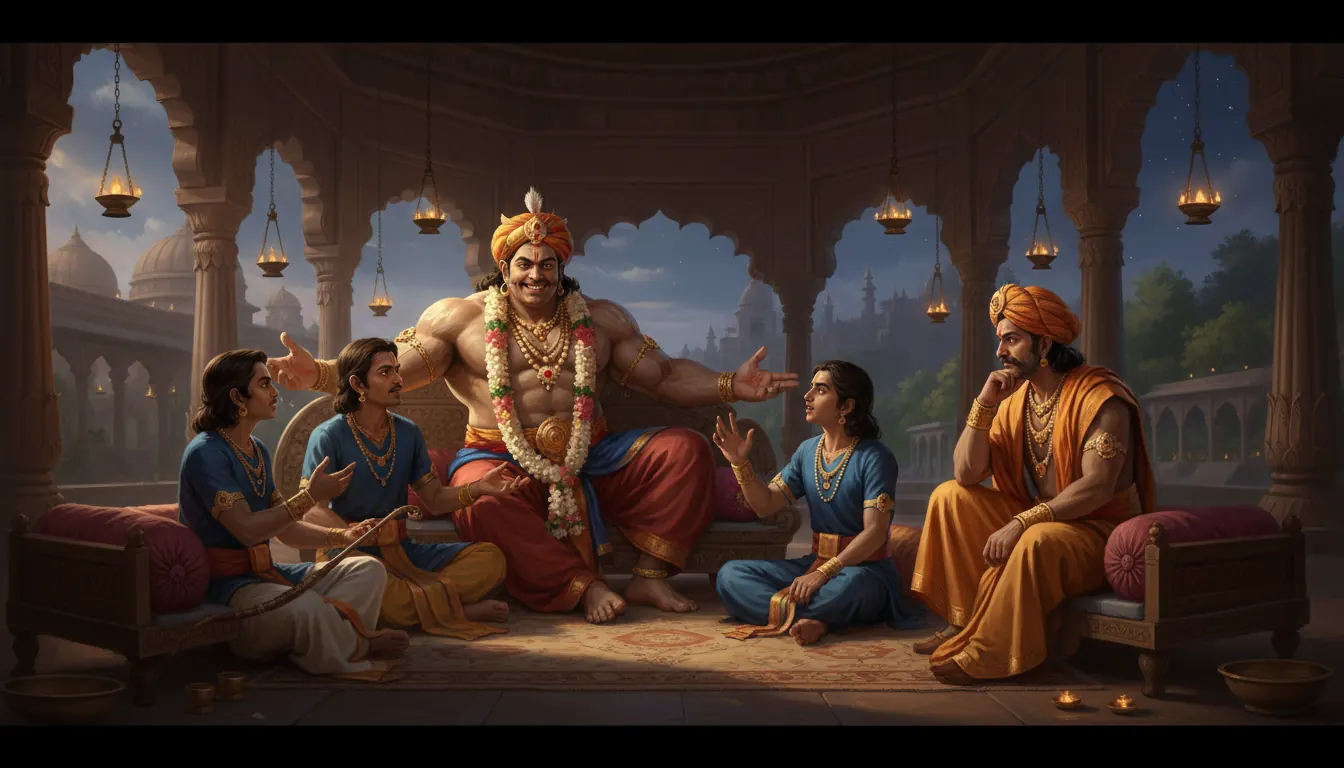
What the Brothers Wanted Most
An evening argument about virtue, wealth and desire
In short
Home from the bed of arrows, Yudhishthira asks his brothers and Vidura which of Virtue, Wealth and Desire comes first. Vidura answers for Virtue, Arjuna for Wealth, the twins for a wealth fenced by virtue, and Bhima, garlanded and smeared with sandal, for Desire. Yudhishthira weighs all four, calls them false philosophy, and names a fifth thing none of them had on the table.
Told in the Shanti ParvaSet in Hastinapura and Kurukshetra18 min read
The Road Back from the Field
Vaishampayana said that when Bhishma had said what he had to say, he became silent, and that Yudhishthira and the others returned home.
That is the whole of the transition, and it is worth standing still in for a moment, because of what it covers. For days the sons of Pandu had been riding out from Hastinapura to the field at Kurukshetra, dismounting at a distance and walking the last part on foot, and sitting down in the sand around a man who was lying on a bed made of the arrows that had gone through him. He had been answering questions about kingcraft. He had told them how a king should choose ministers, how he should treat those he has beaten, what he owes to a beggar and what to a spy, and the brothers had listened the way men listen who know the source will not be there next season.
On this evening the old man stopped, and they got up, and they went back.
The road from the field to the city runs through country that had been fought over and had not yet been cleaned. They rode it in the last of the light. Nobody had asked Yudhishthira a question in a long while; every question in that season went the other way, from the living to the dying. And when they were home and the lamps were lit and his four brothers were sitting with him and Vidura made the fifth of those he meant to question, the king turned to his own brothers and asked them something, which was not usual.
He did not ask it as a king asks. He asked it the way a man asks who has been listening to another man for a fortnight and wants to hear what the people in his own house actually think.
The Question Put to Five Men
"The course of the world rests on Virtue, Wealth and Desire," Yudhishthira said. "Of these three, which comes first in importance, which second, and which last?"
That was the first half. The brothers were ready for it; it is a schoolroom question, and every one of them had an answer waiting behind his teeth. Then he asked the second half, which is the one he actually cared about.
"To subdue the threefold group," he said, "which is lust, wrath and greed, on which of the first three should the mind be fixed?"
So it was not a question about the ranking of goods. It was a question about what a man should hold on to when the three enemies inside him come for him, and it was being asked by a man who had just spent eighteen days watching what wrath and greed do when nobody holds on to anything.
"All of you should answer this question," he added, "cheerfully, and in words that are true."
Cheerfully. He asked them for that too, and it is a small strange courtesy in a house where the fires had not been out of anybody's nose for a month. He wanted an argument in his hall in the evening, brothers talking across a lamp, and not five men agreeing with the king.
He got what he asked for. They answered him in four separate voices and no two of them said the same thing, and one of them, before he was finished, told the room that a man devoted to only one of the three was no superior man.
This is the one council in that whole long season where Bhishma is not present, where nobody quotes him, and where the five brothers and Vidura are obliged to speak for themselves.
Vidura Answers for Virtue
Vidura spoke first, and there is an irony in the order that the text does not point out and does not need to. He was a man versed in the science of Profit. He knew the course of the world, he knew what things cost, he had counselled a kingdom he did not own, and he had great brilliancy of intellect. If anyone was going to argue for Wealth it should have been the minister.
He argued for Virtue, and he did it by making a list, in the manner of a man who does not trust adjectives.
"Study of the various scriptures," he said. "Asceticism. Giving. Faith. The performance of sacrifices. Forgiveness. Sincerity of heart. Compassion. Truth. Self-restraint. These are the possessions of Virtue."
He let the list sit there. Ten items, most of them things a man does rather than things a man feels.
"Hold to Virtue," he said. "Never let your heart turn away from it. Both Virtue and Profit have their roots in these things I have named, and I think all of them can be included in the one word."
Then he gave his grounds, and they were historical rather than moral. "It is by Virtue that the rishis have crossed the world with all its difficulties. It is on Virtue that all the worlds depend for their existence. It is by Virtue that the gods rose to their high place. It is on Virtue that Profit rests."
His ranking followed from that. "Virtue, king, comes first in merit. Profit is said to be middling. Desire, the wise say, is the lowest of the three. So one should live with a restrained soul, giving most attention to Virtue."
And he ended with a rule of conduct rather than a doctrine, which was his way. "One should treat all creatures as one would treat oneself."
No one interrupted him. Vidura had earned a certain silence in that house, over years, by having been right in it when it was expensive to be right.
Arjuna Answers for the Field of Action
Then Pritha's son Arjuna spoke, urged on by the drift of the question. He was well skilled in the science of Profit and versed also in the truths of Virtue, and he began where a soldier begins, with the ground.
"This world, king, is the field of action. So action is praised here. Agriculture, trade, the keeping of cattle, and the many kinds of arts make up what is called Profit, and Profit is the end of all such acts. Without Wealth, neither Virtue nor the objects of Desire can be won. This is the declaration of the Sruti."
Then he said the sentence that cuts. "Even people of impure souls, if they have Wealth of many kinds, are able to perform the highest acts of virtue and to satisfy desires that seem hard to satisfy."
That is not a pious sentiment and Arjuna did not offer it as one. It is an observation about who is able to build the tank and feed the brahmanas at the gate, and it does not depend at all on whether the man doing it is good.
"Virtue and Desire are the limbs of Wealth, as the Sruti declares. Just as all creatures worship Brahman, even people of high birth worship a man of Wealth."
Then he did something to the argument that made it hard to answer. He went down the list of everyone in the world who is supposed to be beyond wanting money, and put them all in the column of men who want it.
"Even those who dress in deer-skins and wear matted locks on their heads. Those who are self-restrained, who smear their bodies with mud, who have their senses under complete control. Even those with shaven heads who are devoted Brahmacharins and live apart from one another, cherish a desire for Wealth. Others in yellow robes, with long beards, graced with modesty, learned, contented, free from all attachments, come to want Wealth. Others follow the practices of their ancestors, and others long for heaven, and they do the same. Believers and unbelievers, and those who rigidly practise the highest Yoga, all bear witness to the excellence of Wealth."
He finished with a definition that a king could act on. "A man is said to truly have Wealth when he cherishes his dependants with things to enjoy, and strikes his enemies with punishment. That, wisest of men, is truly my opinion."
Then he did the courteous thing, and handed the floor on. "But now listen to these two, who are about to speak."
The Twins Answer Together
The two sons of Madri spoke next, and they spoke as one, which is how the twin sons of the Ashvins do most things in this book. Nakula began a sentence and Sahadeva finished it and nobody in the room could afterwards say with confidence which of them had said which half.
They started by agreeing with Arjuna, hard.
"Sitting or lying, walking or standing, one should strive to gain Wealth, even by the most vigorous means. If Wealth, which is hard to gain and very pleasant, is earned, then the one who has earned it is seen, without doubt, to obtain all the objects of Desire."
And then they put the fence around it, which was their contribution, and it is the most practical thing said in the room that night.
"That Wealth which is connected with Virtue, and that Virtue which is connected with Wealth, is certainly like nectar. So our opinions are these. A person without wealth cannot satisfy any desire. In the same way, there can be no Wealth in one who has no Virtue. So the man who stands outside both Virtue and Wealth is an object of fear to the world."
An object of fear. Not a wicked man, not a fool, not a sinner. A hazard. The twins had fought through a war, and their picture of the man with neither money nor scruple is the picture of something you post guards against.
"So one should seek to gain Wealth with a devoted mind, without neglecting what Virtue requires. Those who believe in the wisdom of this saying gain whatever they desire."
Then they gave the order of operations, three steps, in sequence, like a drill.
"One should first practise Virtue. Next, gain Wealth without sacrificing Virtue. And then seek the satisfaction of Desire, for this should be the last act of one who has succeeded in gaining Wealth."
Having said that, the twin sons of the Ashvins remained silent. They had put Desire last, but they had not thrown it out, and they had given the whole thing a shape that a young man could actually live by.
Across the lamp, the second son of Kunti was waiting.
Bhima Speaks for Wanting
Bhimasena was sitting garlanded. His body was smeared with sandal-paste and he wore excellent ornaments, and he had come to his brother's council out of whatever he had been doing that evening without changing anything about himself, which is one way of making an argument before you open your mouth.
"One without Desire never wishes for Wealth," he said. "One without Desire never wishes for Virtue. One who has no Desire can never feel any wish at all. For this reason, Desire is the foremost of all the three."
He then went through the same catalogue Arjuna had used and turned it inside out.
"It is under the sway of Desire that even the rishis devote themselves to penances, living on fruits, or on roots, or on air alone. Others who have Vedic learning busy themselves with the Vedas and their branches, or with rites of faith and sacrificial acts, or with making gifts and accepting them. Traders, farmers, keepers of cattle, artists and artisans, and those employed in rites of propitiation, all act from Desire. There are some who dive to the depths of the ocean, driven by Desire."
That last one is the image he chose to stop on. A man going down into black water with his lungs full because he wants a pearl.
"Desire takes various forms. Everything is pervaded by the principle of Desire. A man beyond the reach of Desire never is, was, or will be seen in this world. This, king, is the truth. Both Virtue and Wealth are based upon Desire."
Then he made his case in the kitchen, because he was a man who thought in food.
"As butter represents the essence of curds, even so is Desire the essence of Profit and Virtue. Oil is better than oil-seeds. Ghee is better than sour milk. Flowers and fruits are better than wood. Similarly, Desire is better than Virtue and Profit. As honeyed juice is extracted from flowers, so is Desire said to be extracted from these two."
Nobody had a rebuttal ready for the churn and the press. You cannot say that curds are more essential than butter without arguing with every woman in the house.
"Desire is the parent of Virtue and Profit," Bhima said. "Desire is the soul of these two. Without Desire brahmanas would never give either sweets or wealth to brahmanas. Without Desire the diverse kinds of action that are seen in the world would never have been seen at all."
The Small Man and the Best of His Species
Then Bhima said the thing that would have got a smaller man thrown out of the hall.
"Go to beautiful young women dressed in fine robes, adorned with every ornament and merry with sweet wines, and enjoy yourself with them. Desire, king, should be the first of the three for us."
He said it to Yudhishthira. To the eldest son of Dharma, in mourning, in a house that had buried most of its family inside the year. It is a rare speech in which somebody tells the king to go and enjoy himself, and Bhima delivered it garlanded and smelling of sandalwood, which is either an insult or a prescription depending on how much you like Bhima.
Then, having got everyone's attention that way, he turned the whole speech around.
"I have thought the question through to its very roots, and this is my conclusion. Do not hesitate to accept it, son of Dharma. These words of mine are not empty. Full of righteousness as they are, all good men will accept them."
And then, from the man who had just spent his whole turn arguing that Desire outranks the other two, came this.
"Virtue, Profit and Desire should all be equally attended to. The man who devotes himself to only one of them is certainly not a superior person. The man who devotes himself to only two of them is said to be middling. But the man who attends to all three is the best of his species."
So the argument for Desire was never an argument for Desire alone. It was a trap laid for four men who had each just finished ranking things, and it caught all of them, Vidura at the top of the list with his ten possessions of Virtue and Arjuna with his catalogue of ascetics who want money. Bhima had let each of them plant a flag and had then informed the room that planting a flag was the error.
When he had said these words to those heroes, briefly and also in detail, Bhima fell silent. Surrounded by friends, smeared with sandal-paste, adorned with excellent garlands and ornaments. The text makes a point of the garlands. It wants you to see him sitting there.
The King Calls It All False Philosophy
King Yudhishthira the just, that most virtuous of men, a man of great learning, reflected carefully for a while on the words all of them had spoken.
And then he thought all those speeches to be false philosophy.
He did not say it rudely. He began with a compliment, and it was a real one. "There is no doubt that all of you have settled conclusions about the scriptures, and all of you know the authorities. I have heard the words you have spoken, full of certainty."
Then: "Now listen with close attention to what I say to you."
What he said had not been on the table at any point in the evening. He did not pick Virtue, which his own name should have obliged him to pick. He did not split the difference with Bhima. He answered a question nobody had asked by describing a man.
"He who is not employed in merit or in sin. He who does not attend to Profit, or Virtue, or Desire. Who is above all faults. Who looks on gold and a brick-bat with equal eyes. Such a man is freed from pleasure and pain and from the need to accomplish his purposes."
Gold and a brick-bat. Given who was in the room, and what had just been fought over, and what the whole war had been about in the end, that is a chosen example and not a random one.
"All creatures are subject to birth and death," he said. "All are subject to decay and change. Woken again and again by the many benefits and evils of life, all of them praise Emancipation."
And then, and this is the sentence that keeps the speech from being a sermon: "But we do not know what Emancipation is."
He went on without pretending otherwise. "The self-born and divine Brahman has said that there is no Emancipation for him who is bound with ties of attachment and affection. But those who have learning seek Extinction. For this reason one should never regard anything as either agreeable or disagreeable. This view seems to be the best."
Seems. He was proposing a fifth thing to men who had each brought him a certainty, and he would not dress it up as one.
No One Acts As He Pleases
Then he took the last step, and it is the step that makes the whole evening land somewhere none of the four speakers had been standing.
"No one in this world can act as he pleases," Yudhishthira said. "I act precisely as I am made to act. The great Ordainer makes all creatures proceed as He wills. The Ordainer is Supreme. Know this, all of you."
Every one of the four answers had assumed a man choosing. Vidura's man chooses Virtue and holds to it. Arjuna's man goes out into the field of action and gets. The twins' man performs three operations in the correct order. Bhima's man wants, and because he wants, he moves. The king had listened to four descriptions of a chooser and had then told his brothers that he could not find the chooser anywhere.
"No one can obtain by his acts what cannot be obtained. What is to be, happens. Know this. And since the man who has withdrawn himself from the threefold group may succeed in winning Emancipation, it seems that Emancipation brings the highest good."
He stopped there.
Vaishampayana said that when they had heard these excellent words, full of reason and pleasing to the heart, Bhima and the others were filled with delight, and joining their hands, bowed to that prince of Kuru's line. Bhima with them, garlands and all. They had heard a speech well adorned with sweet letters and syllables, pleasing to the heart, free of harsh sounds and words, and those foremost of men began to applaud Yudhishthira highly.
And the high-souled son of Dharma, a man of great energy, praised them in return. That is in the text and it is easy to read past. He did not win the argument and leave it there. He praised his convinced auditors, four men who had each come at his question honestly and been overturned, and who had bowed rather than sulk about it.
Then, once more, the king turned to the son of the greatest of rivers, and asked him about duties.
Which is to say that the next morning they got on the road to the field again, and sat down in the sand around the old man on the arrows, and went on with the lesson while there was still somebody there to give it.
Dharma Lesson
Each of the three aims of life is honest and each is incomplete, and the man who insists on ranking them has not yet noticed that he did not choose his own place in the order. Yudhishthira's answer is not a fourth ranking but a refusal to rank: the eye that sees gold and a brick with the same weight is already free of the quarrel. He offers it, notably, without claiming to know what freedom is.