The Wind Answers the Thousand-Armed King
Kartavirya boasts, and an invisible voice begins to argue
In short
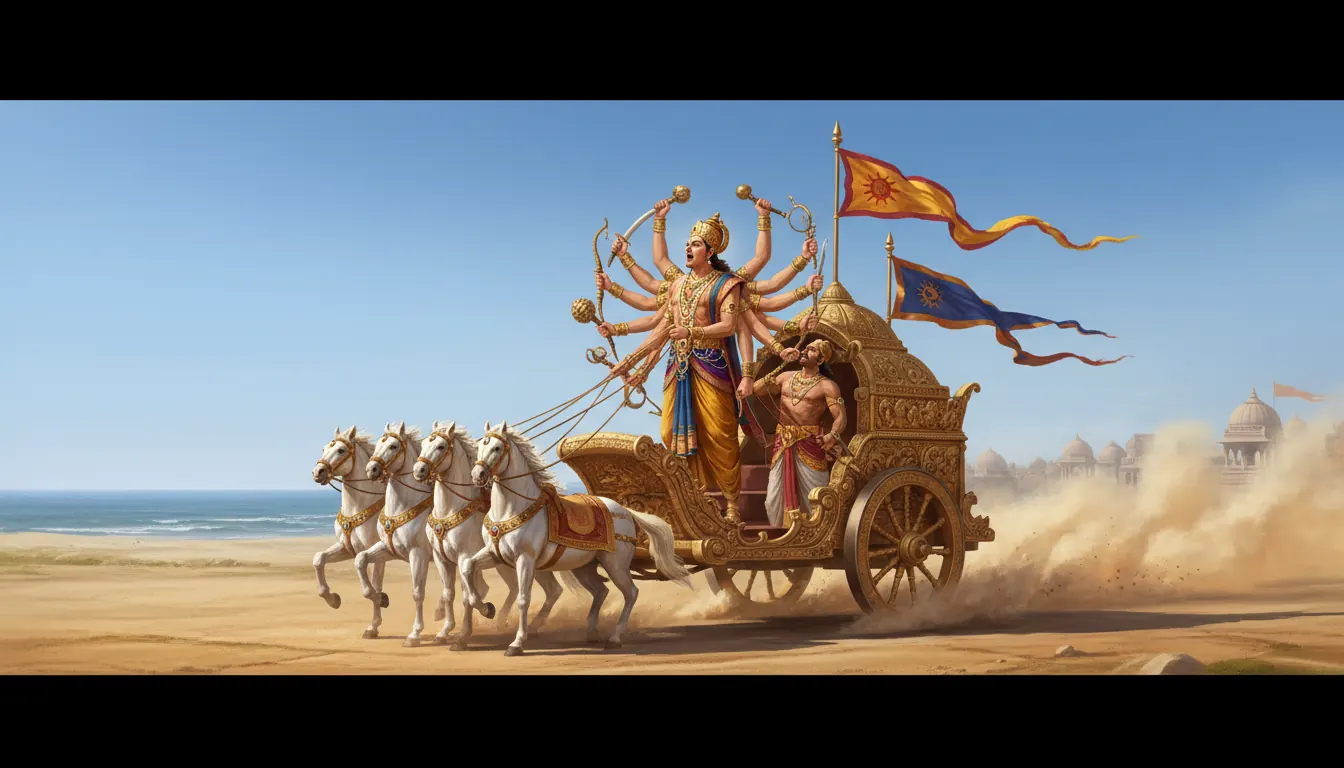
Kartavirya of Mahishmati, granted a thousand arms and a fourth boon that the righteous should correct him whenever he went wrong, rides out and asks aloud who is his equal. A voice from the empty sky answers that the brahmana is, and the god of wind matches every claim of the king's with a brahmana's feat. The king yields, and Vayu warns him of the race of Bhrigu.
Told in the Anushasana ParvaSet in Kurukshetra, Mahishmati and The Ocean20 min read
Why the Grandsire Bows
"Tell us, king," said Yudhishthira, "what reward do you see in worshipping brahmanas, that you worship them? What success comes from worshipping them, that guides you to do it?"
It was a fair question to put to a man on a bed of arrows. Bhishma had ruled Hastinapura in all but name for two generations. He had beaten Rama of Jamadagni's race to a standstill on the Kurukshetra plain. And every day of his life he had risen and made his salutation to men who owned nothing and carried a water pot.
"On this subject," Bhishma said, "people tell the old story of a conversation between Pavana and Arjuna. Not your brother. There was another Arjuna before him, and he had a thousand arms, and he was the lord of all the world, and he learned what I am about to tell you in the middle of the road, out loud, from his own chariot."
The Fourth Boon
Long ago the mighty Kartavirya, who had a thousand arms and great beauty, became lord of all the world. His capital was the city of Mahishmati. That chief of the Haihaya line of kshatriyas, whose prowess was never checked, ruled the whole earth with her belt of seas, together with all her islands and all her precious mines of gold and gems.
He had come by it honestly enough. Keeping to the duties of the kshatriya order, and to humility and Vedic learning, the king gave great gifts of wealth to the rishi Dattatreya. The son of Kritavirya worshipped that great ascetic until he was pleased with him, and the ascetic told him to ask for three boons.
"Let me have a thousand arms when I am among my troops," said the king. "But while I am at home, let me have only two arms, as usual. Let fighters in battle see me with a thousand arms. Let me conquer the whole earth by my own prowess. And once I have won the earth righteously, let me rule her with vigilance."
Then he asked for one more, and it is the only reason his name is worth remembering.
"There is a fourth boon I ask you to grant, best of the twice-born. Since I depend on you: whenever I happen to go wrong, let the righteous come forward to instruct me and set me right."
"So be it," the brahmana replied. And so that king of blazing splendour won those boons, including the one that mattered most.
A Voice Out of the Empty Sky
Then, riding in his chariot, which shone like fire or the Sun, the king, blinded by his great prowess, said aloud what he had been thinking for some years.
"Who is there who could be thought my equal in patience and energy, in fame and heroism, in prowess and strength?"
When he had said this, an invisible voice in the sky answered him. There was nothing overhead but sky.
"You ignorant wretch, do you not know that the brahmana is greater than the kshatriya? It is with the brahmana's help that the kshatriya rules all creatures."
The king did not flinch and did not look for the speaker. He argued.
"When I am pleased, I can create many creatures. When I am angry, I can destroy them all. In thought, word and deed I am the foremost. The brahmana is certainly not above me. You say the two are joined in the very act on which the kshatriya's greatness rests, but there is a difference to be seen. Brahmanas are seen to take refuge with kshatriyas. Kshatriyas never seek refuge with brahmanas. All over the earth the brahmanas accept that refuge, on the pretext of teaching the Vedas, and live off the kshatriyas. The duty of protecting all creatures belongs to kshatriyas. It is from kshatriyas that brahmanas get their living. How then can the brahmana be greater?
"Very well. From today I will bring your brahmanas under my rule, these brahmanas who are greater than all creatures but who live by begging and are so full of conceit. What the virgin Gayatri has said from the sky is not true. Dressed in skins, the brahmanas go about as they please. I will bring those free-roaming creatures under my rule. God or man, there is no one in the three worlds who can throw me down from the sovereignty I hold. This world, which is now thought to have brahmanas as its foremost dwellers, will soon be made a world whose foremost dwellers are kshatriyas."
At these words the goddess who ranges the sky was troubled, and said nothing more.
The Messenger of the Gods
Then somebody else spoke from the sky, and this one did not go away when contradicted.
"Give up this sinful attitude. Bow to the brahmanas. If you harm them, you will bring trouble on your kingdom. The brahmanas will either kill you, king as you are, or, mighty as they are, they will drive you out of your kingdom and strip you of your energy."
"Who are you?" said the king.
"I am the god of wind, the messenger of the gods. I am telling you what is for your good."
And here the fourth boon began to work, though the king did not recognise it. He had asked that the righteous should come forth to set him right whenever he went wrong, and the righteous had come, and what the king did was open the argument wider.
"Oh, I see you have shown your devotion and attachment to the brahmanas today," said Arjuna of the thousand arms. "Tell me, then, what kind of earthly creature the brahmana is. Tell me, is a superior brahmana anything like the Wind? Or is he like Water, or Fire, or the Sun, or the Sky?"
"Listen, deluded man," said the god of wind, "to the qualities that belong to brahmanas. The brahmana is greater than all the things you have named."
And then, riding beside a chariot on an open road, the wind began to recite the record.
The Record, Read Out
"Long ago the great rishi Angiras drank up all the waters by his energy. He drank them off as if they were milk, and still his thirst was not quenched, so he filled the earth with water again by raising a mighty wave. Another time, when Angiras was angry with me, I fled, leaving the world, and for a long time I hid in the Agnihotra of the brahmanas for fear of that rishi. I, whom you have just asked whether a brahmana is like the Wind.
"The illustrious Purandara was cursed by Gautama because he lusted after Ahalya's body. Yet, for the sake of Righteousness and wealth, the rishi did not destroy the chief of the gods outright, though he could have done so.
"The Ocean, king, which in earlier days was full of crystal water, became salty when the brahmanas cursed it. Even Agni, who is the colour of gold, who blazes with brilliance when free of smoke, and whose flames join together and burn upwards, lost all these qualities when the angry Angiras cursed him.
"Look: the sixty thousand sons of Sagara, who came to worship the Ocean, were all ground to dust by the golden-skinned brahmana Kapila. The great kingdom of the Dandakas was destroyed by a brahmana. The mighty kshatriya Talajangha was destroyed by a single brahmana, Aurva.
"You too have won a great kingdom, great might, religious merit and learning, all hard to attain, through the grace of Dattatreya. Why do you, Arjuna, worship Agni every day, who is a brahmana? He carries the sacrificial offerings from every part of the universe. Do you not know this?"
The king rode on and said nothing, and the wind kept pace with him.
The Earth Who Tried to Leave
"Once upon a time, king, a ruler named Anga wanted to give away the whole earth to the brahmanas as a sacrificial gift. At this the earth was filled with anxiety.
"'I am the daughter of Brahman,' she said. 'I hold up all creatures. Alas, now that this greatest of kings has me, why does he want to give me away to the brahmanas? I will give up my nature as the soil and go to my father. Let this king and all his kingdom be destroyed.'
"Having made up her mind, she set off for the region of Brahman. That is to say, the ground itself intended to walk out from under the feet of every living thing, and there was no one to stop her.
"When the rishi Kashyapa saw the goddess Earth about to leave, he at once entered her visible body, casting off his own body by the power of Yoga. Filled with the spirit of Kashyapa, the earth flourished and became rich with every kind of plant and crop. For as long as Kashyapa filled the earth, Righteousness was foremost everywhere and all fears ceased.
"So the earth stayed filled with the spirit of Kashyapa for thirty thousand celestial years, fully awake to all the work it used to do when it was filled with the spirit of Brahman's daughter. When that time was over, the goddess came back from the region of Brahman, arrived here, bowed to Kashyapa, and from then on became that rishi's daughter.
"Kashyapa is a brahmana. That is the feat a brahmana performed. Tell me the name of the kshatriya who could be thought greater than Kashyapa."
At these words King Arjuna stayed silent.
The Man Who Drank the Water Back
"Now hear the story of Utathya, who was born in the line of Angiras. Soma's daughter, named Bhadra, came to be thought unrivalled in beauty, and her father considered Utathya the fittest husband for her. Soma's father Atri invited Utathya to his house and gave him the famous maiden, and Utathya duly took the girl as his wife.
"But the handsome Varuna had long desired the girl. He came to the woods where Utathya lived, and when she went into the Yamuna to bathe, he stole her away, and the Lord of the waters took her to his own home. That mansion was a wonder to see. It was adorned with six hundred thousand lakes. No mansion could be thought more beautiful than that palace of Varuna.
"When he had heard all the facts from Narada, Utathya said, 'Go to Varuna, Narada, and speak to him with proper severity. Ask him why he has carried off my wife, and tell him in my name that he must give her up. Tell him too: you are a protector of the worlds, Varuna, not a destroyer.'
"Narada went, and said what he had been told to say. Varuna replied, 'This timid girl is very dear to me. I dare not let her go.' And Narada came back downcast and said, 'Great ascetic, Varuna has thrown me out of his house by the throat.'
"At this Angiras blazed with anger. Rich in penances as he was, he made the waters solid and drank them up by his energy. When all the waters were drunk up, the Lord of that element grew deeply dejected, with all his friends and kin. Even so, he still did not give up Utathya's wife.
"Then Utathya commanded the Earth: 'Gentle one, show dry land where the six hundred thousand lakes are now.' At these words the Ocean drew back from the place he had named, and land appeared, utterly barren. And to the rivers that flowed through that region Utathya said, 'Saraswati, vanish from here. Leave this region and go to the desert. Auspicious goddess, let this region, without you, cease to be sacred.'
"When that region had dried up, Varuna went to Angiras with Utathya's wife and handed her over to him. Then that great brahmana rescued both the universe and the Lord of waters from the distress he had brought on them. Well, is there a kshatriya who is greater than Utathya?"
Three Who Went to War Without Weapons
"Now hear of the greatness of the brahmana Agastya. Once upon a time the gods were conquered by the Asuras. The gods' sacrifices were all seized, and the Swadha of the Pitris was stolen too. The Danavas halted all the religious acts and observances of human beings, and the gods, stripped of their prosperity, wandered over the earth.
"One day as they wandered they met Agastya of the high vows, who blazed as brightly as the sun. 'We have been defeated by the Danavas in battle,' they said. 'Save us from this terrible danger.'
"Agastya was furious. With his great energy he blazed up at once like the all-consuming fire at the universal dissolution, and the Danavas began to burn in the blazing rays that poured from him. Thousands of them began to drop from the sky. Burning with Agastya's energy, they abandoned both heaven and earth and fled to the south. Afterwards the gods asked him to burn up also the Asuras who had taken refuge in the nether regions, and he answered them, 'Yes, I am fully able to. But if I did, my penances would be diminished, so I will not use my power.' He knew the price of his own fire, and he stopped when he had spent enough.
"Hear also one of the great feats of the illustrious Vasishtha. The gods were performing a sacrifice on the shores of Lake Manasa when a race of Danavas called the Khalins, as gigantic as mountains, wanted to kill them. Whenever a Khalin was crippled or slain in the fight, he was plunged into the waters of Lake Manasa, and by the Grandsire's boon he instantly came back to strength and life. Taking up huge mountain peaks and maces and trees, they churned the waters of the lake until they swelled to the height of a hundred yojanas.
"Vasava was harassed by them and in his distress sought Vasishtha's protection. The rishi helped out of compassion, seeing the gods so downcast. He put forth his energy and burnt those Danavas called Khalins without any effort. Then, rich in penances, he brought the River Ganga, who had gone to Kailasa, to that spot. Ganga appeared, breaking through the waters of the lake, and flowed on from there under the name of Sarayu. The place where those Danavas fell came to be named after them. Was there a kshatriya who could be said to surpass the brahmana Vasishtha?"
Arjuna of the thousand arms stayed silent.
The Rishi Who Became the Sun
"Now hear me, foremost of the Haihayas, as I tell the deed of great-souled Atri.
"Once upon a time, as the gods and Danavas were fighting each other in the dark, Rahu pierced both Surya and Soma with his arrows. The gods, overwhelmed by darkness, began to fall before the mighty Danavas. Struck again and again by the Asuras, the dwellers of heaven began to lose their strength. Then they saw the learned brahmana Atri at his austerities, a rishi who had conquered all his senses and in whom anger had been put out.
"'Look, rishi, at these two, Soma and Surya, whom the Asuras have pierced with their arrows. Darkness has overtaken us, and the enemy is striking us down. We can see no end to our troubles.'
"'How can I protect you?' said the rishi.
"'Become Chandramas yourself. Become the sun as well. And start killing these robbers.'
"At their request, Atri took the form of Soma, the destroyer of darkness, and because of his gentle nature he looked as handsome and delightful as Soma himself. Seeing that the real Soma and the real Surya had been darkened by the enemy's arrows, Atri took the forms of those two lights and began to shine in splendour over the battlefield. Truly, Atri set the universe ablaze with light, driving away all its darkness, and by his power he crushed the vast hosts of the gods' enemies. Seeing those great Asuras burnt by Atri, the gods too, protected by Atri's energy, began to dispatch them quickly.
"That is the feat a twice-born man performed with the help of his sacred fire: a silent reciter of Mantras, dressed in deer-skins, who lived on fruit alone. Is there a kshatriya who is greater than this twice-born rishi?"
At this, Arjuna stayed silent, and the wind told him about Chyavana, who had promised the twin Ashvins a share of the Soma and would not go back on it. When Indra refused to drink in their company, Chyavana began the rite himself, and stunned all the gods with his Mantras, and when Indra ran at him with a mountain and the thunderbolt in his hands, the rishi threw a little water at him and froze him where he stood. Then out of the libations he had poured he created the Asura Mada, with a gaping mouth and a thousand teeth stretching a hundred yojanas, one cheek resting on the earth and the other touching the heavens, so that all the gods, Vasava among them, stood at the root of that creature's tongue like fish swimming into a leviathan's mouth. Standing in there, the gods held a quick council and told Indra to bow his head. He bowed it. And afterwards Chyavana called Mada back and gave him his dwelling in dice, in hunting, in drinking and in women, which is why men who give themselves up to these are destroyed.
The Fires and the Warning
"When the dwellers of heaven found themselves inside the mouth of the Asura Mada, Chyavana took the earth away from them. Having already lost heaven and now stripped of the earth too, the gods threw themselves on the Grandsire's protection.
"'Chyavana has taken the earth from us,' they said, 'and the Kapas have taken heaven.'
"'Go quickly and seek the protection of the brahmanas,' said Brahman. 'If you please them, you will win back both regions as before.'
"The gods went and became suppliants. The brahmanas asked them, 'Whom shall we conquer?' 'Conquer the Kapas.' 'We will bring them down to earth first, and then we will quickly conquer them.'
"The Kapas heard of it and sent a messenger named Dhanin, who came and sat down before those brahmanas and made the best case that has ever been made by a doomed embassy. 'The Kapas are just like all of you. All of them know the Vedas well and are wise. All of them are mindful of sacrifices. All of them have taken Truth as their vow. The goddess of Prosperity lives happily among them. They never eat the flesh of animals that have not been killed in sacrifice. They pour offerings on the blazing fire every day and obey the commands of their teachers and elders. They never eat until they have duly shared their food among their children. They always travel together in chariots and other vehicles, and none of them rides while others go on foot. When women heavy with child or old men have not eaten, they never eat anything themselves. They never sleep during the day. Since the Kapas have these and many other virtues, why would you want to conquer them? You should give up the attempt.'
"'Oh, we will conquer the Kapas,' the brahmanas said. 'In this we are one with the gods. As for Dhanin, he should go back where he came from.'
"So Dhanin went back and told them, and all the Kapas took up their weapons and marched on the brahmanas with the standards of their chariots raised. When the brahmanas saw them coming, they created blazing fires to destroy them. Those eternal fires, created with the help of Vedic Mantras, destroyed the Kapas and then shone in the sky like so many golden clouds. The gods, gathered for battle, killed many of the Danavas, and did not know at the time that it was the brahmanas who had destroyed them. It was Narada who came and told them."
When the god of wind had said this, King Arjuna paid him due homage, and answered.
"Mighty god, always and in every way I live for the brahmanas. I am devoted to them, and I always worship them. It is by the grace of Dattatreya that I have this might of mine, and by his grace I have been able to do great deeds in the world and earn high merit. I have listened closely to the deeds of the brahmanas, with all their interesting details, as you have truly told them."
"Protect and cherish the brahmanas," said the god of wind, "as you carry out the kshatriya duties that are yours by birth. Protect them as you protect your own senses." And then, before he went, he left one more thing on the road behind him. "There is danger to you from the line of Bhrigu. But all that will happen on a distant day."
"He was warned," Bhishma said to Yudhishthira. "He had asked for the warning himself, in the form of a boon, before he ever needed it. And you know as well as I do what came out of the race of Bhrigu, and what it did to him, and to his sons, and to the kshatriya order after them. That is the reward attached to the worship of brahmanas, and that is also the cost of hearing the correction and not acting on it. He listened beautifully. He simply went on being who he was."
Dharma Lesson
The boon worth asking for is the one Kartavirya asked for last, that someone be permitted to tell you when you are wrong, and the measure of a king is whether he still listens when the correction comes. He listened beautifully, worshipped the god who corrected him, and then went on being exactly who he was. A warning heard and admired but not acted upon is worth no more than a warning never given.