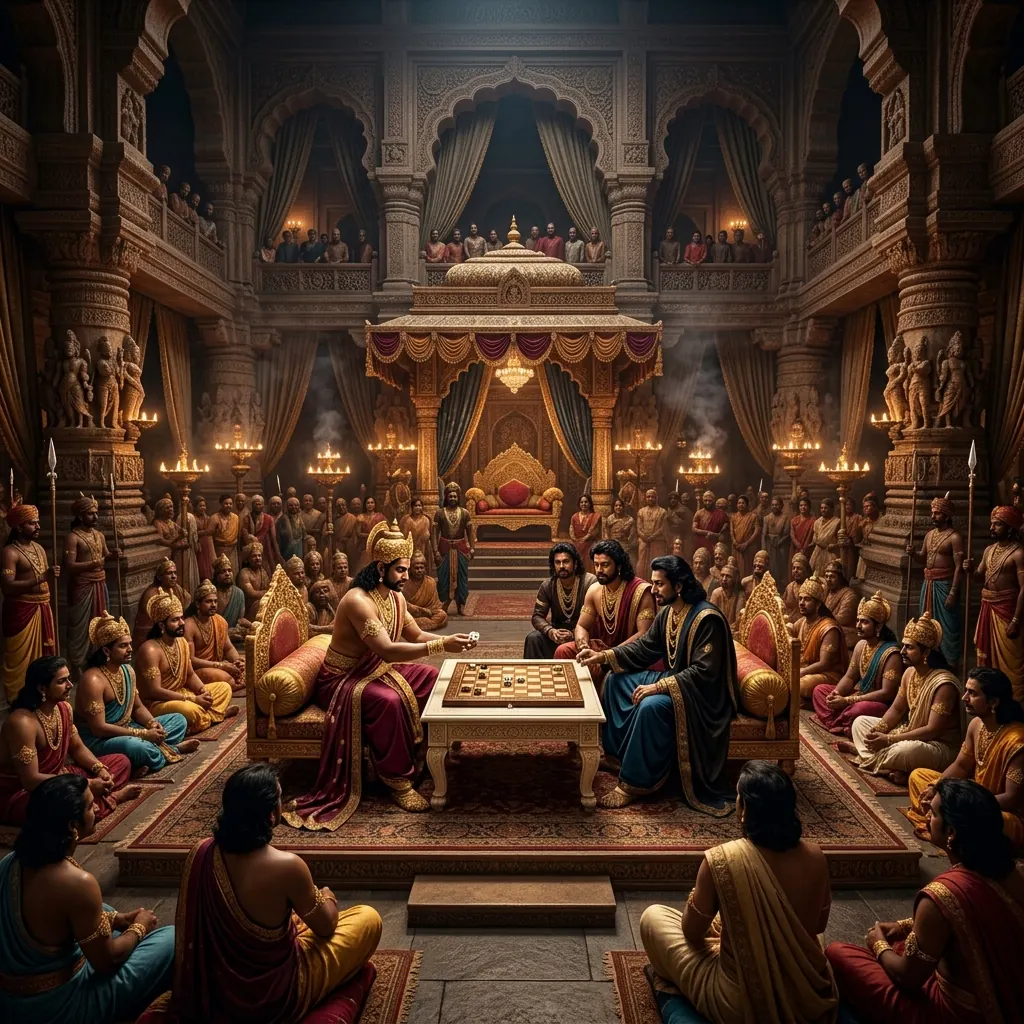
The Errand Vidura Did Not Want
Carrying the invitation to the dice game he had begged the king not to send
In short
Dhritarashtra builds a great assembly hall and orders his brother Vidura to fetch Yudhishthira for a friendly match at dice. Vidura tells the king to his face that the game will destroy the Kuru race, is overruled, and rides to Indraprastha anyway, where he delivers the invitation and warns Yudhishthira in the same breath that cheats are waiting at the other end of it. Yudhishthira asks who the players are, is told, and goes, holding to the vow that he will never refuse a challenge made in open assembly.
Told in the Sabha ParvaSet in Hastinapura and Indraprastha12 min read
The Brother Who Said No
Vaishampayana told it to Janamejaya this way. The hall was already built. Dhritarashtra had seen what his son was set on, and knowing that Fate cannot be escaped, he had given the order, and thousands of skilled craftsmen had worked eagerly until the crystal-arched palace stood finished: a thousand columns, a hundred gates, gold and lapis lazuli, two miles one way and two the other, covered with many-coloured carpets inlaid with gold. All that remained was to fill it.
So the king summoned the chief of his ministers.
Vidura was his younger brother, born of the same house but of a serving woman, which had kept him off the throne and put him where a king can least afford an honest man, at his own elbow. He had been telling Dhritarashtra the truth for years and being thanked for it and disregarded. He heard the command now, and that foremost of intelligent men did not approve his brother's words.
"I do not approve of this order of yours, king," he said. "Do not do this. I fear it will bring about the destruction of our family. Once your sons lose their unity, quarrels will surely break out among them. That is what I fear from this match at dice, king."
He had said the whole thing in four sentences. The race, the sons, the dissension, the dice. Nothing was hidden from the man who was about to send for the Pandavas, and nothing he was told that day was ever afterwards news to him.
Dhritarashtra answered with the argument he used on himself.
"If Fate is not against us, this quarrel will certainly not grieve me. The whole universe moves at the will of its Creator, under the rule of Fate. It is not free."
It is a doctrine, and it is also a way of putting down a burden. The king who had just commanded a gambling hall into existence out of nothing was explaining to his brother that nobody in the world decides anything.
"So, Vidura, go to King Yudhishthira on my orders, and bring that invincible son of Kunti here quickly."
The man who had said the dice would destroy the Kuru race was told to go and fetch the players.
Horses Quiet and Patient
Thus commanded against his will, Vidura set out.
Vaishampayana lingers over the horses, and it is worth asking why. They were spirited, fast and strong, and quiet and patient. Everything a man could want under him on a long road, and every one of those qualities was wasted on this errand, because the one thing Vidura did not want was to arrive quickly. He had argued and lost, and now his own excellent horses were carrying him at their best pace toward the thing he had said would end his house.
He took the road to the capital of the Pandavas. It ran down out of the old Kuru country toward the new city on the Yamuna, the one the Pandavas had raised out of the wilderness of Khandavaprastha and made into an imperial seat, and by the end of it he was riding into Indraprastha as an ambassador of Hastinapura, honoured by countless brahmanas who came out into the streets because Vidura was a man that brahmanas came out into the streets for.
He entered the city and went toward the palace.
It was like the mansion of Kubera himself, the lord of treasures, whose house is the standard the poets reach for when a building has passed the point where lists of gems mean anything. Vidura had been in it before. He had come for the rajasuya, when the kings of the earth had stood in that hall and paid tribute and the assembly built by Maya had made men mistake water for floor and floor for water, and the son of his brother had fallen into a pool in front of everybody and gone home to Hastinapura with something lodged in him that would not come out.
That was what this hall of a thousand columns was answering. Vidura knew it. He walked in under a roof that had been the pride of the world at its own festival, carrying an invitation to come and see a better one.
The virtuous Vidura approached Yudhishthira, the son of Dharma.
You Seem Downcast
The illustrious Ajamida, devoted to truth and with no enemy on earth, greeted his uncle with reverence and asked after Dhritarashtra and his sons. That is the courtesy, and Yudhishthira never failed in it. But he had looked at the man's face first.
"Kshatta," he said, using the name the court used for Vidura, the steward, the one who keeps the door, "you seem downcast. Have you come here in happiness and peace? I hope the sons of Dhritarashtra obey their old father. I hope the people, too, are loyal to Dhritarashtra's rule."
He had read the whole embassy off the messenger's expression before a word of it was delivered. Everything that followed, Vidura said to a man who already knew something was wrong.
"The illustrious king and his sons are well and happy," Vidura said, "and he reigns among his relatives like Indra himself. The king is happy with his sons, who all obey him, and he has no sorrow."
Then, in the middle of the formula, one sentence that is not a formula at all.
"The illustrious king is bent on making himself greater."
Vidura delivered the message. The king of the Kurus had told him to ask after Yudhishthira's peace and prosperity, and to invite him to come to Hastinapura with his brothers, and to say, once he had seen Dhritarashtra's newly built palace, whether it was the equal of his own. Let them enjoy themselves in that mansion. Let them sit down to a friendly match at dice. The Kurus were already there.
And then Vidura told him the rest, which no ambassador is obliged to tell.
"And you will find there the gamblers and cheats that the illustrious King Dhritarashtra has already brought in. That is why I have come, king. Please agree to the king's command."
He had carried the invitation the whole way and set it down, and in the same breath he told the man he was inviting exactly what was waiting at the other end of the road. He was too loyal to refuse the errand and too honest to complete it cleanly. He did both, badly, which was the only thing left to him.
The Names of the Players
"Kshatta," Yudhishthira said, "if we sit down to a match at dice, we may quarrel. What man who knows that would agree to gamble? What do you think we should do? We will all follow your advice."
It is the sentence a nephew says to an uncle he trusts, and it puts the decision squarely in Vidura's hands, which is precisely where Vidura could not take it.
"I know that gambling is the root of misery," he said, "and I tried to talk the king out of it. But the king has sent me to you. You know all this, wise one: do what is best."
That is the whole of his counsel. I tried. I failed. I am standing in your hall because I failed. Now you decide. He would not tell Yudhishthira to disobey the head of the family, and he would not pretend the invitation was innocent, so he handed back a warning with no instruction attached to it, and a man who has been offered that has been offered nothing he can act on.
Yudhishthira asked the practical question instead.
"Apart from the sons of Dhritarashtra, what other dishonest gamblers are there waiting to play? Tell us, Vidura, who they are and whom we will have to play against, staking hundreds upon hundreds of our possessions."
Vidura gave him the list, and gave the first name its full description, because the first name was the point of the list.
"King, there is Shakuni, the king of Gandhara, a master of dice, very quick of hand and reckless in his stakes. Vivingati. King Chitrasena. Satyavrata. Purumitra. And Jaya. Those are the men who are there, king."
Six men waiting in a hall two miles across, and the first of them Shakuni of Gandhara, brother of the blindfolded queen, the man who had already told Duryodhana that betting was his bow, the dice his arrows, the marks upon them his bowstring and the board his chariot.
Yudhishthira had now been told the room, the game, the stakes and the names.
If He Challenges Me I Will Never Refuse
"Then it seems," Yudhishthira said, "that some of the most reckless and dangerous gamblers are there, men who always rely on deceit."
He had understood it exactly. Nothing was concealed from him, and nothing in what follows can be explained by ignorance.
Then he reached for the same doctrine his uncle had used at the other end of the road.
"This whole universe, however, is at the will of its Maker, under the control of fate. It is not free."
Dhritarashtra had said that in Hastinapura to excuse doing what he wanted. Yudhishthira said it in Indraprastha to excuse doing what he did not want, and the words did not change on the journey. Two men on opposite sides of a quarrel, each using the will of the Creator to explain why he could not help himself, and between them they arranged the ruin of both houses.
"Wise one, I do not want to gamble at King Dhritarashtra's command. A father always wishes his son well."
That clause is the trap closing. Dhritarashtra stood to him as a father. A father wishes his son's good. Therefore the summons, whatever it obviously is, must be treated as a father's kindness, and the son who has taken his stand on dharma cannot be the one to say otherwise.
"You are our master, Vidura. Tell me what we should do."
He asked a second time. Vidura had already given the only answer he had.
So Yudhishthira laid out the narrow ground he would stand on, and it was narrow indeed.
"I have no wish to gamble, and I will not, if the wicked Shakuni does not challenge me to it in the Sabha. But if he challenges me, I will never refuse. That, as settled, is my eternal vow."
There it is. He would not sit down of his own motion. But if challenged in open assembly, he would not decline, because a kshatriya does not decline, and the vow was older than the quarrel and he had never in his life broken one.
He had just told the whole world, and Vidura, and by report Shakuni, precisely how to make him play.
Tied As It Were With a Cord
Having said this to Vidura, King Yudhishthira the just commanded that preparations for his journey be made without loss of time.
The next day he set out for the capital of the Kurus with his relatives and his attendants, and he took the women of the household with him, with Draupadi in their midst. Nobody was left behind. He rode in the chariot the king of Bahlika had given him, dressed in royal robes, blazing with royal splendour, with brahmanas walking ahead of him, and as he went out of his own gates he said one thing aloud.
"Fate takes away our reason the way a dazzling light blinds the eyes, and man, bound as if by a cord, gives in to the power of Providence."
Then, says Vaishampayana, that scourge of his enemies set out with Kshatta without weighing that summons from Dhritarashtra any further. He had done all the deliberating he was going to do.
At Hastinapura he went straight to his uncle's palace, and the greetings took a long time, because Yudhishthira greeted everyone. Bhishma, Drona, Karna, Kripa, and the son of Drona, embraced and embracing. Then Somadatta, then Duryodhana and Shalya and the son of Subala, and the other kings who had come in before him. Then the brave Dushasana, then the rest of his cousins one by one, then Jayadratha, then the whole of the Kurus in order, courteously, and none of them refused him.
Surrounded by his brothers he entered the apartments of the wise king. He saw the revered Gandhari, ever devoted to her husband, standing among her daughters-in-law like Rohini among the stars, and he bowed to her and received her blessing, and then he came to his old uncle, that illustrious king whose wisdom was his eye. Dhritarashtra smelt the head of each of the five in turn, beginning with Bhimasena, and all the Kurus were overjoyed to see those tigers among men.
The Pandavas were shown to chambers furnished with jewels and gems. The women of the household came visiting, with Dussala at their head, and the daughters-in-law of Dhritarashtra looked at the blazing beauty and prosperity of Yajnaseni and went away cheerless and filled with jealousy.
Then the five men took their exercise, performed the rites of the day, put on the most fragrant sandal paste, gave gifts to brahmanas for their blessings, ate the finest food, and were lulled to sleep with music by beautiful women. They passed that delightful night with cheerful hearts.
Bards woke them at dawn. They rose, went through the usual rites, and entered the assembly house, and were saluted by the men who were sitting there ready for gambling.
Dharma Lesson
Nothing here is done in ignorance. Vidura names the ruin before it starts, Dhritarashtra hears him and gives the order anyway, and Yudhishthira is told the room, the game and the names of the cheats before he packs. What each of them reaches for instead of a decision is the same sentence, that the universe is not free and moves at the will of its Maker, and in every mouth it does the same work: it turns a choice into a weather report. Fate in this episode is not a force that overrides men. It is the name they give to what they have already decided not to refuse.