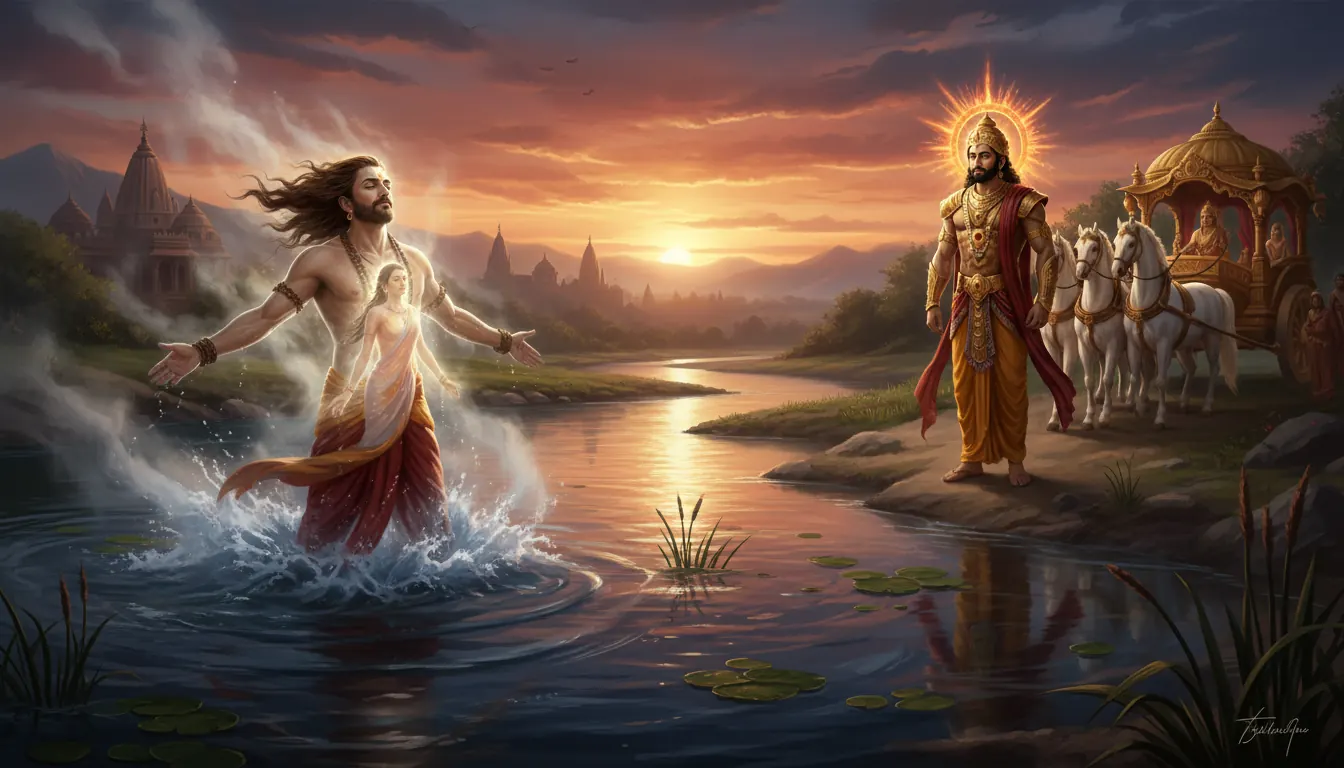
The Yajus Taken From the Sun
A goddess entering a man's mouth, and the fee split in two
In short
Asked by King Daivarati what resides in the Unmanifest, Yajnavalkya first tells how he got his knowledge: he adored Surya until the god granted a boon, then opened his mouth and Saraswati entered his body. He burned, ran into a river, and blamed his benefactor before the heat passed and the whole Satapatha appeared to him by inward light.
Told in the Shanti ParvaSet in Mithila and Videha (Mithila)16 min read
The Question About the Unmanifest
Bhishma lay on the bed of arrows with his head hung back over the shafts, and Yudhishthira sat on the ground by his shoulder and asked him what it was that resided in the Unmanifest, and whether a living man could come to know it.
"You are not the first king to ask that," the grandsire said. "A ruler of Mithila named Daivarati asked it in almost your words, and he asked it of Yajnavalkya, and the answer came down to me through Janaka. Hear it as it was given in that hall."
The king of Mithila had asked and then sat still, in the way of men who have waited a long time to ask something. Yajnavalkya did not answer at once.
"You have asked me, king," he said, "about the Supreme Brahma that dwells in the Unmanifest. Your question touches a deep mystery. Listen to me closely."
Then he did what the king had not expected. Instead of beginning with Brahma he began with himself.
"Before I tell you what I know, you should know how it came to me, because it did not come the way you imagine. You think of a boy sitting at a teacher's feet and repeating what he hears until it sticks. That is how most of it is got, and it is a good way. But the Yajushes I did not get so. I got them out of the sky, from Surya, and it cost me more than a boy's years of repetition. Keeping to humility, by the rules the rishis laid down, I obtained the Yajushes from the heat-giving deity himself."
"Then tell me that first," said Daivarati.
"I intend to," said the sage.
Worshipping the Heat-Giving Deity
"In my youth," said Yajnavalkya, "there was a gap in me, and I knew exactly where it was. I had the hymns and I had the chants, but the Yajushes I had not, and a man who lacks the Yajushes cannot conduct a sacrifice from beginning to end without borrowing another man's mouth for the middle of it. I could have gone and asked for them. I did not. I went instead to the one who has never yet had to ask anybody for anything.
"Long ago, with the harshest of penances, I worshipped the heat-giving deity. Understand what I am saying. I did not merely visit him. I stood before him at his rising and at his setting and I praised him, and I did that for so long that the praise stopped being an act I performed and became simply what I was. It is very difficult to incline Surya to grace. He looks at everyone every day. Nothing is hidden from him, and nothing much impresses him.
"Then one morning the light did not pass over me. It stopped.
"Mighty Surya, pleased with me, said, 'Twice-born rishi, ask for the boon your heart is set on, however hard it may be to obtain. I will grant it gladly. But understand that it is very difficult to incline me to grace.'
"He said the last part as a warning, so that I should not waste on some small comfort a thing that had taken me half my life to obtain. I bowed to him with a bend of my head. I did not have to think about what to ask for. I had been carrying the question so long that it came out of me the moment there was somebody to hear it."
Open Your Mouth
"'I have no knowledge of the Yajushes,' I told him. 'I want to know them, and without delay.'
"There was no bargaining. He did not ask me why, or what I meant to do with them, or whether I was fit. Asked in this way, the holy one told me, 'I will give you the Yajushes. The goddess Saraswati, who is made of the essence of speech, will enter your body.'
"Consider what that sentence contains. I had asked for a text. He did not offer me a text. He offered me the goddess who is the substance out of which all texts are cut, and he proposed to put her not into my memory but into my body, as one puts fire into a vessel that was made for water.
"Then the deity commanded me to open my mouth.
"I want you to see me standing there, king, an ascetic of no great age, on a bank at the hour when the light comes level along the ground, with the lord of all luminaries waiting in front of me for me to do a thing that any child does a hundred times a day without thinking. I did as I was commanded. I opened my mouth.
"Then the goddess Saraswati entered my body.
"I have taught for a great many years and I have never found the words for what followed, so I use the plainest ones I have. At this, I began to burn."
The Man Who Grew Angry With His Benefactor
"It was not the burning of fever and it was not the burning of fire on the skin. It was inside, everywhere at once, as though every word I had ever spoken and every word I had never learned were being pressed into a body sized for neither.
"Unable to bear the pain, I plunged into a stream. I ran to it. The rishi you are looking at, the one whose composure your court remarks upon, went down the bank and into the water like a man whose clothes are alight, and the water did nothing at all.
"And there, standing in the river with the goddess of speech burning in me, I did the thing I am least proud of in my whole life. Not understanding that great-souled Surya had done this for my good, I became angry with him. I had asked. He had given. And because the gift hurt, I stood in the water and blamed the giver, which is what men always do and what I had thought myself past doing.
"He did not withdraw the gift. He did not rebuke me either. While I was burning with the energy of the goddess, the holy Surya said only this: 'Bear this burning for a little while. It will soon stop, and you will be cool.'
"That was all. No explanation, no reproach for my anger. Only the assurance that it had an end, which was the one thing I needed and the one thing I could not have found out for myself.
"And indeed I became cool. The heat went out of me the way weather goes, and I was standing in a river up to my chest with a thing in me that had not been there in the morning."
What the Maker of Light Promised at Parting
"When he saw me at ease again, the Maker of light said to me, 'The whole of the Vedas, even the parts counted as their appendix, together with the Upanishads, will appear in you by inward light, twice-born one. You will also edit the entire Satapathas. After that, your understanding will turn to the path of Emancipation. And you will reach the end that is worth desiring, the end that both Sankhyas and Yogins covet.'
"Notice the order of those four promises, king, because I did not mark it at the time and I have thought about it ever since. First the Vedas by inward light, which is knowledge received. Second the editing of the Satapathas, which is labour, years of it, the work of a man's hands and mornings. Third the turning of the understanding toward Emancipation, which is neither knowledge nor labour but a change in what a man wants. And only fourth the end that Sankhyas and Yogins both covet and neither can hand to the other.
"He did not promise me that the first would produce the fourth. He promised me all four in sequence, and left me to find out that each of them has to be walked.
"When he had said this, the divine Surya went on to the Asta hills. He had a day to finish. I stood on the bank and watched the light go down off the water and off the far trees, and when he had gone from the place where I stood, I came home full of joy.
"And walking home I remembered the goddess."
The Goddess Adorned With All the Vowels
"The moment I thought of her, the auspicious Saraswati appeared before my eyes. She was adorned with all the vowels and the consonants, and she had set the syllable Om at the front, walking before her as a king's word walks before the king.
"I did the ordinary thing, which was the only right thing. I did not fall down and weep. As the rules require, I offered the goddess the customary Arghya, water and what goes with water, the same welcome a householder gives a guest at his door, and I dedicated another to Surya, greatest of all the heat-giving deities, because a man who thanks the messenger and forgets the sender has learned nothing. Then I took my seat, devoted to both those deities, and waited.
"And the whole of it came.
"The entire Satapatha Brahmanas, with all their mysteries and all their abstracts, and their appendices after them, appeared of their own accord before my mind's eye. Not a line at a time as a pupil gets it. All of it, standing there complete, the way a landscape stands complete when the mist goes off it, and I saw at once both that it was very large and that I now held every part of it.
"I was filled with great joy, king. I will not pretend otherwise. I sat in an empty hut with the entire Yajus in me and no one to tell."
A Hundred Disciples and an Angry Uncle
"I did not keep it. I taught it to a hundred good disciples, and in doing so I did something my great-souled maternal uncle disliked.
"You know his name. Vaishampayana, with his own disciples gathered round him, holding the Yajus as it had always been held, in a line, from mouth to ear. And here was his sister's son, who had gone round the whole of that line to the sky, coming back with a Yajus of fifty branches that no one had given him, and teaching it to a hundred men at once. I say plainly that this displeased him, and I say plainly that I did it anyway.
"Then, shining in the midst of my disciples like the Sun himself with his rays, I took charge of the sacrifice of your great-souled father, king, here in this country.
"And in that sacrifice a dispute arose between my maternal uncle and me over which of us should take the Dakshina paid for reciting the Vedas. Look at the smallness of it. Two men who between them held everything that is worth holding, standing in a sacrificial enclosure and arguing over a fee.
"In the very presence of Devala I took half of that Dakshina, and the other half went to my uncle. Your father agreed to it. Sumantra agreed, and Paila, and Jaimini, and the others assembled there. Nobody had to be persuaded. I think they were all relieved that a thing which could have split the Vedas in two was settled by the oldest arithmetic there is.
"So I had the fifty Yajushes from Surya. Afterwards I studied the Puranas with Romaharshan, and then, keeping the original mantras before me and the goddess with them, aided by the inspiration of Surya, I set myself to compile the Satapatha Brahmanas, and succeeded in a task never before undertaken by anyone."
Twenty-Four Questions From a Gandharva
"Once I had set down this knowledge of fifty branches for others to use, I turned to meditating on its one object. And it was then that the Gandharva Viswavasu came to me.
"He was no idler. He was well versed in the Vedanta scriptures and he wanted to know what in this knowledge is beneficial for brahmanas, what truth occurs in it, and what its excellent object is. He put to me twenty-four questions about the Vedas, and then a twenty-fifth that stood apart from the others and concerned the branch of knowledge that proceeds by inference and reasoning.
"Here are some of them. What is universe and what is not-universe? What is Aswa and what Aswa? What is Mitra? What is Varuna? What is Knowledge and what is the Object of knowledge? What is Unintelligent and what Intelligent? Who is Kah? Who possesses the principle of change and who does not? What is it that devours the Sun, and what is the Sun? What is Vidya and what Avidya? What is Immobile and what Mobile? What is without beginning, what indestructible, and what destructible?
"I did not answer at once. I said, 'Wait a little while, until I have thought about your questions.' He said, 'So be it,' and sat in silence, which is a rarer courtesy than you would think in a questioner who has prepared twenty-five.
"Then once again I thought of the goddess Saraswati. And the replies to those questions arose in me naturally, like butter from curds. That is exactly the image, king. Nothing was added. The answers were already dissolved in what I had been given years before on a riverbank, and the thinking only gathered them."
The Fish Is Not the Water
"I gave him the answers as they came. The Universe is the unmanifest, original Prakriti, which carries the principles of birth and death and has the three attributes, because everything she produces carries them. That which is not-universe is Purusha, free of all attributes. By Aswa and Aswa are meant the female and the male: the first is Prakriti, the second Purusha. Mitra is Purusha and Varuna is Prakriti. Knowledge is Prakriti; the object to be known is Purusha. Kah is Purusha. That which changes is Prakriti; that which does not is Purusha. What is mobile is Prakriti, which by undergoing modification becomes the cause of creation and destruction; what is immobile is Purusha, who assists at creation and destruction without himself being modified. The attributes that reside in Prakriti are destructible, but not Prakriti herself.
"Then Viswavasu said the honest thing. 'You have said that the Jiva-soul is indestructible and truly undistinguished from the Supreme Soul. But this is hard to understand. Explain it once more. I have heard Jaigishavya and Devala and Parashara and Bhrigu and Panchashikha and Kapila and Shuka and Gautama and Narada and my own father Kashyapa on this subject, and Rudra after them, and I have taken in all that they say. I wish to hear what you say.'
"So I gave him the fish. Prakriti, which is unintelligent, is apprehended by Jiva; Jiva cannot be apprehended by Prakriti. The fish lives in water and goes where its own nature drives it. Though it lives in the water it is to be regarded as separate from the water. In the same way the twenty-fifth is to be understood, existing in contact with the twenty-fourth and in its real nature independent of her. When a man is overwhelmed with the consciousness of self and cannot understand his identity with the twenty-sixth, the Jiva-soul always sinks down; when freed from that consciousness, it goes upward.
"He was satisfied. 'You have said what is true and excellent,' he told me. 'May blessings without end always be with you, and may your mind always be joined to intelligence.' Then the prince of Gandharvas walked the customary circles around me and went toward heaven, shining, and afterwards taught what he had from me to the dwellers in the regions of Brahman, and to those on Earth, and to those who dwell in the lower worlds."
What the King of Mithila Did With It
"Emancipation flows from Knowledge, king, and without Knowledge it can never be attained. So one should strive for it in all its details. And take it wherever it is found. Whether he obtains knowledge from a brahmana, a kshatriya, a vaishya or a shudra of low birth, a man of faith should always revere that knowledge. Birth and death cannot touch one who has faith. All orders of men are brahmanas. All are sprung from Brahma. All men utter Brahma.
"Your questions were good ones. Cast off all grief. Go to the other end of this enquiry. Blessings on your head for ever."
"Taught in this way by the wise Yajnavalkya," said Bhishma, "the king of Mithila was filled with joy. He honoured that greatest of ascetics by walking around him, and dismissed him, and Yajnavalkya departed from his court.
"Then Daivarati sat down and did the arithmetic of a man who has decided. He touched and gave away to brahmanas ten million cows, and a quantity of gold, and a measure of gems and jewels. He installed his son in the sovereignty of the Videhas. And the old king took up the life of the Yatis. He put away ordinary duties and the failure to do them, virtue and vice, truth and falsehood, birth and death, and everything else that comes from the principles Prakriti produces; he regarded himself as Infinite and thought only of the Eternal and Independent One.
"I had all this from Janaka, and Janaka had it from Yajnavalkya. Knowledge stands far above, Yudhishthira. Sacrifices cannot compare with it. Men attain to heaven through sacrifices and penances and vows and observances, and they must fall again from there to the Earth. With the aid of Knowledge a man crosses the world's ocean, which is full of difficulties and dangers, and no sacrifice will ever carry him over it."
Dharma Lesson
Knowledge that comes directly, without a teacher's line to carry it, still has to be paid for, and the price is pain at the moment of receiving and resentment among those it passes over. Yajnavalkya blames the giver while the gift is still burning in him, and quarrels with his own uncle over a fee. The teaching he ends with is that knowledge should be taken from anyone who has it, of any birth, which is exactly the rule that made his own life difficult.