The Sage Inside the God
How Ushanas robbed Kubera and came out as Shukra
In short
Ushanas of Bhrigu's line enters the body of Kubera by yoga and empties the treasury of heaven, and Mahadeva takes up the lance to hunt him. He answers the weapon by sitting on its point, so Shiva bends the shaft into the bow called Pinaka and swallows him. Ages later he comes out by the one exit left open, is named Shukra for it, and Uma claims him.
Told in the Shanti ParvaSet in Kurukshetra, Alaka and Mount Kailasa17 min read
Four Questions About the Bright Planet
"There is something I have always been curious about, sire," Yudhishthira said.
He had been sitting in the sand at Kurukshetra for a long stretch of days by then, and he had learned to open a morning by admitting that a thing had been bothering him for years rather than by pretending it had just occurred to him.
"Grandsire of the Kurus, I want to hear everything about it from you. Why did the heavenly rishi, the great-souled Ushanas, who is also called Kavi, work for the good of the Asuras and against the gods? Why did he set about draining the energy of the gods? Why were the Danavas always at war with the greatest of the gods?"
Then he asked the two questions that are really his, and they are both about a name and a path in the sky.
"Why did Ushanas, who shines with the splendour of an immortal, come to be called Shukra? How did he gain such excellence? And for all his great energy, why can he never travel to the middle of the sky?"
Anybody who has stood outside at dusk knows the observation behind the last one. The bright planet that carries the seer's name hangs low over the west after sunset or low over the east before dawn, and it never climbs to the top of the sky the way the others do. It goes up so far and then it stops, and comes back down. Yudhishthira wanted to know what had been done to it.
"Tell me all about these things."
"Listen carefully, king, to how all this really happened," Bhishma said. "Sinless one, I will tell you these things as I have heard and understood them."
He began, as the answer to a question about the sky, with a robbery.
The Lord of the Treasury
"Ushanas, that descendant of Bhrigu, firm in his vows and honoured by all," Bhishma said, "began to work against the gods for a good reason."
An adequate cause. That is the whole of the explanation offered for why the greatest brahmana of the age went over to the other side, and the story that follows is not an argument about the merits of gods and Asuras. It is an account of one man taking one thing that belonged to somebody, and of everything that happened afterwards.
"The royal Kubera, the chief of the Yakshas and the Rakshasas, is the lord of the treasury of Indra, that master of the universe."
It is worth being clear about whose money this is. Kubera is not a private millionaire sitting on a hoard of his own. He is the treasurer. The wealth in his keeping at Alaka is the wealth of the lord of the celestials, and Kubera holds it the way a minister holds a king's revenue, which means that a theft from Kubera is a theft from heaven, and that heaven will notice it in the accounts.
It also means that the man who commits it has not merely enriched himself. He has defunded a war.
Notice also what the account quietly declines to do. Yudhishthira had asked why the Danavas and the deities were always at war, and the answer he is given never touches that at all. Bhishma does not explain the enmity. He explains one man's place in it, and leaves the war itself standing where it has always stood, older than the reason anybody could give for it.
The deities and the Danavas had been at each other since before anybody could remember. The seer of Bhrigu's line was about to move a very great deal of money from one side of that quarrel to the other, and he was going to do it without touching a door, a lock, a guard or a wall.
The Theft from Inside
"The great ascetic Ushanas, perfected in Yoga, entered the person of Kubera," Bhishma said, "and, taking away the freedom of the lord of treasures by the power of Yoga, robbed him of all his wealth."
Read that again slowly, because there is no violence in it anywhere and it is one of the most alarming sentences in the parva.
He did not break in. He went into the man. Not into the vault, not into the city, into the person of the guardian himself, and once he was in there he took away Kubera's liberty, which is to say his power to move, to refuse, to raise an alarm, to be anything at all except a set of limbs standing in a treasury with somebody else inside them.
And then he robbed him of all his wealth. All of it. Whatever was signed out was signed out by the lord of treasures himself, in his own hand, in front of anyone who cared to watch, and every guard in Alaka saw the master of the house doing exactly what the master of the house is entitled to do.
When it was finished, he left again the body he had entered by Yoga.
So Kubera came back to himself standing in an empty room. Nothing had been forced. Nobody had fought. There was no thief to describe, no direction in which to send a pursuit, and no injury on his body to show anyone. He had simply been used as a tool for a while, and the tool had been put down.
Seeing his wealth taken from him, the lord of treasures was deeply displeased. Full of anxiety, and with his anger roused as well, he went to Mahadeva, the foremost of the gods.
He did not go to Indra, whose treasury it was. He went to the one being he could think of who would not require the theft to be explained twice.
The Complaint Made to Mahadeva
Kubera laid the matter before Shiva of boundless energy, the first of the gods, fierce and gentle, of many forms.
Those three descriptions are set down together in one line, and they are not decoration. Fierce and gentle and of many forms. This is the god you go to when you have been wronged in a way nobody can be made to understand, and it is also the god who may take the news in a manner nobody can predict.
Kubera said it in two sentences. He had had time on the road to get it short.
"Ushanas made himself pure spirit by Yoga, entered my body, took away my freedom, and has carried off all my wealth. Having entered my body by Yoga, he has left it again."
That is the entire complaint. There is no request in it. He does not ask for the wealth back, he does not ask for the seer to be punished, he does not propose a penalty or name a court. He states what was done to him twice over, the entering and the leaving, because the entering and the leaving were the injury and the loss of the gold was only the consequence.
Hearing these words, Maheshvara of supreme Yoga-powers became filled with rage.
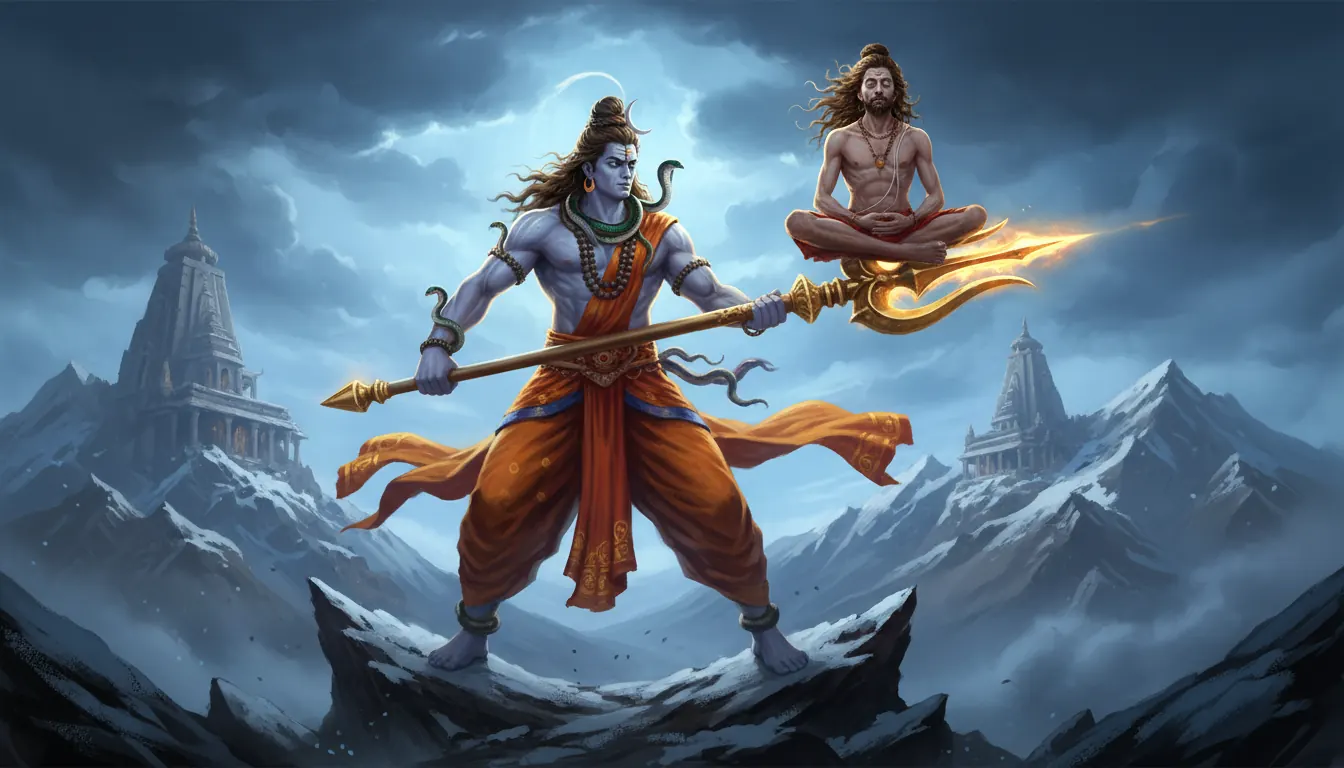
His eyes became blood-red. He took up his lance and waited, ready to strike down Ushanas.
And having taken up that foremost of weapons, the great god began to say, "Where is he? Where is he?"
Twice. The text repeats it, and that repetition is the sound of the whole scene: a god standing with the trident in his fist and nowhere to point it, asking a question that has no answer, because the man he wants is a man who is last known to have been inside somebody.
What the Seer Decided to Do
Meanwhile Ushanas, who had learned Mahadeva's intention from afar by his Yoga-power, waited in silence.
He knew. That is the first thing. He was somewhere else entirely and he knew that the lance had been picked up and that his own name was being said over it, and he did not run, and he did not hide, and he did not begin a defence.
Indeed, once he knew of the anger of the great-souled Maheshvara, whose Yoga-power was greater still, the mighty Ushanas began to weigh whether he should go to Maheshvara, or flee, or stay where he was.
Three options, considered in order, by a man in no hurry. Go and face it. Run. Sit still.
He chose a fourth thing, and it is the finest piece of thinking anybody does in this story.
Thinking, with the aid of his severe penances, of the high-souled Mahadeva, Ushanas, of soul crowned with Yoga-success, placed himself on the point of Mahadeva's lance.
He went and sat on the weapon.
The bow-armed Rudra understood what had happened. Ushanas, whose penances had borne fruit, and who had turned himself into the form of pure Knowledge, was sitting on the point of his lance, and the god found that he could not hurl the lance at one who was on it. A spear cannot be thrown at its own tip. Whatever else the god of the trident could do that day, he could not do the one thing he had come to do.
And there is a reason a spear cannot be thrown at what is sitting on it, beyond the plain geometry of the thing. Ushanas had turned himself into the form of pure Knowledge, and that is what he brought to the point of the lance. Knowledge is not a substance a blade has any purchase on. The god was left holding a weapon that had become, at its business end, an object it was not built to touch.
So he bent that weapon with his hand.
When the fierce-armed and mighty Mahadeva of boundless energy had bent his lance into the shape of a bow in this way, the weapon came to be called Pinaka from that time on. The great bow of Shiva, which every later story hands him as a matter of course, exists because a brahmana sat down on a spear and made it unusable as a spear.
The Lord of Uma Opens His Mouth
When the lord of Uma saw Bhargava brought down onto the palm of his hand like this, he opened his mouth.
That is the sequence. The bending of the lance brought the seer down to the god's palm, close, held, the size of a thing that can be lifted with the fingers. And what the god did then was not to crush him and not to throw him and not to speak to him.
The chief of the gods threw Bhargava into his mouth and swallowed him at once.
It is over in half a line. There is no struggle described, no cry, no last word from the seer, no protest from anyone standing by. The greatest ascetic of the Bhrigu line, who had just outwitted a god with the god's own weapon, went down like a swallowed date.
And then the story does the thing that makes it worth telling, which is that it does not end there.
The mighty and great-souled Ushanas of Bhrigu's line, once inside Maheshvara's stomach, began to wander about there.
Wander. Not suffer, not burn, not dissolve. He walked about in it, the way a man walks about in a country he has arrived in, and Yudhishthira, sitting in the sand at Kurukshetra, stopped his grandsire at exactly that word.
"King, how could Ushanas wander about inside the stomach of that god of supreme intelligence? And what did that illustrious god do while the brahmana was in his stomach?"
The second half of that question is the interesting one, and Bhishma answered it first.
Millions of Years in the Water
"Long ago, after swallowing Ushanas," Bhishma said, "Mahadeva of the severe vows went into the waters, and stood there like an unmoving stake of wood, king, for millions of years, absorbed in Yoga-meditation."
So that is what the god did about it. He went and stood in a lake and did not move for a length of time that has no useful comparison, with the thief of Kubera's treasury inside him the entire while.
When his Yoga penances, the hardest of all, were over, he rose from the great lake. Then the first of the gods, the eternal Brahman, came to him and asked how his penances had gone, and how he was.
The god whose emblem is the bull answered, "My penances have been well performed."
A polite exchange between the two oldest beings there are, on the shore of a lake, at the end of millions of years, in which the subject of the man in the stomach did not come up.
Then Shankara, whose soul is beyond conceiving, of great intelligence, ever devoted to the religion of truth, looked, and saw something.
He saw that Ushanas, inside his stomach, had grown greater through those penances of his.
Not the god's penances. The seer's. The prisoner had spent the same millions of years the way he had spent every other stretch of his life, and had come out of them larger than he went in. That foremost of Yogins, rich in the wealth of his penances and in the wealth he had taken from Kubera too, shone brightly in the three worlds, full of great energy.
Both kinds of wealth are named in the same breath. The gold he stole and the merit he made, held together in one man in one dark place, and both of them still growing.
After this Mahadeva, bearer of Pinaka, the very soul of Yoga, gave himself up once more to Yoga-meditation.
The One Outlet Left Open
Ushanas, however, filled with anxiety, began to wander within the stomach of the great god.
The merit was still accumulating and the man was still in a stomach, and at some point the second fact became the more pressing of the two. The great ascetic began to sing the god's praises from where he was, hoping to find a way out.
Rudra, however, having stopped all his outlets, prevented him from coming out.
So the praise did not work, or rather it worked and the door stayed shut, which is a different thing. The great ascetic Ushanas, from inside Mahadeva's stomach, said to the god again and again, "Have mercy on me!"
And Mahadeva said to him, "Go out through my urethra."
He had stopped up all the other outlets of his body. One was left, and it was named, and it was the least dignified passage a being possesses, and the terms were not negotiable.
Shut in on every side, and unable to find the outlet he had been told of, the ascetic wandered here and there, burning all the while with Mahadeva's energy. He had been told the way and could not find the way, and he searched for it in the dark of a god who was on fire, and how long that took is not said.
At last he found the outlet, and came out through it.
That is why he came to be called Shukra. That is the answer to the first of the two questions Yudhishthira had asked at the start of the morning: the most honoured name in the Bhrigu line, the name of the brightest thing in the evening sky, is a name got in that manner and from that place.
And it was because of that same thing, Bhishma said, that he also became unable to reach the middle of the sky. That is the answer to the second. The planet climbs and stops and turns back because of the door it came out of.
Uma Claims a Son
When Bhava saw him come out of his stomach shining brightly with energy, he stood in his anger with the lance raised in his hand.
Nothing had been settled by any of it. The millions of years in the lake, the swallowing, the search in the dark, the naming, and at the end of all of it the god was standing exactly where he had been standing on the first day, with the weapon up and the same man in front of him, and the wealth of Kubera had never once been mentioned.
Then the goddess Uma stepped in, and forbade her husband, the angry lord of all creatures, to kill the brahmana.
She did not argue that the theft had been small, or that the seer had suffered enough, or that a brahmana may not be killed. She made a claim about who he now was.
"This brahmana no longer deserves to die at your hands," the goddess said. "He has become my son. Lord, one who comes out of your stomach does not deserve to be slain by you."
It is an argument built entirely out of what the god himself had done. He had swallowed the man and kept him and carried him for an age and then brought him out of his own body, and the goddess simply named that sequence by the ordinary word for it, and once it had been named there was no way back to the lance.
And because Uma had stopped her lord from carrying out his purpose in this way, the ascetic Ushanas became, from that day, the son of the goddess.
Calmed by his wife's words, Bhava smiled, and said again and again: "Let him go wherever he likes."
The great ascetic Ushanas, whose intelligence was supreme, bowed to Mahadeva, the giver of boons, and to his wife the goddess Uma, and went to the place of his choosing.
Which was, in the end, back to the Asuras, with the treasury of heaven behind him and the wrath of two gods and one lance settled by a word about family.
There is one more thing in that exchange worth weighing. The goddess did not ask her husband to forgive anybody. She told him who the man was, and he smiled, and the smile is in the text, and it is the only time in the whole episode that anyone is described as pleased. Wrath that is satisfied leaves a body on the ground. Wrath that is disarmed by a relation leaves a household with one more person in it.
"So I have told you, chief of the Bharatas," Bhishma said, "the story of the great-souled Bhargava that you asked me about."
Dharma Lesson
What cannot be defeated by force is sometimes best adopted, and the seer who made himself into pure Knowledge left the god holding a weapon with nothing to strike. Wrath disarmed by kinship ends better than wrath satisfied: the lance came down not because the theft was excused but because Uma named the thief a son.