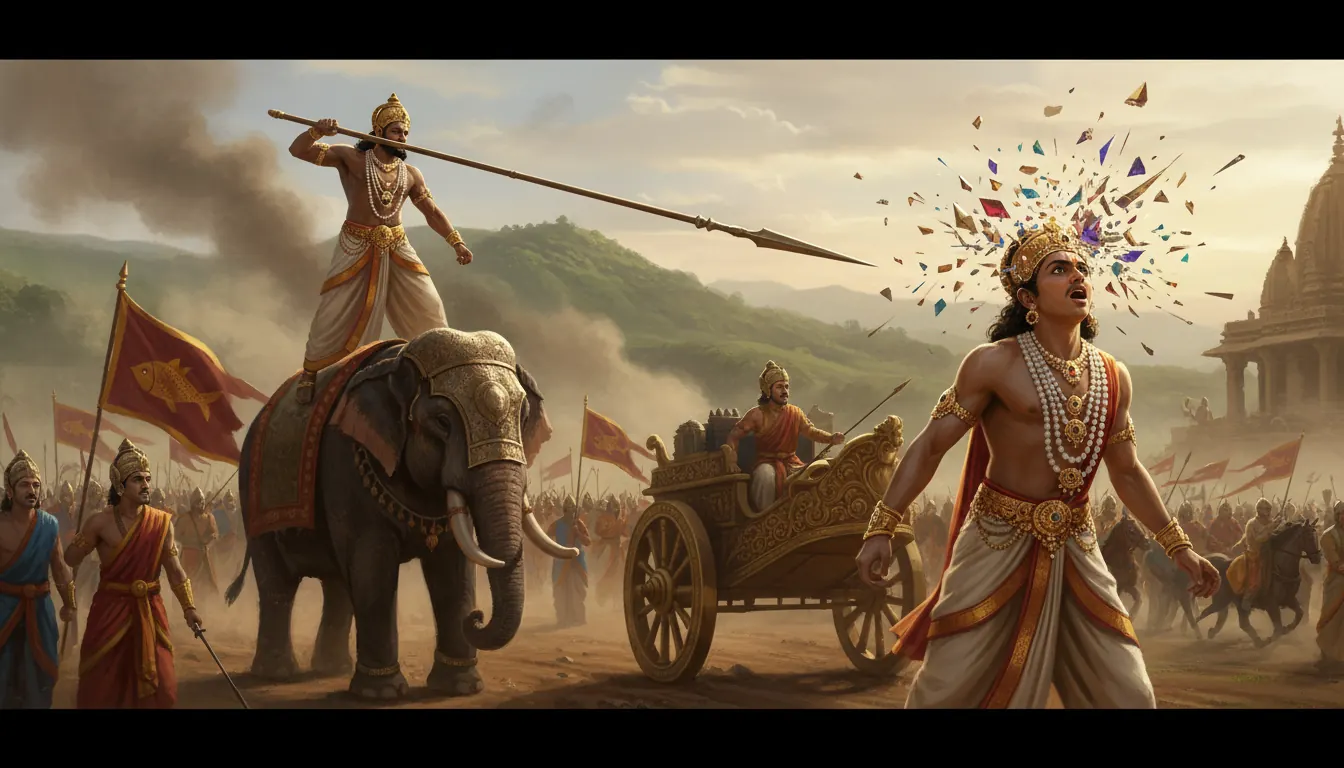
The King Names the Pairs
Yudhishthira assigns each Pandava his enemy as Karna's array comes on
In short
On the seventeenth day Karna forms the Kaurava host in a great array built according to the scheme of Brihaspati, with two wings shaped to trap Arjuna. Yudhishthira looks across at it and answers it not with a charge but with a list, giving Arjuna to Karna, Bhima to Duryodhana, and each of his brothers and allies a named foe. Arjuna says only that it will be done, and goes to the head of the army in the chariot that once carried Brahman. Shalya, driving Karna, watches him come and reads out the omens.
Told in the Karna ParvaSet in Kurukshetra and Hastinapura16 min read
The Question in the Dark Hall
Sanjaya sat in the hall at Hastinapura and went on telling a blind king what his sons were doing on a plain he would never see. The morning he had reached was the seventeenth day of the war and the second day of Karna's command.
On the field, Dhrishtadyumna the son of Drupada, who had led the Pandava army since the first day, had drawn up an array that Sanjaya would not describe modestly. It was unrivalled, he said, and capable of resisting all hostile armies.
Karna looked at it and came on.
He advanced with lion-like roars, his chariot rattling loudly, and he made the earth tremble with the din of musical instruments. That scourge of his foes, that hero in battle, seemed to shake with rage. Then he drew up his own troops against them, and he made a great slaughter of the Pandava forces, as Maghavat slaughters the host of the asuras. He struck Yudhishthira with many arrows, and placed the eldest son of Pandu to his right.
That last is a chariot-warrior's phrase and it carries a chariot-warrior's meaning. To sweep past a man and leave him on your right is what one does with an enemy one has already got the better of. Sanjaya reported it without comment, and the questions came out of the old king in a rush.
"Sanjaya, how did the son of Radha draw up his forces against all the Pandavas led by Dhrishtadyumna and protected by Bhimasena, all those great bowmen whom the gods themselves could not defeat? Who stood in the wings and the further wings of our army? How were the warriors divided and stationed? And how did the sons of Pandu draw up their army against mine? How did that great and terrible battle begin?"
Then the question that was underneath all the others.
"Where was Bibhatsu when Karna went against Yudhishthira? Who could attack Yudhishthira with Arjuna there? That Arjuna who long ago defeated, single-handed, every creature at Khandava: who else who wanted to live, except the son of Radha, would fight him?"
The Wings and the Further Wings
Sanjaya answered in order.
"Hear now how the arrays were formed, how Arjuna came, and how the battle was fought by both sides around their kings."
The right wing was given to Sharadvata's son Kripa, the old teacher who had taught both houses their weapons as boys, and with him the Magadhas, men of great vigour, and Kritavarma of the Satvata race. On the right of these stood Shakuni and the mighty chariot-warrior Uluka, his son, with many fearless Gandhara horsemen armed with bright lances, and many hard-to-defeat mountaineers, as numerous as swarms of locusts and as grim-looking as pishachas. That was the far edge of the Kaurava host: the dice-player of Gandhara, his son, and hill men who fought like ghosts.
The left side was held by thirty-four thousand chariots of the samsaptakas. The word means the sworn ones. They were men who had taken an oath before the fighting either to kill Arjuna or to die on his arrows, and having sworn it they could not leave a field while he stood on it. Never turning back, mad for battle, with Dhritarashtra's sons in their midst and all of them eager to kill Krishna and Arjuna, they covered that flank. On their left again stood the Kambojas, the Sakas and the Yavanas, with chariots and horse and foot, posted there at the command of the Suta's son, challenging Arjuna and the mighty Keshava.
So the left wing and the further wing beyond it had both been built around one man, and the whole left half of that army was a snare with Arjuna's name written on it.
In the centre, at the head of the host, stood Karna himself to guard that point, in armour with a beautiful coat of mail, adorned with Angadas and garlands. Supported by his own angry sons, that greatest of all wielders of weapons, that hero, shone at the head of the army as he drew his bow again and again.
The Array That Seemed to Dance
Behind the centre came the rear, and the rear was the royal house itself.
The mighty-armed Dushasana, bright as the sun or as fire, with tawny eyes and handsome features, rode on the neck of a huge elephant, surrounded by many troops, and from his station at the back of the army he came forward for the fight by degrees. Behind him came Duryodhana, protected by his brothers born of the same mother, riding beautiful horses and cased in beautiful mail, and guarded besides by the united Madrakas and the Kekayas of great energy. The king, said Sanjaya to the king's father, looked as splendid as Indra of a hundred sacrifices surrounded by the gods.
Ashwatthama and the other leading chariot-warriors followed behind that chariot force, and with them many elephants in constant fury, streaming with rut like clouds streaming rain, ridden by brave Mlecchas. Decked with victory banners and blazing weapons, those huge creatures, ridden by warriors skilled in fighting from their backs, looked as beautiful as hills covered with trees. Many thousands of brave warriors who never turned back, armed with axes and swords, walked among their feet as the footguards of those elephants.
Splendidly decked with horsemen and chariot-warriors and elephants, that finest of arrays looked wonderfully beautiful, like the array of the gods or of the asuras.
It had been formed according to the scheme of Brihaspati, the teacher of the gods, and it had been formed by a commander well versed in the ways of battle. Sanjaya gave it the one description that a man who has watched armies keeps afterwards. It seemed to dance as it advanced. It struck terror into the hearts of foes.
And out of its wings and further wings, foot-soldiers and horsemen and chariot-warriors and elephants, longing for battle, began to pour out like clouds that keep appearing in the rainy season.
Look at the Array Karna Has Made
On the other side of that ground, king Yudhishthira looked across at the head of the hostile army and found Karna standing in it.
He had reason to look for him. Of all the men in that host, this was the one whose name kept the eldest son of Pandu from sleeping, and this was the man who had struck him with arrows an hour ago and gone past him on the right in the sight of both armies.
So he turned to Dhananjaya, that slayer of foes, that one hero in the world, and said this.
"Look, Arjuna, at the mighty array Karna has formed for battle. The enemy force looks splendid with its wings and further wings. Seeing this vast enemy force, let us take such measures that it may not defeat us."
It is worth noticing what the king did not say. He did not say kill him. He did not invoke a vow, or name the insults in the assembly hall, or remind his brother of anything at all. He said that the enemy had made a good array and that measures should be taken about it, and he said it to the one man on the field who could take them.
Arjuna replied with joined hands, which is how a man answers his king even when the king is his brother and the field is a wreck of dead horses.
"Everything will be done as you say. Nothing will be otherwise. I will do, Bharata, whatever will bring about the destruction of the enemy. By killing their best warriors, I will destroy them."
That was the offer, and it was made in the general terms of a man who intends to go wherever the fighting is thickest.
What came back was not general at all. Yudhishthira had been looking at that array longer than his brother had, and he had already taken it apart in his head, name by name.
The King Names the Pairs
"With that aim," said Yudhishthira, "you go against the son of Radha, and let Bhimasena go against Suyodhana, Nakula against Vrishasena, Sahadeva against the son of Subala, Satanika against Dushasana, Satyaki, that bull among the Shinis, against the son of Hridika, and Dhrishtadyumna against the son of Drona. I myself will fight Kripa. Let the sons of Draupadi, with Shikhandi among them, go against the rest of the Dhartarashtras. Let the other warriors of our army meet our other foes."
It is a short speech, and it is an entire day of war.
Arjuna to Karna: the commander of the enemy given to the only man the enemy had built two wings to stop.
Bhima to Suyodhana. Yudhishthira used the courteous form of his cousin's name, the one people had used for him since childhood, and handed him to the brother who had spent thirteen years promising in public what he would do to him.
Nakula to Vrishasena, who was Karna's eldest son and a great bowman in his own right. Sahadeva to the son of Subala, which is to say Shakuni, the uncle who had thrown the dice that took their kingdom, matched now with the youngest of the men he had beggared.
Satanika to Dushasana. Satanika was a son of Draupadi, born to her by Nakula, one of the five princes who had grown up in Panchala while their fathers were in the woods; and Dushasana was the man who had dragged their mother by the hair into a hall full of kings. The pairing needed no speech to explain it and got none.
Satyaki, the bull among the Shinis, to the son of Hridika, which is Kritavarma. They were kinsmen, both of the Vrishni race, and Krishna's own people were divided between the two armies, so the king put the two Yadava bowmen against each other and let that quarrel settle itself.
Dhrishtadyumna to the son of Drona. Dhrishtadyumna had killed Ashwatthama's father two days before, and Ashwatthama was the fiercest chariot-warrior the Kauravas still had on the field.
Kripa the king kept for himself: an old teacher who would not be shamed by being met with less than a king, and who was not likely to kill him.
The rest of Dhritarashtra's sons went to Draupadi's five sons with Shikhandi among them. Everybody else was told to find his own enemy.
When Yudhishthira the just had said this, Dhananjaya said, "So be it," and ordered his troops to do what was needed, and went up himself to the head of the army.
The Chariot That Came Out of Brahman
The chariot he rode up in was not an ordinary vehicle, and Sanjaya stopped the battle for a moment to say where it came from.
Agni, the Leader of the universe, who draws his brilliance from Brahman, had become its horses. It was known among the gods as Brahman's chariot, because it first sprang from Brahman himself. In ancient days it had carried Brahman, and then Ishana, and then Indra, and then Varuna, one after another, and now Keshava and Arjuna rode to battle in that primeval chariot.
Shalya, the king of the Madras, was driving Karna's chariot that day. He had come to the war meaning to fight for his nephews and had been tricked into the Kaurava side, and he had spent that whole morning quarrelling with the man whose reins he held. He saw the chariot coming and turned round on the terrace and spoke to Adhiratha's son again.
"There comes that chariot with white horses yoked to it and Krishna as its driver, the chariot no army can resist, like the inescapable fruit of one's deeds. There comes the son of Kunti, slaughtering his foes along the way, the very man you were asking about."
That last clause has an edge on it. Karna had been asking all day where Arjuna was.
"That tremendous uproar we hear, deep as the roar of the clouds, can only be those great-souled ones, Vasudeva and Dhananjaya. Over there a cloud of dust is rising that spreads across the sky like a canopy. The whole earth, Karna, seems to tremble, cut deep by the rims of Arjuna's wheels. These violent winds are blowing on both sides of your army."
The dust came up. The noise came across the field ahead of the chariot that made it. And Shalya, who had been forbidden to say anything more about religion and virtue an hour earlier, began instead to read out the sky.
What Shalya Read in the Sky
"These flesh-eating creatures are howling aloud and these animals are uttering fearful cries. Look, Karna, the terrible and ominous Ketu, vapoury in form, that makes the hair stand on end, has appeared and is covering the sun. Look at the many kinds of animals all around in large packs, and the many mighty wolves and tigers looking at the sun. Look at those terrible Kankas and those vultures, gathered in thousands, sitting face to face as if in conversation."
Then he brought the omens home, off the sky and onto the chariot the two of them were standing on.
"The coloured yak-tails on your great chariot are waving restlessly. Your standard is trembling too. Look, these beautiful horses of yours, huge-limbed and as fast as soaring birds, are quivering as well. From these omens it is certain, Karna, that kings in hundreds and thousands will lie dead on the ground in eternal sleep."
He went on to the sound of it. The loud uproar of conchs, making the hair stand on end. The drums and cymbals on all sides, the whizz of many kinds of arrows, the din of chariots and horses and men, and under all of it the twang of the bowstrings of great-souled warriors.
Then the banners.
"Look, Karna, at those banners of Arjuna, hung with rows of bells and decked with golden moons and stars. Made by skilful artists from cloth embroidered with gold and of many colours, they are blazing on Arjuna's chariot as the wind shakes them, like flashes of lightning in a mass of clouds. Those chariot-warriors of the great-souled Panchalas, with flags flying from the standards of their chariots, look as splendid, Karna, as the gods in their celestial chariots."
And on the top of Partha's standard, that terrible ape, that greatest of apes, that deepener of the fears of foes, drawing the gaze of warriors from every side.
"The discus, the mace, the bow called Saranga and the conch of the wise Krishna, and his gem Kaustubha too, look wonderfully beautiful on him. Over there Gandiva twangs, drawn by Savyasachin."
Who Would Slay Varuna With Water
Then Shalya described what Gandiva was doing, and he described it as a man describes a thing he can see.
The earth strewn with the heads of kings who never turned back, faces beautiful as the full moon, with large copper-coloured eyes. Arms like spiked maces, weapons still in their grasp, smeared with fine perfumes, falling. Horses falling with their riders. Elephants huge as mountain peaks, torn and pierced by Partha, going down like real hills. Chariots whose royal riders had been killed, dropping like the celestial chariots of heaven's dwellers when their merit is exhausted. The army thrown into turmoil by the diadem-crowned Arjuna like herds of countless cattle by a maned lion. And Partha himself no longer visible in it, shrouded by dust and weapons like the sun shrouded by clouds, with only the top of his standard showing.
"Son of Radha, if you succeed in killing the man who has Keshava for his driver and Gandiva for his bow, you will be our king. The samsaptakas have challenged Partha, and he is going against them now."
Karna answered in rage.
"Look, Partha is attacked on all sides by the angry samsaptakas. Like the sun shrouded by the clouds, Partha is no longer visible. Plunged into that ocean of warriors, Shalya, Arjuna is sure to perish."
"Who is there," said Shalya, "that would slay Varuna with water, or put out fire with fuel? Who is there that would seize the wind, or drink up the ocean? That is how I see your attempt to hurt Partha. Only a man who could lift this earth on his two arms, or burn all creatures in his anger, or hurl the gods from heaven, could defeat Arjuna in battle."
Then, having named the man who could not be beaten, the driver went on and named the rest of them, and it came out as a mirror of the speech Yudhishthira had made an hour before.
There stood Bhima, who never tired, mighty-armed, standing like another Meru, his anger always burning and his injuries remembered. There stood Yudhishthira the just, hard to withstand in battle. There stood the two tigers among men, Nakula and Sahadeva, like the twin Ashvins. There were the five sons of Krishna, with the features of Panchala princes, every one of them equal to Arjuna in battle. There were the sons of Drupada led by Dhrishtadyumna, swelling with pride and energy. And there was Satyaki, first among the Satvatas, irresistible as Indra, coming on in his eagerness to fight like the destroyer himself in his fury before their eyes.
While those two lions among men were addressing each other, the two armies mingled fiercely in battle, like the currents of the Ganga and the Yamuna.
Dharma Lesson
Yudhishthira is the least gifted fighter on that field and the most useful man on it that morning, because the work he does is not fighting. He looks at an array built to swallow one man and answers it by giving every man he has the enemy that is properly his, taking for himself the opponent nobody else could meet without dishonour. Command in the epic is rarely a matter of prowess; it is the ability to see a whole field at once and to place people where their history, their skill and their vows already point them.