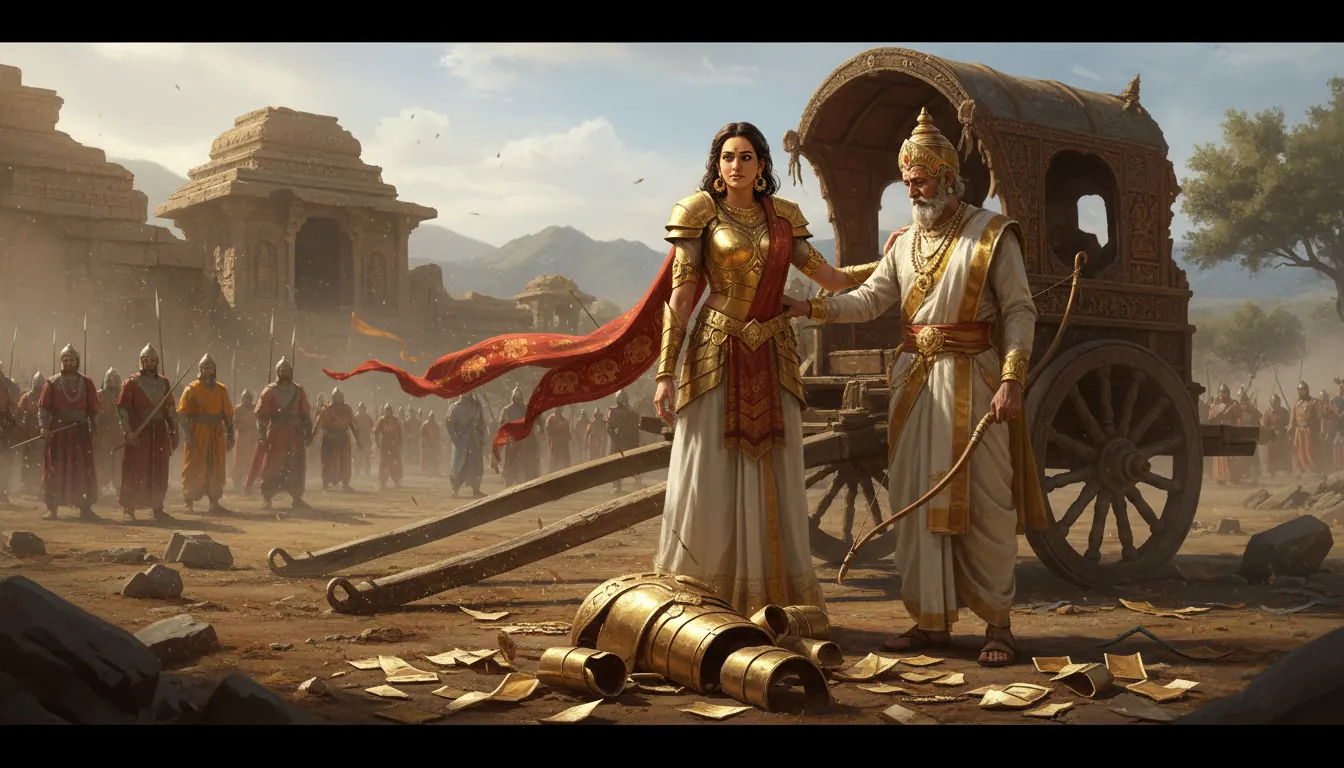
The Son Bhima Beheaded
Bhima cuts down Karna's son Satyasena while Karna fights his way toward Yudhishthira
In short
On the second day of Karna's command, Karna breaks the Panchalas by the hundred and the Pandava heroes rush his chariot in a body. Bhima, disarmed by Karna's son Sushena, takes another bow, cuts Sushena's, and then fells another son of Karna, Satyasena, with his horses and driver and standard, taking off his head with a razor-headed arrow in the sight of his father's friends. Karna twice cuts Bhima's arrows out of the air to save Sushena, then answers with seventy-three shafts. The battle closes over the dead boy and Karna cuts his way through to Yudhishthira's division.
Told in the Karna ParvaSet in Kurukshetra14 min read
The Question About Who Stood in the Way
"Tell me, Sanjaya," Dhritarashtra said, "how Karna, after causing a great slaughter, broke into the midst of the Pandava troops, and struck and wounded king Yudhishthira. Who were the foremost heroes among the Parthas who stood against Karna? Who were the ones Karna crushed before he could wound Yudhishthira?"
It was the second day of Karna's command, and the blind king in his hall was asking for a list of names. Sanjaya, who sat beside him with the sight that let him see the field, gave him one. Not all of the names on it were Pandava names.
"Seeing the Parthas drawn up for battle with Dhrishtadyumna at their head," Sanjaya said, "Karna, that crusher of foes, rushed headlong against the Panchalas."
The Panchalas did not wait to be come at. Longing for victory, they rushed as quickly against him, like swans rushing towards the sea.
Then the conchs began, thousands of them from both hosts at once, a shrillness that seemed to pierce the heart, and under the conchs the fierce peal of thousands of drums, and under the drums the noise of elephants and horses and chariots and the lion-like shouts of men. It seemed to Sanjaya that the whole Earth with her mountains and her trees and her oceans trembled with that sound, and the entire sky covered with wind-tossed clouds, and the whole firmament with the Sun and the Moon and the stars. Every creature on the field took the noise to be exactly that, the shaking of the world, and became agitated.
Those among them who had little strength fell dead where they stood, before a single arrow had been loosed at them.
Seventy-Seven Prabhadrakas
Then Karna, in a great rage, quickly invoked his weapons and began to strike down the Pandava army as Maghavat strikes down the army of the Asuras.
Sanjaya counted for the king, because counting was the only way to tell it. Breaking into the Pandava host and shooting his arrows, Karna killed seventy-seven of the foremost warriors among the Prabhadrakas, who were the picked men of the Panchala host. Then, with twenty-five sharp, well-feathered shafts, he killed twenty-five Panchalas. Then, with cloth-yard shafts winged with gold that could pierce the body of any foe, he slew the Cedis by hundreds and by thousands.
While he was performing those superhuman feats, large throngs of Panchala chariots quickly gathered round him on every side, and the throngs made no difference. Aiming five irresistible shafts, Karna, who was called Vaikartana and also Vrisha, killed five Panchala warriors with them, and their names were Bhanudeva and Chitrasena and Senavindu and Tapana and Surasena.
While the Panchala heroes were being slaughtered in that manner, loud cries of "Oh" and "Alas" arose from among the Panchala host, and it is worth noticing that this is the only sound the Panchalas make in Sanjaya's whole account of that hour. They came, they were counted, and they cried out.
Then ten chariot-warriors among the Panchalas surrounded him. Karna quickly killed them too with his shafts.
That was the state of the field when the Pandavas came for him in force, and the blind king should understand that they did not come to test him. They came because there was nothing else left to do with a man who was emptying an army by arithmetic.
The Sons at the Wheels
Three of Karna's sons were on the field around him, and where each of them stood is worth knowing, because it explains everything that happened next.
The two protectors of Karna's chariot wheels were Sushena and Satyasena, and Sanjaya calls them invincible and says they fought with no thought for their own lives. The wheel of a chariot is the place where a warrior cannot see, and the two young men had taken it. The eldest son of Karna, the mighty chariot-warrior Vrishasena, protected his father's rear, which is the other place a man cannot see.
Against that chariot came Dhrishtadyumna and Satyaki and the five sons of Draupadi. Vrikodara came, and Janamejaya the Panchala prince, and Shikhandi. Many of the foremost warriors among the Prabhadrakas came, and many among the Cedis, and the Kaikayas, and the Panchalas, and the twins Nakula and Sahadeva, and the Matsyas, all of them in armour, all of them rushing fiercely at Radha's son, eager to kill him.
They poured diverse kinds of weapons on him and thick showers of arrows, and began to batter him as the clouds batter the breast of a mountain in the rainy season.
Eager to rescue their father, the sons of Karna, all of them deadly fighters, and many other heroes of the Kaurava army, held off those heroes.
So the fight in front of Karna's chariot became a fight between two sets of sons. The sons of Draupadi were there because their father's brothers had a war to win. The sons of Karna were there because a man who is surrounded is a man whose children come and stand between him and the arrows, and there is no other reason needed.
Bhima went in at the wheel.
Sushena Cuts the Bow
Sushena got the first stroke of that encounter, and it was a good one.
With a broad-headed arrow he cut off the bow of Bhimasena, and then, while the strongest man on the field stood on his chariot with a useless stave in his hands, he pierced Bhima himself with seven cloth-yard shafts in the chest and uttered a loud roar.
Bhima did not answer the roar. He took up another tough bow, strung it quickly, and cut off Sushena's bow with the first thing he shot.
Then he was in it. In a rage, and, as Sanjaya puts it, as if dancing on his chariot, he pierced Sushena himself with nine arrows. And then, within the twinkling of an eye, without turning aside from the man in front of him or giving any sign that he had changed his mind about anything, he put seventy-three sharp shafts into Karna.
That is the moment to hold, because it is the hinge of the whole passage. Bhima had a young man disarmed in front of him and the young man's father a few paces beyond, and he divided his attention between them without a pause, nine arrows to the son and seventy-three to the father, the way a man beats out a fire on two sides at once.
Karna was the general of the Kaurava host that day and the greatest bowman on the field, and for that instant he was being handled by Vrikodara as one obstacle among several.
And Bhima was not finished with the sons of Karna. He had not even begun with them. He reached back for ten more shafts, and the boy those shafts were meant for was not Sushena.
A Lotus Plucked From Its Stalk
His name was Satyasena, Sushena's partner at the other wheel, and he was another son of Karna, and Sanjaya gives him one sentence of life before he gives him his death.
With ten shafts Bhima felled Satyasena, and felled with him his horses, his driver, his weapons, and his standard, so that the whole apparatus of a chariot-warrior went over together, in the very sight of the young man's friends.
Then the razor-headed arrow.
The sightly head of that youth, graced with a face as beautiful as the Moon, cut off with a razor-headed arrow, looked like a lotus plucked from its stalk.
Sanjaya was describing that field to a father, and he did not soften it, and he did not dwell on it either. There is no speech from Satyasena and no speech about him. There is no cry from Karna recorded at that moment, though the phrase in the very sight of the young man's friends is doing quiet work, since the friends in question are Karna's friends, the men whose whole business on that part of the field was to keep this from happening. They saw it. That is all the account says about what they felt.
Nor does anybody stop. Having slain Karna's son, Bhima began to harry the Kaurava troops once more, and the sentence turns over to the next thing as if a standard had fallen and not a boy.
This is what the epic does with the children of great men in the Karna Parva. Abhimanyu had gone down in a ring of chariot-warriors on the thirteenth day and the whole army had heard about it. Satyasena went down in half a verse, with his face compared to the moon, in front of people who had come to the field for the express purpose of standing between him and Bhima, and the battle closed over him.
Down the Line, and the Father's Answer
What Bhima did next is a list, and the list is the point.
Cutting through the bows of Kripa and of Hridika's son Kritavarma, he began to harry those two as well. He pierced Dushasana with three arrows made wholly of iron and Shakuni with six. He robbed Uluka, the son of Shakuni, and Uluka's brother Patatri of their chariots. Kripa was the teacher of the Kuru princes and Kritavarma a lord of the Bhojas, and Bhima went through both of them and four more in the space of two sentences, on his way back to the thing he wanted.
He came back to Sushena.
"You are slain," Bhima said to him, and took up an arrow.
Karna cut that arrow out of the air and struck Bhima himself with three shafts.
Then Bhima took up another straight arrow of great impetuosity and sped it at Sushena, and Vrisha cut that one also.
Twice the father put his own bow between his son and the man who had just beheaded another of his sons, and twice it was enough, and then Karna stopped waiting for the third arrow. Desirous of rescuing his son, and wishing to make an end of the cruel Bhimasena, he struck Bhima with three and seventy fierce arrows at once.
Seventy-three. It is the number Karna spends when he is not fighting for a kingdom or a friend or a reputation, and Sanjaya sets it down plainly for a listening father to hear.
Bhima stood in it. Sushena, whose bow had been cut and whose life had twice been bought back for him, took up an excellent bow capable of bearing a great strain, and turned to look for someone else.
Nakula, Sushena, and the Elder Brother
Sushena found Nakula, and pierced him with five arrows in the arms and the chest.
Nakula pierced him back with twenty strong shafts that could bear a great strain, and uttered a loud roar, and Sanjaya says the roar inspired Karna with fright, which is the first fear anybody records in him that day and is not on his own account. Sushena, however, pierced Nakula with ten shafts and cut off his bow with a razor-headed arrow. Nakula, mad with rage, took up another and answered him with nine. Then, shrouding all the quarters with showers of arrows, the son of Madri slew Sushena's driver, pierced Sushena with three shafts and then with three broad-headed arrows, and cut his strong bow into three fragments. Sushena, beside himself with rage, took up another bow and pierced Nakula with sixty arrows and Sahadeva with seven. The battle between them raged like the battle of the gods and the Asuras.
Behind the chariot, Satyaki was at work on the eldest brother. He killed Vrishasena's driver with three arrows, cut his bow in two with a broad-headed shaft, struck his horses with seven, crushed his standard with another, and put three arrows into Vrishasena's chest. Vrishasena fell senseless on his chariot, and in the twinkling of an eye stood up again. Robbed of driver and horses and standard, he took a sword and a shield and rushed at Yuyudhana on foot to kill him, and Satyaki met the charge by striking at the sword and the shield with ten arrows headed like a boar's ear.
Then Dushasana, seeing Vrishasena without chariot or weapon, took him up on his own chariot, carried him away from the spot and set him on another vehicle.
Karna had three sons on that field at the start of the afternoon. Two of them were still standing.
The Way Out Through the Arrows
Vrishasena came back on the new chariot and paid out what he owed. He pierced the five sons of Draupadi with seventy arrows and Yuyudhana with five, Bhimasena with sixty-four, Sahadeva with five, Nakula with thirty, Satanika with seven, Shikhandi with ten, and king Yudhishthira with a hundred. Then, invincible, he went back to protecting the rear of his father.
With ninety-nine arrows made wholly of iron Satyaki left Dushasana without driver, horses or chariot, and struck him with three shafts in the forehead, and the Kuru prince mounted another chariot and went on fighting from within Karna's division.
Then they all turned on Karna together. Dhrishtadyumna pierced him with ten arrows, the sons of Draupadi with three and seventy, Yuyudhana with seven, Bhimasena with four and sixty, Sahadeva with five, Nakula with three hundred, Satanika with seven, Shikhandi with ten, and Yudhishthira with a hundred. They began to grind that great bowman among them.
And the Suta's son, wheeling his chariot quickly about, pierced every one of those warriors with ten arrows.
"Then we saw," Sanjaya said, "the lightness of hand of great-souled Karna and the power of his weapons. No one could see when he took up his arrows, when he aimed them, and when he let them go. They saw only his enemies dying fast under his wrath."
The sky and the firmament and the Earth and all the quarters were shrouded with sharp arrows, and the firmament looked as if it were covered with red clouds. Armed with the bow and as if dancing on his chariot, the son of Radha pierced each of his assailants with three times as many arrows as each had put into him, and then pierced each of them again, with horses and driver and chariot and standard, ten apiece, and roared.
His assailants gave him a way, and he went through it.
Unresisted now, he penetrated into the division commanded by the Pandava king, destroyed thirty chariots of the Cedis, who never turn back, and struck Yudhishthira with many sharp arrows. Shikhandi and Satyaki and many others closed round their king to rescue him, and all the brave bowmen of the Kaurava army closed round Karna, and the drums began again, and the two hosts encountered each other once more without fear, the one headed by the Suta's son and the other by Yudhishthira.
Somewhere behind them, in the churned ground the armies had already passed over, a boy with a face like the moon lay in the wreck of his chariot with his standard down beside him, and nobody in either host turned round.
Dharma Lesson
The epic gives Abhimanyu a whole parva and Satyasena half a verse, and the difference is not justice, it is only who was watching. Karna's sons stood at his wheels and at his back because that is where sons stand when a father is surrounded, and the war took them there without ceremony and without pause. What Sanjaya sets down for a listening father is not a moral but a count: nine arrows for one boy, seventy-three for the man beyond him, and the field closing over both. A war fought to settle a question of inheritance spends the inheritors first.