In short
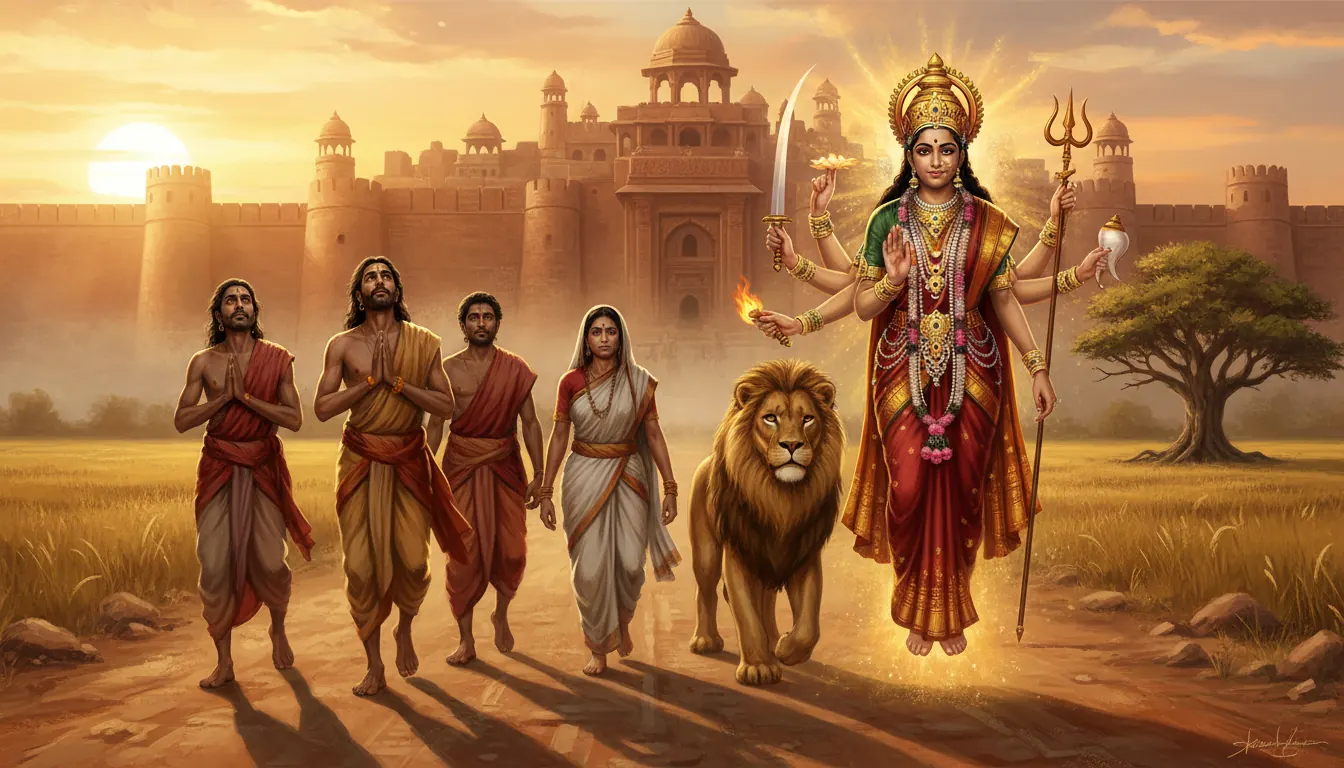
On the last road into Virata's city, with his weapons hidden in a sami tree and his name given away, Yudhishthira praises the Goddess Durga silently as he walks, naming her as Kali, as the child Kamsa could not break, as the slayer of Mahishasura. She stands before him on the road, promises him the earth again, and grants that no one in Matsya will recognise them.
Told in the Virata ParvaSet in Virata, Yamuna and Vindhya16 min read
The Southern Bank
Vaishampayana said: They came down out of the hill country at the close of the twelfth year with swords girt at their waists and the finger-guards of iguana skin still laced onto their hands, and they turned toward the Yamuna.
Twelve years of inaccessible hills and forest fastnesses had left a mark on them that no story could cover. They were wan. They wore beards. They had lived by killing the deer of the forest, and when people on the road asked what they were, they said hunters, and nobody asked a second time.
They crossed to the southern bank of the river and went on through Yakrilloma and Surasena, leaving the country of the Panchalas on their right hand and the Dasharnas on their left, and so came over the border into the dominions of Matsya.
It was late in the night when Draupadi stopped walking.
"There are footpaths here," she said, "and fields that somebody ploughs. Virata's city is still far off. Let us spend what is left of the night where we stand. My fatigue is very great."
Yudhishthira looked down the road, and then at her, and made the only arrangement left to a king with no servants.
"Dhananjaya," he said, "take up Panchali and carry her. The moment we are out of this forest we are at the city."
So Arjuna lifted her the way the leader of a herd lifts what it will not leave behind, and carried her the rest of the way, and set her down only when the walls were close enough to count the gates.
What They Hung in the Tree
Before the city, there was the matter of the weapons.
"Where do we put them?" Yudhishthira said. "If we walk in armed we frighten the citizens. And the Gandiva is known to every man alive. If even one of us is recognised, we go back to the forest for another twelve years."
Arjuna had already chosen the place. "Past the burning ground," he said, "near that peak nobody climbs, there is a great sami tree with branches thrown out wide and no easy way up it. It stands in an out-of-the-way stretch of forest full of beasts and snakes, and a cemetery beside it. No man will see us there."
So they unstrung the bows. Yudhishthira loosened the string of the bow with which he had held his ground at Kurukshetra. Bhima unstrung the bow that had beaten the Panchalas and the lord of Sindhu. Nakula unstrung the bow that had taken the west, and Sahadeva the bow that had taken the south, and Arjuna the Gandiva, whose twang had scattered gods and men and Nagas. They laid the swords in with the bows, and the quivers, and the arrows sharp as razors, and Nakula went up the tree and bound the whole bundle where the branch would not break and the rain would not reach.
Then they hung a corpse in the tree with it, so that the smell would keep herdsmen away. When the cowherds did ask, the brothers said, "That is our mother. She was a hundred and eighty years old. We hang up our dead in the manner of our fathers," and the cowherds went off quickly and did not come back.
Yudhishthira gave out five names for the road: Jaya for himself, and Jayanta, Vijaya, Jayatsena and Jayatvala for his brothers. Every one of them meant victory. Not one of them meant anything at all.
They stood a moment under the tree with their hands empty. Twelve years in the woods had not felt like this. In the woods they had been hunted men with bows. From this moment until the thirteenth year was counted out they would be servants in a stranger's house with nothing to defend themselves with but their manners, and if a single one of them was recognised the whole count began again.
A King with Nothing in His Hands
They walked the last stretch of road toward the delightful city of Virata in the grey before dawn, and Yudhishthira walked at the back of the file.
He had, at that hour, nothing whatever. His kingdom had been dealt away across a gaming board. His fires had gone off in Dhaumya's keeping toward Panchala, and his charioteers and cooks with them, and his wife's maidservants had been sent to the Panchalas with a sentence to repeat: we do not know where the Pandavas went, they left us at the lake of Dvaitavana. His weapons were in a tree behind him with a corpse hung up beside them.
And ahead of him were the parts they had all agreed to play.
Bhima would be Vallabha, a cook, who would make curries better than any cook the king had, and carry loads of wood no other man could lift, and throw wrestlers in the lists without killing them because he had been told not to. Arjuna, whose forearms were scarred hard by the bowstring in ridges like the humps of bulls, would cover those arms in bangles, put rings in his ears and a braid down his back, and go in as Brihannala, of the third sex, to teach the women of the inner apartments to sing and to dance. Nakula would be Granthika and keep the horses, because colts and vicious mares went quiet under his hand. Sahadeva would be Tantripala and keep the cattle, because he knew their marks and their diseases and their tempers. Draupadi, a princess who since her birth had known garlands and perfumes and costly robes and no work at all, would go in as a Sairandhri, a woman who dresses other women's hair, and serve queen Sudeshna, and say if asked that she had once waited on Draupadi in Yudhishthira's house.
And Yudhishthira himself would be Kanka, a brahmana who was fond of play, and would sit with the king over ivory pawns of blue and yellow and red and white and black and red dice, and say, if the monarch asked, that he had formerly been a friend of Yudhishthira's.
A man stripped that far has one thing left to offer, and it costs him nothing and everything at the same time.
So he began, silently, walking, to praise the Goddess. He said nothing aloud. Nobody on that road knew he was doing it. He praised the Divine Durga, the supreme Goddess of the universe, and he called her by the names the old hymns give her, one after another, the way a man in the dark says over the names of everyone he has ever loved.
And because he and his brothers longed to see her with their own eyes, he called on her, and this is what the son of Pandu said.
Hail to You, Giver of Boons
"Hail to you, giver of boons. Hail, maiden, one with Krishna, keeper of the vow of Brahmacharya, whose body is as bright as the rising sun and whose face is as lovely as the full moon.
"Hail to you, four-handed and four-faced, with your fair round hips and full breasts, your bangles of emerald and sapphire and the fine bracelets on your upper arms. You shine, Goddess, like Padma, the consort of Narayana. You roam the regions of the sky, and both your true form and your maidenhood are perfectly pure.
"You are as dark as the black clouds, and your face is as beautiful as Sankarshana's. You have two great arms as long as the pair of poles raised in honour of Indra, and in your other hands you hold a vessel, a lotus, a bell, a noose, a bow, a great discus and other weapons. You alone, of all the women in the universe, have the quality of purity.
"Your shapely ears are graced with fine rings. Your face shines so brightly that it rivals the moon. With your splendid diadem and your lovely braid, your robes made of the bodies of snakes and the brilliant girdle round your hips, you shine like Mount Mandara with the serpents wound around it. Peacock feathers stand upright on your head, and by your vow of lifelong maidenhood you have made the heavens holy."
The road went on under his feet. He did not shorten it. He gave her every name he had.
The Child Dashed on the Stone
He praised her next as the one the cowherds knew.
He saluted her who was born of the womb of Yashoda and who is fond of the boons that Narayana bestowed on her; who sprang from the race of the cowherd Nanda; who is the giver of prosperity and the enhancer of the glory of the house that worships her; the terrifier of Kamsa, the destroyer of Asuras.
He saluted her who ascended into the sky when Kamsa dashed her against a stony platform, expecting a newborn girl to break, and who rose out of his hands instead; who is the sister of Vasudeva; who is always decked in celestial garlands and attired in celestial robes; who is armed with scimitar and shield; who lifts the worshipper sunk in sin the way a cow is hauled out of the mire, and who is called upon by every creature in the hour of distress to take the load off its back.
He knew what he was asking. He had watched a girl be handled once in an assembly hall in Hastinapura, and had sat and not risen. He was walking now behind that same woman on a road at dawn, and he was praising a Goddess whose first act in the world had been to slip out of a murderer's grip and go up into the air where nobody could reach her.
"That is why," he said, "you who killed Mahishasura are praised and worshipped by the gods themselves, so that you will protect the three worlds."
He was praising, and he knew it, the Goddess of everyone who has been counted as nothing. She had come out of a cowherd's house. She had been handed over as a girl-child in the dark to a king who intended to kill her and had been counted, by that king, as one more small obstacle to be dashed against a stone. She had gone up out of his hands into the sky. And after that she had killed the buffalo-demon whom the gods themselves could not put down, and the gods, who had not been able to help her, had come afterwards to worship her.
A man walking into a year of service under a false name could think of worse company to keep.
Kali, Kali
"Greatest of all the gods, show me your grace and your mercy, and be the source of blessings for me. You are Jaya and you are Vijaya, and it is you who give victory in battle. Grant me victory, Goddess, and grant me boons too in this hour of trouble.
"Your eternal home is on the Vindhya, the greatest of mountains. Kali, Kali, you are the great Kali, who always loves wine and flesh and animal sacrifice. You go wherever you will and grant boons to your devotees, and Brahma and the other gods follow behind you on your journeys.
"Those who call on you to lift their burdens, and those who bow to you on the earth at daybreak, can have anything at all, whether children or wealth."
The names he had just given himself and his brothers, Jaya, Jayanta, Vijaya, echoed that very line. He had walked into Matsya wearing the Goddess's titles as false names, because they were the only names he could think of that were not lies.
And he went on naming her. "You rescue people from their troubles, whether they are in distress in the wilderness or sinking in the great ocean, and that is why everyone calls you Durga. You are the only refuge of men when robbers fall on them, or when they are in trouble crossing rivers and seas, or lost in wild places and forests. Those who remember you are never brought low, great Goddess."
Robbed of My Kingdom, I Seek Your Protection
"You are Fame and you are Prosperity. You are Steadiness, you are Success. You are the Wife, you are the Children men have, you are Knowledge, you are the Intellect. You are the two Twilights, and the Night, and Sleep, and the light of the sun and the moon, and Beauty, and Forgiveness, and Mercy, and everything else there is.
"When your devotees worship you, you free them from their fetters, their ignorance, the loss of their children, the loss of their wealth, their disease, their death and their fear."
And then, at the very end of all the titles, the man walking into a stranger's city with nothing on him said the only sentence in the whole hymn that was about himself.
"I have been robbed of my kingdom, and I seek your protection. I bow my head to you, Supreme Goddess with eyes like lotus leaves: protect me. Be Truth that grants boons to us, who act according to Truth. Durga, you who are kind to all who come to you for shelter and love all your devotees, protect me."
He had no fire to make an offering on. He had no gold and no cattle and no hall and no priest. He had a road, and a beard, and a borrowed name, and four brothers and a wife walking ahead of him toward a gate they would have to lie their way through, and he laid the whole of that down and asked for one thing.
She Stands on the Road
Vaishampayana continued: Thus praised by the son of Pandu, the Goddess showed herself to him.
She came near him on the road and spoke, and this is what she said.
"Mighty-armed king, my lord, listen to what I say. By my grace you will defeat and destroy the ranks of the Kauravas, and victory in battle will soon be yours. You will rule the whole earth again, once you have cleared your kingdom of every thorn. And you will find great happiness, you and your brothers together. By my grace, joy and health will be yours.
"And those in the world who recite my qualities and my deeds will be freed from their sins and made content. I will give them kingdoms, long life, beauty and children. And those who call on me as you have called on me, whether in exile or in the city, in battle or in danger from enemies, in forests or trackless deserts, in seas or in the fastnesses of mountains, will obtain everything they seek in this world. And whoever listens to this fine hymn, or recites it himself with devotion, sons of Pandu, will succeed in everything he undertakes."
She had answered the whole of it. Not the part about the kingdom only, which is what a king asks for, but the part underneath it, which is what a man asks for when he is frightened and does not say so.
And she had done something else, which Yudhishthira, standing in the road, would have been the first to notice. He had asked for himself. She had answered for everybody who would ever say those words after him. In exile or in the city, she said, in battle or in danger from enemies, in forests or trackless deserts, in seas or in the fastnesses of mountains. She had taken the private prayer of one dispossessed man on one particular road and turned it into a thing that anyone could pick up and use.
The Boon of Not Being Seen
Then she gave him the one thing he had not thought to ask for, because it was too practical to put into a hymn.
"And through my grace," the Goddess said, "neither the spies of the Kurus nor the people of the Matsya country will be able to recognise any of you, for as long as you live in Virata's city."
That was the whole boon, and it was exactly the size of their problem. Duryodhana had already sent men out along every road with instructions to find five brothers and a woman. Every court in the country would be looking at strangers for a year. And the Goddess had not offered to hide them or to move them or to change their faces. She had simply arranged that people would look at them and not see.
Having said these words to Yudhishthira, that chastiser of foes, and having made her arrangement for the protection of the sons of Pandu, the Goddess disappeared from that place.
He walked on. He did not tell his brothers. There was no time and there was nothing to show them, and in any case a man does not turn round on a road at dawn and announce to four exhausted people that a Goddess has just guaranteed the year.
What he had instead was the thing itself. He had walked out of a forest with a false name and a beard and no weapon, and somewhere between the sami tree and the gate the Goddess had stood in front of him on the road and said victory in battle will soon be yours, and then gone.
A little later that morning the six of them came up to the gate of Virata's city. They separated, as they had agreed, and went in one at a time so that nobody would count them as a party. A dusty brahmana who called himself Kanka asked to be taken to the king, saying that he was a friend of Yudhishthira's and knew something about dice; and the king of the Matsyas looked straight at him, and saw a brahmana, and gave him a seat.
Dharma Lesson
The prayer a man makes when he has been stripped of everything is the truest one he will ever make, because there is nothing left in it to bargain with. Yudhishthira offers no fire, no gold and no cattle, only his own helplessness, and that is accepted. What he receives back is not a weapon but a year of not being seen, which was the only thing he actually needed.