The Hands Marked With Corns
A night in the kitchen, and everything she had not said
In short
The night after Kichaka kicks her in Virata's open court, Draupadi leaves her bed, finds Bhima asleep among the cooking fires and wakes him. What follows is the longest speech she makes in the epic: an inventory of what each husband has been reduced to, ending when she holds out her hands and shows him the corns raised by grinding sandal for another woman.
Told in the Virata ParvaSet in Virata and Indraprastha21 min read
Look For Trees For Fuel
Kichaka knocked her down on the floor of Virata's court and kicked her, in front of the king, in front of the courtiers, in front of the charioteers and the elephant riders and the citizens who had come in to watch the dice.
In the cook's place at the side of the hall, wrinkles appeared on Bhima's forehead and a smoky exhalation shot out of his eyes and his eyelashes stood on end. He pressed his forehead with both hands. He was already coming up off the ground when Yudhishthira, sitting at the board opposite the king with the dice in his fingers, squeezed his own thumbs together and looked at him.
"Are you looking for trees for fuel, cook?" said Yudhishthira mildly. "If you need firewood, go outside and cut some."
Bhima sat down.
Draupadi came to the entrance of the court with her hair loose and her eyes burning, and she saw her husbands sitting there melancholy and keeping their disguises, and she spoke to Virata instead.
"Today the son of a suta has kicked the beloved wife of men whose enemy can never sleep in peace, though four kingdoms lie between him and them. He has kicked the wife of men who, if they were not bound by a pledge, could destroy this entire world. Where are they today, those warriors who have always granted protection to whoever asked it? Why do they quietly suffer their wife to be insulted by a suta's son? And what can I, one woman, do, when Virata himself, lacking in virtue, calmly allows me to be wronged when I am innocent? You do not act like a king toward this Kichaka. Your behaviour is that of a robber and does not shine in a court."
"I do not know what your dispute has been out of our sight," said Virata. "Not knowing the real cause, how can I judge it?"
The courtiers, who had learnt everything within a minute, cried "Well done, well done" and censured Kichaka, and said among themselves that such a woman was surely a goddess, and did nothing else whatever.
Sweat stood on Yudhishthira's forehead. He did not look up from the board.
"Do not stay here, Sairindhri," he said. "Go to the apartments of Sudeshna. The wives of heroes bear affliction for the sake of their husbands. Your gandharva husbands, bright as the sun, do not seem to think this a time to show their anger, since they have not rushed to your aid. You do not understand what the moment calls for, and so you weep like an actress, and interrupt the play of dice in Matsya's court."
"The men whose wedded wife I am," she said, "are, I think, extremely kind. And because the eldest of them is addicted to dice, everybody is free to oppress them all."
And she ran out with her hair unbound.
Washing at Midnight
Sudeshna was still awake in her apartments when the Sairindhri came in with her face wet.
"Who has insulted you? Why do you weep? Who has done you wrong?"
"As I went to bring you wine, Kichaka struck me in the court, in the very presence of the king, as though we stood in the middle of a solitary wood."
"Since Kichaka, maddened by lust, has insulted one he cannot possess," said the queen, "I will have him killed, if you wish it."
"Others will slay him," said Draupadi. "They whom he has wronged. I think it is clear that he will go to the abode of Yama this very day."
Then she went to her own quarters and washed her body and her clothes, because that is what the day had left her to do with her hands. And standing in the wet, Drupada's daughter began to weep and to turn the thing over.
What am I to do? Where can I go? How can I achieve my purpose?
The answer was very short. There was one man in that palace who would not tell her to be timely, and he was asleep at the other end of it.
So the princess of Panchala rose in the middle of the night and left her bed and walked through the sleeping house toward the quarters of Bhimasena, and the corridors were empty, and nobody stopped a serving woman going anywhere at that hour, which was one of the very few advantages her year had given her.
Waking Him in the Cooking Quarters
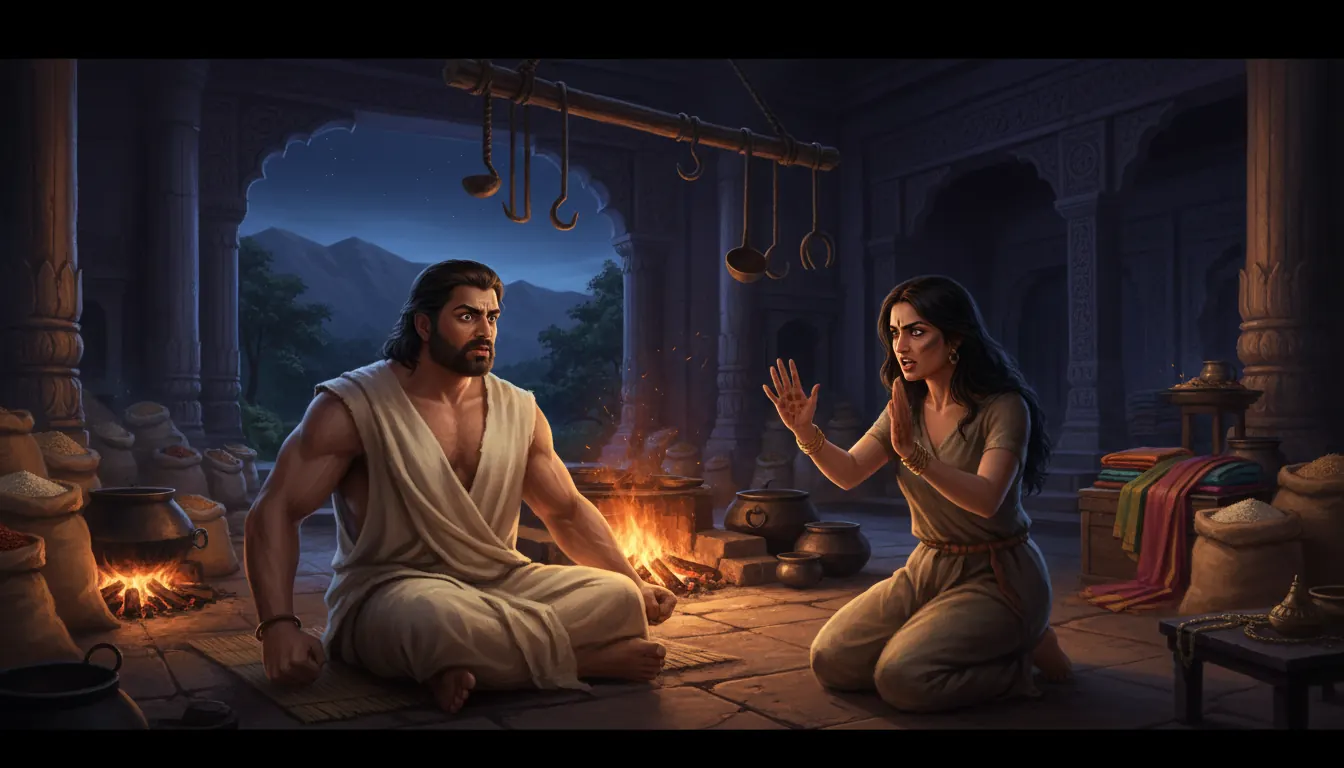
She found him in the cooking apartments, among the banked fires and the covered vessels, breathing hard like a lion in his sleep. And the chamber, filled all at once with the beauty of Drupada's daughter and of the high-souled Bhima, blazed forth in splendour.
She came to him the way a young cow of the woods comes to a great bull, and she put her arms around him as a creeper embraces a huge sala on the bank of the Gomati, and woke him as a lioness wakes a sleeping lion in a trackless forest.
"Get up. Get up. Why are you lying here like a dead man, Bhimasena? Surely a man who is not dead never lets a wicked wretch who has disgraced his wife go on living."
Bhima came up out of sleep, sat on the couch with its rich covering, and looked at her.
"Why have you come here in such a hurry? Your colour is gone. You look lean and pale." He took her by the shoulders. "Tell me everything in detail. I must know the truth. Whether it is pleasurable or painful, agreeable or disagreeable, tell me all. When I have heard everything, I will find the remedy. I alone have the right to your trust in all things, for it is I who deliver you from perils again and again. Tell me quickly what your wish is, and what purpose you have in view, and then go back to your bed before the others wake."
She did not go back to her bed. She stood in the kitchen of another man's house and talked until the fires had gone grey, and it was the longest she had ever spoken to anyone in her life.
The Emperor Who Casts Dice
"What grief does she not have," said Draupadi, "who has Yudhishthira for her husband? Knowing all my griefs, why do you ask me?
"The Pratikamin dragged me into the court in the midst of an assembly of courtiers and called me a slave. That grief consumes me. What other princess but Draupadi would go on living after such misery? Who else could bear the second insult, which the wicked Saindhava offered me in the forest? Who else of my position could live, having been kicked by Kichaka in the very sight of the king of the Matsyas?
"Blame that elder brother of yours who is addicted to wretched dice, whose act alone has brought me to this. Who else but a desperate gambler would play away a kingdom and everything in it, including me? If he had gambled morning and evening for years together, staking nishkas by the thousand, his silver and gold and robes and vehicles, his goats and sheep and his multitudes of horses and mares and mules would not have grown any less at all. And now, stripped of prosperity by the rivalry of dice, he sits dumb like a fool, reflecting on his own misdeeds.
"He who was followed by ten thousand elephants with golden garlands now supports himself by casting dice. That Yudhishthira, who at Indraprastha was adored by kings by the hundred thousand; in whose kitchen a hundred thousand maidservants stood plate in hand, feeding guests day and night; who gave away a thousand nishkas every day; who maintained eighty-eight thousand household Snatakas with thirty maidservants assigned to each, and ten thousand yatis who accepted nothing in gift; who was waited on by a thousand sages of ascetic merit as his courtiers, morning and evening, with bards by the thousand in earrings of brilliant gems singing to him. That Yudhishthira, who was without malice, who gave every creature its due, who out of compassion maintained in his kingdom the blind, the old, the helpless and the parentless.
"That man is now a dependant and a servant of Matsya, a caster of dice in his court, and he calls himself Kanka. He to whom all the rulers of the earth once paid timely tribute now begs his subsistence at another's hands. He once dazzled the whole earth like the sun with his energy, and now he is a courtier of King Virata, sitting beside another man and breathing flattery into his ear. Who can see that and not be stricken with grief?"
Vallava, Who Fights the Beasts
"This is another grief of mine," she said, "and you must not blame me, for I tell it to you out of sadness of heart.
"Whose grief does not deepen at the sight of you, bull of the Bharatas, working at the lowly job of a cook, so entirely beneath you, calling yourself one of the Vallava caste? What can be sadder than that people should know you as Virata's cook, and therefore as one sunk in servitude? When your work in the kitchen is over and you sit humbly down beside Virata and name yourself Vallava the cook, despondency seizes my heart.
"And when the king in his joy makes you fight with elephants, and the women of the inner apartments laugh all the while, I am sorely distressed. When you fight with lions and tigers and buffaloes there, with the princess of Kekaya looking on, I almost swoon away. And when Sudeshna and her maidservants leave their seats and come to help me, and find that I have taken no injury in any limb and that it is only a swoon, then the queen says to her women, 'Surely it is out of affection, and out of the duty that comes from living close together, that this lady of sweet smiles grieves for the immensely strong cook when he fights the beasts. The Sairindhri is very beautiful and Vallava is very handsome too. A woman's heart is hard to know, and I fancy they deserve each other. Most likely the Sairindhri weeps at such times because of her bond with her lover. And after all, they both entered this royal household at the same time.'
"So she reproaches me. And when she sees me angry at it, she takes that too for proof that I am attached to you. Great is the grief I feel when she speaks so. Seeing you afflicted with such calamity, Bhima of terrible prowess, sunk as I already am in grief on account of Yudhishthira, I do not desire to live."
Braids and Bracelets of Conch
"That youth who in a single chariot defeated all the celestials and men is now the dancing master of king Virata's daughter. He who gratified Agni in the forest of Khandava now lives in the inner apartments like a fire hidden in a well.
"He whose mace-like arms were scarred by the strokes of his own bowstring covers his wrists now with bracelets of conch. He, whose bowstring's twang and the sound of whose leather guards made every enemy tremble, entertains delighted women with songs. He whose head was decked with a diadem of solar splendour now wears braids ending in unsightly curls. That high-souled hero, master of all the celestial weapons, repository of all the sciences, now wears earrings like a woman.
"Bhima, when I see that terrible bowman in the midst of women, wearing braids, my heart is stricken. He whom kings of matchless prowess could no more overpower in battle than the waters of the ocean can overleap the land, now waits upon Virata's daughters in disguise.
"Arjuna, the clatter of whose chariot wheels made the whole earth tremble with her mountains and her forests, all her moving and unmoving things, whose birth dispelled all the sorrows of Kunti. When I see the godlike Partha in the music hall, like an elephant with rent temples surrounded by she-elephants, standing among the women and waiting before Virata the king of the Matsyas, I lose all sense of direction.
"Surely my mother-in-law does not know that Dhananjaya is afflicted with such distress. Nor does she know that Ajatashatru, addicted to disastrous dice, is sunk in this misery."
The One Who Sleeps On Calf-Skins
"When I see the youngest of you all, Sahadeva, minding the cattle in the guise of a cowherd, I grow pale. Always thinking of Sahadeva's plight, I cannot sleep, and what am I to say to you of the rest? I do not know what sin Sahadeva may have committed, that a hero of unfailing prowess should suffer such misery. To see that bull among men employed by Matsya to look after his cattle, pleasing Virata by living at the head of his cowherds in robes dyed red, fills me with woe. I am attacked with fever when I look at him.
"My mother-in-law always praised the heroic Sahadeva for his nobility, his excellent behaviour, his uprightness. When we were setting out for the great forest, the weeping Kunti stood embracing him, and she said to me, 'Sahadeva is bashful and sweet-spoken and virtuous. He is also my favourite child. So, Yajnaseni, look after him in the forest day and night. He is delicate and brave, devoted to the king and always revering his elder brother; Panchali, feed him with your own hands.' Seeing that finest of warriors tending cattle and sleeping at night on calf-skins, how can I bear to live?
"And he who is crowned with the three gifts of beauty, arms and intelligence is now the keeper of Virata's horses. Look at the change time has brought. Granthika, at the sight of whom hostile hosts fled from the field of battle, now trains horses in the presence of the king and drives them at speed for him to admire. I see that handsome youth wait upon the gorgeously decked Virata and display horses to him.
"Stricken as I am with all these hundred kinds of misery because of Yudhishthira, why, chastiser of foes, do you still think me happy? Listen now, son of Kunti, while I tell you of woes far worse than these."
These Hands, Which Were Not So Before
"Because of that desperate gambler I am now under Sudeshna's command, living in this palace in the guise of a Sairindhri, and I am living in expectation of the end of a fixed period. That is the extreme of misery.
"Success of purpose, victory and defeat are transitory things among mortals, and prosperity and adversity revolve like a wheel. As a tank once dried is filled up again, so, hoping for a change for the better, I await the return of good fortune. I have heard that persons who give may come to beg; that they who slay may be slain; that they who overthrow others may themselves be overthrown. Nothing is difficult for Destiny and no one can override Destiny.
"But look at me. She who had the whole earth to the verge of the sea under her control is now under the control of Sudeshna and lives in fear of her. She who had attendants walking before her and behind her now walks herself before and behind Sudeshna.
"And here is another grief of mine, which is intolerable, and you must listen to it. She who had never pounded unguents even for her own use, save only for Kunti, now pounds sandal for others."
She held out her hands to him, palms up, in the light of the banked fire.
"Look, son of Kunti, at these hands of mine, which were not so before."
They were marked with corns.
"She who never feared Kunti herself, nor you, nor your brothers, now stands in fear before Virata like a slave, anxious about what the king may say to her concerning the proper preparation of the unguents, because Matsya does not like sandal that has been pounded by other hands than mine."
Then she stopped talking and wept without any sound, looking at him. And after a while, with her words choked in tears, she said, "Great must have been my offence against the gods in the past, that I am still alive when I should be dead."
And Bhimasena, slayer of hostile heroes, took those delicate hands marked with corns and covered his face with them and wept, holding them in his own, and the tears ran down over her palms.
Shame On the Might of My Arms
"Shame on the might of my arms," said Bhima, "and shame on the Gandiva of Falguni, since your hands, that were red before, are now covered with corns.
"I would have made a carnage in Virata's court today, but Kunti's son looked at me and forbade it. I would have crushed the head of Kichaka without any ado, the way an elephant crushes a tree. When I saw Kichaka kick you, I thought in that instant of the wholesale slaughter of the Matsyas. Yudhishthira forbade me with a glance, and understanding his intention I kept quiet.
"That we have been deprived of our kingdom; that I have not yet slain the Kurus; that I have not yet taken the heads of Suyodhana, and of Karna, and of Subala's son Shakuni, and of the wicked Dushasana. These acts and these omissions are consuming every limb of mine. The thought of them stays in my heart like a javelin lodged there."
He held her hands and would not let go of them.
"But do not sacrifice virtue, and master your wrath. If King Yudhishthira hears such rebukes from you, he will surely put an end to his life. If Dhananjaya and the twins hear you speak so, even they will renounce life. And if they give up life, I will not be able to bear my own.
"In olden days Sharyati's daughter, the beautiful Sukanya, followed into the forest Chyavana of Bhrigu's race, whose mind was under complete control and over whom, while he sat in meditation, the ants had built a hill. You may have heard that Indrasena, who in beauty was like Narayani herself, followed a husband a thousand years old. You may have heard that Janaka's daughter Sita, the princess of Videha, followed her lord into the dense woods, and that lady of graceful hips, afflicted with calamities and persecuted by the rakshasas, at length regained the company of Rama. Lopamudra too, young and beautiful, followed Agastya, renouncing all the objects of enjoyment that are unattainable by men. And the intelligent and faultless Savitri followed the heroic Satyavan, the son of Dyumatsena, alone into the world of Yama.
"Like these chaste and beautiful ladies whom I have named, you bloom with every virtue. Wait a short while more, no more than half a month. And when the thirteenth year is complete, you will again be the reigning queen of a king."
The Work of the Hour
"It was only grief, which I could not bear, that made me shed these tears," said Draupadi. "I do not censure Yudhishthira. Nor is there any use in dwelling on the past. Bhima of mighty strength, come quickly forward to the work of the hour.
"Sudeshna, jealous of my beauty, always pains me with her efforts to stop the king from taking a fancy to me, and seeing this in her, the wicked-souled Kichaka keeps pressing his own suit on me. Angry with him, but holding back my wrath, I answer that wretch, robbed of his senses by lust, and I say, 'Kichaka, protect yourself. I am the beloved queen and wife of five gandharvas. Those heroes in their wrath will slay you, rash as you are.' And he answers me, 'I have not the least fear of the gandharvas, Sairindhri of sweet smiles. I will meet a hundred thousand gandharvas in battle and slay them. So, timid one, consent.' And I say to him again, 'You are no match for those illustrious ones. I am of respectable family and good nature, I always hold to virtue and never wish for anyone's death. That is the only reason you are still alive.' And at this he burst out laughing loudly.
"Then Sudeshna, urged by her brother beforehand and moved by affection for him, sent me to his quarters, saying, 'Go, Sairindhri, and fetch wine from Kichaka's apartments.' He addressed me first in sweet words, and when that failed he became enraged and intended to use violence. Understanding his purpose, I rushed to the place where the king was. He felled me to the ground and kicked me, in the very presence of the king himself, before the eyes of Kanka and of many others, charioteers and royal favourites and elephant riders and citizens. I rebuked the king and Kanka again and again. The king neither stopped Kichaka nor punished him in any way.
"He is Virata's chief ally in war, and lacking in virtue as he is, both the king and the queen love him. Though I have rebuffed him again and again, if he sees me once more he will violate me, and then I will surely give up my life. And at my death your highly meritorious acts will come to nothing, and you who are now obeying your pledge will have lost your wife. By protecting one's wife one's offspring are protected, and by protecting one's offspring one's own self is protected; it is because a man begets his own self in his wife that the wife is called Jaya by the wise. And I have heard brahmanas explaining the duties of the orders say that a kshatriya has no other duty than to subdue his enemies.
"It was you who delivered me from the terrible Jatasura, and you who with your brothers vanquished Jayadratha. Smash this lustful creature like an earthen pot dashed upon a stone. If tomorrow's sun shines on the man who is the source of all these griefs of mine, I will mix poison into a drink and drink it down, for I will never yield to Kichaka. Far better, Bhima, that I should die before you."
And having said it, she hid her face in his breast and wept.
Bhima held her and consoled her as well as he could, with words of grave reason and sense, and wiped her face with his hands where it was flooded with tears. Then he thought of Kichaka, and licked the corners of his mouth, and spoke.
"I will do just as you say. I will soon slay Kichaka with all his friends. Tomorrow evening, putting away sorrow and grief, manage to have a meeting with him. The king of the Matsyas has caused a dancing hall to be built."
Dharma Lesson
Endurance kept silently is still endurance, but it is owed one honest hearing from the person it is being kept for. Draupadi does not ask Bhima to break the vow; she asks him to look at what the vow costs, and to look at her hands while he does it. Duty carried without ever being spoken aloud turns into a debt between the people carrying it.