The Walk Across the Field
The king who laid down his armour before the first arrow
In short
With both armies drawn up and the conches already blown, Yudhishthira takes off his mail, sets down his weapon and walks unarmed into the Kaurava line while the enemy calls him a coward. He kneels to Bhishma, Drona, Kripa and Shalya in turn, asking each for permission to fight and for the secret of his own defeat. Krishna carries a last offer to Karna, and Yuyutsu alone walks back with them.
Told in the Bhishma ParvaSet in Kurukshetra20 min read
The Armour Set Down
Sanjaya said: Arjuna took up his arrows and the Gandiva once more, and the great chariot warriors of the Pandava side sent up a shout that ran the whole length of their line. The Somakas and all who followed them blew their sea-born conches. Drums and Pesis and Karkachas and cow-horns were beaten and blown together until the uproar was one solid sound.
And the sky filled. The gods came, with the Gandharvas and the Pitris and the hosts of the Siddhas and the Charanas, to watch. The blessed rishis came in a body with the god of a hundred sacrifices at their head, to look down on the slaughter that was about to begin.
Then, king, the two armies stood facing each other like two oceans, heaving and never still, and in the middle of that noise your enemy the son of Dharma did a thing that no one on either side could possibly have expected.
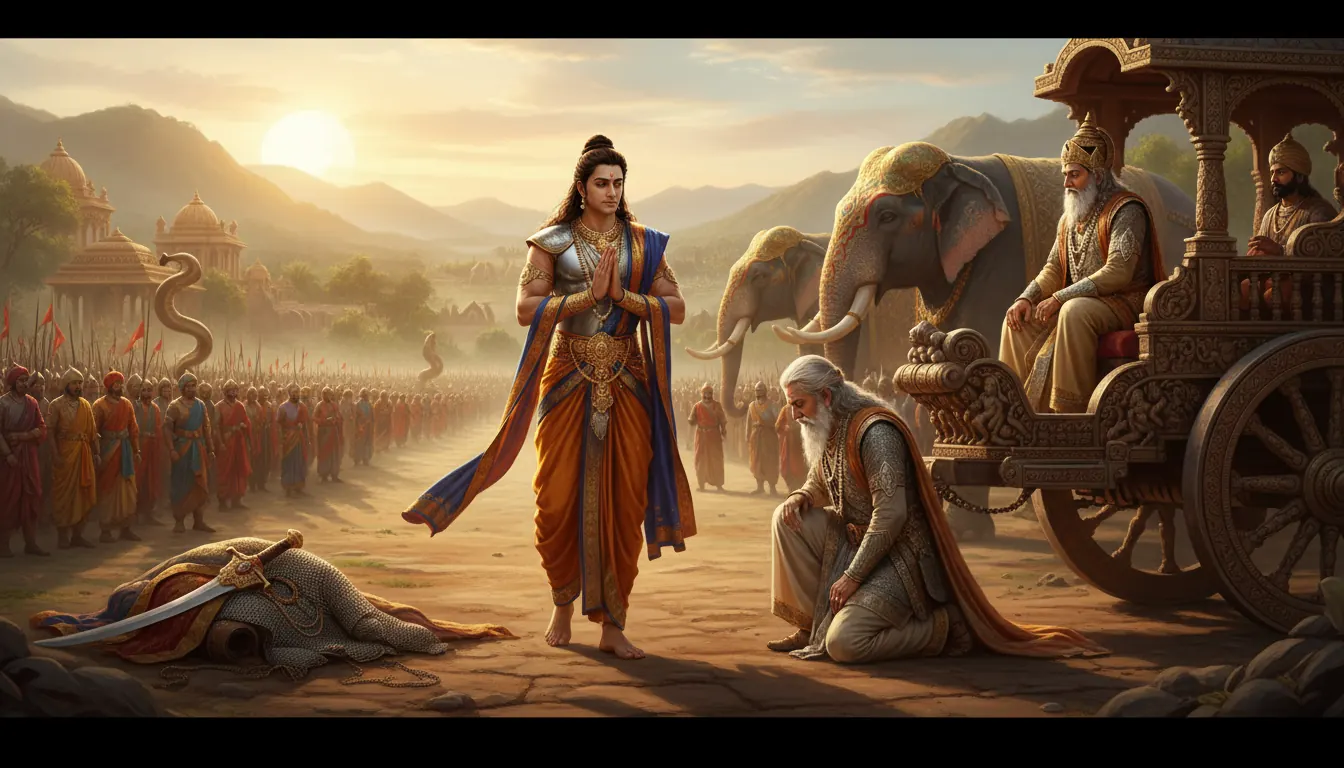
He unfastened his coat of mail and took it off. He set aside his fine weapon. He came down from his chariot, and with his hands joined in front of him he began to walk, on foot, facing east, toward the place where the enemy army stood.
He kept his eyes on the grandsire. He said nothing to anyone.
Arjuna saw him go and jumped down off his own chariot and came after him, and the others came after Arjuna. Lord Vasudeva followed behind them. The chief kings of that army, full of anxiety, left their chariots too and walked the same way, because their king was walking and no one could think of a reason for it.
Four Questions and One Answer
"What are you doing, king?" Arjuna said, keeping pace with him. "You are leaving your brothers and walking east on foot into the enemy army."
"Where are you going, king of kings?" said Bhimasena. "You have thrown off your coat of mail and your weapons, and the warriors you are walking toward are clad in mail. You have left your brothers behind you. Where are you going?"
"You are my eldest brother," Nakula said. "When I see you go like this, my heart is full of fear. Tell us. Where are you going?"
"These enemy divisions are terrible and they are many," Sahadeva said, "and we are here to fight them. Where are you going, king, walking toward our enemies?"
Yudhishthira, a man sparing with words, said nothing at all to any of them, and kept walking.
It was Vasudeva who answered them, and he was smiling when he did it.
"I know what he means to do. He will pay his respects to all his elders first, to Bhishma and Drona and Kripa, and to Shalya too, and then he will fight the enemy. The old histories say that a man who first salutes his teachers as the rules require, and those who are older, and his kinsmen, and only then goes to battle against his elders, is sure to win. I think so too."
So the four brothers walked with him, and Krishna walked with them, and none of them said anything more.
What the Kaurava Line Said
In your ranks, king, a loud noise went up, Alas, and Oh, and the other army stayed perfectly still.
Your son's heroic warriors watched an unarmed man in a plain garment walking across open ground toward them, and they knew at once what they were looking at.
"This man is a disgrace to his race," they said to one another. "It is plain. The king is coming to Bhishma in terror. Yudhishthira and his brothers have come begging for the grandsire's protection."
"But why? Dhananjaya protects him, and Vrikodara, and Nakula and Sahadeva. Why would the eldest son of Pandu come here in fear?"
"Because he is weak, whatever the world says of him, and his heart is full of fear at the thought of battle. A man like that could never have been born a kshatriya."
And they praised the Kauravas, all of them, and their hearts lifted, and they took hold of their garments and waved them over their heads at him. They jeered at Yudhishthira and every one of his brothers, and Keshava with them, and cried Shame at the five men walking toward them across the field.
Then the noise died all at once, and your army, king, went perfectly still again.
Because the man had not turned back. He was still coming. And a different question began to move along the line: what will this king say? What will Bhishma say to him? What will Bhima say, who boasts so of his strength in battle, and what will Krishna and Arjuna say? What, in fact, does he have to say at all?
Both armies, king, were burning with curiosity, and eighteen armies stood still in the sun and waited to hear it.
The Grandsire's Wheel
He went into the array. It bristled with arrows and darts and every man in it had a weapon in his hand, and he walked through it with his brothers around him until he came to the chariot of Shantanu's son, who stood there ready for battle.
Then he took hold of Bhishma's feet with both his hands.
"I salute you, invincible one. We are going to fight you. Give us your permission, and give us your blessing too."
"If you had not come to me like this, lord of the earth," Bhishma said, "I would have cursed you, and your defeat would have followed. I am pleased with you, my son. Fight, and win. Whatever else you desire, win it in battle. And ask me for a boon besides, son of Pritha, any boon you wish. If you do that, great king, defeat will not be yours."
He was silent a moment, and then he said the thing he was to say four times over that morning, in four mouths, in the same words.
"A man is the slave of wealth, but wealth is no one's slave. That is very true, king. The Kauravas have bound me with their wealth. That is why, son of Kuru's line, I speak to you like a eunuch and say: the Kauravas have bound me with their wealth. Apart from the battle itself, what do you want?"
"You are so wise: think of my interests day by day, and wish me well. But fight for the Kauravas. That is always my prayer to you."
"What help can I give you in this, son of Kuru's line? Of course I will fight for your enemies. Tell me what you have to say."
So Yudhishthira asked him the question he had come across the field to ask.
"Then I ask you, sir. I bow to you, grandsire. How can we defeat you in battle, when you cannot be defeated? Tell me this, for my good, if you see any good in it."
"I do not see the man, son of Kunti, who could defeat me in battle when I fight," Bhishma said. "Not even if he were the king of the gods himself."
"My salutations to you, grandsire. Then I ask you this. Tell us how your enemies can bring about your death in battle."
The old man looked at him for a while.
"I do not see the man, sir, who could defeat me in battle," he said. "And the time of my death has not yet come. Come to me again."
Yudhishthira saluted him a second time and accepted the words with a bend of his head, and did not ask again.
The Teacher Names His Own Death
Then the mighty-armed king went through the middle of all those soldiers, who stood watching him as he passed, toward the teacher's chariot, and his brothers went with him. He saluted Drona and walked round him from left to right, and then spoke to that invincible warrior about what concerned his own good.
"I ask you, invincible one: how can I fight without sin, and how, with your permission, brahmana, can I defeat all my enemies?"
"If you had made up your mind to fight and had not come to me like this," Drona said, "I would have cursed you, king, to utter defeat. But I am pleased with you, Yudhishthira, and you have honoured me, sinless one. I give you my permission. Fight, and win. I will grant your wish too. Say what you have to say. As things stand, apart from the battle itself, what do you want?" And then, exactly as the grandsire had said it: "A man is the slave of wealth, but wealth is no one's slave. I have been bound by the Kauravas with their wealth. That is why, like a eunuch, I will fight for the Kauravas' sake. I will fight for the Kauravas, but I will pray for your victory."
"Then pray for my victory, and advise me for my good. But fight for the Kauravas. That is the boon I ask."
"Victory is certain for you, with Hari as your counsellor," Drona said. "I grant it too: you will defeat your enemies in battle. Where righteousness is, there is Krishna, and where Krishna is, there is victory. Go and fight, son of Kunti. Ask me. What shall I tell you?"
"I ask you, greatest of brahmanas. Listen to what I have to say. How can we defeat you in battle, when you cannot be defeated?"
"As long as I fight, victory can never be yours," said Drona. "So, king, you and your brothers must look for a way to kill me quickly."
"Alas. Then tell us, mighty-armed one, how you can be killed. Teacher, I bow to the ground and ask you this. My salutations to you."
And the son of Bharadwaja told him, standing in his own chariot in the middle of his own army, on the morning of the first day.
"I do not see the enemy who could kill me while I stand in battle and fight, with my anger roused, pouring out showers of arrows without pause. Except when I have set my mind on death. When I have laid down my arms and withdrawn from everything around me in Yoga meditation, then, and only then, can I be killed, and no one will be able to do it any other way. What I tell you is true. And I tell you truly as well that I will throw down my arms in battle when I hear something very bitter from someone whose word I trust."
Yudhishthira honoured the teacher and went on. Fourteen days later a sentence would be spoken on that field that was bitter enough, and the man who spoke it would be the one man on the Pandava side whose word Drona could not doubt, and he had just been told which man that was.
The One Who Could Not Be Killed
He came next to the son of Sharadvan, and saluted Kripa, and walked round him, and being skilled in speech he said what he had said twice already.
"With your permission, teacher, I will fight without sin, and with your leave, sinless one, I will defeat all my enemies."
"If you had made up your mind to fight and had not come to me like this, I would have cursed you, king, to utter defeat," said Kripa. "A man is the slave of wealth, but wealth is no one's slave. That is very true, and I have been bound by the Kauravas with wealth. I must fight for their sake. That is my view. So I speak to you like a eunuch when I ask: apart from the battle itself, what do you want?"
"Alas. Then I ask you, teacher. Listen to my words."
And then the king stopped.
He stood in front of the man who had taught him and his brothers to string a bow before any of them was tall enough to draw one, and he could not finish the sentence. He was deeply shaken, and lost all his wits, and he stood there silent, with his hands still joined.
Kripa understood what he had meant to say, and answered the question that had not been asked.
"I cannot be killed, king," he said. "Fight, and win. I am pleased that you came. Every day when I rise from my bed I will pray for your victory, king. I tell you this truly."
And of the four men Yudhishthira went to that morning, this was the only one who could grant him everything he had come for without also handing him a way to kill an old teacher, and he did it by being the only one of them the war could not touch.
The king paid him due honour, and went on toward the place where the ruler of the Madras was standing.
The Boon Asked of an Uncle
Shalya was his mother's brother, and the uncle of Nakula and Sahadeva, and he had come to this field with an army because he had been intercepted on the road with hospitality and flattery and had given his word before he understood whose word he was giving.
Yudhishthira saluted him and walked round him and said, "With your permission, invincible one, I will fight without sin, and with your leave, king, I will defeat my brave enemies."
"If you had made up your mind to fight and had not come to me like this, I would have cursed you to defeat in battle," Shalya said. "I am pleased, and I am honoured. Let it be as you wish. I give you my permission. Fight, and win. Speak, hero. What do you need? What shall I give you? As things stand, king, apart from the battle itself, what do you want? A man is the slave of wealth, but wealth is no one's slave. This is true. I have been bound by the Kauravas with wealth, nephew, and that is why I speak to you like a eunuch. I will do whatever you wish. Apart from the battle itself, what do you want?"
"Think every day, king, of what is for my great good. Fight for the enemy as you please. That is the boon I ask."
"As things stand, best of kings, tell me: what help shall I give you? Of course I will fight for your enemy, for the Kauravas have made me one of their party with their wealth."
And Yudhishthira asked for the thing he had asked for once already, before the armies ever came to this plain, when the messages were still going back and forth and the boon had been given in private and might have been forgotten.
"My boon is the one I asked of you, Shalya, while we were preparing for the war. You must sap the energy of the Suta's son in battle."
"Your wish will be granted, son of Kunti," Shalya said. "Go and fight as you please. I will look to your victory."
Fifteen days later, on the morning the Suta's son was made commander of what was left of your army, Karna would ask for a driver who was Krishna's equal with horses, and there would be exactly one such man on the field, and he would agree to hold the reins on the condition that he might say whatever he pleased while he held them. He had renewed this promise, in the open, on the first morning, to a man standing in front of him without armour.
Krishna Goes to Radha's Son
With the permission of his maternal uncle, the ruler of the Madras, the son of Kunti came out of that vast army surrounded by his brothers.
But Vasudeva did not come out with them. The elder brother of Gada turned aside, there on the battlefield, and went to Radha's son, and spoke to him for the sake of the Pandavas.
"I have heard, Karna, that out of hatred for Bhishma you will not fight."
Karna said nothing. It was true, and both of them knew where it had been said and in front of whom: the grandsire had gone down the muster naming every man on the field at his true worth, and had priced Karna at half a chariot, and Karna had walked out of the tent swearing not to take up a bow until Bhishma was down.
"Come over to our side, son of Radha," Krishna said. "Stay with us as long as Bhishma is alive. Once Bhishma is killed, you can go back into battle on Duryodhana's side, if you have no preference for either party."
It was an offer that cost Karna nothing at all. He was not going to fight for ten days in any case. He was being asked only to spend those ten idle days on the other bank of the same field.
"I will do nothing that displeases Dhritarashtra's son, Keshava," Karna said. "I am devoted to Duryodhana's good, and I tell you, I have given up my life for him."
When he heard that, Krishna stopped, Bharata, and turned back, and rejoined the sons of Pandu with Yudhishthira at their head.
He Who Will Choose Us
Then, standing between the two armies with nothing on him, the eldest son of Pandu turned round to face your army and called out so that both lines could hear it.
"Whoever will choose us, we will choose him for our ally!"
Nothing moved. Eleven armies stood in front of him with their weapons up.
Then one man came out of the Kaurava line.
He was your son, king, and he was not Gandhari's. He had been born to you of a vaishya woman in the same year as Duryodhana, he had grown up in the same house as the hundred, he had eaten at their table and stood at their shoulder in their assembly, and no one on either side had thought to count him as anything but one more of Dhritarashtra's sons.
He looked over them all, and then he spoke with a glad heart to Kunti's son, King Yudhishthira the Just.
"I will fight under you in battle, for all your sakes, against the sons of Dhritarashtra, if you will accept me, sinless king."
"Come, come," said Yudhishthira. "All of us will fight your foolish brothers. Yuyutsu, Vasudeva and all of us say this to you: I accept you, mighty-armed one. Fight for my cause. It seems the thread of Dhritarashtra's line rests on you, and his funeral offering too. Prince, glorious one, accept us as we accept you. The angry, wicked-minded Duryodhana will not live."
And Yuyutsu left the Kurus, your sons, and went over to the Pandava army, and he did it to the beat of drums and cymbals, in the open, in front of everybody, so that no man on that field could afterwards say he had not seen it.
One man out of a hundred and one. And of all your sons, king, he would be the only one alive at the end, exactly as Yudhishthira's words that morning foresaw.
The Mail Put On Again
Then mighty-armed King Yudhishthira, full of joy, put his shining golden coat of mail on again, and those bulls among men climbed back into their chariots. They drew up their troops in battle order again exactly as before. Drums and cymbals were sounded by the hundred, and the men roared like lions.
And when the kings of that side, with Dhrishtadyumna and the others, saw the sons of Pandu back on their chariots, they shouted again for joy.
But the strange thing, king, and the thing I was sent to tell you, is what happened in the space between the armies afterwards.
All the kings who were present applauded them. They had watched the sons of Pandu pay due honour to men they were about to try to kill, and the kings on both sides talked to one another about it, about the friendship in it, and the compassion, and the kindness to kinsmen shown at the right moment by those great-hearted men. Excellent, excellent, was heard everywhere, pleasing words joined with hymns of praise for those famous men, and the minds and hearts of everyone there were drawn toward them.
And the Mlechchhas and the Aryas alike who saw how the sons of Pandu behaved, or only heard of it afterwards from someone standing nearer, all wept with choked voices.
Then those warriors, full of great energy, had large drums and Pushkaras sounded by the hundreds upon hundreds, and blew their conches, all of them white as cow's milk.
Nothing had changed. Bhishma still commanded your army and had promised nothing except a prayer. Drona would fight for you and pray for them. Kripa would fight for you and pray for them. Shalya would drive for your side and speak against it. Not one arrow had been withheld and not one man had been spared by anything that happened in that hour.
And yet every man on that plain had just been shown what your son could have had for nothing, at any point in thirteen years, and would not take: a nephew who would come to him bareheaded and unarmed across open ground and take hold of his feet.
Dharma Lesson
A man who honours the elders he must fight has already won the only victory that outlasts the battle. Yudhishthira gained no arrow and no advantage by walking across that field, only four blessings and one hint, and both armies wept for him. Reverence costs nothing at the moment it is offered and is the last thing anybody remembers.