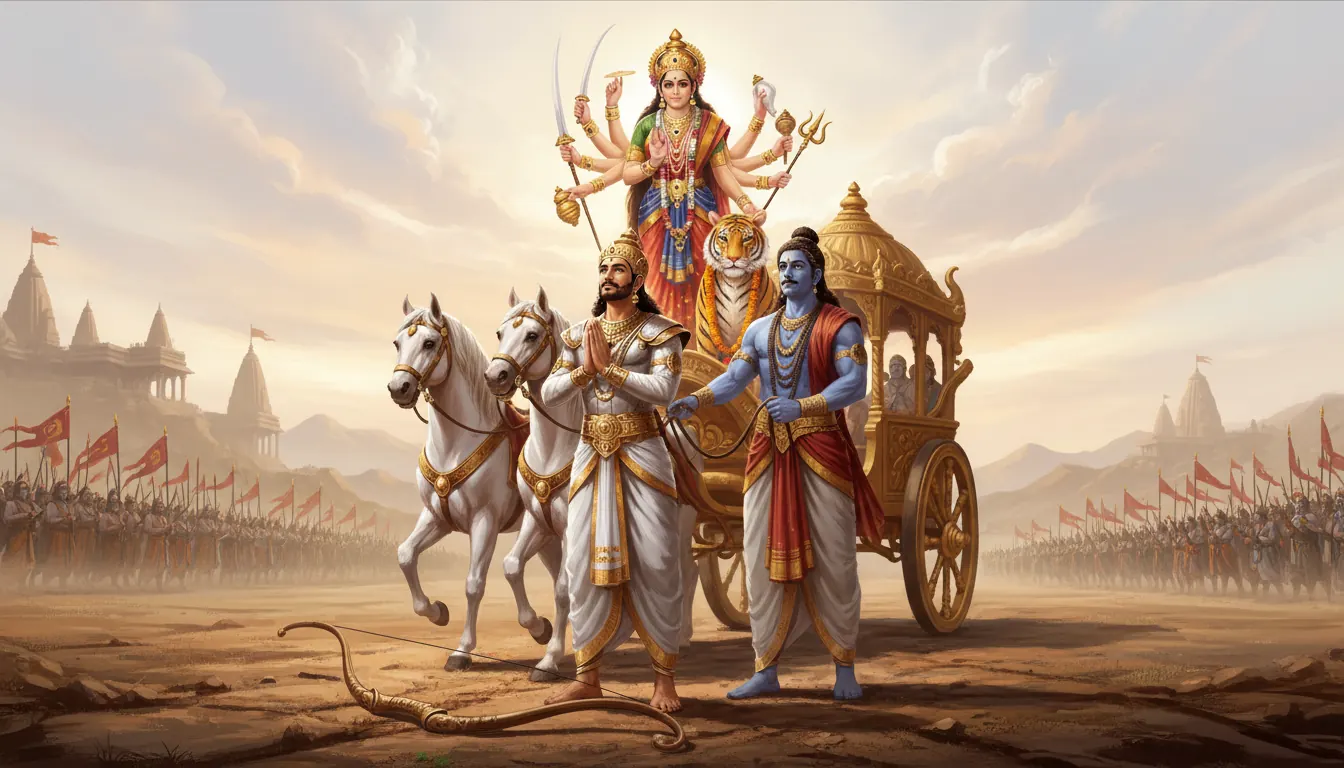
The Hymn Before the Conches
Krishna sends Arjuna down from the chariot to praise the goddess
In short
With the Kaurava line already walking toward them, Krishna tells Arjuna to cleanse himself and sing his hymn to Durga for the defeat of the foe. Arjuna gets down from the chariot, lays Gandiva aside, and names her by everything she is, from Mahakali to the sleep of creatures. The goddess appears in the sky before Govinda, promises victory, and vanishes.
Told in the Bhishma ParvaSet in Kurukshetra18 min read
The Questions of a Man Who Cannot See
"When the sun rose, Sanjaya, which of them went forward first, gladly, wanting it? My army under Bhishma, or the Pandava army under Bhima?"
Sanjaya had come back from the field with the sight Vyasa had given him still burning behind his eyes, and the blind king would not let him sit down until he had emptied it.
"To which side were the sun and the moon and the wind hostile? Against whom did the beasts of prey cry out their evil sounds? Who were those young men whose faces were bright that morning? Tell me all of it, truly and in order."
"Both armies were joyful, king," Sanjaya said. "That is the first thing to say. When they were drawn up, both of them were joyful, and both of them were beautiful. They had the look of woods coming into blossom. Both were thick with elephants and chariots and horses. Both were vast and terrible to look upon, and neither could bear the sight of the other. Both had been arrayed to conquer heaven itself, and both were made of excellent men."
"You have told me nothing."
"I have told you that they were equal in everything a man can count. Now hear the things a man cannot count. Your Kauravas stood facing the west. The sons of Pritha stood facing the east. Your host looked like the army of the chief of the Danavas, and theirs looked like the army of the gods. And the wind, king, got up behind the Pandavas and blew into the faces of your sons. The beasts of prey yelled, and they yelled against your sons. Your elephants would not stand quiet in their ranks, because that same wind carried them the smell of the rut fluid running from the temples of the huge elephants on the other side, and they could not bear it."
Dhritarashtra sat with his hands on his knees and said nothing for a long moment. Sanjaya waited. There was no kindness in the account and there was no lie in it either, and both men knew which of those the king had asked for.
"Go on," Dhritarashtra said. "Tell me how Bhishma set them out."
The White Mountain at the Head of the Line
"Your son rode in the very centre of the Kurus," Sanjaya said, "on a lotus-coloured elephant, its temples split and running, a golden Kaksha on its back and a coat of steel mesh over it. The bards and the singers of praise walked beside it praising him as he went, and over his head they held a white umbrella with a golden chain, as radiant as the moon. Behind him came Shakuni the ruler of the Gandharas, with his mountaineers placed all around.
"At the head of everything stood the venerable one. A white umbrella above him. A white headgear. A white banner on his chariot and white horses yoked to it, and his bow and his sword in his hands. From where I stood, king, the grandsire looked like a white mountain that had come down onto the plain to stand there.
"In Bhishma's own division were all your sons, and Sala the countryman of the Bahlikas, and those kshatriyas called the Ambashthas, and the Sindhus, and the Sauviras, and the fighting men of the country of the five rivers. Behind all the troops, protecting them the way Indra protects, was Drona on a golden chariot with red horses yoked to it, bow in hand and a heart that has never failed, the teacher of very nearly every king on that field. Sharadvan's son Kripa, who is called Gautama, took the northern point with the Sakas and the Kiratas and the Yavanas and the Pahlavas about him. Kritavarma went to the south with the chariot-warriors of the Vrishni and the Bhoja races and the well-armed men of Surashtra. And ten thousand chariots of the Samasaptakas went out, who were created for one purpose only, the death of Arjuna or the fame of it, and who had sworn to follow at his heels wherever he went; and the brave Trigartas went out with them.
"You had a thousand elephants of the greatest fighting power, Bharata. To every elephant a hundred chariots. To every chariot a hundred horsemen. To every horseman ten bowmen. To every bowman ten combatants with sword and shield. That is how Bhishma disposed your divisions, and as each day dawned he changed the shape of them, the human array one morning, the divine the next, then the Gandharva, then the Asura. Thronged with Maharathas, roaring like the very ocean, it stood facing the west and waited.
"Your army was past counting, ruler of men, and it was terrible. And still the smaller army opposite seemed to me the larger and seemed to me unbreakable, because Keshava and Arjuna were at the head of it."
How the Few Overcome the Many
"Before any of that, king, when Kunti's son first looked at what Bhishma had built, he gave way to grief. I saw his face go pale. He turned to Arjuna and spoke like a man who has already lost.
"'How are we to fight the Dhartarashtras with the Grandsire for their chief combatant? Look at that array. It is immovable and it cannot be penetrated. That grinder of foes has designed it by the rules the scriptures lay down, and there is no gap in it that I can find. Our troops have begun to doubt. Where is our victory to come from, in the face of such a host?'
"And Arjuna answered him, king, not with comfort but with a rule.
"'Listen to how a few soldiers defeat the many who have every quality. You are without malice, so I may tell you the means. The rishi Narada knows it. Bhishma knows it, and Drona knows it too. In the old war between the gods and the Asuras the Grandsire of all creatures said this to Indra and the gods: those who want victory do not conquer by might and energy so much as by truth, by compassion, by righteousness and by energy. So tell righteousness from unrighteousness. Understand what greed is and what it costs. Then put out all your strength and fight without arrogance. Where righteousness is, there victory is.
"'Narada said a shorter thing than that, and a harder one. There is victory where Krishna is. Victory is part of him and follows Madhava everywhere. Victory is one of his qualities, and humility is another. His energy is infinite, and in the midst of countless foes he feels no pain, and he is the most eternal of male beings. Long ago, appearing as Hari, he called aloud to the gods and the Asuras together, asking which of them would be victorious. And the very side that was losing answered him, with Krishna in the front we will conquer. It was through Hari's grace that Shakra and the gods won the three worlds. You have the Sovereign of the Universe standing on this field wishing you victory, brother. I cannot find in you the slightest cause for sorrow.'"
The Counter-Array, and the Man Set in the Middle of It
"Then Yudhishthira set out his own troops against Bhishma's divisions and urged them on. 'The Pandavas have arrayed their forces as the scriptures lay down,' he said. 'Fight fairly, you sinless ones, desiring the highest heaven.'
"In the centre he placed Shikhandi and his troops, and Arjuna to protect them. Dhrishtadyumna moved at the front, with Bhima to protect him. The southern division he gave to that mighty bowman Yuyudhana of the Satvata race, who stood there looking like Indra himself. Yudhishthira took his place on a chariot fit to carry Mahendra, with an excellent standard on it, patterned with gold and gems, golden traces on the horses, and he set himself in the middle of his elephants. His pure white umbrella with the ivory handle was raised over his head, and great rishis walked around him singing his praise, and priests and Siddhas walked with them wishing his enemies destroyed by Japas and Mantras and potent herbs and every rite of blessing they knew. And that chief of the Kurus gave away to the brahmanas cows and fruits and flowers and golden coins with cloths, and went forward like Shakra.
"Arjuna's chariot had a hundred bells on it, king, and was decked with Jamvunada gold of the best kind, and had excellent wheels and the brilliance of fire, and white horses were yoked to it, and it looked like a thousand suns together. On that ape-bannered chariot, with Keshava holding the reins, stood the man with Gandiva in his hand whose peer does not exist on earth and never will. For the crushing of your sons' troops, Bhimasena went to the front with the twins beside him, that one who when his weapons are gone pounds men and horses and elephants to dust with his bare hands. Your warriors looked at him standing there like a proud leader of an elephant herd, and their strength was weakened by fear, and they began to tremble like elephants sunk in mire.
"And Janardana said to Arjuna, standing in the midst of his troops: 'The man who scorches us with his wrath and stays in the middle of his forces, who will fall on our troops like a lion, who performed three hundred horse-sacrifices, that banner of Kuru's race, Bhishma, stands over there. Great warriors are ranked around him on every side like clouds around the bright sun. Destroy those troops, best of men, and seek battle with that bull of Bharata's race.'"
Come Down From the Chariot
"Then your army began to move, king. The whole western line came on at once for the fight, and the sound of it reached us across the field before the dust did.
"Arjuna had his hand on Gandiva. And Krishna, holding the reins, said a thing that had nothing to do with the bow.
"'Purify yourself, mighty-armed one, and on the eve of battle say your hymn to Durga, for the defeat of the enemy.'
"He did not explain it, and Partha did not ask him to. Understand what I am telling you, king. The Dhartarashtra host was walking towards him. The conches had not yet gone but every man on both sides had his hands on his weapon. And the driver told the archer to get down.
"So Arjuna came down from the chariot. He purified himself there in the open, in front of two armies, with the noise of your elephants coming across the plain at him, and then he stood on the ground beside the wheel with his palms joined and his head bent, and he began to name her.
"He named her by everything she is. He named her by the terrible names and the gentle ones together, by her weapons and by her kindred, by the sciences she is and the sleep she is, and he did not hurry, though your army was coming. I heard every word of it, and I have carried it since. Hear it now, and hear who it was that was standing behind him while he said it."
The Names of the Fierce One
"'I bow to you, leader of Yogins, you who are one with Brahman, you who dwell in the forest of Mandara, you who are free of old age and decay. Kali, wife of Kapala, you who are black and tawny, I bow to you.
"'You who bring blessings to your devotees, I bow to you. Mahakali, wife of the destroyer of all, I bow to you. Proud one, you who rescue from danger, you who have every auspicious quality, you who are sprung from the Kata race, you who deserve the most reverent worship, I bow to you.
"'Fierce one. Giver of victory, and victory's own self. You who carry a banner of peacock plumes and are decked with every ornament. You who carry a terrible spear, who hold a sword and a shield.
"'In places no one can reach, where there is fear, in places of hardship, in the houses of those who worship you, and in the lower regions of Patala, there you always dwell. You always defeat the Danavas. Great goddess, by your grace let victory be with me always on the field of battle.'
"He said it, king, standing on the ground with his chariot empty behind him and Gandiva laid aside, and he said it the way a man says a thing he has said every morning of his life. There was nothing new in his mouth. That is the part I want you to hear. Your sons had been told for thirteen years that Arjuna was a bowman. He was a bowman who got down off his chariot with an army walking at him and gave the first moments of the war away to a goddess, because the one who held his reins told him to, and because he had never in his life supposed that the arrow was the beginning of anything."
Sister of the Chief of the Cowherds
"'You who are the younger sister of the chief of the cow-herds. Eldest one. You who were born in the race of the cowherd Nanda.
"'You who are always fond of buffalo's blood. You who were born in the race of Kushika. You who are dressed in yellow robes. You who took on the face of a wolf and devoured the Asuras. I bow to you who love battle.
"'Uma. Sakambhari. You who are white and you who are black. You who killed the Asura Kaitabha. Yellow-eyed one, you of varied eyes, you whose eyes are the colour of smoke, I bow to you.
"'You are the Vedas, and the Srutis, and the highest virtue. You are gracious to brahmanas engaged in sacrifice. You have knowledge of the past. You are ever present in the sacred abodes that men have raised to you in the cities of Jambudvipa. I bow to you.'
"Consider what he was doing there, king, and to whom. The younger sister of the chief of the cow-herds. Born in the race of the cowherd Nanda. He was standing at the wheel of a chariot and calling the goddess by the household she belongs to, and the man holding the reins of that chariot was the son of that same house, who had been carried across a river in the night into it. Arjuna was praising her, and he was naming her brother while he did it, and the brother was standing three paces behind him listening and did not say one word."
The Sleep From Which There Is No Waking
"'Among the sciences you are the science of Brahma. You are that sleep of creatures from which there is no waking.
"'Mother of Skanda. You who possess the six highest attributes. Durga, you who dwell in regions no man can reach. You are described as Swaha and as Swadha, as Kala and as Kashta, as Saraswati, as Savitri the mother of the Vedas, and as the science of Vedanta. With my inner soul cleansed, I praise you.
"'You are the unconsciousness, the sleep, the illusion, the modesty and the beauty of all creatures. You are the twilight and you are the day. You are Savitri and you are the mother. You are contentment, you are growth, you are light. It is you that support the sun and the moon and make them shine. You are the prosperity of the prosperous. The Siddhas and the Charanas see you in contemplation.'
"That was the end of it, king. There were no other names left in him.
"And it is worth saying aloud what he had just asked her to be. He had called her the sleep from which creatures do not wake, and then in the same breath he had asked her for victory on a field where countless men were standing in the sun waiting to be given exactly that sleep. He did not soften either half of it. The grandsire, who raised him, would have understood the honesty of that. A man about to kill on a scale nobody had ever attempted does not get to pretend he is asking for something small."
The Goddess in the Firmament
"She understood the depth of Partha's devotion, king, and she is always kindly disposed towards mankind. So she came.
"She appeared in the sky over that field, in the open sky above two armies that were already moving. And here is the thing I would have you hold, Dhritarashtra: she did not appear before Arjuna, who had praised her. She appeared in the presence of Govinda, and it was to the archer standing on the ground beside Govinda's chariot that she spoke.
"'In a short time you will conquer your foes, Pandava. Invincible one, you have Narayana to aid you once again. No enemy can defeat you, not even the wielder of the thunderbolt himself.'
"The boon-giving goddess said that and was gone almost at once, and the sky over Kurukshetra was only sky again.
"Kunti's son, once he had that boon, regarded himself as a man whose business was already finished. He climbed back onto his excellent chariot. He took up Gandiva. And then those two, seated on the same chariot, filled their lungs and blew their divine conches, and the sound went out over the plain and into your lines, and your sons heard it and did not know what it was they were hearing.
"They heard two men on a chariot. That is all they heard. Not the goddess who had just spoken above their heads and named the pair of them, not the promise she had made and not the name she used."
Recite It at Dawn
"There is a virtue in that hymn beyond the day it was said, king, and I will tell it to you because you will not get it from your sons.
"The man who rises at dawn and recites it has no fear at any time from Yakshas, or Rakshasas, or Pishachas. He can have no enemies. He has nothing to fear from snakes, or from any animal with fangs and teeth, or from kings. He is victorious in all disputes. If he is bound, he is freed from his bonds. He gets over difficult places, and he is freed from thieves, and he is ever victorious in battle, and he wins the goddess of prosperity and keeps her. With health and with strength, he lives a hundred years.
"I have known all of this through the grace of Vyasa, who has great wisdom, and I say it to you plainly. Your sons, all of them entangled in the meshes of death, do not know from ignorance that those two on that chariot are Nara and Narayana. Nor do they know, being in the same meshes, that the hour of this kingdom has come.
"Dvaipayana forbade your son. Narada forbade him. Kanva forbade him, and the sinless Rama forbade him. He would not accept the words of any of them.
"There where righteousness is, there are glory and beauty. There where modesty is, there are prosperity and intelligence. There where righteousness is, there is Krishna, and there where Krishna is, there is victory."
Then the armies met. The fighters on both sides were cheerful, king, and the flowery garlands and the perfumes of both gave out the same fragrance. The musical instruments and the blare of the conches and the noise of the drums and the shouts of brave men roaring at one another became one loud uproar, and the elephants gave out loud grunts, and the two hosts came together staring at each other with joy in their faces, and the collision was dreadful.
Dharma Lesson
Before the hand that will do the work is raised, the head that guides it should be bowed. Arjuna is the finest bowman alive and the enemy is already moving, and still the first act of the war he performs is to get down off his chariot and praise someone else. The one who asks for victory honestly must also name what victory costs, and he calls her the sleep from which creatures do not wake in the same breath in which he asks her for the field.