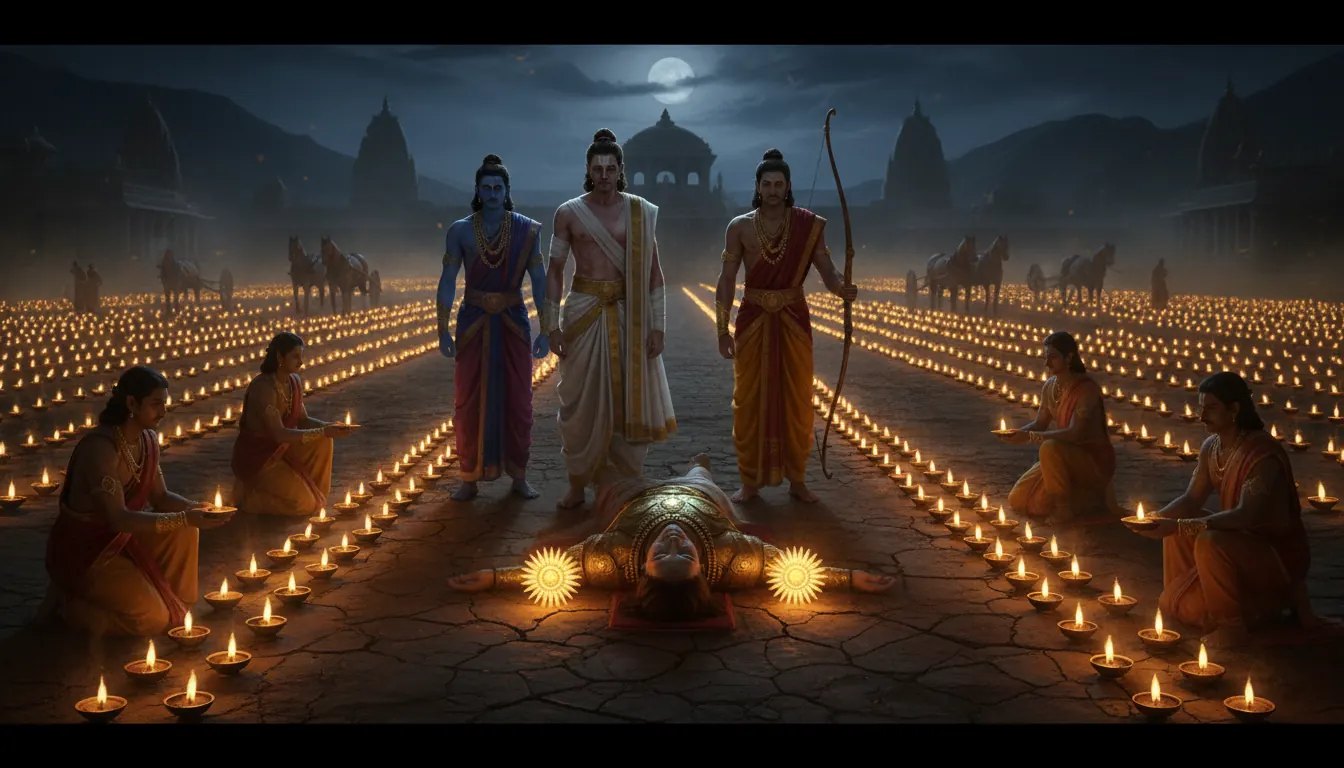
A Thousand Lamps Around Karna
Yudhishthira rises from his bed to look at his enemy
In short
Krishna embraces Arjuna, tells him men will speak of Karna's death and Vritra's in one breath, and sends him to report to the king. They find Yudhishthira on a gold bed, still bleeding from Karna's arrows, and he reads the news off their faces. Then he has his chariot yoked and rides out to see the body lit by a thousand golden lamps of perfumed oil.
Told in the Karna ParvaSet in Kurukshetra, Pandava Camp and Hastinapura16 min read
Men Will Say Vritra and Karna in One Breath
"When Karna had been slain like this and the Kaurava troops had fled," Sanjaya said, "the hero of Dasharha's race embraced Partha for joy, there on the chariot, with the dust still coming down over them, and said these words to him.
"'Vritra has been slain by you. Men will speak in the same breath of the killing of Vritra and of Karna in that awful battle. Vritra was slain in battle by the god of great energy with his thunderbolt. Karna has been slain by you with bow and sharp arrows.'
"Then he said the other thing, which was not praise.
"'Go, son of Kunti, and report this feat of yours to King Yudhishthira the just, a feat that can win you great fame and is already known throughout the world. You have been working for long years to bring about Karna's death in battle. Once you have reported it to him, you will be free of the debt you owe the king. While you and Karna were fighting, the son of Dharma came once to see the field. But he had been pierced so deeply and so badly by arrows that he could not stay in the battle. The king, that bull among men, then went back to his tent.'
"Partha answered Keshava, that bull of Yadu's race, 'So be it.' And Keshava cheerfully turned back the chariot of that finest of chariot-warriors."
Stand Here With Care Until We Come Back
"When he had said this to Arjuna, Krishna spoke to the soldiers: 'Blessings on you all; stand ready, every one of you, facing the enemy.' And to Dhrishtadyumna and Yudhamanyu and the twin sons of Madri and Vrikodara and Yuyudhana, Govinda said, 'Kings, stand here with care until we come back from telling the king that Arjuna has slain Karna.'
"They gave him their permission, and he set out for the quarters of the king.
"All kinds of creatures joined together to congratulate Dhananjaya, that hero shining on the field of battle, and Janardana too, those two best of men who looked then like a pair of risen suns. At Karna's death the gods and the gandharvas and the caranas and the great rishis and the yakshas and the great nagas paid homage to Krishna and Arjuna with great respect and wished them victory in all things.
"The road they took ran back through the whole of what the day had made. The white horses went at a walk between the wrecked chariots, and the two of them said little. The Pandava soldiers they passed did not cheer them. Many of them were sitting down where they had stopped, in armour, with their weapons across their knees, looking at nothing, the way men do at the end of a thing they have been carrying for seventeen days. Some of them stood up as the chariot went by. Its rattle was like the roar of the clouds, and its splendour like the midday sun in an autumn sky, and in it rode two men so pierced with Karna's arrows that they looked, both of them, like the bright and many-rayed moon and the sun risen after scattering the dark. They were casting off those arrows as they went, plucking them out and dropping them over the rail of the chariot, the way a man empties his hands before he goes into a house."
The Bed of Gold
"With Partha beside him, Govinda saw Yudhishthira, that tiger among kings, lying on a fine bed of gold.
"He had gone out that afternoon to see the field for himself, and Karna's arrows had found him there, and he had not been able to stay. They had brought him back and cut the shafts out of him and bound him and laid him down, and there he had lain through the last of the light, listening. A camp tells a man what is happening if he knows how to listen to it. He had heard the noise change twice, and the second time it did not change back, and he had not been able to read it, and no one who came in would say anything that was not comfort.
"Both of them, with great joy, touched the king's feet. And seeing their joy, and seeing the extraordinary wounds on their bodies, Yudhishthira took the son of Radha to be dead, and rose quickly from his bed. He did not ask first. He had read it off their faces, which was the one message that had come to him all day that he could trust.
"Once he was up, the mighty-armed king, scourge of his foes, embraced Vasudeva and Arjuna again and again with affection, and held on to them. Then that descendant of Kuru asked Vasudeva for the details of Karna's death."
Exactly as It Had Happened
"And Vasudeva of the sweet speech, that descendant of the Yadu race, told him of Karna's death exactly as it had happened.
"How the left wheel of that chariot had been swallowed by the earth in the afternoon, and how Karna, standing in the churned ground beside it, had called out upon virtue and the rules of fair fight and asked for time. How Vasudeva had answered him from the other chariot. 'By good luck, son of Radha, you remember virtue. When Shakuni, an expert at dice, beat Kunti's son Yudhishthira, who knew nothing of the game, in the assembly, where had this virtue of yours gone? When innocent Krishna was dragged out of the women's apartments, you did nothing to stop it. Where had this virtue of yours gone? You told her, in that hall, that the Pandavas were lost and had sunk into eternal hell, and that she should choose another husband, and you watched the scene with delight. Where, then, Karna, had this virtue of yours gone? When many mighty chariot-warriors surrounded the boy Abhimanyu in battle and killed him, where had this virtue of yours gone then? Now you are all for the practice of virtue, Suta, but you will not escape with your life.'
"And how Karna had hung his head and given no answer, and then had raised his bow with lips quivering in rage and gone on fighting from where he stood. How he had invoked the brahmastra and Arjuna had countered it with the same. How the fire weapon was quenched with the weapon of Varuna, and the clouds Karna raised, which wrapped every point of the compass in a darkness like a rainy day's, were blown apart by the Vayavya before his very eyes. How at last the terrible arrow came from Karna's arms, and when it was fixed to the bowstring the earth trembled with her mountains and waters and forests, and how it struck Dhananjaya's chest and went into it like a mighty snake into an ant-hill, and how Gandiva dropped out of his hand.
"How Karna, seeing that, had jumped down to seize the wheel with his two arms, and could not lift it, though he was strong enough. How Arjuna, coming back to his senses, had first cut down the standard bearing the device of the elephant's rope, crafted with care by the finest of artists, adorned with gold and pearls and gems and diamonds, that had always filled the Kaurava troops with courage; and how, when it fell, the fame and the pride and the hope of victory of the Kurus fell with it. And how, after that, he took out of his quiver the Anjalika, three cubits long with six feathered tufts, and said over it, 'If I have ever practised ascetic austerities, pleased my elders, and listened to the counsel of those who wished me well, then by that Truth let this arrow slay my enemy Karna.'
"He told him about the light too. That from the body of the fallen Karna a light had passed through the sky and entered the sun, and that the human warriors had seen it."
By Good Luck, Victory Is Yours
"Then Krishna, who is also called Acyuta, smiled, joined his palms and spoke these words to King Yudhishthira, whose foes had been killed.
"'By good luck, the wielder of Gandiva, and Vrikodara the son of Pandu, and you, and the two sons of Madri, are all safe, freed from this battle that has destroyed so many heroes and made the very hair stand on end. Son of Pandu, do what should be done next. The Suta's son Karna, of great might, who is also called Vaikartana, has been slain. By good luck, victory is yours, king of kings. By good luck, your fortunes rise, son of Pandu. Today the Earth drinks the blood of that Suta's son, that wretch among men, who laughed at Krishna when she was won at dice. That enemy of yours lies today on the bare ground, pierced all over with arrows. Look at that tiger among men, pierced and mangled with arrows. Mighty-armed one, now rule this earth with care, rid as it is of all your foes, and enjoy every good thing with us.'
"When he heard these words of the great-souled Keshava, Yudhishthira joyfully honoured that hero of Dasharha's race in return. 'Good luck, good luck,' he said. And he added, 'It is no wonder, mighty-armed son of Devaki, that Partha, with you for his charioteer, should achieve feats that are more than human.'
"Then that righteous son of Pritha took hold of Keshava's right arm, adorned with Angadas, and, speaking to both Keshava and Arjuna, said, 'Narada told me that you two are the gods Nara and Narayana, those ancient and best of rishis, who are always at work preserving righteousness. The wise master Krishna Dvaipayana, the most blessed Vyasa, has also told me this celestial history again and again. Through your influence, Krishna, this Dhananjaya the son of Pandu has faced his foes and defeated them, without ever turning back from any of them. Victory, not defeat, is certain for us, since you agreed to drive Partha's chariot in battle.'"
Yoke the Chariot
"And then, having said this, the king who could not stand upright an hour before called for his chariot.
"They brought it, that chariot of his adorned with gold, and yoked to it the ivory-white horses with black tails, swift as thought, and he mounted it. Surrounded by many Pandava troops he set out, talking pleasantly with Krishna and Arjuna along the way, to see the field of battle where thousands of things had happened.
"It was full dark by then. The field between the two camps was not dark, because men were out on it with torches, looking for their own among the heaps; and where a great man had fallen the lamps had been set about him and somebody had been left to keep them alight. They passed the place where the samsaptakas had died in the morning, and the ground where the elephants lay with their housings of gold, and the long wrack of broken chariots that marked the line where the two armies had leaned against each other all afternoon. They passed men carrying other men on shields, and a place where the horses that were not dead yet were making a noise nobody went near. Talking with those two heroes, Madhava and Phalguna, the king went on, and came at last to the place where the Suta's son lay."
A Thousand Golden Lamps
"The king saw Karna, that bull among men, lying on the field of battle.
"He saw him pierced all over with arrows, like a Kadamva flower with straight filaments all around it. And Yudhishthira saw Karna lit by thousands of golden lamps filled with perfumed oil, which had been set in rows on the ground around him so that he lay in a lake of small steady flames. Though his armour had been cut away by arrows, the beauty of feature the son of Radha had in life had not left him in death. His body kept the colour of heated gold in that light, as though the metal had been taken out of the fire only a moment before, and it seemed still to be alive.
"His son lay beside him, mangled by arrows shot from Gandiva.
"When he saw him, King Yudhishthira looked at him again and again before he could believe his eyes. He looked, and turned away, and looked again, and then got down from the chariot and stood nearer.
"This was the man on whose account he had not slept. This was the voice that had come across the assembly hall saying the words about the woman in one garment; the archer who had emptied his brothers' hands one by one and let them walk away; the man who that very day had driven him from the field in front of both armies, touched him on the shoulder, and told him to go back and not fight again. That had been the worst hour of the war for him, and it had been mercy, and he had not known it. And the thing was lying still now, with the lamps burning all round it, and there was nothing in it to be afraid of, and nothing to be answered, and nothing to be won back."
Tonight We Will Sleep
"Then he praised those tigers among men, Madhava and Phalguna, in these words.
"'Govinda, today I have become king of the earth, with my brothers, because you in your great wisdom became my protector and lord. When he hears that that tiger among men, the proud son of Radha, has been slain, the wicked-souled son of Dhritarashtra will despair of both his life and his kingdom. By your grace, bull among men, we have gained what we sought. By good luck, Govinda, the victory is yours. By good luck, the enemy has been slain. By good luck, the wielder of Gandiva, the son of Pandu, has been crowned with victory.'
"And then he said the last of it, standing over the body in the lamplight, with his own wounds bleeding again from the ride.
"'For thirteen years we have lain awake in great sorrow. Mighty-armed one, by your grace, tonight we will sleep happily.'
"Beyond that one word, proud, he said nothing against the dead man. There was no one there to hear it who would have thought it strange if he had, and he did not.
"In this way, ruler of men, King Yudhishthira the just praised Janardana highly, and Arjuna too."
As if Born Again
"Seeing Karna and his son slain by Partha's arrows, Yudhishthira, the upholder of Kuru's line, felt as if he had been born again.
"The kings in the Pandava army, great chariot-warriors, all filled with joy, came up to Kunti's son Yudhishthira and gladdened him greatly. Nakula and Sahadeva, and Vrikodara the son of Pandu, and Satyaki, finest of the Vrishni chariot-warriors, and Dhrishtadyumna, and Shikhandi, and others among the Pandus, the Panchalas and the Srinjayas, honoured the son of Kunti for the death of the Suta's son. Those warriors who loved battle, deadly fighters, sure of aim and hungry for victory, sang King Yudhishthira's praises, and they praised the two Krishnas too, those scourges of their foes, in glowing speeches.
"Then those great chariot-warriors, filled with delight, went back to their own camp, and received all their friends, each according to his age, and were praised by those friends in return for their matchless feats.
"The lamps were left burning behind them on the field, and nobody put them out.
"That, king, is how that great carnage, which makes the hair stand on end, came about because of your evil policy. Why do you grieve for it now?"
The Other Hall
When he heard that terrible news, the Kuru king Dhritarashtra suddenly fell from his fine seat to the ground. And the royal lady Gandhari, so far-sighted, fell too, and poured out lament after lament for Karna's death in battle.
Then Vidura and Sanjaya both lifted the fallen king and began to comfort him, and the Kuru ladies lifted Gandhari. Believing destiny and necessity to be all-powerful, that royal ascetic seemed to lose his senses under that great grief. His heart was full of anxiety and sorrow, yet the king did not faint again. Comforted by them, he sat silent, lost in gloomy thought.
So the night divided itself. On the one side a man who had not slept for thirteen years lay down at last, in a camp where the wounded were being carried past and the lamps were burning out on the field. On the other, in a house that no longer teemed with kinsmen and friends, a blind man sat with nothing further to ask, having been told everything he had spent seventeen days refusing to hear.
Whoever reads of this great battle, which is like a sacrifice, between the great-souled Dhananjaya and Adhiratha's son, and whoever hears the account of it read, both win the fruit of a great sacrifice duly performed. And that was the end of the Karna Parva.
Dharma Lesson
Relief and grief arrive together at the end of a long enmity, and a man who has to look twice at his enemy's body has already begun to understand what he lost with him. Yudhishthira says he will sleep tonight after thirteen years of wakefulness, and says almost nothing against the dead man, though everyone present would have let him. Victory is quieter than the hatred that bought it.