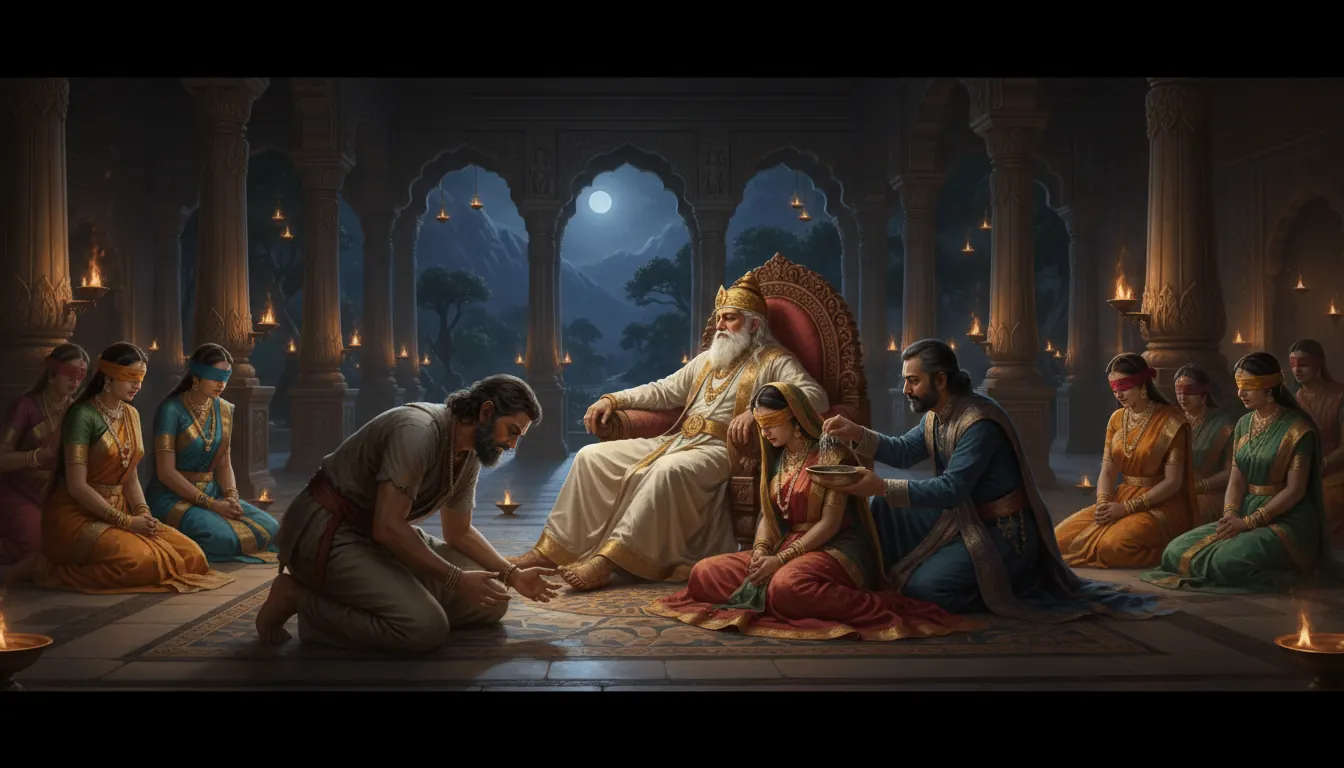
The Word Brought to Hastinapura
Sanjaya rides through the night with the news of Karna
In short
On the night Karna falls, Sanjaya rides from Kurukshetra on wind-swift horses and tells the blind king that Vikartana's son is dead with his sons and brothers, and that Bhima has drunk Dushasana's blood. Dhritarashtra collapses twice, Gandhari and the household women fall with him, and Vidura sprinkles water on his face. Then the king demands the roll of the dead, name by name, on both sides.
Told in the Karna ParvaSet in Hastinapura and Kurukshetra20 min read
The Question Janamejaya Asked
When the recitation had come as far as the fall of Drona, Janamejaya lifted his hand and stopped the brahmana.
"He did not die when Bhishma fell," the king said. "He did not die when Drona fell. Not at Bahlika, not at Somadatta, not at Bhurishravas, not at his sons and his grandsons. Now tell me how a man hears that Karna is dead, Karna on whom that king had rested the whole hope of his sons' victory, and still goes on breathing. I begin to think that giving up one's life is very hard, even in the depths of grief. Tell me all of it in detail, exactly as it happened. I cannot hear enough of the great deeds of my ancestors."
"It is hard," Vaishampayana said. "Hear how it was done."
After Drona had been slain, the royal warriors of the Kaurava army went and sat around Drona's son, and when night came they went to their tents and found no happiness in them. Four of them did not sleep at all. Karna, and King Suyodhana, and Dushasana, and Shakuni passed that night together in Duryodhana's tent, and what came into their minds there was not Drona. It was the assembly hall, and the match at dice, and Draupadi dragged into that hall in her misery. Remembering it, they were filled with regret. The night went over them, and it was one night, and it seemed as if it were really a hundred years.
When morning came they did what the ordinance required and duly performed the customary rites, and were comforted a little, and ordered the troops to be drawn up. They made Karna their commander by tying the auspicious thread round his wrists. They had many of the foremost brahmanas pray for their victory, giving them vessels of curds and clarified butter, akshatas and gold coins, cows and jewels and costly robes, and heralds and musicians praised them with hymns of victory.
Under Karna's command the battle lasted two days. On the second, after he had made an immense slaughter of his enemies, Vrisha was slain by Arjuna in full view of Dhritarashtra's sons. That night the son of Gavalgana called for horses.
The House That No Longer Teemed
He rode for Nagapura in the dark, on horses as swift as the wind. The house he entered was one that no longer teemed with kinsmen and friends. He went through it to where the king sat, drained of all strength by grief, and joined his hands and bowed at his feet. Then he made the sound men make when there is no word for a thing, and began.
"I am Sanjaya, lord of Earth. Are you not happy? I hope you are not bewildered, now that your own faults have brought you into such distress. Vidura and Ganga's son and Keshava all gave you advice for your good. I hope it does not pain you now to remember that you rejected it. Rama and Narada and Kanva and others also gave you good advice in that assembly. I hope it does not pain you now to remember that you rejected theirs. I hope it does not pain you to remember how the enemy slew Bhishma and Drona and others in battle, friends who were always working for your good."
The king drew a long, hot breath before he answered.
"When I hear of the fall of the heroic son of Ganga, master of every celestial weapon, my heart feels great pain. He was born of the Vasus themselves, and every day he killed ten thousand armoured chariot-warriors, and he has been slain by Yajnasena's son Shikhandi under the Pandavas' protection. And Drona, by whose grace the royal sons of Kunti became maharathas, slain by Dhrishtadyumna. Those two had no equal in the world in the four kinds of weapons." He turned his blind face toward the voice. "Tell me what the men of my side did. How did the faces of Duryodhana and Karna look, and of Kritavarma the chief of the Bhojas, and Shalya the ruler of the Madras, and of my remaining sons, when the Kuru divisions fled from the field? Tell me all of it exactly as it happened."
"Sire," Sanjaya said, "when you hear all that has happened to the Kauravas through your fault, you must not be tormented. A wise man never feels pain at what Destiny brings."
"I do not feel great pain, Sanjaya," the king said. "I see all this as the work of Destiny. Tell me whatever you wish."
What Duryodhana Said Over the Teacher's Body
"When the great bowman Drona fell," Sanjaya said, "your sons went pale and lost their wits. Weapons in hand, all of them hung their heads. Stricken with grief, not looking at one another, they stood in total silence. Many of them let their blood-stained weapons drop from their hands, and the weapons still held hung loose in their grip, so that they looked like meteors falling in the sky.
"Then your son, seeing that army of yours standing as if paralysed and lifeless, said to them: 'It was relying on the might of your army that I called the Pandavas to battle. Now that Drona has fallen, the outlook seems bleak. But warriors who go into battle all die in battle. A warrior wins either victory or death. What is so strange about that? Fight, facing every direction. Look now at great-souled Karna, son of Vikartana, that mighty bowman, ranging the battle with his celestial weapons. That coward Dhananjaya is so afraid of him in battle that he always turns back, like a little deer at the sight of a lion. It was Karna who, with a loud roar, killed brave Ghatotkacha of the thousand illusions with his invincible dart. Let the sons of Pandu see today the prowess of both Ashwatthama and Karna. Each one of you alone could kill the sons of Pandu and their troops. How much more, then, all of you together.'
"With these words, your son and his brothers made Karna commander of the Kuru army. Once he had the command, that mighty chariot-warrior, so fierce in battle, roared aloud and fought the enemy. He made a great slaughter among the Srinjayas, the Panchalas, the Kekayas and the Videhas. Countless lines of arrows flew from his bow, each close behind the feathers of the one before, like flights of bees. He killed thousands of warriors, and at last he was slain by Arjuna."
The First Fall
At this, the son of Ambika was overwhelmed by grief and took Suyodhana to be already dead. The king fell to the Earth like an elephant that has lost its senses.
When that greatest of kings fell, the ladies of the royal household cried out, and the noise seemed to fill the whole Earth. Gandhari came to where the king lay, and she and the other ladies of the household all fell to the ground, senseless.
Sanjaya went among them and comforted them, and they trembled like a plantain grove shaken by the wind. Vidura took water and sprinkled it on that descendant of Kuru, and slowly the king whose only eye was knowledge came back to himself.
Knowing that the women of the household were in the room, the king sat perfectly silent for a long time, like a man robbed of reason. Then he thought it over, and drew long breaths, and began to speak against his own sons and to praise the Pandavas, and against his own judgment, and against the judgment of Shakuni the son of Subala. Then he steadied his mind, and put his question to his charioteer.
"I have heard, Sanjaya, all that you have said. Has my son Duryodhana, who always longs for victory, already gone to Yama's realm, giving up hope of success? Tell me truly, even if you have to say it again."
"King, the mighty chariot-warrior Vaikartana has been slain, with his sons and brothers and other suta warriors, all of them mighty bowmen ready to lay down their lives in battle. Dushasana too has been slain by the famous son of Pandu. Indeed, Bhimasena in his fury drank his blood in battle."
The Roll of Our Own
"Through the evil policy of my short-sighted son," the king said, "Vikartana's son has been slain. This news is cutting me to the very core of my heart. I want to cross this sea of grief. So clear away my doubts: tell me who is still alive and who is dead among the Kurus and the Pandavas."
So Sanjaya began the count, and it went on a long while.
"Bhishma, son of Shantanu, has been slain after ten days. The invincible bowman Drona of the golden chariot has been slain, after slaughtering the Panchala divisions. Vikartana's son Karna has been slain, after slaughtering half of what was left after the carnage of Bhishma and the illustrious Drona. Your heroic son Vikarna, robbed of horses and weapons, stood facing the enemy, remembering the duties of kshatriyas, and Bhimasena has slain him, keeping his own vow in mind. Jayadratha, who ruled ten kingdoms with Sindhu at their head, has been slain by Arjuna after he defeated eleven akshauhinis of troops. King Bhagadatta, the dear friend of the chief of the gods himself, has been slain by Dhananjaya. Bhurishravas has been slain by Satyaki. Your son Dushasana has been slain by Bhimasena. Karna's son Vrishasena has been sent to Yama's realm by Dhananjaya, before Karna's very eyes, for Dhananjaya fought with all his might, remembering the killing of his own son Abhimanyu. Shalya's son Rukmaratha has been slain by Sahadeva, even though he happened to be Sahadeva's brother. Your grandsire Bahlika has been slain by Bhimasena, with all his followers. The Vasatis, two thousand of them, have all been slain. That prince of rakshasas, Alayudha, whose chariot was drawn by monstrous asses, has been sent to Yama's realm by Ghatotkacha. Radha's son of the suta caste, and those mighty chariot-warriors who were his brothers, have all been slain."
He came at last to the end of it, and did not soften the end.
"As Mahendra slew Vritra and Rama slew Ravana, so Arjuna, in single combat, has slain Karna and all his kinsmen, Karna the greatest of fighters, who was invincible in battle and on whom Dhritarashtra's sons had pinned their hopes of victory. Pandu's son has now done what you once could not believe him capable of, although well-meaning friends did not fail to warn you of it. You, king, wishing them well, have heaped these evils on the heads of your greedy sons. The fruit of those evils is showing itself now."
And Now Theirs
"Son, you have named those of my side who have been slain in battle by the Pandavas. Now tell me the names of those among the Pandavas who have been slain by my side."
It was a shorter list, and the king listened to it as a man listens to money counted out that he knows will not cover what he owes.
"The Kuntis have been slain in battle by Bhishma, with all their kinsmen and counsellors. Satyajit, who matched diadem-crowned Arjuna himself in energy and might, has been slain by Drona of the sure aim. The two kings Virata and Drupada, both old in years, who fought with great prowess for their ally, have been slain in battle by Drona, along with their sons."
He paused there, and then said the next thing plainly.
"That invincible hero Abhimanyu, who, though only a child in years, was still a match in battle for Arjuna or Keshava or Baladeva, made an immense slaughter of the enemy, and at last was surrounded by six of the finest chariot-warriors and slain by them. Unable to stand against Arjuna himself, they killed Arjuna's son instead. Though he had lost his chariot, that hero still stayed in the battle, remembering the duties of a kshatriya. At last, king, Dushasana's son killed him on the field.
"Nila and Vyaghradatta have both been sent to Yama's realm by Ashwatthama. Citrayudha and Citrayodhin have both been slain by Vikarna. Purujit and Kuntibhoja, the two maternal uncles of Savyasachin, have been killed by Drona's arrows. Shikhandi's son Kshatradeva has been slain by your grandson Lakshmana. Virata's son Shankha, and Uttara of great strength, have gone to Yama's realm. These and many other mighty chariot-warriors of the Pandavas have been slain by Drona, fighting with great energy. I have now named them all, as you asked."
Who Is Left Standing
"Now that all the best of my warriors have perished," the king said, "I do not see how what is left of my army can escape perishing too. Now that those two mighty bowmen, those two foremost of the Kurus, Bhishma and Drona, have been slain, what use is life to me any longer? Nor can I bear the death of Radha's son, that ornament of battle, whose arms had the strength of ten thousand elephants. Tell me now who is still alive in my army after the death of all its greatest heroes. You have told me the names of the fallen. But it seems to me that those still alive are almost all dead."
"That hero to whom Drona gave many blazing celestial weapons of the four kinds, Drona's great-souled son, is still on the field, eager to fight for your sake. The son of Hridika, the foremost of the Satvatas, Kritavarma, is on the field. Artayana's son, who left his own sister's sons, the Pandavas, to keep his word, the hero who promised in Yudhishthira's presence that he would crush Karna's proud spirit in battle, the invincible Shalya, is still on the field. The king of the Gandharas is on the field with his Ajaneyas and Saindhavas and Kambojas. Sharadvata's son, called Gautama, is on the field with a great bow that can bear any strain. Duryodhana too is in his gold-adorned chariot in the midst of an elephant force, and among many kings he shone in his golden armour like a fire with little smoke. Your sons Sushena, armed with sword and shield, and the heroic Satyasena are with Chitrasena, and two sons of Karna are at the head of forces that warriors of little strength cannot break."
"You have duly told me everyone who is alive, on our side and the enemy's," the king said. "From this I can plainly see which side will win. The facts make it clear."
And having said it, having learnt that only a small part of his army was alive, he felt his heart shaken by grief, and fainted a second time. Coming partly back to his senses, he put out a hand and said, "Wait a moment." Then he said, "Son, now that I have heard of this terrible disaster, my heart is in turmoil. My senses are failing, and my limbs are about to give way." And with these words that lord of earth lost consciousness and fell to the ground.
The Lament for the Son of Adhiratha
"When he had heard of Karna's fall and the slaughter of his sons," Janamejaya said, "what did the king say, once he had been comforted a little? Tell me everything the king said then."
Vaishampayana said that the news had struck him like the fall of Meru, or a clouding of wise Shukra's intellect, or the shining Sun dropping from the sky to the Earth. And when he had thought it over, the king believed that his army had been wiped out, and thinking that other creatures as hard to kill as Karna would meet the same fate, he began to lament, sighing like a snake.
"Sanjaya, the heroic son of Adhiratha had the prowess of a lion or an elephant. His neck was as thick as a bull's, and his eyes, his gait and his voice were like a bull's. His limbs were as hard as the thunderbolt, and that young man never gave up a fight even if his foe was the great Indra himself. At the sound of his bowstring and the slap of his palms, men and horses and chariots and elephants fled from the battle. How, then, could Partha have slain Karna by force in battle?
"He often used to say to foolish, greedy, kingdom-hungry, tormented Duryodhana: 'Alone, in battle, I will throw down from their fine chariot those two invincible warriors together, the wielder of sarnga and the wielder of gandiva.' He had conquered the Gandharas, the Madrakas, the Matsyas, the Trigartas, the Tanganas, the Khasas, the Videhas, the Kulindas, the Kashi-kosalas, the Angas, the Nishadhas, the Pundras, the Kichakas, the Vatsas, the Kalingas and the Asmakas. He conquered all these brave peoples with his keen, whetted arrows fitted with kanka feathers, and made every one of them pay tribute to us, to make Duryodhana great.
"Among horses, Uccaisravas is the greatest. Among Yakshas, Vaishravana is the greatest. Among gods, Indra is the greatest. Among fighters, Karna was the greatest. Now I hear that he has been slain by Savyasachin in single combat, and I am sunk in an ocean of sorrow like a wrecked ship in the vast deep. I long for poison, or fire, or a fall from a mountain top. I cannot bear this heavy load of grief, Sanjaya."
The Bird With Its Wings Cut Off
"The world thinks you equal to Yayati, son of Nahusha," Sanjaya said, "in beauty, birth, fame, asceticism and learning. Gather your courage. Do not give way to grief."
"I think destiny is supreme and effort useless," the king said, "since even Karna, who was like a shala tree, has been slain in battle. This hard heart of mine must surely be made of adamant, for it does not burst into a thousand pieces at the news of Karna's fall.
"Because of the gambling I have fallen into great misery, like a bird with its wings clipped. Children at play catch a bird, cut off its wings and gleefully let it go, but the creature cannot move because it has no wings. That is what I have become. Weak, without kinsmen, stripped of family and friends, overpowered by enemies, which way can I turn?
"How could Death touch him, a hero equal to Indra himself, while he was loosing his many celestial weapons? He to whom Purandara gave, in exchange for his earrings, that foe-slaying, gold-decked celestial dart that flashed like lightning. He who kept in his quiver, among sandal-dust, that snake-mouthed celestial arrow decked with gold. He who had won the terrible brahmastra from Jamadagni's son. He who killed that prince of rakshasas, Ghatotkacha, with Shakra's dart. His bow must have broken, or his chariot sunk into the earth, or his weapons run out, since you tell me he is slain. I can see no other way to explain his death.
"That great-souled man who made the terrible vow, 'I will not wash my feet until I kill Phalguni.' That warrior for fear of whom King Yudhishthira the just did not get a wink of sleep in the wilderness for thirteen years together. That hero on whose valour my son relied when he dragged the wife of the Pandavas by force into the assembly, and there, before the very eyes of the Pandavas, called the princess of Panchala the wife of slaves. That hero who said to her in the middle of the assembly, 'All your husbands, Krishna, who are like sesame seeds without a kernel, are finished. So find yourself another husband, fairest one.' How was that hero slain by the enemy?"
Who Guarded the Right Wheel
"When Bhishma, lying on his bed of arrows, begged for water, Partha pierced the surface of the earth, and when the mighty-armed Bhishma saw the jet of water the son of Pandu had brought up, he said to my son, 'Make peace with the Pandavas. Let the fighting stop, and peace will be yours. Let the war between you and your cousins end with me. Enjoy the earth as a brother to the sons of Pandu.' My child ignored that advice, and he must surely be regretting it now. What far-sighted Bhishma foretold has now come to pass.
"Was my son Dushasana slain while fleeing the field, humbled to the dust and destitute of all manliness? I hope he did nothing cowardly then. Did that hero not meet his death like the other kshatriyas who have fallen? What did Shakuni, son of Subala, who had been so full of joy after cheating the son of Pandu at dice, say when he saw Karna slain? What did Kritavarma say? What did Ashwatthama say? What did Kripa, that teacher of the science of arms, say? What did the great bowman Shalya, that foremost of chariot-warriors who was driving the chariot for the time, say when he saw Karna slain?
"Tell me how Shalya, ruler of the Madras, came to be driving Vaikartana's chariot. Who guarded the right wheel of the Suta's son while he was fighting, and who guarded his left wheel, and who stood behind that hero? Which heroes stood by Karna, and which contemptible men ran away? How was Karna slain with all of you together around him? Tell me too how that mighty arrow with a head like a serpent's came to nothing.
"Tell me everything that happened in the battle between the brave warriors of the Kauravas and their enemies after Drona's death. Tell me how the sons of Kunti fought the battle with Karna, and how that slayer of foes met his end in the fight."
And so the blind king, who had refused every counsel while there was still a war to prevent, asked to be told the whole of it again, from the beginning, with the names of the men who had held the wheels. Sanjaya sat down, and told him.
Dharma Lesson
A man who refused every warning while he still had the power to act is left with nothing to spend his grief on but the counting of names. Dhritarashtra asks to hear the whole battle again, in order, with the names of the men who guarded the wheels, because the accounting is the only thing left that he can still control. Grief that arrives after the decision is not repentance; it is the bill.