The Field After the Sun Fell
Shalya counts the dead and the Kauravas walk away
In short
Karna's body lies where it fell and warriors of both armies crowd round it, some glad, some frightened, some simply staring. Bhima slaps his arms and dances. Twenty-five thousand Kaurava foot soldiers who have nothing left but their feet make a stand, and Bhima gets down from his chariot to fight them on foot with the mace. Then Shalya walks him through the field and tells him whose doing it is.
Told in the Karna ParvaSet in Kurukshetra17 min read
The Crowd That Gathered Round the Body
"When the ruler of the Madras saw how the troops had been crushed with arrows in that clash between Karna and Arjuna," Sanjaya said, "he drove on in fury, in that chariot stripped of all its gear. And your son Duryodhana, seeing his army robbed of the Suta's son, its chariots, horses and elephants destroyed, sighed again and again with his eyes full of tears, the very picture of sorrow.
"Then they came to see him. Men of your army and men of the enemy's wanted to look with their own eyes at the heroic Karna, pierced with arrows, bathed in blood and stretched upon the earth like the sun dropped from the sky at will, and they came and stood in a ring around the fallen hero. Each man showed what his own nature gave him: some joy, some fear, some sorrow, some wonder, and some gave themselves up to deep grief.
"Other Kauravas, hearing that Karna of mighty energy had been killed by Dhananjaya, and seeing his armour, his ornaments, his robes and his weapons all torn from their places, fled in terror, like a herd of cows panicking at the loss of its bull.
"And Bhimasena began to roar. His tremendous shouts made the sky shake. He slapped his arms, he leapt, he danced there beside the body, and the Dhartarashtras shrank from him in fear. The Somakas and the Srinjayas blew their conchs, and all the kshatriyas embraced one another for joy to see the Suta's son lying dead at that moment. Karna had fought a dreadful battle and had fallen to Arjuna as an elephant falls to a lion. So that bull among men fulfilled his vow, and so Partha came to the end of his enmity."
Shalya Brings the Empty Chariot Back
"The ruler of the Madras, his heart numb, came quickly to Duryodhana's side in that chariot without its standard, and spoke to him in sorrow.
"'The elephants and horses of your army are dead, and so are its finest chariot warriors. Mighty fighters, horses, and elephants as big as hills have met and killed one another, and your army now looks like the kingdom of Yama. Never before, Bharata, has there been a battle like the one fought today between Karna and Arjuna. Karna pressed the two Krishnas hard today, and every other enemy of yours. But destiny has run the way Partha steered it. That is why destiny is protecting the Pandavas and wearing us down. Many heroes who were set on winning your cause have been cut down by the enemy. Brave kings, equal in energy, courage and might to Kubera or Yama or Vasava or the Lord of the waters, men of every virtue, almost impossible to kill, all eager to win your cause, have fallen to the Pandavas in battle. Do not grieve for it, Bharata. This is destiny. Take comfort. Success cannot always be won.'
"Hearing Shalya's words, and thinking of his own wrongdoing, your son lost heart and almost lost his senses, and he sighed again and again, the very picture of sorrow."
It Is Me That Bibhatsu Is Chasing
"What did the Kuru army look like on that awful day," the old king asked, "while it was being crushed with arrows and scorched with weapons, and while it was running from the field?"
"Listen closely, king," Sanjaya said, "and I will tell you how that great and terrible slaughter of men, elephants and horses came about.
"When Karna had fallen and Partha let out his lion's roar, a great terror took hold of your sons. Once Karna was down, not one warrior in your army had the heart to rally the troops or show his courage. Arjuna had destroyed the man they leaned on, and they were like merchants whose ship has broken up on the bottomless ocean and who have nothing to cling to. Terrified, torn by arrows, leaderless and looking for someone to protect them, they were like a herd of elephants harried by lions. Beaten by Savyasachin that afternoon, they fled like bulls with broken horns, or snakes with broken fangs.
"They had thrown away their weapons and their armour. They could no longer tell one direction from another. They trampled each other as they ran and stared at each other in fear. 'Bibhatsu is coming for me.' 'Vrikodara is coming for me.' Every one of them thought it, and they went pale with fear and stumbled and fell as they ran. On horseback, in chariots, on elephants and on foot, great chariot warriors fled as fast as they could go. Elephants smashed chariots, great chariot warriors rode down horsemen, and horsemen trampled whole bands of foot soldiers in the rout.
"After the Suta's son fell, your warriors were like people without a protector in a forest full of wild beasts and robbers. They were like elephants without riders, like men without arms. In their fear the whole world seemed to them to be full of Partha."
Drive My Horses Slowly Behind the Army
"Seeing them run, and seeing his troops leave the field by the thousand, your son cried out in grief and spoke to his driver.
"'Partha will never get past me while I stand here with my bow. Drive my horses slowly behind the whole army. If I fight from the rear, the son of Kunti will never get past me, any more than the ocean can get past its shores. I will kill Arjuna and Govinda and the proud Vrikodara and the rest of my enemies, and so pay the debt I owe to Karna.'
"Hearing the Kuru king speak so like a hero and a man of honour, the charioteer slowly drove on the horses in their gold trappings, and took him back down the length of that broken army, against the flow of it, to stand where the last of his own men were running.
"Then twenty-five thousand of your foot soldiers, without chariots, cavalry or elephants among them, made ready to fight. They had nothing left but their feet and what they held in their hands. Bhimasena in his fury, and Dhrishtadyumna the son of Prishata, surrounded them with all four arms of their forces and began to shoot them down. Those men fought back against Bhima and Prishata's son, and some of them called the two heroes out by name."
Bhima Gets Down From His Chariot
"Then Bhimasena was filled with rage. He got down from his chariot, mace in hand, to fight the men who had come against him. Keeping to the rules of fair combat, Vrikodara the son of Kunti stepped down from his chariot and, trusting to the strength of his arms, fought on foot against enemies who were on foot.
"He took up his massive gold-covered mace and began to kill them all, like the Destroyer with his club. The Kaurava foot soldiers, mad with rage and careless of their lives, threw themselves at Bhima like insects into a blazing fire. They were hard men to beat, but as each furious fighter came at Bhimasena he died in an instant, as living things die at the sight of the Destroyer. The mighty Bhima ranged over them with his mace like a hawk and destroyed all twenty-five thousand.
"When he had wiped out that division of brave men, Bhima, whose strength nothing could check, stood ready again, with Dhrishtadyumna in front of him. Beside him Dhrishtadyumna, the mighty bowman and destroyer of enemies, looked splendid in his chariot drawn by horses as white as doves, under his tall standard made from the trunk of a Kovidara tree. At the sight of that standard the Kauravas fled in terror."
The Rest of the Field
"Meanwhile Dhananjaya bore down on your chariots, twanging Gandiva, the bow famous across the three worlds. When your troops saw that chariot with its white horses and Krishna at the reins, and saw that it was Arjuna standing in it, they ran in fear.
"The two sons of Madri and Satyaki rushed joyfully at Shakuni and cut down the troops of Subala's son. They killed his cavalry and his elephants with sharp arrows and then charged Shakuni himself, and a great fight followed. They chased the king of the Gandharas, a man very quick with his weapons, and then the twins and Satyaki came back to the Pandava ranks.
"Chekitana and Shikhandi and the five sons of Draupadi, having slaughtered your huge army, blew their conchs. Though they could see your troops running with their backs to the field, those heroes still hunted them, like bulls chasing angry bulls they have already beaten.
"Then Savyasachin saw that a remnant of your army was still standing to fight. In his fury he charged those chariots and suddenly buried them under showers of arrows. The dust that rose darkened everything, until nothing could be made out at all. With the earth shrouded in dust and darkness over everything, your troops, king, fled in every direction in fear."
The Speech to Men Who Had Stopped Listening
"With the Kuru army broken, your son charged at all the enemies coming towards him and challenged the whole Pandava army to fight, as the Asura Vali once challenged the gods. At that all the Pandava heroes joined together and rushed at Duryodhana as he came on, shooting and hurling every kind of weapon at him and taunting him again and again. But Duryodhana, in his fury, fearlessly killed those enemies by the hundred and the thousand with his sharp arrows. The courage we saw in your son then was truly wonderful, for he fought alone, with no one to help him, against all the Pandavas together.
"Then he saw his own troops, torn by arrows and bent on flight, still not far from the field. Determined to keep his honour, he rallied them, raised their spirits, and spoke to them.
"'There is no place on earth or in the mountains where you can run and the Pandavas will not kill you. So what is the use of running? The Pandavas have only a small force left. The two Krishnas are badly wounded too. If we all stand and fight, victory will surely be ours. If we scatter and run, the wicked Pandavas will hunt us down and kill every one of us. So it is better to die in battle. Death in battle is a happy death. Fight, and keep to the duty of a kshatriya. The man who dies in battle knows no misery; he enjoys endless bliss in the world to come. Listen, all you kshatriyas gathered here. Yama the destroyer spares neither the hero nor the coward, so who would be fool enough not to fight? Will you put yourselves in the power of our angry enemy Bhimasena? You must not abandon the duty your fathers and grandfathers kept. For a kshatriya there is no greater sin than running from battle. There is no surer road to heaven, Kauravas, than the duty of battle. Warriors who die in battle go to heaven at once.'
"But even while your son was saying these words, the warriors, badly mangled, fled in every direction and paid no heed to him."
Look at This Awful Field
"Then the ruler of the Madras, seeing your son trying to rally the troops, spoke to Duryodhana with fear on his face and his heart numb with grief.
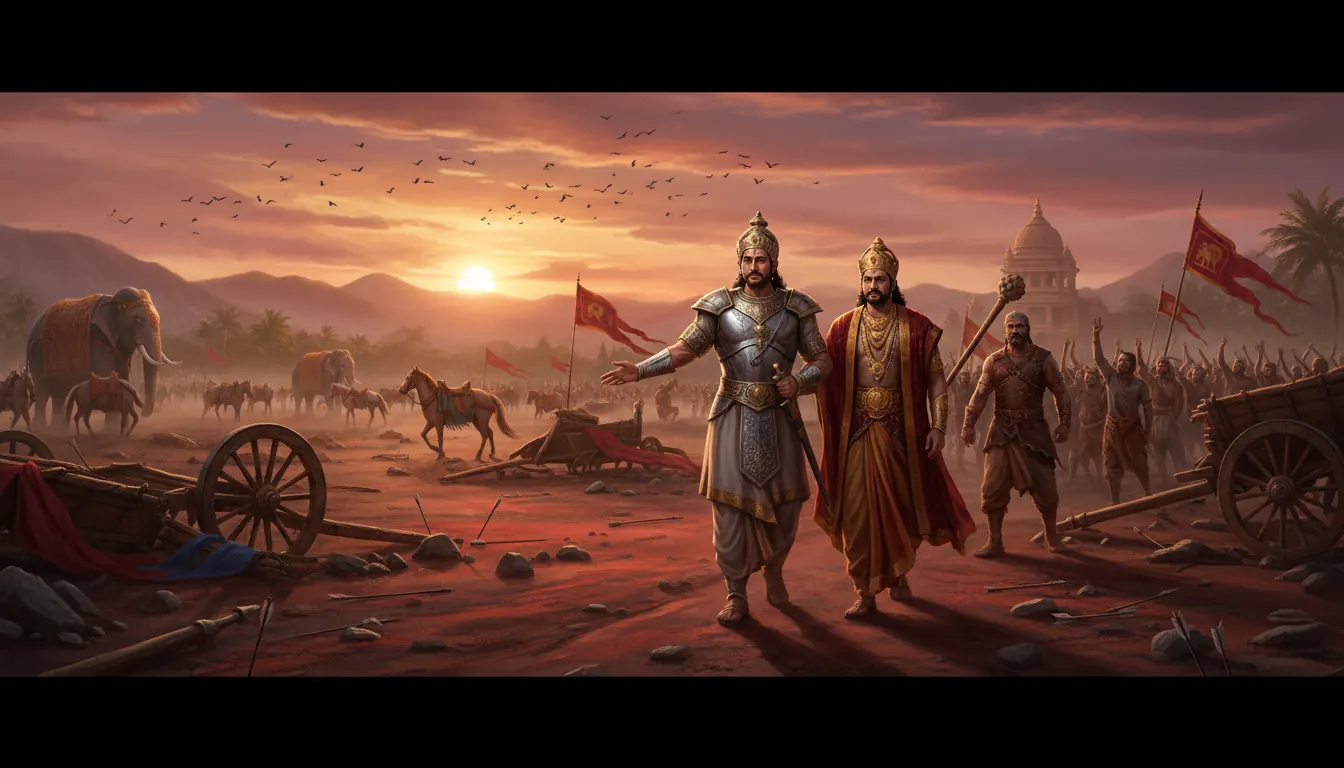
"'Look at this awful battlefield, hero, heaped with dead men and horses and elephants. In some places it is covered with fallen elephants as big as mountains, lying helpless and lifeless, their vital parts pierced by arrows, their armour knocked loose and their weapons, shields and swords scattered around them. The bells and iron goads, the lances and standards those huge beasts carried, lie on the ground. Their gold trappings are soaked in blood. In other places the ground is covered with fallen horses, torn by arrows, gasping in pain and vomiting blood. Some whimper softly, some bite the earth with rolling eyes, and some neigh piteously. Covered with the corpses of men and horses and elephants and with wrecked chariots, the earth has become as dreadful to look at as the great Vaitarani.
"'The arrows shot from the arms of Karna and Arjuna went through the bodies of elephants and horses and men, quickly stilled their lives, and buried themselves in the earth like great snakes sliding head first into their holes. What with the heaps of dead and the countless arrows, there is no way across the ground. Chariots lie everywhere, their traces broken, their joints sprung, their axles and yokes and Trivenus smashed to pieces, their wheels loose, their Anukarsanas cut apart, the straps of their quivers cut through and the drivers' seats broken. Strewn with those chariots adorned with gems and gold, the earth looks like the sky covered with autumn clouds. Spiked maces hung with golden bells, battle-axes, sharp lances, heavy clubs, mallets, bright drawn swords and maces wrapped in cloth of gold lie on the field. All about lie bows decorated with gold, arrows fitted with beautiful feathers of pure gold, umbrellas and fans and conchs, elephants' trappings, standards, chariot rails and diadems, necklaces and brilliant crowns, yak-tail whisks, garlands shining with coral and pearls, chaplets for the head, bracelets for the wrists and the upper arms, gold-strung collars for the neck, every kind of costly diamond and gem and pearl, bodies raised in great luxury, and heads as beautiful as the moon.
"'Turn back, Duryodhana. Let the troops withdraw. King, you who give honour to others, go back to your camp. Look, my lord, the sun is hanging low in the sky. Remember, ruler of men, that you are the cause of all this.'
"When he had said this, Shalya fell silent, his heart full of grief."
Karna, Oh Karna
"Then Duryodhana, stricken and half out of his senses, wept for the Suta's son with his eyes full of tears, crying, 'Karna. Oh Karna.' All the kings, led by Drona's son, comforted Duryodhana again and again and set off towards the camp, often looking back at Arjuna's tall standard, which seemed to blaze with his fame.
"At that terrible hour, when everything glowed so brightly, the Kauravas, their faces so covered in blood that no one could tell who they were, looked at the earth soaked with the blood of men and horses and elephants. It looked like a courtesan dressed in crimson robes, flower garlands and gold ornaments, and they could not bear to stay there. Grieving for the death of Karna, they lamented aloud, 'Alas, Karna. Alas, Karna.' When they saw the sun turn crimson, they all hurried back to their camp.
"As for Karna, though he was dead, pierced with gold-feathered arrows sharpened on stone, red with blood and shot from Gandiva, the hero lying on the ground still shone like the bright-rayed sun himself. It seemed as if the glorious Surya, always kind to those who worship him, had touched Karna's blood-soaked body with his rays and then gone down to the western ocean to bathe, his face crimson with grief. With that thought in their minds, the crowds of gods and rishis who had come to watch the battle went home to their own worlds.
"His armour had been cut away with arrows, and he had been killed in that dreadful fight, yet the beauty of Radha's son did not leave him in death. To everyone his body looked like heated gold. It seemed to be alive, glowing like fire or the sun. All the warriors were frightened at the sight of the Suta's son lying dead on the field, as other animals are frightened at the sight of a lion. Dead as he was, that tiger among men looked ready to give his orders. Nothing about that illustrious dead man seemed changed. He lay stretched out like a great tree with all its branches and twigs, like a heap of pure gold, or like a blazing fire put out by the water of Partha's arrows. When anyone came to him asking, he always said, 'I give,' and never the words 'I have not.'
"When Karna fell, the rivers stood still. The sun set pale. The planet Mercury, the son of Soma, turned the colour of fire and seemed to cross the sky on a slant. The sky seemed to split in two. The earth roared aloud. Fierce and terrible winds began to blow. The great oceans heaved. The mountains and their forests trembled, and every living thing felt pain. Darkness covered the sky. Blazing meteors fell."
The Walk Back to Camp
"Then those two greatest of men, filled with joy, took their loud conchs, white as snow and adorned with gold, set them to their lips and blew them together. The blast of Panchajanya and of Devadatta filled the earth, the sky and heaven. The moment the Kauravas heard those conchs they all fled from the field as fast as they could, abandoning the ruler of the Madras and the chief of the Bharatas, your son Duryodhana.
"Then the leaders, full of anxiety, wanted to pull back their troops, and your son, on Shalya's advice, withdrew the army. Kritavarma, with what was left alive of the Narayana troops around him, made quickly for the camp. Shakuni, with a thousand Gandharvas around him, saw that the son of Adhiratha was dead and made quickly for the camp. Sharadvata's son Kripa, with his great force of elephants massed around him like a bank of clouds, made quickly for the camp. The heroic Ashwatthama, sighing deeply again and again at the sight of the Pandavas' victory, made quickly for the camp. Susharma went too, with what was left alive of the samsaptakas around him, looking over those terrified soldiers. King Duryodhana, stricken and stripped of everything, went with his heart full of grief and prey to many dark thoughts. And Shalya, that finest of chariot warriors, went back to the camp in that chariot without its standard, looking about him on every side.
"The other great chariot warriors of the Bharata army, still many in number, fled quickly, overcome with fear, full of shame and almost out of their senses. Seeing Karna brought down, they went with voices choked with tears, some praising Arjuna and some praising Karna. Of all those thousands of warriors of your army in that great battle, not one had any wish left to fight. With Karna fallen, king, the Kauravas gave up hope of life, of kingdom, of wives and of wealth.
"Your son, full of grief and sorrow, led them back with care and resolved to let them rest for the night. And those great chariot warriors bowed their heads to his orders and left the field with heavy hearts and pale faces."
Dharma Lesson
A man who will not hear a warning while it can still be acted on will hear it at last as a description of what he has already done. Duryodhana's speech about the duty of battle is faultless and nobody stays to hear the end of it, because words only hold men who still believe the speaker can win. Authority spent on the wrong cause does not carry over to the hour when it is needed.