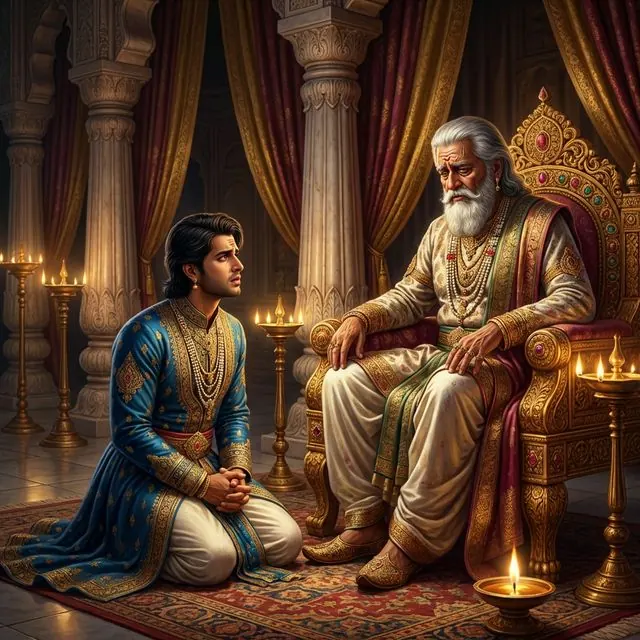
Arishtanemi and King Sagara
A sage tells a reigning king when to let go of his house, and the king keeps his throne
In short
Yudhishthira asks Bhishma how a king may keep the great object of acquisition in view and still be free from attachments, and Bhishma answers with the counsel Arishtanemi once gave to King Sagara. The sage lays down a timetable for release from family and wealth, dismantles the belief that one's relatives cannot survive without one, and recites a long catalogue of the marks of a free man. Sagara, hearing it, acquires those virtues and goes on ruling his subjects.
Told in the Shanti ParvaSet in Kurukshetra and Kosala15 min read
The King Who Went to the Brahmana
The questions Yudhishthira brought to the bed of arrows had begun to change. In the first days he had asked how a king should punish, how he should tax, how he should choose his ministers. Now, with his brothers sitting around him in the field and Krishna beside them and Vyasa and Narada among the listeners, he asked something that had nothing to do with the running of a kingdom.
"Grandsire, how should a king like us live in this world, with the great goal of attainment in view? And what qualities should he always have, so that he may be freed from attachments?"
The great goal of attainment. He did not name it, because by then he did not need to. He had sat through the whole science of rule and he was asking whether a man who wears a crown can also want the one thing the crown cannot buy.
Bhishma did not answer in his own voice. He often did not, when the question was this one.
"On this subject I will tell you the old story of what Arishtanemi said to Sagara when Sagara came to him for counsel."
Two names, and Bhishma explained neither, because his hearers knew them. Sagara was a king of the Ikshvaku line, lord of the earth, the ancestor whose sons dug down after a stolen horse until the sea itself was named for them. He was not a seeker in a forest. He was a ruling monarch in the middle of his reign, with a treasury and an army and a house full of children.
Arishtanemi was of Tarkshya's line, learned in all the scriptures, and he had no kingdom at all.
The king went to the brahmana, and not the other way about. That is the whole of the setting. A man who owned everything walked up to a man who owned nothing and asked him to explain happiness.
And Arishtanemi, judging the questioner fully worthy of his teaching, agreed to answer him.
A Mind Suffering From Thirst
Sagara asked it plainly, the way men ask when they have already tried the obvious answers.
"Brahmana, what is the good by doing which one can find happiness here? How can one escape grief and agitation? I want to know all this!"
Three questions in a breath, and the last two are the real one. He did not ask how to be happy. He asked how to stop being agitated, which is a different complaint and a more honest one, and it is the complaint of a man who has everything and cannot sit still.
Arishtanemi answered with a sentence that shut the door on every other kind of answer.
"The happiness of Emancipation is the true happiness in the world."
Not a happiness. The happiness. Everything else that goes by the name is a resemblance, and the sage did not spend a word arguing the point. He went straight to why the king had not seen it for himself.
"The ignorant man does not know it, attached as he is to his children and his animals, and owning wealth and grain."
That is a portrait of Sagara delivered to his face, and there is nothing insulting in it, because it is a portrait of nearly everybody. Children, cattle, money, grain. The four things a prosperous man counts, and the counting is exactly what keeps him from seeing what he is missing.
Then the diagnosis, put the way a physician puts one.
"An understanding attached to worldly things and a mind suffering from thirst: these two defeat all skilful treatment."
Defeat all skilful treatment. Not hard to cure. Beyond the reach of the art. A mind in that condition cannot be reasoned into freedom, because the reasoning is being done by the part of him that is thirsty, and it will always find grounds for one more year, one more acquisition, one more season of holding on.
"The ignorant man bound in the chains of affection cannot win Emancipation. I will tell you now about all the bonds that spring from the affections. Listen carefully."
The chains he was about to name were not vices. They were the loves of a decent man's life.
In Due Season, and Not Too Late
What Arishtanemi gave the king first was not a renunciation. It was a timetable.
"Father children at the right time, marry them off when they are young men, make sure they are able to earn their own living, and then free yourself from all attachments and wander in happiness."
Read the conditions. He is not told to walk out on infants. He is told to father his children, marry them off when they are grown, and then satisfy himself that they can feed themselves, and only then to go. Every duty is discharged first. The sage's quarrel is not with the household. It is with the man who has finished the household and cannot admit that it is finished, and who invents a reason to stay another twenty years because the alternative frightens him.
Then the hardest clause, and it is the hardest because it concerns the person who has given him the most.
"When you see your dearly-cherished wife grown old and devoted to the son she has borne, leave her in time, with the highest goal of attainment in view."
Dearly-cherished. The affection is not denied and not diminished. She is old, she has a grown son she is bound to, and the season in which the two of them were necessary to each other has passed. Leave her in time, the sage says, and the words in time carry the weight. Not in anger, not in coldness, and not too late.
"Whether you have a son or not, once you have duly enjoyed with your senses, in the first years of your life, the things that are meant for them, free yourself from attachments and wander in happiness."
Whether you have a son or not. The schedule does not bend for a childless man. Nor does it demand that he should never have tasted anything. The early years are for the senses and their objects, and the text says duly enjoyed, without apology and without a warning attached.
"Once you have indulged the senses with their objects, you should suppress the desire to indulge them further. Then, free of attachments, you should wander in happiness, content with whatever comes without effort and without planning ahead, and looking on all creatures and things with an equal eye."
Without effort and without planning ahead. The whole apparatus of a king's life, the planning and the provisioning and the reckoning ahead, laid down in a phrase.
How Will These Live Without Me
"That, son, is what I have told you in brief. Now listen, for I will tell you in detail why Emancipation is worth winning."
The detail began with insects.
"Worms and ants are busy gathering food and are seen to die in the search. Those who are free of attachments are happy, while those attached to worldly things are destroyed."
The king of the earth was being shown an ant carrying a crumb and dying on the road with the crumb still in its jaws, and was being told that the picture was complete and needed no adjustment to fit him.
Then Arishtanemi named the thought that holds men in place more firmly than greed does, because it wears the face of duty.
"If you want to attain Emancipation, you should never dwell on your relatives, thinking, How will these live without me?"
And he took that thought apart in four strokes, each of them offered as a thing that ought to wake a man up.
Your relatives are carried off by death before your very eyes, in spite of your utmost efforts to save them. That alone should wake you up.
You may die first. While your relatives are still alive, and before your own duty of feeding and protecting them is done, you may die and leave them, and all the indispensability you were counting on will have been imaginary.
Once they have been carried away from this world, you cannot know what becomes of them there, whether they find happiness or misery. This ought to wake you up.
And since, by the fruits of their own deeds, they manage to support themselves in this world whether you live or die, you should think on this and do what is for your own good.
Behind all four stands one claim, stated flatly.
"A living creature is born alone, grows alone, and meets happiness and misery, and death, alone. A man is only a lump of clay, and is always wholly dependent on other forces. So, being so frail oneself, what reasonable thought can one give to protecting and feeding one's relatives?"
Then the question the king was meant to be left holding.
"When this is known to be so, who in the world can be said to belong to whom?"
A Handful of Grain From a Million Carts
"So set your heart on attaining Emancipation. Now listen to what more I have to tell you."
What followed was a catalogue, and the sage built it the way a man builds a wall, one plain course at a time. Each entry ends in the same verdict: that man is emancipated. Sagara was not being handed a doctrine. He was being handed a list against which he could measure himself, item by item, in his own house.
The man of firm soul who has conquered hunger and thirst and the other states of the body, and anger and greed and delusion too, is certainly emancipated.
The man who does not lose himself, through folly, in gambling and drinking and concubines and the hunt is always emancipated. Four amusements, and every one of them a king's amusement, named to a king.
The man whose only concern, from one day to the next and one night to the next, is what he will enjoy is said to have a tainted understanding. Not a wicked man. A man whose attention never rises above the next meal.
One who, after careful reflection, sees his repeated births as due only to sexual union with women is held to be free of attachments.
The man who truly knows the nature of the birth, the destruction and the striving of living creatures is certainly emancipated.
And then the entry that puts a number on the whole matter.
The man who, from among millions upon millions of carts loaded with grain, thinks only a handful worth accepting, to keep himself alive, and who sees no difference between a shed of bamboo and reeds and a palace, is certainly free.
The image is not of a poor man contenting himself with little. It is of a man standing in front of an assembled harvest that is genuinely his, with every cart of it at his disposal, taking one handful because one handful is what a body requires today. The granary is not condemned. It is simply found to be irrelevant to the question of what will be eaten.
And the bamboo shed is set beside the palace in a discourse being delivered to the owner of the palace.
The Bed, the Rice and the Bark
The list went on, and it turned from what a man does to what a man sees.
The man who sees the world afflicted by death and disease and famine is certainly free. One who sees the world like this manages to be content, while one who fails to see the world in this light is destroyed.
That is the sentence to sit with, because it inverts the usual arithmetic. The man who looks steadily at how bad things are is the one who ends up content. The man who declines to look is the one who is destroyed, and he is destroyed by the disappointment of a world that had never promised to behave otherwise.
The man who is content with only a little is regarded as free.
The man who sees the world as made up of eaters and eaten, and himself as different from both, and who is never touched by pleasure and pain, which are born of illusion, is regarded as emancipated.
Then comes a run of pairings, and the point of the run is the pairing itself.
A soft bed on a fine bedstead and the hard ground, equal. Good sali rice and coarse thick rice, equal. Linen and cloth made of grass, the same. Silk and the bark of trees, the same. Clean sheep-skin and unclean leather, no difference seen between them.
Bedding, food, clothing. Every register in which a king is distinguished from a beggar, gone through one by one and levelled, and the levelling is not an instruction to be uncomfortable. The man in this account still sleeps somewhere and still eats something and still wears something. He has simply stopped receiving a report from the difference.
The man who sees this world as the product of the five primal elements combined, and who lives in this world with that idea foremost, is emancipated.
And then the pairings move inward, off the body and into the life of a man who rules.
The man who regards pleasure and pain as equal, and gain and loss as level, for whom victory and defeat are no different, to whom like and dislike are the same, and who stays unchanged under fear and anxiety, is wholly emancipated.
Victory and defeat, set level with one another. Spoken by a sage to a king, and repeated by Bhishma on that field, to another.
Stay or Go, But Go Through It Free
Last, Arishtanemi turned the king's attention to the one possession he could not give away.
The man who sees his body, with all its imperfections, as only a mass of blood, urine and excrement, and of disorders and diseases, is emancipated.
The man who always remembers that this body, when old age overtakes it, is beset by wrinkles and white hair and thinness and pallor and a stooping frame becomes emancipated. The man who remembers that his body is liable to lose its virility, and to failing sight, and deafness, and loss of strength, is emancipated.
The list is not cruel. It is a schedule of appointments that every man listening already had in his diary.
Then the sage widened it until nothing was left standing.
The man who knows that even the rishis, the gods and the Asuras must leave their own spheres for other regions is emancipated. The man who knows that thousands of kings, even very powerful ones, have departed from this earth manages to become emancipated.
Thousands of kings. Sagara was one, and knew it.
The man who knows that in this world things are always hard to get, that pain is plentiful, and that supporting one's relatives always brings pain, becomes emancipated. Seeing the many faults of children and of other men, who would not revere Emancipation? The man who, awakened by the scriptures and by the experience of the world, sees every human concern in this world as without substance, becomes emancipated.
And then, having spent the whole discourse taking the householder's life apart, Arishtanemi finished by declining to order the king out of it.
"Keep these words of mine in mind, and conduct yourself like one who has become emancipated, whether you choose to lead the life of a householder or to seek emancipation, without letting your understanding be confused."
Either road. Stay or go, but go through it as a free man goes.
Sagara did not abdicate. He did not walk into the forest. That lord of earth listened carefully to these words, gained the virtues that lead to Emancipation, and with their help went on ruling his subjects.
That was Bhishma's answer to Yudhishthira, and he let the old story carry it without adding anything of his own. The king who had asked how to be freed from attachments was shown a king who had learned how, and had then gone back to work.
Dharma Lesson
Arishtanemi does not tell Sagara to abandon his kingdom, and Sagara does not abandon it. The teaching is about timing and about grip, not about location: father your children, raise them, see that they can feed themselves, and then stop needing to be needed. The belief that one's family cannot survive without one is treated here not as devotion but as the last and most respectable of the attachments, because it lets a man call his refusal to let go by the name of duty. What the sage offers is a way of holding a throne, a house and a body while knowing exactly what each of them is worth.