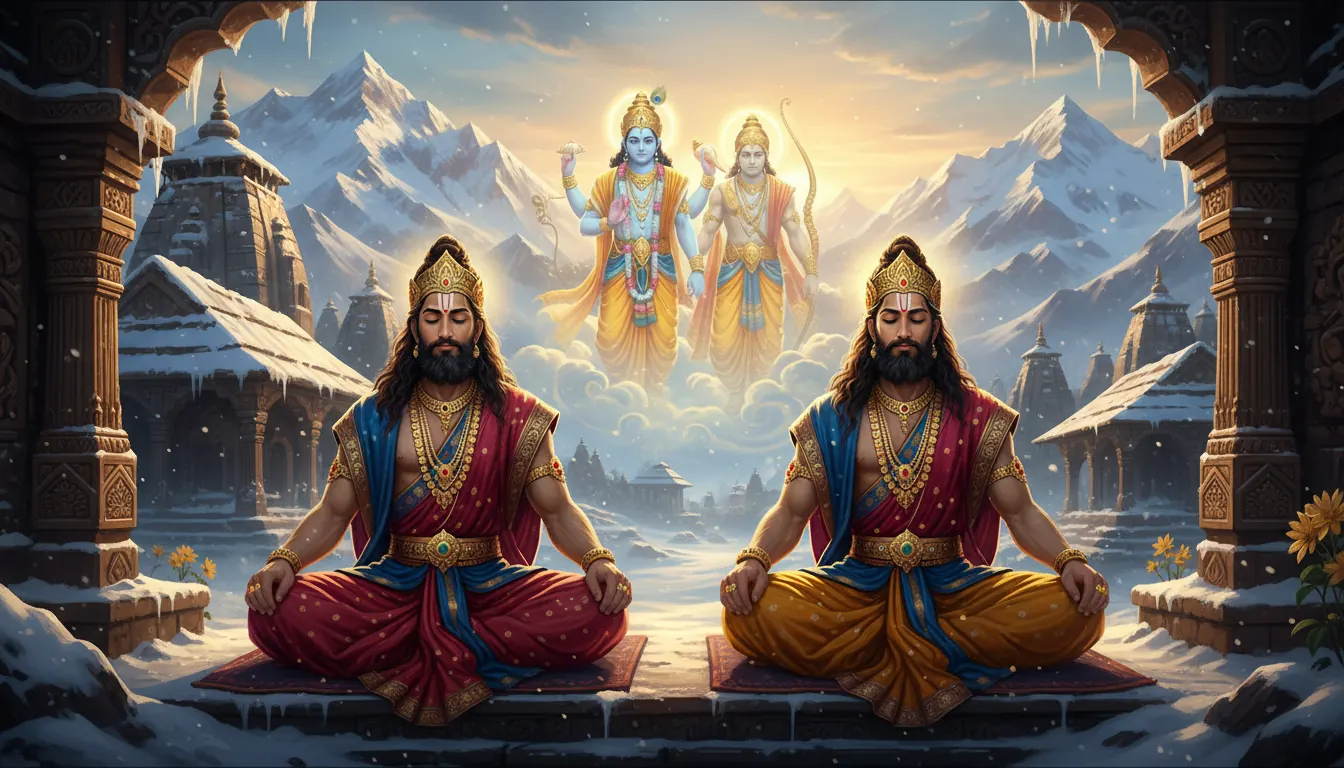
The Road of Works
Brahman and the first rishis stand a thousand years on the shore, and sacrifice is founded
In short
Saunaka asks how Narayana can be both the doer and the enjoyer of sacrifices when he himself ordained the religion of abstention. The answer runs back through Vaishampayana to Vyasa, who saw the beginning of the Kalpa: the newly made Rudras, Prakritis and celestial rishis ask Brahman what their jurisdictions and their strength are to be, and Brahman leads them to the northern shore of the Ocean of milk. After a thousand celestial years of penance a voice grants them strength invested with Pravritti, takes the first share of the first sacrifice, and divides the world into those who act and those who cease.
Told in the Shanti ParvaSet in Kshira Sagara, Mount Meru and Naimisharanya21 min read
The Doubt Left at Naimisha
The rishis of the Naimisha forest had heard the whole of the Narayaniya by then, the hymn and the vision and the White Island, and when Sauti paused it was Saunaka, master of that twelve-year sacrifice, who found the one thread that had not been tied off.
"How can that illustrious god," Saunaka said, "the mighty Narayana, who knows the Vedas and all their branches, be at once the one who performs sacrifices and the one who enjoys them?"
He set the difficulty out plainly, because it is a plain difficulty and no amount of devotion dissolves it. Narayana is forgiving. Narayana has adopted the religion of Nivritti, which is abstention, the turning away from works. More than that, it is he himself who ordained the duties of Nivritti and laid them down for those who would follow them.
"Why then has he made so many of the gods takers of shares in sacrifices?" Saunaka asked. "All sacrifices come from the way of Pravritti. And why, again, has he created others with the opposite nature, who follow the rules of the religion of abstention?"
Two roads, then, laid down by the same hand. Pravritti, which is the way of acts, of fires lit and butter poured and shares distributed and rewards collected. Nivritti, which is the way of ceasing, of no fire at all. If the second is better, why is the first there. If the first is good enough for the gods, what is the second for.
"Clear up this doubt of ours, Suta," Saunaka said. "It seems as old as time and is bound up with a great mystery."
Sauti did not answer it himself. He answered the way a reciter answers, by finding the place where the same question had been asked before.
"Excellent Saunaka," he said, "I will tell you what Vaishampayana, the disciple of the wise Vyasa, said when king Janamejaya asked him about these very things."
The Dagger in Janamejaya's Heart
Janamejaya had listened to the same discourse in his own hall, and the doubt had gone into him harder, because he was a king and kings are men of works.
"The whole world of beings, Brahma, the gods, the Asuras and human beings, is seen to be deeply attached to the acts that are said to bring prosperity," he said. "And you have told me, twice-born one, that Emancipation is the highest happiness and consists in the end of existence. Those who become emancipated, free of both merit and demerit, enter, we are told, the great God of a thousand rays."
That was the teaching he had just been given. Now he turned it over and looked at what was underneath it.
"It seems to me, brahmana, that the eternal religion of Emancipation is very hard to follow. All the gods have turned away from it and become enjoyers of the clarified butter poured with mantras on sacrificial fires."
Then he named them, one after another, and the list is the argument. Brahman. Rudra. The mighty Shakra, slayer of Vala. Surya. Chandramas, the Lord of the stars. The Wind-god. The god of fire. The god of the Waters. Infinite Space as a living Being, and the Universe itself as a conscious agent, and the rest of the dwellers in heaven.
"It seems they do not know the way to bring conscious existence to an end. That, perhaps, is why they have not taken the path that is certain, indestructible and unchanging. That, perhaps, is why they have turned away from it and adopted the religion of Pravritti, which leads to a conscious existence measured by time. And this is one great fault of those who are wedded to actions: all their rewards come to an end."
He was accusing the gods of taking the lesser road, and he knew it.
"This doubt, twice-born one, is lodged in my heart like a dagger. Pull it out by telling me some of the old discourses on this subject. Why are the gods said to take their shares of the sacrificial offerings? Why are the dwellers in heaven worshipped in sacrifices? And when they themselves perform great sacrifices, to whom do they, who take their shares of the offerings made in their honour, make offerings?"
The Five on Meru
"The question you have asked me, ruler of men, touches a deep mystery," Vaishampayana said. "No man who has not practised penances, and who does not know the Puranas, can answer it quickly."
So he did what Sauti had done, and reached back one link further. He would not answer out of himself. He would repeat what his teacher had said, the Island-born Krishna, otherwise Vyasa, the great rishi who classified the Vedas, when the same question had been put to him by his own students.
There had been five of them: Sumantu, Jaimini, Paila of firm vows, Vaishampayana himself as the fourth, and Shuka, Vyasa's son, as the fifth. They were self-controlled and pure in their practice, they had wholly conquered anger and mastered their senses, and their teacher used to teach them the Vedas, with the Mahabharata as the fifth.
Once, while they were studying on the slopes of Meru, the greatest of mountains, where Siddhas and Charanas live, this very doubt arose in their minds. It is worth noticing where it arose. Not in a hall of kings and not in the middle of a war. Five men sitting on a mountain with the four Vedas open in front of them, and the thing that troubled them was why any of it should be done at all.
They put it to Vyasa, and Vyasa, who drives away the darkness of ignorance, did not begin with an argument. He began by saying how he came to know.
"I have practised very severe penances, the harshest of all," he said. "Best of men, I know the Past, the Present and the Future fully. Because of those penances, and because of the restraint in which I kept my senses while I lived on the shores of the Ocean of milk, Narayana was pleased with me. Through the great God's favour, this knowledge of the Past, the Present and the Future, which I had longed for, arose in my mind."
Then he told them where he was going to take them.
"With the eye of knowledge I have seen everything that happened at the beginning of the Kalpa."
What Came Down From the Unmanifest
He began where there was nothing yet to see.
He whom both the Sankhyas and those who know Yoga call Paramatma, the Supreme Soul, comes to be regarded as Mahapurusha, the Great Purusha, because of his own acts. From him springs the Abyakta, the Unmanifest, whom the learned call Pradhana. From the mighty Unmanifest sprang the Manifest, the Byakta, for the creation of all the worlds, and he is called Aniruddha, and among all creatures he is known as the Mahat Atma, the great Self. It is that Aniruddha who, becoming manifest, created the Grandsire Brahman.
Aniruddha has another name, Ahankara, which is consciousness, the sense of I, and he has every kind of energy. From Ahankara sprang the five great elements: Earth, Wind, Space, Water, and Light as the fifth. When he had created the Mahabhutas he created their attributes, and by combining the Mahabhutas he created embodied beings.
Vyasa named the first of them.
Marichi, Angiras, Atri, Pulastya, Pulaha, Kratu, the great-souled Vasishtha, and the Self-born Manu. These eight are known as the Prakritis, and all the worlds rest on them. They are not gods of any department. They are the eight foundations under the floor of things, and everything that will happen afterwards happens on top of them.
Then Brahman, the Grandsire of all the worlds, created the Vedas with all their branches, and the Sacrifices with all their parts, for the fulfilment of all creatures. From these eight Prakritis this vast universe has sprung.
And then, out of a different material altogether, Rudra sprang from the principle of anger. As soon as he came to life he created ten others like himself, and these eleven Rudras are called the Vikara-Purushas, the men of alteration.
So the roll was complete. The eight Prakritis, made for founding. The eleven Rudras, made out of anger. The celestial rishis. All of them alive, all of them new, all of them standing in a creation that had just been finished and given no instructions.
They went to the one who had made them.
Tell Each of Us What We Are For
The Rudras, the Prakritis and the celestial rishis went to Brahman to see to the upholding of the universe and its workings. That is the reason given, and it is a workmanlike reason. They had not come to be praised or to complain. They had come because a world was running and nobody had been told which part of it was his.
"You have created us, holy one of great power," they said. "Tell each of us, Grandsire, what jurisdiction is to be ours. What jurisdictions have you created for overseeing the different affairs? What kind of consciousness should each of us have, and which of these will each of us take charge of? And ordain for each of us the measure of strength we are to have for carrying out the duties of our jurisdictions."
Three requests, and the third is the one that decides everything that follows. A jurisdiction is a list of duties. A consciousness is a nature fitted to them. But strength is a supply, and a supply has to come from somewhere, and nothing had yet been arranged from which it could come.
The Grandsire did not pretend to have the answer ready.
"You have done well, gods, to raise this with me," Brahman said. "Blessings on you all. I was thinking about this very question myself. How are the three worlds to be upheld and kept going? How are your strength and mine to be used to that end?"
Then the Creator of the worlds said the thing that is the hinge of the whole discourse, and he said it about himself.
"Let us all leave this place and go to that unmanifest and foremost of Beings, the witness of the world, and seek his protection. He will tell us what is for our good."
The maker of the Vedas and the sacrifices did not know how the world was to be kept fed. He knew who did. So he stood up and went, and the eight Prakritis and the eleven Rudras and the celestial rishis went with him, out of the place they had been made in, wanting to do good to the three worlds.
A Thousand Years on the Northern Shore
They went north, to the northern shores of the Ocean of milk, and there they stopped and began to practise the harsh penances that Brahman sets out in the Vedas. The harshest of them are called Mahaniyama, the foremost vows and observances, and those were the ones they undertook.
The posture is given exactly, and it should be read slowly, because the ones standing in it are the gods.
They stood there with their minds fixed, motionless as wooden posts, eyes turned upward and arms raised.
That is the attitude of any village ascetic on any riverbank, the arms held over the head until they wither, the eyes turned up until the world goes out of them, the body left standing until it might as well be timber driven into the ground. The eight who hold up the worlds took it. The eleven born of wrath took it. Brahman the Grandsire, who had made the Vedas they were reciting, took it with them.
For a thousand celestial years they kept up those severe penances.
Nothing is recorded of the thousand years. No visitor, no temptation, no test, no interruption. The sea on one side and the row of raised arms on the other, and the whole apparatus of creation waiting somewhere behind them for someone to tell it how to work. This is the part of the story that a reader wants to hurry through and that the text refuses to hurry, because the answer that is coming is not going to be an argument. It is going to be a grant, and a grant is made to those who have waited for it.
At the end of that time, they heard words.
They did not see anything. There was no form on the water and no light in the sky. Out of the air above the northern shore came a voice, sweet, and in harmony with the Vedas and their branches, and it was speaking to them by name and by station.
"Gods and rishis rich in austerity, with Brahman among you, I welcome you all, and I say this to you: I know what is in your hearts."
The Terms
"Truly, the thoughts that occupy you are for the good of the three worlds," the holy one said. "I will increase your energy and strength, and give it to you through Pravritti."
There it was, in one line, and it was not a rebuke. The strength they had asked for would be given, and it would be given in a particular currency. Pravritti. Predilection for acts. Their power would come to them through works, and would therefore come to them the way anything comes through works, by being generated, delivered and spent.
"Gods, you have done well to undergo these penances out of a wish to worship me. Foremost of Beings, now enjoy the excellent fruits of the austerities you have gone through. This Brahman is the Lord of all the worlds. With his power, he is the Grandsire of all creatures. And you too are the foremost of the gods."
Then the terms.
"All of you, with your minds fixed and gathered, perform sacrifices for my glory. In the sacrifices you perform, always give me a portion of the offerings. Then, lords of creation, I will assign each of you your jurisdiction and ordain what is for your good."
The gods are to sacrifice. That is the answer to the question Janamejaya had asked at the end of his list, the one that sounded almost impudent: to whom do the takers of shares themselves make offerings. They make them here, on this shore, at the first sacrifice there ever was.
When they heard these words of the God of gods, all those gods and great rishis and Brahman were so delighted that the hair on their bodies stood on end. At once they made arrangements for a sacrifice in honour of Vishnu, according to the rules laid down in the Vedas.
In that sacrifice Brahman himself set aside a portion of the offerings for Vishnu, and the gods and the celestial rishis, following Brahman's lead, each set aside a similar portion for the great God. The portions offered followed, in both the amount and the quality of what was used, the rules laid down for the Krita age, which is to say that nothing bled and nothing was stinted.
And they worshipped him as one with the colour of the Sun, the foremost of Beings, beyond the reach of Tamas, vast, pervading all things, the Supreme Lord of all, the giver of boons, and mighty. He was invisible and bodiless the entire time. They were pouring butter into a fire for a god who was not there to be looked at.
Rewards With an End in Them
Then the voice came back out of the heaven, and what it said first was an acknowledgement, like a man signing for goods.
"The offerings you have dedicated in this sacrifice have all reached me. I am pleased with all of you."
And then, immediately, before any reward was named, the flaw in the reward was named.
"I will give you rewards, but they will be rewards with an end in them, and from that end there will be a return."
He told them to their faces. Everything they were about to receive would run out. Whatever they gained by this rite and by every rite after it would carry them up and then set them down again, and there would be no exception made for gods.
"This will be your distinguishing mark, gods, from this day on, by my grace and kindness to you. Performing sacrifices in every Yuga, with rich gifts, you will become enjoyers of the fruits born of Pravritti."
Then the arrangement, which is the actual answer to the whole question, was laid out as a circuit.
"Gods, men too who perform sacrifices according to the rules of the Vedas will give all of you shares of their offerings. In the Veda-sutras I make him the receiver of a share like the one he has himself offered in this sacrifice. You were created to look after the affairs of your jurisdictions: uphold the worlds according to the measure of your strength, as it depends on the shares you receive in those sacrifices."
So the strength they had asked for on the shore was not to be handed to them in a lump. It was to be metered to them out of the fires of men, for as long as men kept lighting them.
"Draw your strength from the rites and observances that will be practised in the various worlds, springing from the fruits of Pravritti, and go on upholding the affairs of those worlds. Strengthened by the sacrifices men perform, you will strengthen me. This is what I intend for you all. It is for this that I have created the Vedas and sacrifices and plants and herbs. When human beings on earth duly serve the gods with these, the gods will be pleased."
A man pours butter. A god is fed. The god holds up his corner of the world. And the portion that goes past the god to the one who does not need it goes to the only being in the account who is not being paid.
Two Sets of Seven, and Four Ages
"Foremost of the gods, I have ordained your creation to last until the end of this Kalpa, and made your nature depend on the fruits of the religion of Pravritti."
Then he divided the rishis, and the division is the answer Saunaka had asked for at Naimisha.
Marichi, Angiras, Atri, Pulastya, Pulaha, Kratu and Vasishtha. These seven were created by an act of will. They will become the foremost of those who know the Vedas, the very teachers of the Vedas. They are wedded to the religion of Pravritti, for they were meant to devote themselves to begetting offspring.
And seven others, the spiritual sons of Brahman: Sana, Sanatsujata, Sanaka, Sanandana, Sanatkumara, Kapila, and Sanatana as the seventh. Their knowledge comes to them of itself, without study or effort. These seven are wedded to the religion of Nivritti. They are the foremost of those who know Yoga and the Sankhya philosophy, and it is they who introduce the duties of abstention and set them flowing through the worlds.
Fourteen men, sent down two roads.
"The path of those who are wedded to Karma springs from Ahankara and always leads back. By that path one cannot reach the place from which there is no return. Different creatures have been created for different ends. Some are meant for the path of Pravritti and some for that of Nivritti. The reward a creature enjoys follows the path he takes."
Then he set the clock. This present age is the best of all and is called Krita, and in this Yuga no living creature may be killed in the sacrifices that are performed. Righteousness will flourish whole. After it comes Treta, in which the Vedas lose a quarter and only three remain, in which animals will be killed after being dedicated with sacred mantras, and Righteousness loses a quarter. Then the mixed age, Dvapara, in which Righteousness loses two quarters. Then Kali, under the Tisya constellation, in which Righteousness loses three and only a quarter of it remains anywhere.
The deities heard their own future read out and asked the only question worth asking.
"If only a quarter of Righteousness is to remain anywhere in that age, tell us, holy one, where are we to go then, and what are we to do?"
"In that age you should go to the places where the Vedas and sacrifices, Penance, Truth and Self-restraint, together with duties full of compassion for all creatures, still flourish. Sin will never touch you at all."
The Head of a Horse
At this command the gods and all the rishis bowed their heads to him and went to the places they wanted, each with his measure of strength and the pipe that would carry it.
Brahman did not go. After the rishis and the dwellers in heaven had left, he stayed on the shore, wanting to see the great God in the form of Aniruddha. He had spoken to a voice for a thousand years and wanted to see who had been speaking.
The foremost of gods then showed himself, in a form with a vast horse's head.
He came with a bowl and the triple stick, the kamandalu and tridanda that any wandering ascetic carries, reciting the Vedas with all their branches as he came, and above that the head of a horse. The Lord of all sacrifices appeared to the Creator in the shape of a mendicant who has renounced sacrifice, with the face of the animal that sacrifice most prizes.
When Brahman saw him, wanting to do good to his creation, he bowed his head to that boon-giving Lord and stood with hands joined in reverence. And the great God embraced him.
"Brahman, think carefully about the courses of action creatures are to follow. You are the great ordainer of all created Beings. You are the master and lord of the universe. Once I have laid this burden on you, I will soon be free of care."
An odd sentence for a god, and said plainly. The work is handed over. He has arranged the fires, the shares, the jurisdictions and the ages, and now he sets it down.
"But at times when it is hard for you to accomplish the purposes of the gods, I will appear in incarnate forms, as my self-knowledge directs."
With these words that great horse-headed form vanished on the spot, and Brahman, having received his command, went quickly to his own realm.
That is why, Vyasa told his five disciples on Meru, the eternal God with the lotus in his navel became the receiver of the first share offered in sacrifices, and came to be called the eternal upholder of all Sacrifices. He himself took up the religion of Nivritti, the goal of those who seek fruits that never perish. At the same time he ordained the religion of Pravritti for others, to give variety to the universe.
He is the beginning, the middle, and the end of all created Beings. He is their Creator and their one object of meditation. He is the actor and he is the act.
Dharma Lesson
The gods did not choose the road of works because they were ignorant of the better one. They were given it, and told in the same breath that its rewards would run out. Every rite in the world is part of a circuit that keeps the worlds standing, and the one who set the circuit going stepped out of it himself. The lesson is not that action is worthless but that it is load-bearing, and that a man who understands what he is holding up may still want something that does not have to be held.