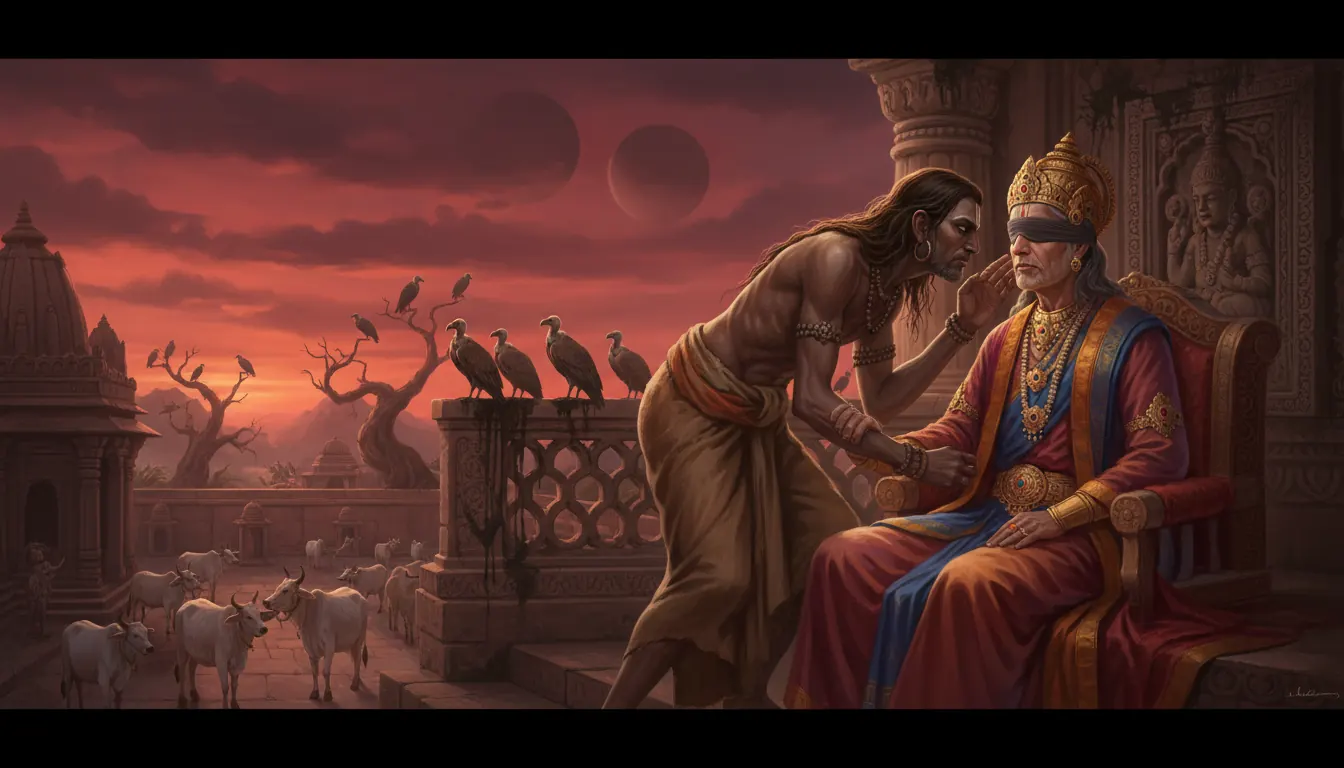
The Signs Before the War
What Vyasa saw in the sky, the cattle and the birth-rooms
In short
With both armies drawn up, Vyasa comes privately to Dhritarashtra and reads him the state of the world: vultures on the treetops, images of gods vomiting blood, asses born of cows, two eclipses on the thirteenth day of one month. He tells the king he is still competent to stop it. Dhritarashtra calls it destiny and does nothing.
Told in the Bhishma ParvaSet in Hastinapura and Kurukshetra17 min read
In Private, With the Armies Already Formed
Vaishampayana said to Janamejaya: the two armies stood to the east and the west, ready for the fierce battle to come, when the holy rishi Vyasa, the son of Satyavati, came to the royal son of Vichitravirya and spoke to him in private.
He found the king distressed and giving way to sorrow as he brooded on the evil policy of his sons.
"King," Vyasa said, "the hour of your sons and the other kings has come. They have gathered for battle and they will kill one another. Their hour has come, Bharata, and they will all perish. Remember the changes time brings, and do not give your heart up to grief. King, if you want to see them fighting, I will give you sight, my son. Watch the battle."
"Best of twice-born rishis," Dhritarashtra said, "I do not want to see my kinsmen slaughtered. But through your power I would like to hear about this battle in every detail."
So the boon went sideways, to the man standing at the king's shoulder. Vyasa turned to Sanjaya the son of Gavalgani and gave him what the king had refused.
"This Sanjaya will describe the battle to you, king. Nothing in the whole battle will escape his eyes. Open or hidden, by day or by night, even what is only thought in the mind, Sanjaya will know it all. Weapons will not cut him and exertion will not tire him. This son of Gavalgani will come out of the battle alive.
"As for me, I will spread the fame of these Kurus and of all the Pandavas. Do not grieve. This is destiny, tiger among men. Do not give way to grief. It cannot be prevented. As for victory, it lies where righteousness is."
Then, having said that, the grandsire of the Kurus stayed where he was and began on the other thing he had come to say.
The Birds Are Already Waiting
"The slaughter in this battle will be great, king. I see many omens of terror here as well.
"Hawks and vultures, crows and herons and cranes are settling on the treetops and gathering in flocks. These birds, delighted at the prospect of battle, are looking down on the field in front of them. Flesh-eating beasts will feed on the flesh of elephants and horses. Fierce herons, foretelling terror with their merciless cries, are wheeling across the centre toward the south.
"Every day, at both twilights, morning and evening, I see the sun covered by headless trunks as it rises and sets. Clouds of three colours, white and red at the edges and black at the neck, charged with lightning and shaped like maces, wrap the sun at both twilights.
"I have seen the sun, the moon and the stars all blazing. In the evening there is no telling them apart. I have seen this all day and all night. All this foretells fear. Even on the fifteenth night of the bright fortnight in the month of Kartika, the moon lost its splendour and vanished, or turned the colour of fire, while the sky was the colour of the lotus.
"Many heroic lords of the earth, kings and princes of great bravery with arms like maces, will be killed and will sleep on the bare ground. Every night I hear in the sky the fierce cries of boars and cats fighting."
The king said nothing. Vyasa went on, because a catalogue is a kind of argument and he had not yet reached his conclusion.
The Images Sweat
"The images of gods and goddesses sometimes laugh, sometimes tremble, sometimes vomit blood from their mouths, sometimes sweat, and sometimes fall down.
"King, drums sound without being beaten, and the great chariots of kshatriyas move with no animals yoked to them. Kokilas, woodpeckers, jays, water-cocks, parrots, crows and peacocks utter terrible cries. Here and there horsemen in mail, armed with weapons, raise fierce shouts, and there is nobody there. At sunrise insects are seen flying in hundreds. In both twilights the cardinal quarters seem to be ablaze, and the clouds, Bharata, shower dust and flesh.
"She who is famous through the three worlds and praised by the righteous, the constellation Arundhati herself, keeps her lord Vasishtha at her back. The planet Sani has appeared too, afflicting the constellation Rohini. The mark of the deer in the moon has moved from its usual place. A great terror is indicated. Even though the sky is cloudless, a terrible roar is heard there.
"The constellation named after the seven great-souled rishis has grown dim. Rahu of fierce deeds is afflicting the constellation Kirtika, and rough winds, foretelling fierce danger, are constantly blowing.
"The animals are all weeping, and their tears are falling fast."
That was the end of the first list. Dhritarashtra sat in the chair he had been sitting in when the news of every previous disaster in his reign had reached him, and made no reply, and the rishi began the second list, which was worse.
Asses Out of Cows
"Cows are giving birth to asses. Some are mating with their own mothers. The trees in the forests are bearing flowers and fruit out of season. Pregnant women, and even women who are not pregnant, are giving birth to monsters.
"Flesh-eating beasts, mingling with flesh-eating birds, are feeding together. Ill-omened beasts, some with three horns, some with four eyes, some with five legs, some with two sexual organs, some with two heads, some with two tails, some with fierce teeth, are being born, and with mouths wide open are uttering unholy cries. Horses with three legs, with crests, with four teeth and with horns are being born as well.
"In your own city, king, the wives of many who recite the Brahma are giving birth to Garudas and peacocks. The mare is giving birth to a cow-calf, and the bitch is giving birth to jackals and cocks, and antelopes and parrots are all uttering inauspicious cries. Certain women are giving birth to four or five daughters at a time, and these, as soon as they are born, dance and sing and laugh.
"A bird with only one wing, one eye and one leg hovers in the sky at night and screams so frightfully in its wrath that it seems to make its hearers vomit blood. Little children, as if driven by death, draw pictures of armed men, run at one another with clubs, and, eager for battle, break down the towns they build in play. Lotuses of different kinds and lilies are growing on trees. Strong winds are blowing fiercely and the dust does not settle. The earth is trembling again and again."
He was describing the king's own city, street by street, to a man who could not see it and had heard nothing of it from anyone else in the household.
He Read the Sky Like a Ledger
"Rahu is approaching the sun. The white planet has passed beyond the constellation Chitra and stays there. All this foretells, above all, the destruction of the Kurus.
"A fierce comet has risen, afflicting the constellation Pushya. This great planet will do terrible harm to both armies. Mars is wheeling toward Magha, and Brihaspati toward Sravana. The son of the sun is closing on the constellation Bhaga and afflicting it. The planet Shukra is rising toward Purva Bhadra and shining brilliantly, then wheeling round to face the Uttara Bhadra. The white planet, blazing like fire mixed with smoke, has attacked the bright constellation Jeshtha, which is sacred to Indra, and stays there. The constellation Dhruva blazes fiercely and wheels to the right. Both the moon and the sun are afflicting Rohini. The fierce planet has taken up its position between the constellations Chitra and Swati.
"Those two blazing planets, Brihaspati and Sani, have come to the constellation called Visakha and have stood still there for a whole year.
"And there is this. Until now a lunar fortnight has had fourteen days, or fifteen as usual, or sixteen. But I never knew the new moon to fall on the thirteenth day from the first lunation, or the full moon on the thirteenth day from the same. And yet in this one month both the moon and the sun have been eclipsed on the thirteenth day. Because the sun and the moon have been eclipsed on these unusual days, they will cause a great slaughter of the creatures of the earth. Rakshasas will drink blood by the mouthful and still not have enough."
He had counted the days himself. That was the part he kept returning to: not the monsters, not the blood in the sky, but a calendar that had stopped behaving.
Blood in the Milk
"The earth, which grows each crop in its own season, is now covered with the crops of every season. Every barley stalk carries five ears, and every paddy stalk a hundred. And the cows, the best of creatures in the worlds, on whom the universe depends, give only blood when they are milked after the calves have suckled.
"Bright rays of light come from bows, and swords blaze brilliantly. Clearly the weapons see the battle ahead of them as if it had already come. Weapons and water, coats of mail and standards, are all the colour of fire.
"The great rivers are flowing in opposite directions. The waters of rivers have become bloody. The wells, foaming up, are bellowing like bulls. Meteors as bright as Indra's thunderbolt fall with loud hisses. From the mountains of Kailasa and Mandara and Himavat thousands of explosions are heard, and thousands of peaks are tumbling down. Because the earth is trembling, each of the four oceans has swelled high and seems ready to burst its shores.
"When brahmanas pour libations on the sacrificial fire, it turns blue, or red, or yellow. Its flames bend toward the left with a bad smell and loud cracks. Touch, smell and taste, king, have become what they never were. The standards of warriors, trembling again and again, are giving off smoke, and drums and cymbals are throwing off showers of coal dust. All around, from the tops of tall trees, crows wheel in circles from the left, crying fiercely, pakka, pakka, and perch on the tops of standards, foretelling the destruction of the kings. Vicious elephants, trembling all over, are running here and there, urinating and dropping dung. The horses are all melancholy.
"Fierce clouds, foretelling danger, rain blood in the night. When this night is over, evil will overtake you. People who come out of their houses with lighted torches to meet one another still find a thick gloom all around.
"Great rishis have said that when such things happen the earth drinks the blood of thousands of kings. In this battle of the Kurus with the Pandavas the earth will be a river of blood with the standards of warriors as its rafts.
"Now that you have heard all this, Bharata, let the right thing be done, so that the world is not emptied of people."
Destiny, Said the King
Dhritarashtra had listened to all of it without interrupting once, and when it was finished he gave his answer.
"I think all this was ordained long ago. A great slaughter of human beings will take place. If the kings die in battle keeping to the duties of the kshatriya order, they will reach the regions kept for heroes and know nothing but happiness. These tigers among men, giving up their lives in a great battle, will win fame in this world and great bliss for ever in the next."
That prince of poets gathered his mind in supreme yoga. He meditated for a short while. Then he tried once more.
"There is no doubt, king of kings, that it is Time that destroys the universe. It is Time too that creates the worlds. Nothing here is eternal. Show the path of righteousness to the Kurus, to your kinsmen, relatives and friends. You have the power to restrain them. The slaughter of kinsmen is called a sin. Do not do what displeases me.
"King, Death himself has been born in the shape of your son. Slaughter is never praised in the Vedas. It can never do good. The customs of one's race are like one's own body. Those customs kill the man who destroys them. Calamity has come to you in the shape of your kingdom. Your virtue is wasting away. Show your sons what righteousness is. You who cannot be defeated, what is a kingdom worth to you if it brings you sin? Guard your good name, your virtue and your fame. Then you will win heaven.
"Let the Pandavas have their kingdom, and let the Kauravas have peace."
He said it in a sorrowful tone, and the king, who was accomplished in speech, answered him accomplishedly.
"I know as much as you do about life and death. I know the truth of these things. But where his own interests are concerned, a man loses his judgment. Sire, take me for an ordinary man. Your power is immeasurable. I beg you to use it for us. Your soul is perfectly controlled; you are our refuge and our teacher. My sons do not obey me, great rishi. And my own mind has no wish to do wrong. You are the source of the Bharatas' fame, their achievements and their love of virtue. You are the revered grandsire of both the Kurus and the Pandavas."
Nobody was sent to fetch Duryodhana.
What Victory Looks Like
"Royal son of Vichitravirya," Vyasa said, "tell me freely what is in your mind. I will remove your doubts."
The king had one question left, and it was not about peace.
"Holy one, I want to hear from you all the signs that appear for those who are going to win in battle."
So the rishi, who had just spent the evening telling him that the world was ending, told him instead how to recognise a winner.
"The sacred fire glows cheerfully. Its light rises upward. Its flame bends to the right. It blazes up without smoke. The libations poured on it smell sweet. These, it is said, are the signs of success to come. The conches and cymbals sound deep and loud. The sun and the moon both shine with pure rays.
"Crows, whether perched or on the wing, give pleasant cries. Where vultures, swans, parrots, cranes and woodpeckers cry sweetly and wheel to the right, the brahmanas say that victory in battle is certain for that side. Those whose divisions shine so with ornaments, coats of mail and standards, and with the music of their horses' neighing, that no one can look at them, always conquer their enemies. Those who give cheerful shouts, warriors whose spirits are never dampened and whose garlands never fade, always cross the ocean of battle. Those who speak kindly even to the enemy, and warn him before they strike, win victory.
"Whether the army is small or large, cheerfulness among the fighters is said to be a sure sign of victory. One panic-stricken soldier can make even a large army take fright and run. And when an army panics and runs, even heroic warriors take fright. Once a large army is broken and put to rout, it is as hard to stop as a herd of deer scattered in fright, or a mighty current of water.
"It is said that success won by negotiation and other such means is the very best. Success won by sowing division among the enemy is middling. Success won by battle is the worst. Battle holds many evils, and the first of them, as they say, is slaughter. Even fifty brave men who know one another, who are free of family ties and firmly resolved, can crush a large army. Even five, six or seven men who will not retreat can win. So numbers are not always what wins a battle.
"Victory is uncertain. It depends on chance. Even those who win must suffer loss."
The Question He Asked Instead
When he had said this to Dhritarashtra, Vyasa left.
And Dhritarashtra, when he had heard it, sat thinking in silence. He thought for only a short while. Then he began to sigh again and again, and then he sent for Sanjaya, who had been standing there the whole while with the new sight in his head and nothing yet to use it on.
"Sanjaya, these kings, these lords of the earth, so brave and so delighted by battle, are about to strike at one another with weapons of every kind, ready to lay down their very lives for the earth. No one can hold them back, and they are striking at one another to swell the population of Yama's realm. They long for the prosperity that comes with owning the earth, and they cannot bear one another. So I think the earth must have many virtues. Tell me all of them, Sanjaya. Many thousands, many millions, many tens of millions of heroic men have come together at Kurujangala. I want to hear exactly where the countries and cities they have come from lie, and how large they are."
So Sanjaya, who had been given eyes that could see through night and distance and into the thoughts of men, was set to describe real estate.
"Wise king, I will tell you the virtues of the earth as far as I know them. See them with your eye of wisdom. Creatures in this world are of two kinds, moving and unmoving. Of moving creatures the foremost are men and animals. Among tame creatures, men are foremost, while lions are foremost among those that live in the woods. All creatures live by feeding on one another.
"Everything springs from the earth, and everything, when it is destroyed, goes back into the earth. The earth is the support and refuge of all creatures, and the earth is eternal. Whoever has the earth has the whole universe with everything in it, moving and unmoving.
"That is why kings, longing to possess the earth, kill one another."
The warning had been delivered, understood, and answered in full, by a man who could recite the whole doctrine of Time and had merely declined to act on it. Vyasa had told him plainly that he was able to restrain them. Far off, on the plain by the Hiranvati, eighteen armies were making their fires for the night, and soon the drums would go.
Dharma Lesson
A warning understood and not acted on is worse than one never given, because it removes the excuse of ignorance. Dhritarashtra could recite the doctrine of Time as well as the sage could, and used it as a reason to do nothing. Knowledge that is not permitted to touch a decision is not wisdom but decoration.