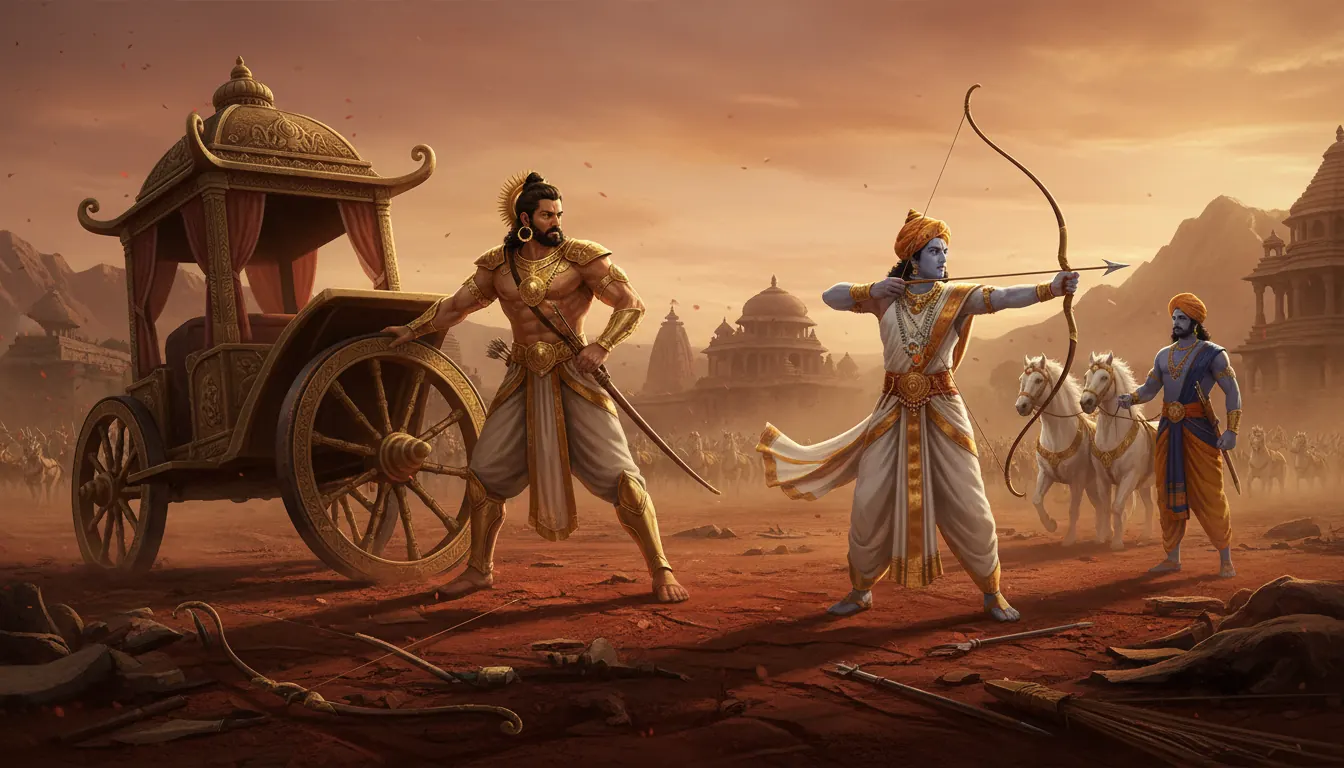
Arjuna Rides Out for Karna
The chariot is yoked again, the omen birds go on ahead, and the field between Arjuna and Karna breaks into duels
In short
On the afternoon of the seventeenth day, forgiven by Yudhishthira and sworn to kill Karna before dark, Arjuna has his chariot re-equipped by Daruka and rides out under a sky full of auspicious birds while Krishna, holding the reins, tells him plainly that Karna is his equal or his better. Behind them the armies close and split into single combats, and the Panchala prince Uttamauja cuts off the head of Karna's son Sushena in his father's sight. Deeper in the Kaurava host, Bhima has his driver Vishoka count what is left in the quivers and watch the horizon for the Ape banner.
Told in the Karna ParvaSet in Kurukshetra23 min read
The Chariot Made Ready Again
Sanjaya was telling it to Dhritarashtra in the hall at Hastinapura, and this was the part he had come to: the seventeenth day of the war, some hours after noon, with Karna commanding the Kaurava army and Yudhishthira lying wounded in his tent behind the lines.
Arjuna had just come out of the worst quarter of an hour of his life. He had gone back to see his brother, had been reproached for coming, had drawn a sword on him over a word about Gandiva, had been stopped by Krishna, and had ended lying at Yudhishthira's feet asking to be forgiven. The king had forgiven him and had given him an order instead. Go and slay Karna.
So Arjuna turned to Govinda with a cheerful heart and spoke like a man giving instructions for an ordinary errand.
"Have my chariot made ready again, and my best horses yoked to it. Have every kind of weapon put on that great vehicle. The horses have had their roll on the ground. They were trained by men skilled in horse lore. Have them brought quickly with the rest of the chariot's gear, in their trappings. Go quickly, Govinda, to kill the Suta's son."
Krishna did not do it himself. He called Daruka, who was his own charioteer and drove for him on the days when he was not driving for Arjuna, and told him to do everything that Arjuna had said. Daruka yoked the horses to that chariot covered with tiger skins, and when it was ready he came and reported the fact, formally, as a servant reports.
Then the brahmanas were brought to perform the propitiatory rites and to utter their blessings over him, and Arjuna took his leave of Yudhishthira, and the king who had been shouting at him an hour before blessed him for victory. And Arjuna climbed up onto the chariot and had it turned toward Karna's.
Sanjaya said that when men saw that chariot begin to move, all creatures on the field regarded Karna as already slain.
The Birds That Went in Front
All the points of the compass became serene.
That is how Sanjaya described the weather of the next few minutes, and then he described the birds, because the birds were the omen and every man on that field knew how to read them.
Kingfishers and parrots and herons wheeled around the son of Pandu. A large number of beautiful and auspicious birds of the kind called Pung flew about him uttering their cries, and the cries were cheerful, and their timely appearance was the sort of thing that makes a man put on more speed. Then the other kind came. Terrible kankas and vultures, cranes and hawks and ravens, tempted by the prospect of food, went out in advance of his chariot and flew on ahead of him in the direction he was travelling.
Both flights meant the same thing. The first said that the gods were with him. The second said that there would shortly be a great deal to eat where he was going, and that it would be Kaurava.
And in the middle of all that, with the omens reading his way and the army opening for him, copious sweat covered Arjuna's body.
His anxiety became very great. He had sworn in front of his brother, touching his weapons, that he would kill Karna before the day ended or fall on the earth killed by him, and now the thing was in motion and could not be called back, and he was riding along thinking about how it was to be done.
Krishna had the reins and his back to him, and saw it anyway.
"Wielder of Gandiva," he said, "no man but you could have defeated those you have defeated with this bow of yours. We have seen many heroes with prowess like Shakra's reach the highest regions by meeting you in battle. Who that is not your equal would come through safe and sound after facing Drona and Bhishma and Bhagadatta, Vinda and Anuvinda of Avanti, Sudakshina the chief of the Kambojas, and mighty Srutayudha? You have celestial weapons, a light hand and great strength, and you are never bewildered in battle. You also have the humility that comes from knowledge."
He was steadying him the only way that works on a man of that kind. He was reading his record back to him.
Do Not Disregard Karna
Then, having built him up, Krishna took him down again, which was the purpose of the whole speech.
"But I must tell you what is for your good. Mighty-armed one, do not underrate Karna, that ornament of battle."
Arjuna had heard Karna abused for thirteen years, in his own camp, by men who had never once stood in front of him. What Krishna gave him instead was a measurement.
"Karna is mighty. He is proud and skilled in weapons. He is a maharatha. He knows every way of fighting and knows well what suits each place and time. Why say more? Hear it in brief, son of Pandu. I think the mighty chariot warrior Karna is your equal, or perhaps your better. You must kill him in this great battle with the greatest care and resolve.
"In energy he is Agni's equal. In speed he is as swift as the rushing wind. In wrath he is like the Destroyer himself. He is mighty, and built like a lion. His arms are mighty. His chest is a full cubit broad. He is invincible. He is quick to take offence. He is a hero, the greatest of heroes. He is very handsome. He has every gift a warrior can have, and he takes away the fears of his friends."
The man who wanted Karna dead more than anyone else alive was giving an honest inventory of him, and he did not leave out that Karna was handsome, or that he was easily wounded in his feelings, or that men on his own side stopped being afraid the moment he arrived.
Then the other half of it.
"He works for the good of Dhritarashtra's son and always hates the sons of Pandu. No one but you, I think, not even the gods with Vasava at their head, can kill the son of Radha. So kill the Suta's son today. Send that greatest of chariot warriors, whose death is near, to Yama. Kill that tiger among men, that quick and proud Karna, who has a sword for a tongue, a bow for a mouth and arrows for teeth. Kill brave Karna in battle, as a lion kills an elephant."
The horses went on carrying them toward him the whole time he was speaking.
The Seventeenth Day, Counted Back
"Today is the seventeenth day, Bharata, of this terrible massacre of men and elephants and horses."
Krishna said it the way a bookkeeper reads out a date, and then he went through the account.
At the outset the host that belonged to the Pandavas had been vast, and it had been very much reduced. The Kauravas had been numerous too, teeming with elephants and horses, and they had been nearly exterminated. Ten of those days had belonged to Bhishma. A master of the highest weapons, he had covered the Cedis, the Panchalas, the Karushas, the Matsyas and the Kaikayas with shafts and deprived them of life. The sky had been filled with the gold-winged arrows that came out of his bow. He slew thousands of chariot warriors at a time and a hundred thousand men and elephants in all, and made the terraces of numberless chariots empty, and he took the form of Rudra in battle and did it all to rescue Suyodhana, who was sinking in a raftless sea. At last Shikhandi, protected by Arjuna, slew that tiger among men with straight shafts, and the grandsire was lying on his bed of arrows while they spoke.
Five days had belonged to Drona. He made an impenetrable array, he protected Jayadratha, he was fierce as the Destroyer in the fighting by night, and he consumed innumerable fighters with his arrows until he met Dhrishtadyumna and attained the highest end. Krishna was careful about the mechanism of it. Drona could be slain by the son of Prishata only because Arjuna, on that day, had held in check the whole Dhartarashtra force headed by the Suta's son.
Then Jayadratha, killed inside the ring of an entire army by a man who had promised to do it before sunset.
"Now that Bhishma and Drona have been killed," Krishna said, "the terrible Dhartarashtra host may be said to have lost all its heroes. Its best warriors are dead, its horses and chariots and elephants destroyed, and today the Bharata army looks like a sky without the Sun, the Moon or the stars. All that is left of that great force is five great chariot warriors: Ashwatthama, Kritavarma, Karna, Shalya and Kripa."
Five men. That was what was left of what had marched out of Hastinapura. And Krishna went down the five naming the reasons Arjuna had to spare four of them: his teacher's son, and Kripa to whom the honour due to a teacher was owed, and Kritavarma who was kin on the mother's side, and Shalya, his own uncle, the ruler of the Madras.
"I ask you to kill Karna today, quickly, with your sharp arrows."
The Reasons, and the Raft
Then Krishna gave the reasons, in order, the way a man lays out the items of a debt.
The attempt made in the night to burn Kunti with all her children in the house at Varanavata: the wicked-souled Karna was the root of it. The conduct Suyodhana adopted toward them after that match at dice: in all those acts of injury Karna had been the leader. And Abhimanyu, the bull-necked son of Subhadra, surrounded by six mighty chariot warriors of cruel heart. Karna had been unable to stay in the battle before that boy's face, mangled and bathed in blood, and had turned his back on the field, and had come back at Drona's word and cut Abhimanyu's bow from behind so that five men could kill him. When it was done, grief entered the heart of everyone on both sides. Two men on that field laughed, and Karna was one of them.
And there were the words in the assembly hall, which Krishna repeated exactly, sitting in front of the husband they had been said to.
"The Pandavas are dead. They have sunk into eternal hell. Choose other lords now. Go into Dhritarashtra's house now as a serving woman, for your husbands are finished. You are the wife of slaves, princess of Panchala, and you are a slave yourself. Clearly they are all sesame seeds without kernel."
"Let gold-decked arrows whetted on stone, shot by you," Krishna said, "put out the fire of those words and of all the other wrongs that wicked wretch did you."
Then he turned from the old debts to what was happening a mile in front of the horses, because that was the urgent thing.
The Bhargava weapon was out. Karna had it from Rama of Bhrigu's race, and its awful form was displayed and blazing with its own energy, surrounding the whole army, and the arrows from his bow were flying thick as a swarm of bees. The Panchalas had never turned their faces from Bhishma or from Drona. They were flying away in all directions now, and Karna was taking their lives in hundreds as a blazing fire takes the lives of myriads of insects. And Bhima, of unappeasable wrath, surrounded by the Srinjayas, was in the middle of that, afflicted by Karna with keen shafts.
"Be a raft, and rescue those brave warriors, those great bowmen, who are sinking in the raftless ocean that is Karna. Left alone, Karna will wipe out the Pandavas, the Srinjayas and the Panchalas, like a neglected disease whose seed has entered the body."
Today
When he heard that, Bibhatsu soon threw off his anxiety and grew cheerful.
He rubbed the string of Gandiva and stretched it, and held the bow for the destruction of Karna, and answered.
"With you to protect me, Govinda, and with you, who know the past and the future, pleased with me today, victory is sure to be mine. With your help I could destroy the three worlds together. What then of Karna? I see the Panchala host running away. I see Karna ranging fearlessly over the field. I see the bhargava weapon sweeping in every direction, called up by him as Shakra calls up his mighty thunder. This is the battle in which I will kill Karna."
Then came the litany, and every clause of it began with the same word.
Today Dhritarashtra would curse that intelligence of his by which he had installed Duryodhana, undeserving of sovereignty, upon a throne. Today Duryodhana would be made to call to mind the words Krishna had spoken in his own hall for the sake of peace. Today the son of Subala would learn that Arjuna's shafts were the dice, that Gandiva was the box for throwing them, and that his chariot was the chequered cloth. Today the earth would drink the blood of that Suta's son who in battle condemns all other men on earth.
Karna had sworn that he would not wash his feet until he had slain Phalguna. Arjuna meant to make that vow false by bringing his body down from his chariot with straight shafts.
"Those who were called sesame seeds without kernel that day," he said, "will become seeds with kernel today, when the Suta's son falls. Today I will kill Karna in battle, and his son, and give joy to Bhima and the twins and Satyaki. Today I will pay off my debt to the Panchalas, to Dhrishtadyumna and Shikhandi. Today I will free myself of the debt I owe to all bowmen, to my own wrath, to the Kurus, to my arrows and to Gandiva. Today I will be free of the grief I have nursed for thirteen years.
"My palms bear these marks of arrows, and this excellent and outstretched bow with arrow fixed on the string. On each of the soles of my feet is the mark of a chariot and a standard. When a man like me goes out to battle, no one can defeat him."
With that, his eyes red as blood, he went quickly into battle, for two purposes: to rescue Bhima, and to cut the head from Karna's trunk.
A Baneful Shower Out of Season
"In that terrible, bottomless clash," Dhritarashtra asked, "when Dhananjaya went into battle, how did the fight go?"
The innumerable divisions of the Pandava army, said Sanjaya, decked with lofty standards and united together, began to roar aloud, drums and other instruments forming their mouth, like masses of clouds at the close of summer.
The battle that followed was like a deadly storm out of season, cruel and destroying living creatures. Huge elephants were its clouds. Weapons were the water they were to pour. The peal of musical instruments, the rattle of chariot wheels and the noise of palms formed their roar. Various weapons decked with gold formed their flashes of lightning, and arrows and swords and cloth-yard shafts formed their torrents of rain. Blood flowed in streams. Many chariot warriors united together surrounded one chariot warrior and sent him to Yama's presence. Or one great chariot warrior sent many enemies together to Yama. One rider on a single elephant sent chariot warriors and horsemen to their deaths at once.
Then the field sorted itself into pairs, as it always did once the lines had properly met, and Sanjaya listed them for the blind king the way a man lists the couples at a wedding.
Kripa and Shikhandi met each other. Satyaki went against Duryodhana. Srutasravas was engaged with Drona's son. Yudhamanyu was engaged with Chitrasena. Sahadeva rushed against Shakuni, the king of the Gandharas, like a hungry lion against a mighty bull. Nakula, who knew all modes of warfare, attacked Kritavarma. Dhrishtadyumna, the son of Yajnasena and king of the Panchalas, attacked Karna, the commander of the Kaurava army, with all his forces. And Dushasana, with the swelling host of the samsaptakas, fiercely attacked Bhima, that warrior of irresistible impetuosity.
Two of the pairs were sons.
The youthful Satanika, son of Nakula by the princess of Panchala, rushed against the youthful Vrishasena, son of Karna, shooting showers of shafts, and the son of Karna struck him with many arrows in return. And the great Srinjaya chariot warrior Uttamauja, one of the two Panchala princes who guarded the wheels of Arjuna's chariot, was engaged with Karna's son Sushena.
Everywhere along that line the fathers had found the fathers, and in two places their children had found each other.
The Head of Sushena
The heroic Uttamauja, putting forth his strength, struck the son of Karna and cut off his head.
It fell to the earth, Sanjaya said, filling the earth and the sky with a loud noise, which is his way of saying that the whole field heard the armies react to it.
Karna saw the head of Sushena lying on the ground. He was in the middle of a duel with Dhrishtadyumna and he was the commander of an army in a battle that was going badly, and for the length of a breath he was only a father looking at part of his son in the grass. He became filled with grief.
The grief lasted about as long as it takes to fit an arrow to a string. Then, in a rage, he cut to pieces the horses, the chariot and the standard of his son's killer with many keen shafts, and left the man standing on the ground in the middle of a battle.
Uttamauja did not stop. On foot, in the press, he pierced the horses of Kripa with his keen shafts and cut down with his bright sword the warriors who were protecting Kripa's flanks, and then, having no vehicle of his own any longer, he quickly climbed up onto the chariot of Shikhandi, who was fighting Kripa a few yards away.
And Shikhandi, standing on his own chariot with his bow in his hand and the old teacher in front of him without horses or wheels, raised his bow to shoot.
Seeing Kripa deprived of his chariot, he wished to strike him with his shafts. Kripa was the teacher of both houses, the man who had taught the sons of Pandu and the sons of Dhritarashtra their first lessons in arms while they were children in one courtyard, and he was standing in the wreck of his chariot with a Panchala bow bent at him. Then the son of Drona came across, drove Shikhandi back with his own chariot, and drew his mother's brother out of that place, Sanjaya said, like a bull sunk in a mire.
So in one small square of that field a Panchala prince killed a man's son; and the father took his revenge for it and stopped there; and a third man took aim at the old teacher; and a fourth pulled his uncle out of the mud. Meanwhile Bhima, the son of the Wind-god, clad in golden mail, went on scorching the troops of Dhritarashtra's sons with his keen arrows like the mid-day sun scorching everything in the summer season.
Bear Me Into the Midst of Them
Bhima was fighting alone, surrounded by innumerable foes, and what he said to his driver was that they should go further in.
"Take me into the thick of the Dhartarashtra host. Drive fast, charioteer, with these horses. I will send all these Dhartarashtras to Yama."
The charioteer's name was Vishoka. He had driven Bhima for years and was one of the few men in either army who could be spoken to in that voice and answer in an ordinary one, and he took the chariot quickly and with great speed to the spot from which his master wished to do the slaughtering.
A large number of Kaurava troops came against him from all sides with elephants and chariots and horse and foot, and began from every side to strike that foremost of vehicles with numerous arrows. Bhima cut all of those arrows out of the air as they came with shafts of his own with golden wings, so that they fell to the earth in two and three fragments. The foremost of kshatriyas, struck by his shafts, set up a loud wail that resembled the din made by mountains when they are riven with thunder, and then rushed at him again from every side like new-fledged birds toward a tree. He displayed all his vigour like the Destroyer armed with a mace at the end of the Yuga, and the Bharata host, mangled and burnt, broke and fled in fear in all directions like masses of cloud scattered by a tempest.
When he had done that much, he cheerfully asked his driver two questions, and both of them are worth hearing.
"Find out, Suta, whether those massed chariots and standards coming toward me are ours or the enemy's. I am so caught up in the fighting that I cannot tell them apart. I do not want to shower our own troops with my arrows."
That is the first: a man in the worst of a battle, with his blood entirely up, stopping to be sure of what he is shooting at.
Then the second, and behind it the thing that was actually eating him.
"When I see enemy warriors and chariots and the tops of their standards on every side, I am deeply troubled. The king is in pain. And the diadem-decked Arjuna has not come yet. These things fill my heart with sorrow, Suta. This is my grief: that king Yudhishthira the just should have gone away and left me in the middle of the enemy. I do not know whether he, or Bibhatsu, is alive or dead. That makes my sorrow worse."
Are Those Two Ears of Yours Gone
"Look through all my quivers," Bhima said, "and tell me, Suta, once you have checked carefully, how many arrows are still left on my chariot, and how many of each sort."
Vishoka counted, and gave him the inventory.
Of arrows, sixty thousand. Of razor-headed shafts, ten thousand, and of broad-headed ones as many again. Of cloth-yard shafts, two thousand. Of Pradaras, three thousand. What remained, he said, was more than six bullocks could carry if it were placed on carts.
"Shoot and hurl them, wise one, for you have thousands upon thousands of maces and swords and other weapons wielded by the arm alone, and lances and scimitars and darts and spears as well. Never fear that your weapons will run out."
So Bhima looked out over the field and began to say what he could see. The Bharata host was breaking. All the Kauravas, having lost their sense, were running like elephants filled with panic at a forest fire, uttering cries of woe.
"Why do those kings fly away?" he said. "It is evident that Savyasachin, that foremost of men, is quickly covering that host with his shafts."
And Vishoka, who had been watching it for some time, lost patience with him.
"Bhima, how can you not hear the loud twang of the yawning Gandiva, drawn by Partha in his wrath? Are those two ears of yours gone? All your wishes have come true, son of Pandu. There is the Ape, in the middle of the elephant force. Look, the string of Gandiva is flashing like lightning among blue clouds. There Arjuna's diadem is shining, with the precious jewel on it as bright as the sun. Look, there is his conch Devadatta, with its loud blare, the colour of a white cloud. There beside him, reins in hand, is Janardana, and look at his discus, bright as the sun, its edge as sharp as a razor. There the trunks of huge elephants, cut off by Kiritin, are falling to the earth like trees. Look at the four hundred chariot warriors and seven hundred elephants he has killed in this battle. Your younger brother is cutting down the Kurus and coming to your side like the constellation Chitra. All your wishes have come true. May your might and the span of your life keep on growing."
Bhima, standing in the ruin he had made, with sixty thousand arrows still in the chariot and his brother's banner finally in sight, answered like a king in a hall.
"Since you bring me word that Arjuna has come, I am pleased with you, Suta, and for this good news I will give you fourteen populous villages, a hundred female slaves and twenty chariots."
Dharma Lesson
Krishna spends the whole ride telling Arjuna that his enemy is the better man, because a warrior who despises the person he is about to fight is already half beaten. The same hour shows the shape of that respect in miniature: Karna, having avenged Sushena, cuts away his son's killer's chariot and leaves him alive on the ground. Between the omens and the arrow counts, this stretch of the war is mostly men measuring things accurately - what an enemy is worth, what is left in the quiver, whether the brother they are waiting for has come. The ones who measure honestly are the ones still standing at dusk.