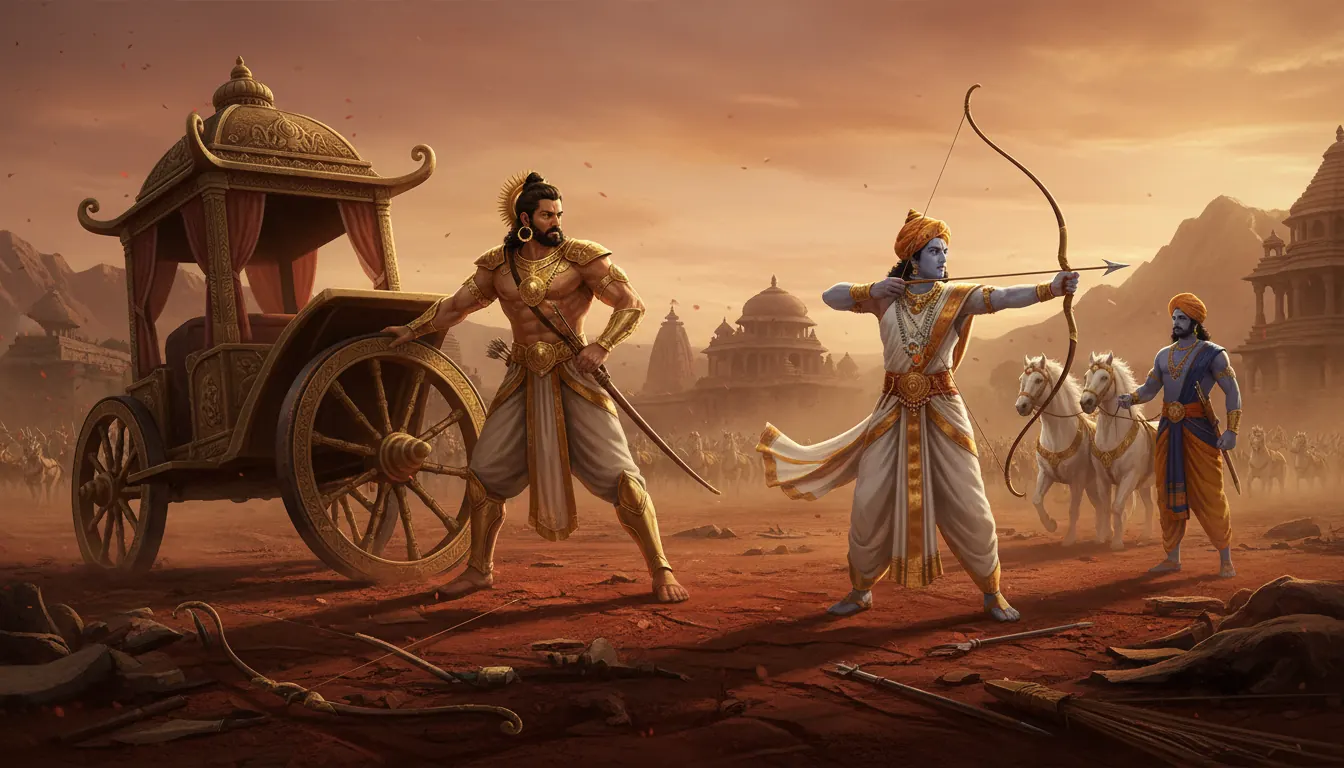
Arjuna Cuts His Way to Karna
An army ordered to tire one man before Karna kills him
In short
On the afternoon of the seventeenth day Arjuna sights Karna's standard and tells Krishna to drive him to it. Karna orders the whole Kaurava host to close on Arjuna and wear him down so that he may be killed easily afterwards, and Arjuna goes through them: the teachers, ten of Dhritarashtra's younger sons, ninety sworn chariot-warriors, and thirteen hundred elephants of the Mlecchas. While he is cutting his way across the field, Karna breaks the Panchalas, Satyaki kills a son of Karna, and five Panchala champions are left standing inactive on their ruined chariots.
Told in the Karna ParvaSet in Kurukshetra21 min read
The River He Left Behind Him
Sanjaya was telling the seventeenth day to a blind king in a hall at Hastinapura, and he had come to the hour in the afternoon when the two men who had been looking for each other since the war began at last saw each other's standards.
Arjuna had been working the far end of the field. He had slain the four kinds of forces, foot and horse and chariot and elephant, and when he turned and got his first sight of the angry son of the Suta in that dreadful battle, he had already set a river flowing behind him.
Sanjaya described it to Dhritarashtra the way a man describes a country he has crossed.
It was tawny with flesh and marrow and bone. Human heads were its rocks and stones. Elephants and horses made its banks. It was full of the bones of heroic combatants and it resounded with the cries of ravens and vultures. Umbrellas floated on it as swans, or as rafts. It ran bearing away heroes the way a river in flood bears away trees. Necklaces were its clusters of lotuses and headgear its fine foam, bows and shafts were its fishes, and the crowns of crushed men turned over and over on its surface. Shields and armour made its eddies. Chariots were the rafts that crowded it.
And it could be forded easily by any man who wanted victory. To cowards it was unfordable.
Having made that river, Arjuna spoke to his driver.
"There, Krishna, the standard of the Suta's son can be seen. There Bhimasena and the others are fighting that great chariot-warrior. There the Panchalas, afraid of Karna, are running away. There is king Duryodhana, with the white umbrella over his head, looking splendid beside him as he routs the Panchalas. There Kripa and Kritavarma and Drona's son are protecting the king, and are themselves protected by the Suta's son. There Shalya, who knows the reins so well, looks splendid on the terrace of Karna's chariot as he guides it.
"Take me to that mighty chariot-warrior. I will never return without killing Karna in this battle."
Keshava turned the white horses and went.
The Man Holding the Reins
Shalya, the ruler of the Madras, had been holding Karna's reins since morning. He had taken the work under protest and he did it well and he had spent the day saying things to the man in front of him that no charioteer says to his warrior.
He saw the white horses coming before Karna did.
"There comes that chariot-warrior with white horses yoked to his chariot and Krishna for his driver, killing his foes as he comes. There comes the man you were asking about, holding his bow Gandiva. If you can kill him today, great good may come to us. He is coming, wanting to fight you, killing our chief warriors on the way.
"Avoiding all our warriors, Dhananjaya is advancing at speed. Judging by his look, swelling with rage and energy, he wants you. Blazing with anger, Partha will not stop to fight anyone else, especially now, when you are pressing Vrikodara so hard. He has learned that you have mangled king Yudhishthira the just and left him without a chariot. He has seen the state of Shikhandi and Satyaki and Dhrishtadyumna, and of the five sons of Draupadi, and of Yudhamanyu and Uttamauja, and of the brothers Nakula and Sahadeva. That is why he is charging at you on a single chariot.
"I do not see any arrangements made to protect him, on his flanks or at his rear. He is coming at you by himself. Look to your success now.
"Go against him, Karna, for there is no other bowman among us who can. You are the equal of Bhishma, of Drona, of Drona's son, of Kripa. Look, those kings, those mighty chariot-warriors of this army, are running away for fear of Arjuna, paying no heed to one another. Except for you there is no man who can drive away the fears of retreating men. All the Kurus have taken you as their refuge and are depending on you."
Karna heard the whole of it out and answered mildly, which was new.
"You seem to be yourself again now, and I am pleased with you. Do not be afraid of Dhananjaya. See today the might of my arms, and see my skill."
Fear Enters My Heart Together With Courage
"Single-handed I will destroy the mighty host of the Pandavas today," Karna said, "and those two lions among men, the two Krishnas. I say this truly. I will never come back from the field today without killing those two heroes. Or, killed by them, I will sleep on the field of battle. Victory in battle is uncertain. Killing or killed, I will achieve my purpose today."
"All the great chariot-warriors say that this finest of chariot-warriors cannot be defeated even when he is alone," Shalya said. "When Krishna protects him as well, who will dare try to defeat him?"
And then Karna, who had spent the war being told what Arjuna was, told Shalya himself, item by item, in the voice of a man reading out an inventory he had memorised long ago.
"As far as I have heard, no chariot-warrior to match him has ever been born on earth. His two arms never sweat. They never tremble. They are massive and covered with scars. He takes a great many arrows and shoots them as if they were one, and he sends them two miles, and they always fall on the foe. What warrior on earth is his equal?
"With Krishna as his ally he satisfied Agni at Khandava, and there Krishna got his discus and Savyasachin got Gandiva, and his terrible chariot with those white horses, and two celestial quivers that are never empty, from the God of Fire. In the world of Indra he got the conch Devadatta and killed the Kalakeyas. He pleased Mahadeva himself in fair fight and got from him the Pashupata, which can destroy the three worlds. The Regents of the world gave him their weapons. And in Virata's city, on a single chariot, he defeated all of us and took our cattle and took pieces of our garments from us.
"He is protected, besides, by Keshava, who is Narayana himself, whose qualities the whole world together could not exhaust in ten thousand years. Seeing the two Krishnas together on the same chariot, fear enters my heart together with courage. The mountains of Himavat may move from where they stand, but not those two.
"Who else but me, Shalya, would go against them? Either I will overthrow those two today, or the two Krishnas will overthrow me today."
Then he began to roar in that battle like a cloud.
Tire Them For Me
Before he went against Arjuna, Karna went to Duryodhana, and was saluted by him, and gave an order to the whole army standing round the king.
He said it to Kripa and to the Bhoja chief Kritavarma, to Drona's son, to the king of Gandhara and his son, to the teachers, to his own younger brothers, and to the foot-soldiers and the horsemen and the elephant-riders together.
"Rush at Achyuta and Arjuna, block their path on every side and tire them out, so that, lords of the earth, I can easily kill those two once you have all wounded them deeply."
"So be it," they said, and went.
What followed was not a duel. It was an army spending itself on one chariot to blunt it for another man's use.
Like the great ocean receiving all rivers with their tributaries, Arjuna received them. His foes could not see when he fixed his arrows on the string or when he let them go. All that could be seen was men and horses and elephants falling one after another, pierced and lifeless. Like men with diseased eyes unable to gaze at the sun, the Kauravas could not look at him, with arrows for his rays and Gandiva bent to a circle for his disc.
Drona's son came at him and pierced Dhananjaya with ten shafts and Keshava with three and the four horses with four, and rained arrows on the Ape on Arjuna's banner. Arjuna cut the full-drawn bow in his hands with three shafts, took the head off his driver with a razor-faced arrow, killed the four horses, cut down the standard, and felled Ashwatthama from his chariot. The son of Drona stood up on the ground, took another bow bright as the body of Takshaka, decked with gems and gold, strung it where he stood, and went on shooting from close range.
Then Kripa and Kritavarma and Duryodhana closed over Arjuna like clouds shrouding the sun. Arjuna showered Kripa's bow and horses and standard and driver until the old teacher stood with his weapons destroyed, struck with as many thousands of arrows as Ganga's son Bhishma had been on the day of his fall by the same hand. He cut the standard and bow of the roaring king. He destroyed Kritavarma's handsome horses and cut down his standard too.
That vast host broke into a hundred parts, like an embankment washed away by water.
Word From His Brother's Tent
Then Arjuna did something that cost him the ground he had gained. He saw Bhima far off, attacked by many of the best warriors of the Kuru army and seeming to sink under the attack, and he turned away from Karna's troops to get him out.
Successive showers of his shafts stood overspread on the sky while others were still killing men below. Filling the sky with arrows that looked like dense flights of feathery creatures, Dhananjaya became the very Destroyer to the Kurus. With broad-headed arrows, and arrows flat and sharp as razors, and polished cloth-yard shafts, he mangled bodies and cut off heads, and the field was strewn with men cut and mangled, men stripped of armour, men without heads.
Sanjaya reached for the only comparison that would serve. Like the great Vaitarani, which separates the country of the living from the country of the dead, the field became uneven and impassable and unsightly and terrible, heaped with crushed horses and chariots and elephants, covered with broken shafts and wheels and axles, with chariots that had lost their horses and chariots that had lost their drivers.
Four hundred trained elephants, always furious, maddened with rage, ridden by warriors in golden mail and urged on by their guides with pressure of heels and toes, came at him and fell where they came, struck by the diadem-decked Arjuna, like loosened summits of gigantic mountains with living creatures still on them.
Like the sun piercing masses of cloud, Arjuna's chariot passed through those dense bodies of elephants. The twang of Gandiva was tremendously loud, like thunder in the sky. The Dhartarashtra army broke like a large vessel on the ocean lashed by a tempest, and the men who had been standing over Bhima left him and turned their faces from the battle.
Then Bibhatsu came up to his brother and stopped there a moment. In the middle of all that they held a short consultation, and what Arjuna had come to say was a piece of news from the camp.
The arrows had been drawn out of Yudhishthira's body. The king was perfectly well.
With Bhima's leave, Dhananjaya went back to his work.
Ten Brothers in Golden Mail
He had not gone far, with the rattle of his chariot making the earth and the sky resound, when ten heroic warriors surrounded him.
They were sons of Dhritarashtra, all of them younger than Dushasana. Sanjaya named them to their father that way and not by their names, and the old king in the hall would have known what the count meant without being told.
They tormented Arjuna with their shafts the way hunters torment an elephant with burning brands, and with their bows outstretched they seemed to dance on their chariots.
The slayer of Madhu, guiding the horses, put all ten of them on the right side of the chariot. He did it deliberately. He expected that Arjuna would very soon send all of them to Yama's presence, and he was arranging the ground for it.
When they saw Arjuna turn toward them, the ten young men fell back.
With cloth-yard shafts and crescent-shaped arrows, Partha cut off their standards and their horses and their bows and their arrows and let all of it fall to the earth. Then he took ten broad-headed shafts of great force, with wings of gold, and cut off their heads.
Sanjaya told his father what those heads looked like as they went. The lips were bitten. The eyes were blood-red with rage. And the faces, he said, looked beautiful, like an assemblage of lotuses.
That is the whole of the notice given to ten princes of the house of Kuru, cased in golden mail, on the seventeenth day. Ten arrows, one apiece.
Having slain them, the slayer of foes went on.
Thirteen Hundred Elephants of the Mlecchas
Ninety chariot-warriors came next, who had sworn a terrible oath about the other world, which is to say they had promised each other not to come back. They surrounded Arjuna and pursued him, pouring showers of shafts, while Krishna, paying them no heed at all, kept urging the white horses, decked with gold ornaments and covered with nets of pearls, straight towards Karna's chariot.
Arjuna cut down all ninety with their drivers and bows and standards without changing direction. Slain by the diadem-decked one, they fell with their chariots like Siddhas falling out of heaven when their merit is used up.
After that the Kauravas came on without counting: chariots and elephants and horses together, a large force of Dhritarashtra's sons crowded with struggling men and swollen with the finest elephants, and it closed around Dhananjaya and stopped him where he was. They shrouded him with darts and swords and lances and spears and maces and scimitars and arrows. Like the sun destroying darkness with his rays, he destroyed that shower of weapons spread across the sky.
Then the elephant corps came into his flank.
They were Mlecchas, foreigners in the Kaurava host, riding thirteen hundred elephants that were always furious, and they had been ordered in at that spot by Duryodhana himself. They struck Partha with barbed arrows and Nalikas and cloth-yard shafts and lances and spears and darts and Kampanas and short arrows, and some of the weapons were not shot at all but hurled by the elephants with their tusks.
Phalguna cut that matchless shower out of the air with broad-headed shafts and crescent-shaped arrows of great keenness. Then he struck the elephants themselves, and their standards and banners and riders, like Indra striking mountains with thunderbolts. Afflicted with gold-winged shafts, those huge beasts in their necklaces of gold went down deprived of life, like mountains ablaze with volcanic fires.
Amid the roaring and shouting and wailing of men and elephants and horses, the twang of Gandiva rose over everything. Struck elephants fled in every direction. Horses whose riders had been killed wandered loose. Chariots in thousands, empty of riders and horses, drifted about the field looking like the changeful forms of vapour in the sky.
At that time, said Sanjaya, the might of Arjuna's arms was seen: that alone, in one battle, he defeated horsemen and elephants and chariot-warriors who were coming at him from every side at once.
Come To Me
Bhima, seeing his brother ringed by a host of three kinds of forces, left the small surviving remnant of the chariot-warriors he had been fighting and drove headlong to where Dhananjaya's chariot was.
He was not tired. He came into what Arjuna had left with a mace in his hands, and the mace did the rest.
Sanjaya described it as a thing with an appetite. Fierce as the death-night, feeding on men and elephants and horses, capable of crushing walls and mansions and the gates of cities, it descended without stopping on everything within reach of his arms. It slew numberless horses and riders. It crushed men and horses clad in steel armour so that they fell with a great noise and bit the earth, bathed in blood, their crowns and bows and lower limbs broken, and supplied all carnivorous creatures with food. Satiated with blood and flesh and marrow, and eating bones as well, that mace became like the death-night, hard to look at.
Having killed ten thousand horses and numberless foot-soldiers, Bhima ran here and there in rage. The Kaurava troops, seeing him mace in hand, thought that Yama himself was among them with his fatal bludgeon. Then, like an enraged elephant, he plunged into the elephant division like a Makara entering the ocean, and in a very short time he had sent the whole of it to Yama's abode. Elephants with spiked plates on their bodies fell on every side with their riders and standards, like winged mountains.
Then he got back on his chariot and followed Arjuna at his rear.
What was left of that great host stood almost still, downcast, about to run and not yet running, and Arjuna covered it with life-scorching shafts. Men and horses and elephants pierced with those showers looked beautiful, Sanjaya said, like Kadamva flowers with their filaments.
The Kauravas gave it up. Judging the touch of Arjuna's arrows unbearable, they fled from the field, deserting Karna as they went and loudly calling on the Suta's son to rescue them. Partha pursued them shooting hundreds of shafts, and Bhimasena and the warriors behind him were glad.
So Dhritarashtra's sons ran to Karna's chariot. Sinking as they seemed to be in a fathomless ocean, Karna became an island to them. Like snakes without poison they took his shelter, the way creatures burdened with their own acts take shelter in virtue from fear of death.
And Karna, who was not afraid, said to those men bathed in blood and stuck full of arrows: "Do not fear. Come to me."
Prasena and the Grandson of Shini
Seeing that the Kurus had left the field, Karna reflected a little, set his heart on the slaughter of Partha, and began to draw deep breaths. Then he bent his formidable bow and went at the Panchalas again in the very sight of Savyasachin, because they were what he could reach.
He destroyed the sons of the Panchalas the way a tempest destroys congregated masses of cloud. He felled the driver of the Panchala prince Janamejaya with broad-faced shafts called Anjalikas and then killed his horses. He pierced Satanika and Sutasoma, two of Draupadi's sons, and cut off both their bows. He pierced Dhrishtadyumna with six arrows and, without losing a moment, killed his horses. He killed the horses of Satyaki. Then he killed Vishoka, the son of the ruler of the Kaikayas.
At that, Ugradhanva, who commanded the Kaikaya division and had just lost his prince, rushed forward and struck Prasena, a son of Karna, with many shafts of fierce impetuosity, and made him tremble in his chariot.
Karna cut off the arms and the head of his son's assailant with three crescent-shaped arrows, and Ugradhanva went down from his chariot like a Sala tree with its branches lopped off with an axe.
So Prasena, alive because his father had covered him, turned on the man whose horses had been killed. Satyaki, the grandson of Shini, was standing on a chariot with no horses. Prasena covered him with many sharp, straight-flying arrows and seemed to dance on his own chariot while he did it.
Soon, however, struck by the grandson of Shini, the son of Karna fell down.
His heart filled with rage, Karna spoke to that bull among the Shinis, wanting to kill him.
"You are slain, grandson of Shini," he said, and sent at him an arrow that could kill any foe.
Shikhandi cut that arrow in the air with three shafts and struck Karna with three more. The fierce son of the Suta cut off Shikhandi's bow and standard with a couple of razor-faced arrows, pierced him with six, and then cut off the head of Dhrishtadyumna's son. He pierced Sutasoma with a very keen shaft.
And Krishna, watching the Panchala princes going down one after another while his own warrior kept driving forward, spoke.
"The Panchalas are being exterminated. Go, Partha, and slay Karna."
Arjuna smiled, and turned the chariot toward the son of Adhiratha.
Five Who Could Not Shake Him
Stretching Gandiva of loud twang, Arjuna created a darkness with his arrows, and the echoes travelled through the sky until the birds, finding no room left in their own element, took shelter in the caverns of mountains. Bhimasena came on behind him, protecting his rear, and the two of them drove toward Karna, fighting through whoever stood in the way. It took time, and in that interval Karna went on grinding the Somakas.
Five Panchala champions closed on him together, roaring: Uttamauja and the prince Janamejaya, and the enraged Yudhamanyu, and Shikhandi, uniting with Prishata's son Dhrishtadyumna. They pierced him with many shafts and could not shake him from his chariot, said Sanjaya, any more than the objects of the senses can shake a man of purified soul.
Karna cut off their bows and standards and horses and drivers and banners, struck each of the five with five arrows, and roared like a lion. People became cheerless at the sound, thinking that the earth with her mountains and trees might split at the twang of that bow.
Then he pierced Shikhandi with a dozen keen shafts, and Uttamauja with half a dozen, and Yudhamanyu with three, and Janamejaya with three, and Dhrishtadyumna with three. Beaten, those five mighty chariot-warriors stood idle on the field, to the delight of their foes.
The five sons of Draupadi drove in with well-equipped chariots and took their maternal uncles out of it, the way men in other vessels rescue shipwrecked merchants from the depths of the sea.
Then Satyaki came back at him, pierced Karna with many shafts made entirely of iron, and put eight into Duryodhana. Kripa and Kritavarma and the king and Karna all four turned on him at once, and that hero of the Yadu line fought the four of them like the chief of the Daityas fighting the Regents of the four quarters. The Panchala chariot-warriors, remounted and clad in mail, closed round him and protected him.
And while that was going on, Dushasana came out fearlessly against Bhima, and the two struck each other like elephants fighting near a she-elephant in her season. Bhima cut off his bow and standard with two razor-headed arrows, put a winged arrow through his forehead, and took the head off his driver. Dushasana took up another bow, held his own reins, and sent a shaft decked with gold and diamonds, irresistible as the stroke of Indra's thunder, into Bhima's body.
Bhima fell on the terrace of his own chariot with his limbs gone slack and his arms outstretched, like a dead man.
Then he recovered his senses, and began to roar like a lion.
Dharma Lesson
Karna's order was sound generalship and it was also an admission. He asked an entire army to mangle one man deeply so that he could finish him easily, and the army obeyed and was consumed doing it. There is a kind of planning that spends everything a man has in order to arrange a single moment, and Karna spent the Kurus that afternoon the way he had spent everything else he was given. What the day actually showed is that the two men were already alone, and that everyone else on the field was only being used up in the space between them.