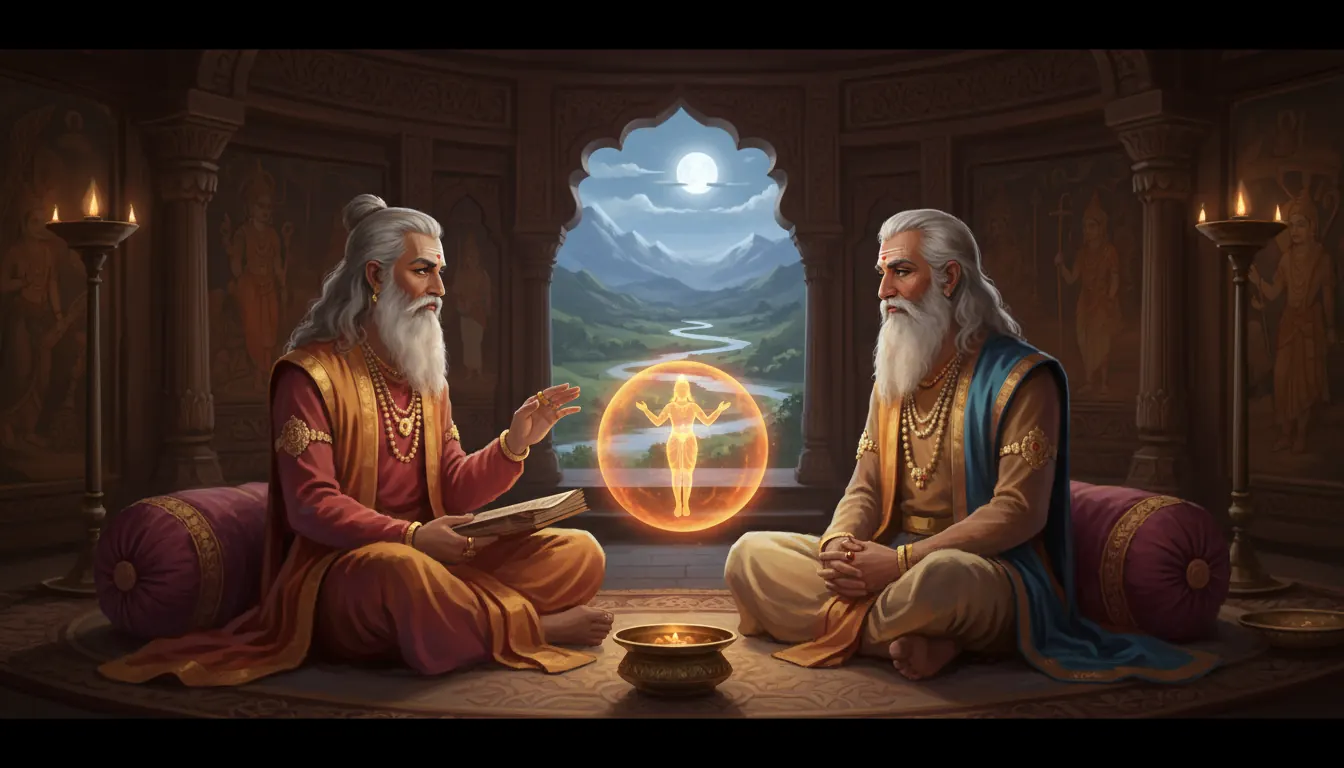
Arjuna's Hymn at Parting
On the road to Hastinapura, Arjuna praises Krishna and gives him leave to go home
In short
The Anugita finished, Krishna asks Arjuna's leave to go home and see his father, and the two set out together for Hastinapura in delightful conversation. On the road Arjuna gives back to Krishna the whole credit of the war and then praises him as the soul of the universe, whose smile is the moonlight and whose wrath is death. At Yudhishthira's court the leave is formally granted, the offered treasure is refused, and Krishna sets out for Dwaraka with Subhadra beside him and his friends walking behind the chariot as far as they are allowed to.
Told in the Ashvamedhika ParvaSet in Hastinapura, Indraprastha and Dwaraka15 min read
Yoke My Chariot
Vaishampayana told it to Janamejaya in this way. The teaching was over. Krishna had finished repeating to Arjuna, in that quiet town where the two of them had been sitting together since the war ended, the whole of the religion he had first declared on the field with the armies waiting; and at the end of it he had said the plainest thing he had said all day.
"It is a long time since I saw my lord and father. I would like to see him again, if you will let me go."
Arjuna answered that they would go that same day to the city named after the elephant, and that they would meet Yudhishthira there, and that from Hastinapura Krishna could go home to his own city.
After this, Krishna gave an order to Daruka, his charioteer, the man who had stood ready with Krishna's own chariot through the war while Krishna drove for Arjuna.
"Yoke my chariot."
In a very short time Daruka came back and said, "It is yoked."
Then the son of Pandu gave orders to all his attendants. "Get yourselves ready. Today we go to the city named after the elephant." The troops armed and dressed themselves and told Pritha's son, whose energy was boundless, that everything was ready.
So the two of them climbed into their chariot and set out, and Vaishampayana, who is careful about such things, says what they did on that road. The loving friends passed the time in delightful conversation.
It is worth stopping on that. Every other journey these two had taken together in the last twenty years had a battle or an embassy or a burning forest at the end of it. This one had nothing at the end of it but a leave-taking, and they filled the road with talk, and one of them had begun to understand that the talking was nearly finished.
It was on that ride, seated behind Daruka with the dust going up on either side, that Dhananjaya of great energy turned to Vasudeva and once more began to speak.
With You for Our Raft
"Pride of the Vrishni race," Arjuna said, "the king has won his victory by your grace. All his foes have been slain, and he has recovered his kingdom with no thorn left in it to trouble him. Slayer of Madhu, through you the Pandavas have a powerful protector. With you for our raft, we have crossed the Kuru ocean."
That is where the hymn begins, and it begins where a soldier would begin it. Not with the nature of God. With the ledger of the war. The kingdom is recovered and the thorn is out of it, and the man saying so is the one who did the shooting, and the first sentence he says is that the victory belonged to somebody else.
The raft is his own image and it is exact. A raft is not a boat. It is a thing you cling to with your arms while the water does what it likes, and it does not promise you a dry crossing, only that you will be on the far side when the crossing is over. The Kuru ocean had taken his son, his teacher, his grandsire, the sons of his enemy and most of the men he had ever known by name, and Arjuna does not pretend otherwise. He says only that there had been something to hold on to, and that he was still holding it, and that it was now getting down off the chariot and going west.
And then, without any joint in the speech at all, the address changes. The friend beside him on the seat becomes the thing that made the water.
"You whose handiwork this universe is, I salute you, Soul of the universe, best of all beings in it. I know you only as far as you allow me to know you."
Read that last line twice. He does not claim to know Krishna. He claims to know exactly as much of him as Krishna has consented to be known. It is the only modest sentence in a hymn otherwise made entirely of superlatives, and it is the one that gives the rest its licence.
The Moonlight Is Your Smile
From there the praise opens out, and Arjuna, who had spent his life describing distances and targets, begins describing the world as a body.
"Slayer of Madhu, the soul of every creature is always born of your energy. Play is your sport. Earth and sky, lord, are your illusion. This whole universe, everything that moves and everything that does not, rests on you."
Sport is the word to hold on to. Creation, preservation and destruction are not labour to the one he is sitting beside; they are the way that one amuses himself, and Arjuna has just come off a field where the amusement cost eighteen akshauhinis. He says it anyway, because he has decided to say the whole of what he sees.
"By transforming yourself you create the four orders of beings," he said, and named them as the books name them: those born from the womb; those born from the egg; those born of filth and heat; and those that come up out of the ground. "You create the Earth, the Sky and Heaven, slayer of Madhu."
Then the catalogue turns to the face and the weather at once.
The spotless moonlight is your smile. The seasons are your senses. The ever-moving wind is your breath. And death, which exists for ever, is your wrath.
He puts death in the list. A man composing flattery would have left it out. Arjuna sets it exactly where it belongs, between the wind and the goddess, because he has watched that wrath work for eighteen days and knows the name of every man it took.
"The goddess of prosperity lives in your grace. Sree truly rests in you always, you of the highest intelligence. You are the play that creatures delight in; you are their contentment, their intelligence, their forgiveness, their inclinations, their beauty. You are the universe with all that moves and all that does not. At the end of the cycle, sinless one, it is you who are called destruction."
And then the bowman ran out of arrows.
"I could not recite all your qualities even in a very long time. You are the Soul and the Supreme Soul. I bow to you, lotus-eyed one."
He had not been asked for any of it. The chariot went on down the road.
I Learnt It From Narada and From the Grandsire
Having finished the praise, Arjuna does something that is very like him. He cites his authorities.
"Irresistible one, I have learnt from Narada and Devala and the Island-born, and from the Kuru grandsire too, that this whole universe rests on you. You are the one Lord of all creatures."
Four names, and he had them from four different rooms of his life. Narada, who came and went among gods and men with news that nobody wanted. Devala, an ascetic of the old school. The Island-born, which is Vyasa, who fathered the line Arjuna belonged to and wrote down what became of it. And the Kuru grandsire, Bhishma, who had said it last of all from a bed of arrows with his death postponed until the sun should turn north.
Arjuna is telling Krishna that he did not arrive at this by himself and did not arrive at it on the strength of affection. Men whose business was the truth had told him, one after another, over a lifetime, and the last of them had told him while dying of wounds that Arjuna's own army had given him.
Then he binds himself.
"Sinless one, everything you have so kindly told me I will duly carry out in full, Janardana."
He means the teaching just concluded, the second giving of what had been given before the battle, and he promises to live by it. And then, as if the promise reminded him of what it had already cost, he goes back once more over the work of the war and gives the credit away a second time.
"What you have done out of your wish to please us is truly wonderful: the destruction in battle of the Kaurava prince, the son of Dhritarashtra. That army had already been burnt by you before I defeated it in battle. It was your feat that made the victory mine. It was the power of your intelligence that showed the way to bring about, as it should be, the destruction of Duryodhana in battle, and of Karna, and of the sinful king of the Sindhus, and of Bhurishravas."
The host was burnt before I ever came to it, says the greatest archer alive, and I only went through the ashes. Duryodhana, Karna, Jayadratha and Bhurishravas: four deaths, three of them credited to the Gandiva and one to Bhima's mace, handed back across the seat of a chariot to the man holding the reins.
"Son of Devaki, I will do everything that you, in your kindness to me, have told me. I have no doubt about it."
I Approve of Your Departure
Then the hymn ends, and what it ends on is a piece of household business, because Krishna had asked for leave and leave had to be got from the king.
"I will go to righteous King Yudhishthira, sinless one, and urge him to give you leave, you who know every duty. Lord, I approve of your departure for Dwaraka."
That is Arjuna letting him go. He had begun the speech calling him the Soul of the universe and he finishes it promising to speak to his elder brother about the travel arrangements, and he adds the one thing a friend adds at a parting, which is a picture of the welcome at the other end.
"You will soon see my maternal uncle, Janardana. You will also see the irresistible Baladeva and the other chiefs of the Vrishni race."
My maternal uncle. Arjuna's mother Kunti was Vasudeva's sister, and so the old man Krishna was aching to see was Arjuna's uncle as well. The two men on that chariot were cousins before they were anything else, and at the very end of the hymn the god goes back to being a relative going home to his father.
Talking like this, the two reached the city named after the elephant. They entered the palace of Dhritarashtra, which was like the mansion of Shakra, with cheerful hearts and free of any anxiety.
And Vaishampayana names for us everyone who was sitting in that hall, because the list is a kind of accounting of what was left. King Dhritarashtra. Vidura of great intelligence. King Yudhishthira, and the irresistible Bhimasena, and the two sons of Madri by Pandu. The unvanquished Yuyutsu, the one son of Dhritarashtra who had crossed over before the first day and was therefore alive to sit there. Gandhari of great wisdom, and Pritha, and the beautiful Krishna who is Draupadi, and the other ladies of Bharata's race with Subhadra counting first. And all those women who used to wait upon Gandhari.
One blind king, one blindfolded queen, one surviving son of a hundred, and a room of women.
Going up to Dhritarashtra, those two scourges of their foes announced their names, as men do to a man who cannot see them, and touched his feet. They touched the feet of Gandhari and of Pritha and of Yudhishthira the Just and of Bhima. They embraced Vidura and asked after his welfare.
Then night came, and the old king dismissed them all to their chambers, and Krishna went to Arjuna's rooms and slept happily there with Dhananjaya for company.
Say What Is on Your Mind
When morning came, the two heroes finished their morning rites, dressed with care, and went to the mansion of Yudhishthira the Just, where the king sat with his ministers.
They entered the richly adorned chamber, and Vaishampayana says they looked on the king as the two Ashvins look on the chief of the gods. And Yudhishthira, seeing something plainly unsaid between them, spoke first to spare them the asking.
"Heroes, foremost of the Yadu and Kuru races, it seems you two want to tell me something. Say what is on your mind. I will see it done soon. Do not hesitate."
Then Phalguna, who was skilled in speech, humbly approached the king and put it with nothing of the hymn left in it.
"King, mighty Vasudeva here has been away from home a long time. With your permission, he wants to see his father. Let him go to the city of the Anarttas, if you think it right. Please give him your leave, hero."
Yudhishthira gave it at once, and then went on giving, because the leave was easy and the parting was not.
"Blessings on you, lotus-eyed one. Go this very day to the city of Dwaravati to see that foremost man of Sura's race. You have my leave to go. You have not seen my maternal uncle, or the goddess Devaki, for a long time. When you meet him, and go to Baladeva as well, you will honour them both on my behalf, as they deserve."
Then the requests that a man makes when he is losing something.
"Think of me every day, and of Bhima, foremost of mighty men, and of Phalguna and Nakula and Sahadeva. Once you have seen the Anarttas, and your father, and the Vrishnis, you will come back for my horse-sacrifice, sinless one."
The king of the whole earth asking a departing guest to remember him, and fixing a date to see him again, and then trying to load him with goods.
"Go, then, and take with you all kinds of gems and riches, and whatever else you like. It is by your grace, Keshava, that the whole Earth has come under our rule and all our foes have been slain."
Vasudeva refused the treasure in a way that left nothing to argue with.
"Mighty-armed one, all the jewels and gems, all the wealth, and the whole Earth are yours and yours alone. Whatever wealth there is in my house, lord, you are always its owner."
To which Yudhishthira, the son of Dharma, said only, "So be it," and paid him homage.
Drive the Horses Fast
Vasudeva then went to his paternal aunt.
Kunti had been his father's sister, and she had sent five sons into a war that he had driven the middle one through, and there is no speech recorded between them. He honoured her duly and walked round her from left to right, the circuit a man makes about a thing he reveres, and she greeted him properly in return, and then all the others greeted him, with Vidura first among them.
The four-armed elder brother of Gada then set out from Nagapura in his fine chariot. Seating his sister, the lady Subhadra, beside him, Janardana left with the permission of both Yudhishthira and his paternal aunt, and a large crowd of citizens went out of the gates with him.
And so did everyone else. The hero who had the foremost of apes on his banner, which is to say Arjuna with Hanuman on the flagstaff, went with him. Satyaki went. The two sons of Madravati went. Vidura of boundless intelligence went, and Bhima whose tread was like a lordly elephant's went, all of them walking or riding out along the road behind Madhava because none of them could think of a reason to stop yet.
Mighty Janardana let it go on for a while, and then sent all those men who were enlarging the Kuru kingdom back, and Vidura too.
Then he turned to the two men who were staying on the chariot, and said the words that end the episode.
"Drive the horses fast."
Daruka drove them on. Satyaki, foremost of Shini's race, sat beside him. And Janardana of great prowess, crusher of enemy hosts, went on toward the city of the Anarttas with all his foes slain, like the god of a hundred sacrifices going to Heaven after slaughtering all his own.
Vaishampayana gives that comparison and then stops. He does not say what the men standing in the road did next, or how long they stood there. He had already given the sentence that mattered on the way out, when the chariot was going the other way with the two of them on it and the whole of the epic still to be settled: the loving friends passed the time in delightful conversation.
There would be more meetings, the greatest of them at a horse-sacrifice, with a date on it. And after that there would be Dwaraka, and the sea.
Dharma Lesson
Arjuna's praise is not flattery, because he pays it in the one currency he owns: he hands back the credit for the great killings of the war, even the ones the world gives to his own bow. A man who has been given everything can only give thanks by refusing the credit for it. And the hymn ends not in the sky but on a road, with a request for travel leave and a message to an uncle, because devotion that cannot survive being ordinary was never devotion at all.