The Kings Who Gave Lawfully
Indra refuses the rishis, a king answers for convenience, and the names of those who reached heaven by honest gifts
In short
Janamejaya cannot accept that a mongoose was right to belittle his forefather Yudhishthira's horse sacrifice, and asks how any gift could outweigh the rites by which Indra himself won heaven. Vaishampayana answers with Indra's own sacrifice, at which the rishis begged him to offer three-year-old seed instead of living animals and were refused out of pride. The dispute that followed was sent to king Vasu of the Chedis, who answered it for convenience rather than truth and was swallowed by the nether regions for one false sentence. What is left standing at the end is a short list of ancient kings who reached heaven by giving away what they had honestly acquired.
Told in the Ashvamedhika ParvaSet in Takshashila, Amaravati and Chedi17 min read
The Question Janamejaya Asked
Vaishampayana had come to the end of the horse sacrifice, and the end of it was not a triumph.
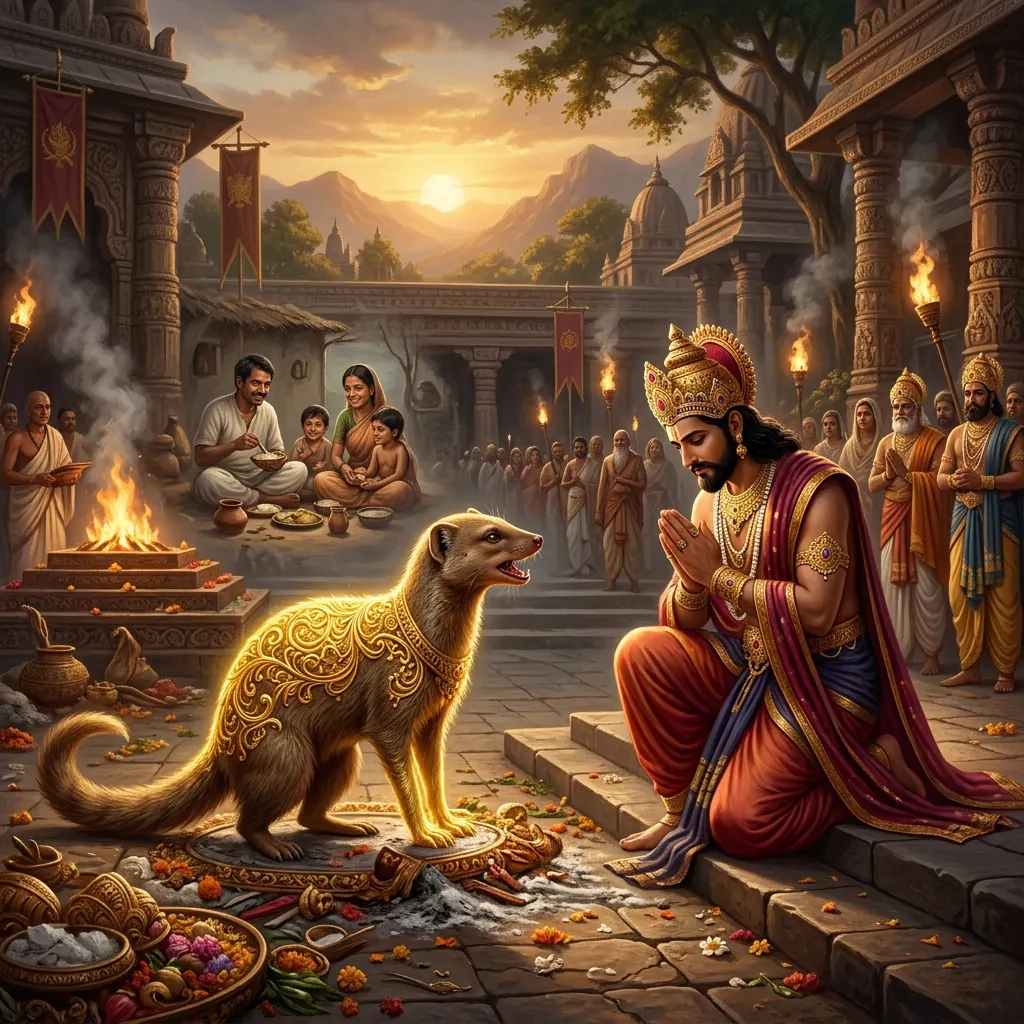
He had described the gifts made in profusion, the brahmanas pleased, the poor and the blind and the helpless all satisfied, the flowers raining down on the head of Yudhishthira the just. And then he had described the blue-eyed mongoose with one side of his body turned to gold, who walked into that assembly and said in a human voice that the whole rite was not equal to a prastha of powdered barley given away by a brahmana of Kurukshetra who lived by the unccha vow. The mongoose had explained himself at length, and had not been contradicted, and had vanished.
Janamejaya, whose great-grandfather Arjuna had stood beside the king in that story, did not accept it.
"Mighty rishi," he said, "kings are devoted to sacrifices. The great rishis are devoted to penances. Learned brahmanas cultivate calm of mind, peaceful conduct and self-control. So it seems that nothing in this world can compare with the fruits of sacrifice. That is my conviction, and it seems to me beyond doubt that it is right."
He was not arguing from sentiment. He was arguing from the record, and he produced the record.
"Best of the twice-born, countless kings worshipped the gods with sacrifices, won great fame here and gained Heaven hereafter. Indra of the thousand eyes, the mighty chief of the gods, a being of great energy, won sovereignty over the gods through the many sacrifices he performed with lavish gifts, and every one of his wishes was fulfilled."
That was the case, and it is a strong one. The lordship of heaven itself had been bought at an altar.
"When king Yudhishthira, with Bhima and Arjuna at his side, was the equal of the chief of the gods himself in prosperity and prowess," Janamejaya said, "why did that mongoose belittle the great Horse-sacrifice of that great-souled king?"
Vaishampayana did not defend the mongoose and did not defend the sacrifice. He began, instead, to talk about Indra.
The Sacrifice of the Thousand-Eyed
"Listen to me, king," he said, "and I will tell you properly, Bharata, about the excellent rules of sacrifice, and about the fruits that sacrifice yields, ruler of men."
Once, long ago, Shakra performed a particular sacrifice.
Shakra is Indra under another of his names, and it is worth noticing which name the story chooses for him here. Not the wielder of the thunderbolt. Not the slayer of Vritra. The lord of a hundred sacrifices, doing one more, at the height of everything Janamejaya had just finished praising him for.
The account of it is admiring, and the admiration is not ironic. The parts of the sacrifice were laid out. The Ritwijas busied themselves with the different rites laid down in the scriptures, each man at his own office, nothing left to improvisation. The priest who pours the offerings, a man with every qualification, was pouring clarified butter, and the qualification is mentioned because a man not qualified would have ruined it. The great rishis were seated around, which is to say that the most exacting audience available in the three worlds was watching, and had come.
Contented brahmanas of great learning summoned the gods one by one, chanting scriptural mantras in sweet voices. Those finest of Adhwaryyus, never tiring of their work, recited the mantras of the Yajurveda in soft tones.
Hold on to that phrase. Never tiring. Soft tones. This was not a rite being hurried through by tired men in a smoky field. Everything was correct, everything was unhurried, everything was beautiful, and everyone present was competent to judge whether it was.
Nothing in the description can be faulted. That is the point of describing it at such length. Whatever is about to go wrong with the sacrifice of the chief of the gods, it is not going to be a defect of learning, or of wealth, or of attention, or of the standing of the man performing it.
Then the time came for slaughtering the animals.
The Animals Grew Cheerless
When the animals selected for sacrifice were seized, the great rishis felt compassion for them.
That is the whole of the turn, and it happens in a single sentence, and it happens to the wrong people. These were not squeamish men. They were ascetics who had come to attend a rite performed according to the scriptures, at which animals had certainly been offered before, in their sight, without any of them saying a word. They knew the ordinances. They were seated in the places the ordinances gave them.
And when the ropes went on, they looked at the animals, and the text says exactly what they saw. The animals had all become cheerless.
When they saw that, those rishis, rich in penances, went to Shakra and said to him what nobody says to the king of the gods in the middle of his own sacrifice.
"This way of sacrificing is not auspicious. You want to win great merit, but this truly shows that you do not understand sacrifice."
They had called Indra ignorant of the thing he was famous for. Then they said the sentence the whole story turns on.
"Purandara, animals have not been ordained to be killed in sacrifices. Mighty one, these preparations of yours destroy merit. This sacrifice is not in keeping with righteousness. The destruction of living creatures can never be called an act of righteousness."
Not that it was excessive. Not that it was unnecessary in this instance. That it had never been ordained at all, and that the merit he was accumulating was being destroyed by the very act he thought was accumulating it.
They had come with their compassion, and they had stayed to make an argument out of it, and the argument was about the scriptures rather than about their own feelings. That is why it could not simply be dismissed as softness. It was a claim about what the books said, made by men who had spent their lives in the books, standing in front of a fire that was already lit.
Seeds Kept for Three Years
They did not stop at the objection. They brought a remedy with them, and the remedy is the practical heart of the passage.
"If you are willing, let your priests perform your sacrifice according to the Agama. If you perform a sacrifice according to the true meaning of the scriptural rules, the merit you win will be great. Hundred-eyed one, perform the sacrifice with seeds of grain that have been kept for three years. That, Shakra, would be full of great righteousness and would bring fruits of great power."
Seeds kept for three years. It is a small, technical, unglamorous instruction, and it is the only alternative anyone offers in the whole of this history.
Grain three years old will not sprout. It is grain that has finished with the possibility of becoming a plant, and can therefore be poured into a fire without anything being cut off in the middle of its living. The rishis were not asking Indra to abandon his sacrifice or to substitute a symbol for it. They were telling him to lay in a different store, three years in advance, and to conduct the identical rite with it, and they promised him the fruits would be high.
The whole of the remedy costs him three years of foresight and nothing else. No merit is lost. No ordinance is broken. He is offered the same heaven at the same price with the killing taken out of it.
But the god of a hundred sacrifices, swayed by pride and overcome by delusion, would not accept what the rishis said.
Two reasons are given, and neither of them is an argument. He was proud, and he was deluded. He did not answer their point about the Agama. He did not produce a text of his own. He was the lord of a hundred sacrifices and they were telling him he did not understand sacrifice, and he refused, and the refusal is recorded as a failure of character rather than a difference of opinion.
The fire was still burning. The animals were still tied.
The Dispute That Wore Everyone Out
Then, Bharata, a great dispute broke out among the ascetics at Shakra's sacrifice about how sacrifices should be performed: whether with moving creatures or with things that do not move.
Notice that the quarrel is no longer between the rishis and Indra. It is among the ascetics themselves. Once the chief of the gods had refused to be corrected, the question was loose in the assembly, and men who had arrived that morning in complete agreement about everything found that they disagreed about this.
Moving or unmoving. That is the ancient way of putting it, and it is exact. Everything offered on a fire is either something that can walk away from it or something that cannot. A goat and a handful of barley are the same thing from the point of view of the ladle. They are not the same thing from the point of view of the goat.
They all wore themselves out with arguing.
That is a plain and rather human line, and it is the reason for everything that follows. The dispute did not end in a conclusion. It ended in exhaustion. Learned men had argued the scriptures against each other until nobody had anything new left to say and nobody had changed his position, and the sacrifice was still standing there half performed with the whole assembly deadlocked around it.
So the rishis, those seers of truth, came to an agreement with Shakra to put the matter to arbitration, and went looking for someone to decide it.
Read that carefully, because it is the only sensible thing done by anyone in this story. They did not out-shout each other. They did not appeal to Indra's authority, which was compromised, or to their own, which was divided. They agreed, both sides and the king of the gods together, to put the question to a third party and abide by what he said.
There was a man alive at that time who was famous for his righteousness, and they went to him.
His name was Vasu, and he was the ruler of the Chedis.
The King Who Answered for Convenience
They asked king Vasu, "Blessed one, what do the Vedas declare about sacrifices? Is it better to sacrifice with animals, or with horses and juices?"
Everything about the moment was in his favour. He had been sought out by the great rishis and by the chief of the deities together. He had the standing to settle it. He had been asked a question about the Vedic declaration, which is a question with an answer, and he was reckoned the sort of man who would know it. Nobody was hurrying him.
When he heard the question, king Vasu weighed the strengths and weaknesses of the two sides, and then answered, "Sacrifices may be performed with whichever of the two kinds of offering is at hand."
He weighed it. That is what makes the charge against him so heavy: he had considered both sides, and still he gave the answer that pleased everyone.
The answer itself sounds generous. It offends nobody. It gives each party its practice and sends everyone home. It is also a lie, because one of those two things had been declared and the other had not, and the king had been asked which, and he had answered a different question instead. He had ruled on convenience. Whichever is ready.
Because he answered the question in this way, he had to go down into the underworld.
There is no trial, no curse spoken aloud, no interval in which he might have corrected himself. The mighty ruler of the Chedis, a king whose righteousness was the reason he had been chosen in the first place, went down out of the world for one sentence, and the epic states the reason without softening it. He had to suffer that misery because he had answered falsely.
Then Vaishampayana drew the rule out of the wreckage.
"So when a doubt arises, no one, however wise, should decide the matter alone, unless he is the mighty and self-born Lord of creatures himself."
Not that the king was stupid. That no one man, standing alone, is competent to decide a doubtful question of righteousness. The one exception named is the Grandsire who made the world.
Gifts That Go for Nothing
Having buried a king in the middle of his answer, Vaishampayana turned to the thing Janamejaya had actually asked about, which was the worth of a great man's giving.
The catalogue he gave is a catalogue of failures, and it is worth having in the order he gave it.
Gifts made by a sinner whose understanding is impure, even very large ones, are lost. Such gifts come to nothing. The size is mentioned only to be dismissed.
The gifts of a man of unrighteous conduct, sinful in soul and a destroyer, never win him true fame, here or hereafter. He may buy the appearance of fame. He does not acquire the thing itself, in this world or the next.
The foolish man who wants merit and performs sacrifices with wealth gained by unrighteous means never succeeds in earning it. The desire is genuine in that man. He wants the merit. He has simply paid for it with something that was never his to spend.
The low, sinful wretch who puts on a show of righteousness and makes gifts to brahmanas only convinces people of his own righteousness. That is all he manufactures. A conviction, in other people, about himself.
The brahmana of unruly conduct who gains wealth by sinful acts, overcome by passion and delusion, reaches in the end the goal of the sinful. The learning does not save him and the birth does not save him.
Then the portrait behind all of them. A man, overcome by greed and delusion, sets his heart on piling up wealth. He is seen to persecute all creatures, driven by a sinful and impure understanding. If he makes gifts or performs sacrifices with wealth gained in that way, he never enjoys their fruits in the other world, because the wealth was earned by unrighteous means.
Persecutes all creatures. The phrase reaches back to the animals tied at Indra's altar and forward to every ledger in which a man's generosity is funded by somebody else's suffering. The fire does not launder it. What was wrong when it was gathered is still wrong when it is given away.
Roots, Fruits, Potherbs, Water, Leaves
Against all of that he set a single sentence, and the sentence is an inventory of nearly nothing.
Men rich in penances who give away, as far as their means allow, grains of corn gleaned from the fields, or roots, or fruits, or potherbs, or water, or leaves, win great merit and go to Heaven.
Grains picked up from the fields is the unccha vow, the same one kept by the brahmana of Kurukshetra whose prastha of barley had outweighed a horse sacrifice at the start of all this. Roots and fruits are what a forest recluse eats. Potherbs are the bitter leaves nobody else wants. Water is free and available to a man with nothing at all.
As far as their means allow. That is the measure, and it is the only measure named. Not the weight of the gift. The proportion it bears to what the giver had.
And then he widened it past giving altogether.
Such gifts, and compassion for all creatures, and Brahmacharya, truthfulness of speech and kindness, fortitude and forgiveness, are the eternal foundations of Righteousness, which is itself eternal.
Six things stand in that list beside the handful of leaves, and none of the seven costs money. Compassion for all creatures, which is what the rishis felt when they looked at the tied animals. Brahmacharya. Truthfulness of speech, which is precisely what king Vasu failed at while doing nothing else wrong. Kindness. Fortitude. Forgiveness.
Righteousness is called eternal and the foundations are called eternal, and the word is doing real work in a discourse about sacrifice. A rite yields a fruit, and a fruit is consumed, and heaven bought at an altar is a term of residence that runs out. These are named as the foundation rather than the fruit. They are what the structure is standing on, not what it pays.
Janamejaya had asked why one mongoose should be believed against the practice of innumerable kings. He was about to be given the kings.
The Kings Who Gave Lawfully
"We hear of Vishvamitra and other kings of long ago."
The list is short and it is not explained, and each name on it is a whole history the audience was expected to know already.
Vishvamitra, who was born a king and spent lifetimes of effort becoming a brahmana, and who is put first here not for the effort but for the giving.
Asita.
King Janaka, the ruler of Mithila, who governed a kingdom while holding nothing in it as his own, and who is the standing example in this epic of a man who could be a king without the kingship costing him anything.
Kakshasena.
Arshtishena.
King Sindhudwipa.
These and many other kings, rich in penances, gave away things they had acquired lawfully, and reached the highest success.
That last clause is the entire answer to Janamejaya's question, and it takes a handful of words. Gave away things they had acquired lawfully. Not gifts in profusion. Not gifts of a hundred sacrifices. Lawfully acquired, and then given.
Indra had been offered the same terms in the middle of his own rite, and the terms were three years of grain and no killing, and he had refused them out of pride. Vasu had been handed the question in one sentence and had answered it for convenience and had gone down into the earth. The kings on this list are the ones who did the plain thing, at the ordinary price, with what was honestly theirs.
And Vaishampayana closed it by taking the whole matter out of the hands of kings.
"Those among the brahmanas, kshatriyas, vaishyas and shudras who take up penances, Bharata, and purify themselves by gifts and other righteous acts, go to Heaven."
All four orders, named in order, and no distinction drawn between them at the end of the sentence. The gate that had been shut against the lord of a hundred sacrifices was standing open to any of the four with a handful of leaves in his hand.
The mongoose had said as much, in the middle of a horse sacrifice, and had not been believed.
Dharma Lesson
The epic does not say that sacrifice is worthless; it says that no rite can clean what was wrongly got or wrongly done. Indra had every qualification except the willingness to be corrected, and Vasu had every virtue except the courage to answer a question truly once he had weighed it, and both of them lost more than any offering could have bought. What survives the whole discourse is small and cheap and available to anyone: grain gleaned from a field, water, a handful of leaves, given to the best of one's power out of what was lawfully one's own.