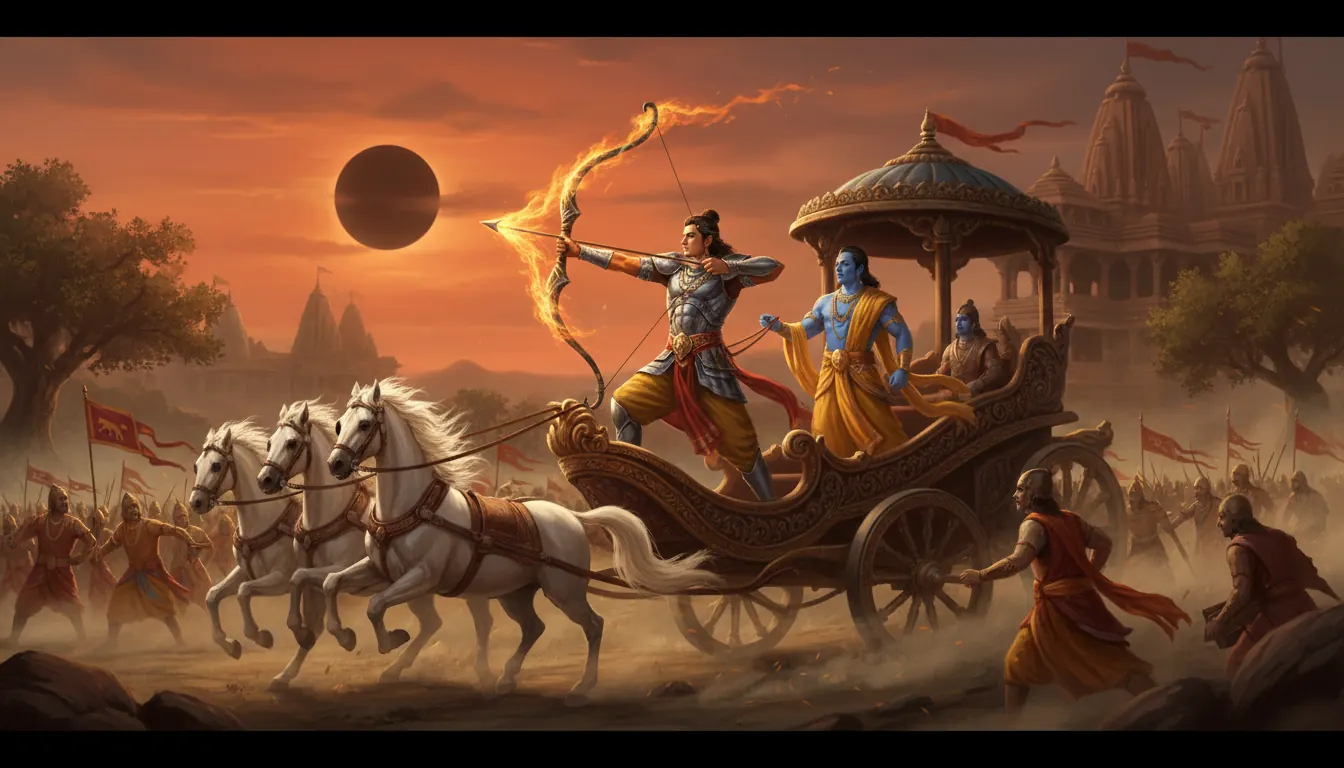
The Road to Jayadratha
Arjuna breaks through the head of Drona's array on the fourteenth morning, from the omens at dawn to the river of blood
In short
The fourteenth day opens with crows on Arjuna's chariot, howling jackals and falling meteors, and with Durmarshana promising to stand against the wielder of Gandiva like a continent against the sea. Arjuna goes through him, through Dushasana's elephants, past Drona at the gate of the array, and then through the kings sent to stop him one after another: Kritavarma spared, Srutayudha killed by his own returning mace, Sudakshina of the Kambojas, and Shrutayush and Achyutayus, who struck him senseless in his own chariot before he recovered and killed them and their sons. By the time the Mlecchas break on him, Sanjaya is describing a river of blood running toward Yama's country.
Told in the Drona ParvaSet in Kurukshetra23 min read
The Hour Called Rudra
Sanjaya told this part of it to a blind king in a hall, and he told it in the order that it happened, beginning with the noise.
The Kuru divisions had been drawn up. Drums and mridangas were beaten, conchs were blown, a terrible roar went up that made the hair stand on end, and the field slowly filled with Bharata heroes eager for a fight. Then the hour called Rudra set in, and Savyasachin appeared.
He did not come alone. Many thousands of ravens and crows went playing about in front of Arjuna's chariot, keeping pace with it. Beasts with terrible cries, and jackals that were an ill omen to see, began to yell and howl on the Kaurava right as they advanced. Thousands of blazing meteors fell with a great noise. The earth trembled. Dry winds rose on every side with thunder in them, driving hard pebbles and gravel into the faces of men, and all of this happened at the moment Kunti's son came to the start of the battle.
Sanjaya, who had watched every day of that war, set the omens down without comment. They belonged to the Kauravas, who saw them, and not to the man they were about.
Across the field, Satanika the son of Nakula and Dhrishtadyumna the son of Drupada, two very wise warriors, were drawing up the Pandava divisions. This was the fourteenth morning. Abhimanyu had been dead since the afternoon before, six men had killed him inside a formation he could enter and not leave, and Arjuna had sworn in front of both armies that Jayadratha of the Sindhus would die before the sun went down or he would walk into fire himself.
Drona had spent the night answering that vow with an array. Forty-eight miles of it, part cart and part circle, with a lotus inside the cart and a needle inside the lotus, and Jayadratha stationed at the far end of the needle behind Karna and Kripa and Ashwatthama and Shalya and a hundred thousand horse.
Between the man and the vow lay every soldier Duryodhana had.
The Continent and the Sea
At the very front of all the Kaurava troops, covering a stretch of ground fifteen hundred bow-lengths long, stood Durmarshana, a son of Dhritarashtra, with a thousand chariots and a hundred elephants and three thousand heroes and ten thousand foot soldiers behind him.
He had thought about what he wanted to say.
"As the continent holds back the surging sea, so today I will hold back the wielder of Gandiva, that scourge of his enemies, the warrior no one can stand against in battle. Let everyone see today how angry Dhananjaya crashes into me, like one mass of rock against another. You chariot warriors who are eager for battle, stay and watch. I will fight all the Pandavas together, alone, to increase my honour and my fame."
That noble son of yours, said Sanjaya, said this and stood there surrounded by many great bowmen, waiting to be looked at.
What came toward him is described in the text by a list, because one comparison was not enough. Like the Destroyer himself in his anger. Like Vasava armed with the thunderbolt. Like Death with his club, driven on by Time. Like Mahadeva with the trident, whom nothing can disturb. Like the blazing fire at the end of the yuga, risen to consume creation. The slayer of the Nivatakavachas, blazing with rage and swelling with strength, the ever-victorious Jaya, devoted to truth and determined to fulfil his great vow, in armour, wearing a golden diadem, garlands of white flowers and white robes, with angadas on his arms and fine earrings in his ears, standing in his own splendid chariot. Nara, with Narayana beside him. Shaking Gandiva, and shining like the risen sun.
Arjuna placed his chariot at the very front of his army, in the exact place where the densest showers of arrows would fall, and blew his conch. Krishna, fearless, blew Panchajanya at the same moment.
Every animal in the Kaurava army emptied its bowels where it stood. Men lost their strength at the sound, some were filled with dread, some lost their senses altogether, and the ape on Arjuna's banner opened his mouth wide and gave a terrible cry with the other creatures on the standard, to help.
Conchs and horns and cymbals were beaten again on the Kuru side to cheer the warriors up.
Then Arjuna spoke to his driver.
"Drive the horses to where Durmarshana stands, Hrishikesha. I will break through that elephant division and drive deep into the enemy army."
Where Is Partha? Here Is Partha
Keshava drove the horses to where Durmarshana was standing, and the fight that began there was one against many.
Partha covered them like a pouring cloud, the way a mass of clouds pours rain on the slopes of a mountain. They answered with great speed of hand, covering both Krishna and Dhananjaya with arrows, and then Arjuna was filled with rage and began striking the heads of chariot warriors from their bodies.
The earth was strewn with handsome heads in earrings and turbans, the lower lip bitten by the upper, the eyes still clouded with anger. They looked, Sanjaya said, like a heap of plucked and crushed lotuses scattered over the field. Golden armour dyed with blood lay thick over the ground like banks of cloud charged with lightning. The sound of severed heads dropping on the earth was the sound of palmyra fruits falling when they have ripened in due time.
Headless bodies stood up, some with the bow still in hand, some with bare swords raised to strike. The brave men who could not bear Arjuna's feats and wanted to beat him never clearly knew the moment their own heads came off. Arms that had been cut from their bodies, still in armour, still wearing angadas, still gripping lances or battle-axes or scimitars, were seen to leap and jerk and move about the field with great force, as if in rage.
And the army began to say one thing.
"This is one Partha." "Where is Partha?" "Here is Partha!"
Robbed of their senses by Time, said Sanjaya, they saw the whole world as full of Partha and nothing else. Many of them died striking one another. Some struck themselves.
No one could find the smallest opening to hit him. He seemed to dance in the chariot as it moved, his bow drawn into a circle without pause, and the speed with which he took his arrows, fitted them and let them fly filled his enemies with wonder. As the rising sun drives away the thick dark of the sky, so Arjuna destroyed that elephant force with arrows fletched with kanka feathers, until the ground where Durmarshana's men had stood looked like the earth strewn with huge hills at the hour of the dissolution of the world.
Then they broke. Cavalry, chariot warriors and foot soldiers together, urging their beasts on with spurs and hooks and the tips of their bows and with threats, and many of them, blinded and running, ran straight into Arjuna instead of away from him.
Dushasana's Elephants
Afterwards the blind king asked the question that had been sitting in him.
"When the front of my army, cut down like that by the diademed Arjuna, broke and fled, which heroes went out against him? Did any of them actually fight him, or did they all give up and go into the cart array, to get behind fearless Drona, who stood like a solid wall?"
One did. Dushasana, in a beautiful coat of golden armour, his head wrapped in a turban worked with gold, saw the state of the troops and was filled with rage, and he had a way of fighting Arjuna that did not require him to stand in front of Arjuna. He had a force of elephants brought round the Pandava so vast it seemed it could swallow the whole earth.
With the sound of the bells, the blare of conchs, the twang of bowstrings and the trumpeting of the tuskers, the earth and every quarter and the sky seemed completely filled. That hour, Sanjaya said, became fierce and terrible.
Arjuna saw the huge beasts with their trunks stretched out coming at him like winged mountains driven on with hooks, and gave a lion's roar, and went into them. Like a makara plunging into the deep when a storm has raised the water into mountains, the diademed warrior plunged into that elephant host.
The arrows from Gandiva flew by thousands upon thousands, and their touch was the touch of deadly snakes. Elephants torn by them bellowed and fell to the earth one after another like mountains with their wings cut off. Struck on the jaw, or on the domes of the forehead, or on the temples by long arrows, they cried out like cranes. Arjuna cut off the heads of the men riding on their necks, and those heads with their earrings fell steadily to the ground and looked like a heap of lotuses that Partha was calling down as an offering to his gods.
Warriors hung dead from the sides of wandering elephants, stripped of armour, covered in blood, like figures in a painting. Sometimes two or three men, pierced by a single well-aimed arrow, fell together.
Then that division broke too. Their leader himself was in great pain. Dushasana, badly wounded by those arrows and overcome with fear, took what was left of his force into the cart array and went looking for Drona to save him.
Past the Gate
When he had cut down Dushasana's force, Savyasachin went after the ruler of the Sindhus, and the road to him ran through the entrance of the array, where Drona stood in white armour with his bow drawn, like the Destroyer in his anger.
At Krishna's request Arjuna joined his hands.
"Wish me well, brahmana, and bless me with the word Swasti. By your grace I want to break into this unbreakable array. You are to me what my father is, or King Yudhishthira the just, or Krishna. I tell you this truly, sinless one. As Ashwatthama deserves your protection, so do I. By your grace I want to kill the ruler of the Sindhus in battle. Lord, see that my vow is fulfilled."
The teacher smiled at his pupil.
"Bibhatsu, you will not defeat Jayadratha without first defeating me."
Then, still smiling, he covered him with sharp arrows, his chariot and his horses and his standard and his charioteer. Arjuna, true to a kshatriya's duty, pierced him with nine. Drona cut his bowstring, and hit his horses and his standard and his driver, and while Arjuna was stringing the bow again the old man went on shooting.
What came back was a demonstration. Six hundred arrows as though he had taken and shot only one. Then seven hundred more, then a thousand no one could withstand, then ten thousand. Men and horses and elephants of Drona's array fell dead in heaps, chariot warriors dropped from their chariots stripped of horses and standards and weapons and life, and elephants came down like hilltops shaken loose by thunder.
Drona struck him in the chest with a long arrow made to drink the life-blood of any enemy, and Arjuna shook in every limb like a hill in an earthquake, and recovered, and shot again.
Then Krishna, who was counting the hours, said what he had been thinking.
"Partha, mighty-armed one, we must not waste time. Let us go on and leave Drona, for a more important task is waiting for us."
"As you wish, Keshava."
They kept Drona to their right and went past him, Arjuna shooting over his shoulder as he went.
"Where are you going, son of Pandu? Is it not true that you never stop fighting until you have beaten your enemy?"
"You are my teacher, not my enemy. I am your pupil, and so I am like a son to you. And there is no man in the whole world who can defeat you in battle."
The Bhoja and the Wheel-Guards
Behind him came Drona, in pursuit. Around him closed the men whose work that morning was to stop him: Kritavarma of the Satvata clan, the ruler of the Kambojas, Jalasandha, Srutayudha, and ten thousand chariot warriors under them. The Abhishahas, the Surasenas, the Sivis, the Vasatis, the Kaikeyas, the Madrakas, the Narayana Gopalas and the tribes of the Kambojas, all of them known for great courage, put Bharadwaja's son at their head and stopped caring whether they lived. They held out against that one man, said Sanjaya, the way medicines hold out against a raging disease.
Two Panchala princes, Yudhamanyu and Uttamaujas, followed Arjuna as the protectors of his wheels. Their whole assignment in that war was to stay behind him and keep his flanks clear.
Arjuna went at the array itself, and burned through it the way a disease burns through a body. Horses were pierced, chariots were smashed with their riders in them, elephants were thrown down, umbrellas were cut away and knocked aside, carriages lost their wheels. Drona came up on him again with twenty-five straight arrows aimed at the vitals, and Arjuna called up the Brahma weapon and cut the arrows out of the air, and even so, young as he was and fighting hard, he could not put a single arrow into his teacher. That, Sanjaya said, was the most wonderful skill they saw all morning.
So he left him. Steering clear of the invincible Drona, who stood as unmoving as the Mainaka mountain, he drove his chariot in between Kritavarma and Sudakshina the ruler of the Kambojas, and began to cut down the army of the Bhojas.
Kritavarma coolly pierced him with ten arrows. Arjuna answered with a hundred, and three more that stunned him. The Bhoja laughed and put twenty-five into Arjuna and Krishna both. Arjuna cut his bow, and put twenty-one arrows into him like angry, deadly snakes, and Kritavarma took up another bow and hit him five times in the chest.
Krishna saw the minutes going.
"Show Kritavarma no mercy. Forget that he is your kinsman, and crush him and kill him."
Arjuna stunned him with arrows and drove on into the Kamboja force, and did not kill him, though he had him within reach.
Kritavarma, furious, turned on the two wheel-guards instead. He cut their standards and their bows, they strung others and came on again, and he held them there. Struggle as they did, Yudhamanyu and Uttamaujas could not get into Dhritarashtra's army that morning.
From that point Arjuna was inside the Kaurava army alone.
The Mace and the Karnikara Tree
Srutayudha came at him shaking his great bow, and this was a man with a promise on him. His mother was the river Parnasa and his father was Varuna, and she had begged the lord of the waters to make her son unkillable on earth. Varuna had given him a mace with mantras in it and one rule: it was never to be hurled at a man who was not fighting, or it would turn in the air and kill the man who threw it.
He pierced Arjuna with three arrows and Janardana with seventy. Arjuna answered with ninety straight arrows, then cut his bow and his quiver, then killed his horses and his charioteer, and Srutayudha came down off the useless chariot with the mace raised.
Then, when his hour had come, he broke the rule and threw Varuna's mace at Krishna, who was driving and not fighting.
It struck Sauri on one of his strong, well-made shoulders and could not shake him, as the wind cannot shake the Vindhya mountain, and it came back. It struck the angry king where he stood in his own chariot, like a spell gone wrong that strikes the one who cast it, and killed him. As he fell, that dear son of Parnasa looked like a tall banyan broken by the wind, and cries of Alas and Oh went up all over the field at the sight of a man killed by his own weapon.
The troops fled. Then Sudakshina, son of the ruler of the Kambojas, came against Phalguna.
Arjuna shot seven arrows at him. They passed clean through his body and went into the earth. Pierced like that, Sudakshina pierced Arjuna with ten arrows fletched with kanka feathers and Vasudeva with three. Then Arjuna cut down his bow and his standard, and Sudakshina gave a lion's roar and hurled a terrible dart made all of iron.
It came like a great meteor throwing off sparks, went through Arjuna and fell to the ground, and he fainted on the floor of his own chariot and came back to himself licking the corners of his mouth.
Fourteen arrows took the prince's horses and standard and bow and driver, and countless others cut his chariot to pieces. Then one sharp arrow in the chest, and his armour split and his limbs went slack and his diadem and angadas came off, and he fell head first like a pole of Indra flung from its frame.
He lay on the bare ground, a man who deserved the costliest bed, in his golden garland, with his copper-coloured eyes. Sanjaya said he looked like a beautiful karnikara tree in spring, growing on a mountaintop, torn up by the wind.
Shrutayush and Achyutayus
When Sudakshina and Srutayudha were both down, the Kaurava warriors rushed at Partha in a rage. The Abhishahas, the Surasenas, the Sivis and the Vasatis rained their arrows on him. He burned up six hundred of them at once, and they fled like small animals from a tiger, and rallied, and surrounded him again, and he cut down their heads and arms with arrows from Gandiva until not an inch of that field was left bare, and the crows and vultures over it seemed to form a canopy of cloud.
Two men watched their people being wiped out and came to put an end to it: Shrutayush and Achyutayus, proud, strong-armed, hungry for great fame, ready for Duryodhana's sake to bring about Arjuna's destruction. They came at him from the right and the left at once, and covered him with a thousand straight arrows like two masses of cloud filling a lake.
Then Shrutayush, full of rage, struck Dhananjaya with a well-tempered lance, and the crusher of enemies, deeply wounded, fainted in his chariot, and the sight of it stunned Keshava too. In that moment Achyutayus struck the son of Pandu hard with a sharp-pointed spear, pouring acid, Sanjaya said, into a wound already made. Partha kept himself upright by gripping the flagstaff.
A lion's roar went up from the whole Kaurava army, who believed that Dhananjaya was dead. Krishna, burning with grief, spoke gentle words to a man who could not hear them, and those two sure-aimed archers poured arrows from every side until the chariot and its wheels and its horses and its flagstaff could not be seen at all.
Then Bibhatsu slowly came back to his senses, like a man returned from the very house of the king of the dead.
He looked at his chariot covered over with arrows and his friend standing in it, and at the two men in front of him burning like two fires, and invoked the weapon named after Shakra.
Thousands of straight arrows flowed out of it. They caught the arrows of Shrutayush and Achyutayus in the air and sent them flying off through the sky, and then took the arms and the heads off the two bowmen, and they fell like a pair of tall trees broken by the wind.
Men who saw it, Sanjaya said, felt the surprise they would have felt at the sight of an ocean going dry.
Fifty chariot warriors of their following died after them. Then their sons, Niyatayus and Dirghayus, rushed at the son of Kunti in rage and grief, stricken by what had happened to their fathers, and with his straight arrows Arjuna sent them both to Yama's house in a moment.
The River That Ran to Yama
The bulls among kshatriyas in that army could not hold him now. He churned the Dhartarashtra ranks the way an elephant churns the water of a lotus lake.
Thousands of trained elephant-riders among the Angas surrounded him with their beasts. Urged on by Duryodhana, kings of the west and the south, and others led by the ruler of the Kalingas, closed in with elephants as huge as hills. Partha cut off the heads and the ornamented arms of the men riding at him, and the field strewn with those heads and those arms in their angadas looked like golden stones with snakes twined round them, and the falling arms looked like birds dropping out of trees. Elephants bleeding from thousands of arrows looked like hills in the rainy season with red chalk melting down their sides.
Then the Mlecchas came in on him: Yavanas and Paradas and Sakas and Bahlikas, Darvabhisaras and Daradas and Pundras by the thousand, in bands, together forming a force that could not be counted. Fierce-eyed men, skilled fighters, who looked like messengers of Death and knew the tricks of the Asuras, dressed in strange clothes, armed with strange weapons, their heads fully shaved or half-shaved or covered with matted hair. They covered Arjuna with arrows, for they were skilled in many kinds of warfare.
Dhananjaya poured his own arrows on them, and those arrows, shot from Gandiva, looked like swarms of locusts as they flew through the sky. He cast a shade over the troops like the shade of clouds, and under it he killed them all. Those of the hill tribes and the mountain-cave dwellers who were left fled in fear.
Ravens and kankas and wolves came down in great glee and drank the blood of the elephants and the horses and their Mleccha riders where they lay.
And Arjuna set a fierce river flowing there, a river whose current was blood.
Dead foot soldiers and horses and chariots and elephants were its banks. The showers of arrows poured into it were its rafts. The hair of the fighters was its moss and weeds, and the fingers cut from their hands were its little fish. It flowed toward the realm of Yama, blocked here and there by the bodies of dead elephants floating in it, and it was as terrible, Sanjaya said, as Death itself at the end of the yuga.
The earth on both sides of it was one bloody expanse, like the ground when Indra sends down a heavy downpour and covers uplands and lowlands alike.
Six thousand horsemen went into the jaws of death there, and a thousand foremost kshatriyas after them.
The Mace of the Ambashthas
As a forest fire driven by the wind consumes a dense forest of trees and creepers and dry wood and grass, so that fire, Pandu's son Dhananjaya, with arrows for flames and the wind of Krishna behind it, angrily consumed the forest of Dhritarashtra's warriors. He emptied the floors of the chariots. He seemed to dance, bow in hand, in the middle of those vast masses of men.
As he pressed on like that, still going forward, still looking for one man in a whole army, another Shrutayush, the ruler of the Ambashthas, put himself in the road.
Arjuna brought down his horses with sharp arrows fletched with kanka feathers, and cut his bow, and raced on past him. So the ruler of the Ambashthas, his eyes clouded with rage, took up a mace and came after the chariot on foot, and struck the chariot with it to stop it, and struck Keshava with it.
That was the second man that morning to lift a mace at a charioteer who was not fighting, and this one was not carrying a boon from Varuna.
Seeing Keshava struck, Arjuna was filled with rage and covered the man with gold-winged arrows, like clouds covering the risen sun. Then, with other arrows, he cut the mace itself to pieces in the man's hands, almost to dust, and all this, Sanjaya said, seemed truly wonderful. The Ambashtha looked at what was left of his weapon, threw it down, took up another huge mace, and struck both Arjuna and Keshava with it again.
Then Arjuna, with a couple of sharp broad-faced arrows, cut off the uplifted arms that held it, those arms that looked like a couple of Indra's standards, and with another winged arrow took off his head.
He fell, filling the earth with a loud noise, like a tall standard of Indra when the ropes that tie it to its frame are cut.
That was the morning. Durmarshana's van, Dushasana's elephants, the gate where his teacher blessed him and then tried to kill him, Kritavarma spared, Srutayudha killed by his own mace, Sudakshina, Shrutayush and Achyutayus and their two sons, and Mlecchas beyond counting, and the sun still climbing.
Then the chariots closed around him in rings, and hundreds upon hundreds of elephants behind them, and Partha became invisible, like the sun covered with clouds.
Behind him, in the dust he had come through, Duryodhana was already driving to Drona to ask what could possibly be done next.
Dharma Lesson
The omens on this morning belong to the men who see them, not to the man they surround, and the epic is careful about that. Arjuna rides under crows and falling meteors toward the one thing he has sworn to do, and it is his enemies who lose their senses at the sound of his conch. Notice too how the day sorts its dead. Srutayudha has a boon that makes him unslayable and one condition attached to it, and he breaks the condition in the heat of a moment and is killed by his own weapon; the Ambashtha king repeats the same act with an ordinary mace and dies of it too. And Kritavarma, who is a kinsman, is stupefied and left alive with Krishna's order to kill him still hanging in the air, because a man riding toward a vow at sunset has to choose what he spends the hours on.