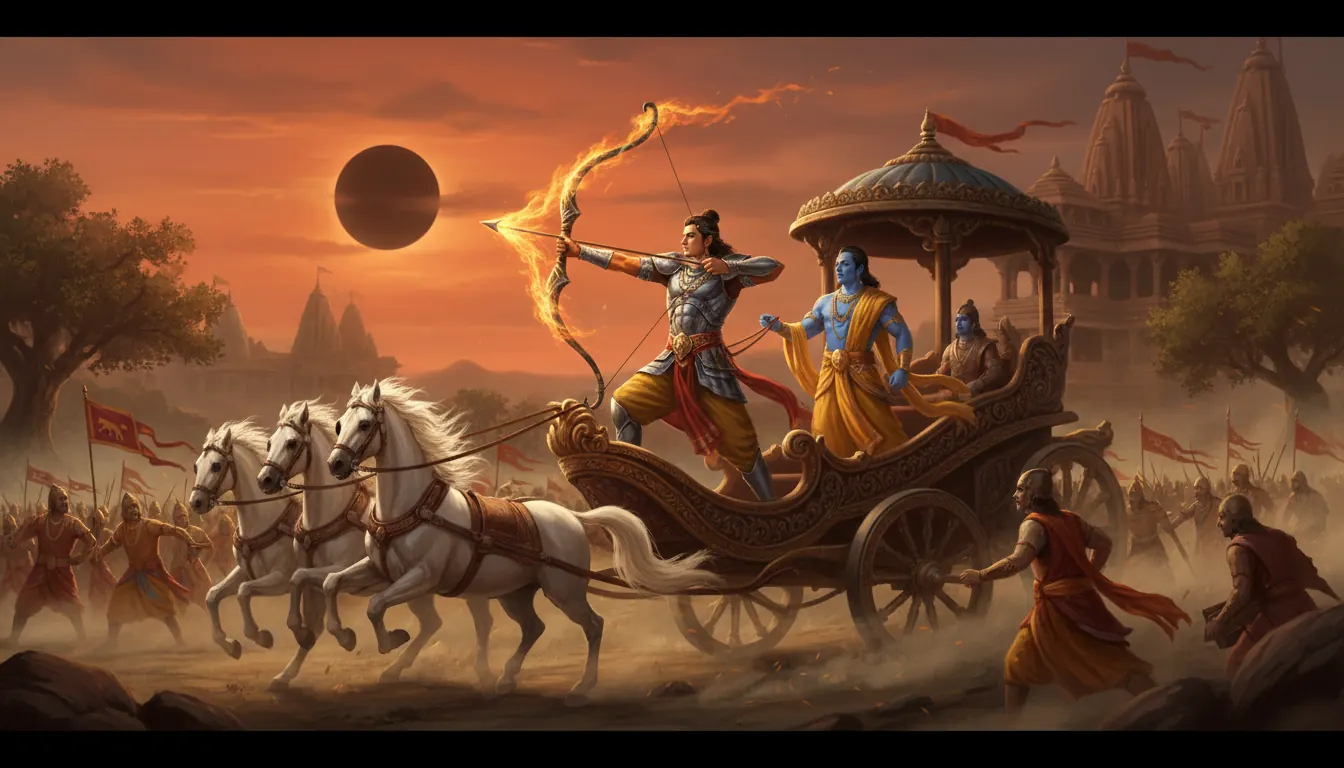
The Blind King Is Answered
Dhritarashtra laments the night after Abhimanyu's death, and his own messenger tells him whose fault it is
In short
On the night after Abhimanyu is killed, Dhritarashtra asks Sanjaya what the Pandavas did the next morning, and then talks for an hour instead of listening: the silence in his sons' camps, the peace he says he urged, the half of the earth the Pandavas deserve, and the roll of enemies against which he can find only four men of his own. Sanjaya hears him out and then tells him that lamentation after the fact is an embankment built after the water has gone. He names the four moments at which a king could have stopped this, and defends the sons the father has just finished blaming.
Told in the Drona ParvaSet in Hastinapura, Kurukshetra and Upaplavya14 min read
The Question in the Dark Hall
The thirteenth day was over, and in Hastinapura the old king sat in his hall and would not let the messenger begin.
Sanjaya had come back from Kurukshetra with the news already delivered: that Abhimanyu, the son of Arjuna and Subhadra, a boy of sixteen, had been drawn into the wheel array alone and killed there by six great chariot-warriors of the Kaurava side. Dhritarashtra had heard that much. What he wanted now was the morning after it.
"After Abhimanyu was slain, when the next day came," he said, "what did the Pandavas do in their grief and sorrow? Who among my warriors fought them?"
He did not wait for the answer. He never did.
"The Kauravas knew what Savyasachin had done before. Tell me how, after doing such a wrong, they could stay fearless. How could they even dare to look at that tiger among men in battle, as he came on in fury like all-destroying Death himself, burning with grief for his slain son? When they saw that warrior with the prince of apes on his banner, grieving for his child and shaking his gigantic bow in battle, what did my warrior do? What has happened to Duryodhana, Sanjaya?"
Sanjaya was the king's suta, his charioteer and his court reporter, and he had been given by Vyasa a sight that let him see the whole field from where he stood. He had told this king every death for thirteen days. He knew the shape of the questions by now, and he knew that this one was not really a question about the fourteenth day at all.
"A great sorrow has come upon us today," Dhritarashtra said. "I no longer hear the sounds of joy."
The Sounds That Were Not Heard
What followed was not a question but an inventory, and every item in it was a silence.
"Those charming sounds, so sweet to the ear, that used to be heard in the house of the Sindhu king, alas, are heard no more today. In the camp of my sons the sounds of countless bards and praise-singers singing their praises, and of dancing, are heard no more. Once such sounds used to fill my ears without end."
He went tent by tent through his own army, the way a blind man goes through a house he knows, touching each thing to be sure it is still there.
"Once, sitting in the house of Somadatta, who was devoted to truth, I used to hear such delightful sounds. Alas, how poor in merit I am, for today I find the house of my sons echoing with grief and lamentation, and empty of every sound of life and energy. In the houses of Vivinsati, Durmukha, Chitrasena, Vikarna, and other sons of mine, I do not hear the sounds I used to hear."
Then Ashwatthama, the son of Drona, on whom his sons had leaned.
"Brahmanas and kshatriyas and vaishyas and a great number of disciples used to wait on him, men who delighted day and night in debate, in talk, in the stirring music of many instruments and in lovely songs; he was honoured by many among the Kurus, the Pandavas and the Satvatas. In the house of that son of Drona no sound can be heard as before. Singers and dancers used to wait close upon that mighty bowman. Their sounds can be heard no more."
Vinda and Anuvinda of Avanti, whose camp roared every evening. The Kaikeyas, whose soldiers sang and slapped their palms in time while they danced. The priests skilled in sacrifice who waited on the son of Somadatta.
And last, his teacher's tent, which had a particular noise of its own.
"The twang of the bowstring, the sound of Vedic recitation, the whiz of lances and swords, and the rattle of chariot-wheels never used to stop in the house of Drona. Alas, those sounds can be heard there no more."
He had been listening to his war through his ears for thirteen days. Now the war had gone quiet, and he could tell from the quiet exactly what it meant.
The Counsel He Says He Gave
From the silence he went, as he always went, to the day he says he was right.
"When Janardana of unfading glory came from Upaplavya, wishing for peace out of compassion for every creature, I said to the wicked Duryodhana then: take Vasudeva as your means, my son, and make peace with the Pandavas. I think the time has come. Do not disobey my command, Duryodhana. If you set Vasudeva aside, when he begs you for peace and speaks to you for my good, you will never have victory in battle."
That was the embassy every man in the hall remembered. Krishna had come from the Pandava camp at Upaplavya and asked for five villages, and had been refused, and an attempt had been made to seize him in that very room.
"But Duryodhana did set aside the hero of Dasharha's race, that bull among all bowmen, who spoke then for Duryodhana's good. In doing so he embraced his own ruin. Seized by Death himself, that wicked-souled son of mine rejected my counsel and took up the counsel of Dushasana and Karna."
Then, further back still, to the dice.
"I myself did not approve of the game of dice. Vidura did not approve of it. The ruler of the Sindhus did not, nor Bhishma, nor Shalya, nor Bhurishravas, nor Purumitra, nor Jaya, nor Ashwatthama, nor Kripa, nor Drona."
It is a strange list to hear a man recite. Jayadratha of the Sindhus, who was at that hour sitting in his tent with Arjuna's vow over his head, is in it. So is Bhishma, lying on his arrows a few miles away. Every name on it belongs to a man who did not stop the game either, and the king who is naming them is the one who sent Vidura to fetch Yudhishthira to the hall.
"If my son had acted on the counsel of these men, he would have lived for ever in happiness and peace with his kinsmen and friends."
Half the Earth, Offered to Nobody
He came round then to the Pandavas, and spoke of them the way a man speaks of a property he has lost.
"Sweet and pleasant in speech, always speaking kindly among their kinsmen, high-born, loved by all, and wise, the sons of Pandu are sure to find happiness. The man who always and everywhere looks to righteousness finds happiness. After death such a man wins blessing and grace."
Then the sentence that thirteen days of corpses had finally pushed out of him.
"The Pandavas have the strength for it, and they deserve to enjoy half the earth. The sea-girt earth is as much their ancestral possession as it is the Kurus'. Once they hold sovereignty, the Pandavas will never stray from the track of righteousness."
Half the earth. It was the exact settlement that had been on the table before the war, and he was granting it now, aloud, in an empty hall, to nobody.
And he had a plan for it too, worked out and complete, as though the thirteen days behind him could be unmade by good sense applied late.
"Child, I have kinsmen whose voice the Pandavas will always heed. Shalya, Somadatta, the great-souled Bhishma, Drona, Vikarna, Bahlika, Kripa, and other Bharatas who are illustrious and revered in years. If they speak to them on your behalf, the Pandavas will certainly follow that good advice. Which of these, do you think, is on their side, that he would tell them otherwise? Krishna will never leave the path of righteousness. The Pandavas all obey him. And those heroes will never disobey words of righteousness spoken by me, for the Pandavas are all righteous at heart."
Bhishma had fallen on the tenth day. Vikarna would die on the fourteenth. Somadatta's son would die on the fourteenth. Of the delegation the blind king was assembling in his mind, one was already down on his arrows and two more would not live out the next day, and he was still counting heads for it.
"Lamenting piteously, Suta, I said these and many other such things to my son. Foolish as he is, he would not listen to me. I think all this is the evil work of Time."
Four Men, and No Fifth
Then he counted the other side, which was the one exercise at which he had always been exact.
"Where Vrikodara and Arjuna are, and the Vrishni hero Satyaki, and Uttamaujas of the Panchalas, and the invincible Yudhamanyu, and the unstoppable Dhrishtadyumna, and the unconquered Shikhandi, the Asmakas, the Kekayas, and Kshatradharman of the Somakas, the ruler of the Chedis, and Chekitana, and Vibhu the son of the ruler of Kashi, the sons of Draupadi, and Virata, and the mighty chariot-warrior Drupada, and those tigers among men the twins, with the slayer of Madhu to give them counsel: who in this world would fight these and expect to live?"
He had the whole roll by heart. Nobody had to read it to him.
"Who else is there, besides Duryodhana and Karna and Shakuni the son of Subala, with Dushasana as the fourth? For I see no fifth who would dare to stand against my foes when they bring out their celestial weapons. Those who have Vishnu himself on their chariot, clad in mail with the reins in his hand, those who have Arjuna as their warrior, can never be defeated."
Four names on his own side. He could not find a fifth man in his army who would stand in front of the Pandavas by choice, and he said so, while his army was still on the field.
"Does Duryodhana not remember those laments of mine now? The tiger among men, Bhishma, has been slain, you have told me. I think my sons are lamenting now, as they see the fruit of the words the far-seeing Vidura spoke. I think my sons are lamenting as they see their army overwhelmed by Shini's grandson and Arjuna, and the platforms of their chariots empty. As a spreading fire driven by the wind burns up a heap of dry grass at the end of winter, so Dhananjaya will burn up my troops."
Then, at last, the thing he had summoned the messenger for.
"Sanjaya, you are skilled at telling. Tell me everything that happened after that great wrong was done to Partha in the evening. When Abhimanyu was slain, what was the state of your minds? What did Duryodhana resolve, and what did Karna? And what did Dushasana and Subala's son do? Tell me what measures my son took then. Were they ill-judged, or well-judged?"
The Embankment After the Water
Sanjaya had heard this lament, in one form or another, since the first day. He did not begin with the fourteenth morning.
"I will tell you everything, for I saw it all with my own eyes. Listen calmly."
Then, before the narration, four words that a servant does not say to a king.
"Great is your fault."
He said it flatly, and went on before the old man could interrupt.
"An embankment is useless once the water has flowed away, and these laments of yours are just as useless, king. Bull of Bharata's race, do not grieve. Wonderful as the decrees of the Destroyer are, they cannot be broken. Do not grieve, for this is nothing new."
And then he laid out, one after another, the four moments at which this could have been stopped, and named the man who had been standing at each of them.
"If you had held back Yudhishthira, the son of Kunti, and your own sons from the match at dice, this calamity would never have come upon you.
"If, when the time for battle came, you had held back both sides in their fury, this calamity would never have come upon you.
"If you had urged the Kurus in time to kill the disobedient Duryodhana, this calamity would never have come upon you. Had you done any of these things, the Pandavas, the Panchalas, the Vrishnis and the other kings would never have known how wrong-headed you were.
"If you had done your duty as a father, set Duryodhana on the path of righteousness and made him walk along it, this calamity would never have come upon you."
Four chances. Not one of them beyond the reach of a king. The dice, the muster, the moment when the assembled Kurus could have been told to put down a son who would not obey, and the ordinary daily business of a father with a boy.
"You are the wisest man on earth," Sanjaya said. "How could you abandon eternal virtue and follow the counsel of Duryodhana and Karna and Shakuni?"
That was the charge. The king had spent an hour naming the counsels he had given. Sanjaya answered by naming the counsels he had taken.
Honey Mixed With Poison
"These laments I hear from you, king, a man wedded to worldly wealth, seem to me like honey mixed with poison."
He had one more thing, and it was the one that would land.
"Once, king, Krishna did not respect king Yudhishthira, the son of Pandu, or Drona, as much as he respected you. But when he came to know you as a man who had fallen away from the duties of a king, from then on Krishna stopped holding you in respect."
A few minutes earlier the king had told the hall that Krishna would never abandon righteousness, and that the Pandavas would heed words of righteousness spoken by himself. Sanjaya had let him finish, and then told him what Krishna thought of him.
"Your sons spoke many harsh words to the sons of Pritha. You let those words pass then, you who hold the sovereignty. Now the consequence of that indifference has caught up with you. Sinless one, the ancestral sovereignty is in danger now. The kingdom that the Kurus enjoy, and their fame too, were won by the Pandus. The virtuous sons of Pandu added to that kingdom and that fame. But their achievements bore no fruit once they came into contact with you, since the greedy robbed the Pandavas even of their ancestral kingdom."
Then, having finished with the father, he defended the sons.
"Now that the battle has begun, king, you blame your sons and point out their many faults. This is hardly fitting. Kshatriyas in battle do not spare their very lives. Those bulls among kshatriyas are fighting their way into the array of the Parthas. Who else but the Kauravas would dare to fight a force protected by Krishna and Arjuna, by Satyaki and Vrikodara? Those who have Arjuna as their warrior, Janardana as their counsellor, and Satyaki and Vrikodara as their protectors: what mortal bowman would dare to fight them, except the Kauravas and those who follow their lead? Everything that heroic friendly kings who keep to the duties of kshatriyas can achieve, the warriors on the Kaurava side are doing."
The men out there were doing the only honourable thing left to them in a war their king's silence had made. It was not their courage that had failed. It was his.
"So listen now," Sanjaya said, "to everything that has happened in the terrible battle between those tigers among men, the Kurus and the Pandavas."
And he began the fourteenth day.
Dharma Lesson
Dhritarashtra is not lying when he says he wanted peace. He did want it, and he said so, and he said so to the one person who could have been made to obey him. What he never did was use the authority he had. Sanjaya's rebuke is precise about this: the four places where a word from the king would have ended it are all ordinary places, a game, a muster, an assembly, a father's house. Grief that arrives only after the outcome is not conscience. It is the same passivity, wearing a different face.