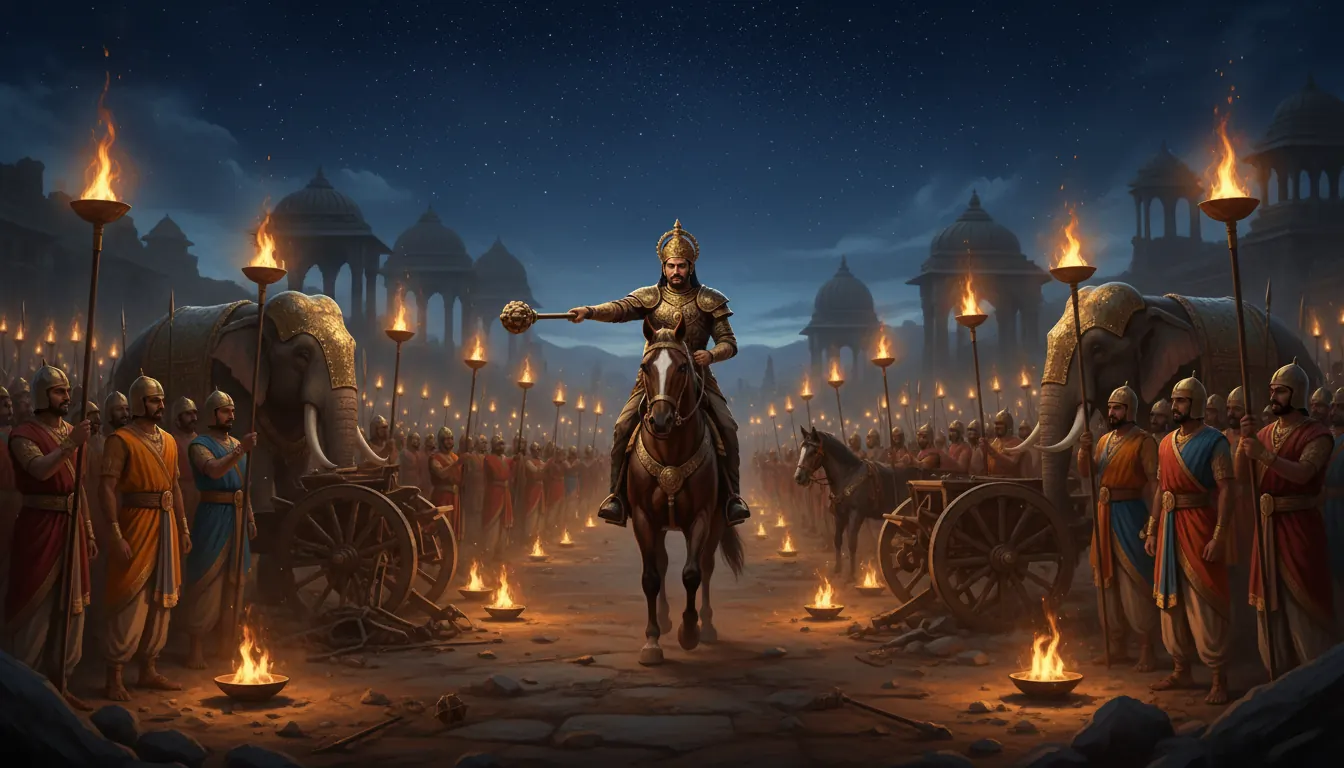
The Herb in the Grandsire's Hand
A wounded Duryodhana asks Bhishma for reassurance and is given honesty, a pledge, and medicine
In short
At the end of the sixth day of the war, Duryodhana comes to Bhishma still bleeding from Bhima's arrows and asks the grandsire to promise him victory. Bhishma laughs without cheer, tells him plainly that the Pandavas are angry, tireless and allied to Krishna, and then pledges to spend his own life for him anyway. He names every great warrior in the Kaurava host, warns that the enemy cannot be beaten even by the gods, and heals his grand-nephew's wounds with a herb before arraying the host at dawn in the circle called Mandala.
Told in the Bhishma ParvaSet in Kurukshetra16 min read
The Tents at the End of the Day
Sanjaya said that when the sixth day was over, the men who had spent it trying to kill one another went back to their tents covered in blood.
They rested a while, as the rule required. They washed. They praised one another for the feats of the day, which is a thing armies do in the evening whatever they have done to each other since dawn, and then they were seen again in their mail and eager for battle, because the war was six days old and nobody had yet learned how to stop.
That was the hour, king, said Sanjaya to the blind man in the hall at Hastinapura, when your son went to the grandsire.
Duryodhana came overwhelmed with anxiety. He was not a beaten man. He had a hundred thousand chariots and the greatest bowman alive commanding them, and the day had ended with Bhishma breaking the Panchala ranks and driving them back before he withdrew to his encampment. But Bhima had come at him that evening with thirty-six arrows, had cut his bow and killed his four horses and cut the umbrella from over his head, and had brought down the standard with the elephant device on it in the sight of all the kings, so that it fell out of the sky like lightning falling out of a cloud. Kripa had taken him up into his own chariot. He had sat down on the floor of it in great pain.
He came to Bhishma with blood still trickling from his wounds, and he did not have himself tended first.
That is the detail to hold at the start. The king of the Kurus walked through his own camp, past his own physicians, in the state Bhima had left him in, because there was something he wanted to hear more than he wanted to be treated, and only one man in the army could say it to him.
I Cannot Regain My Peace of Mind
"Our troops are fierce and terrible, with countless standards," Duryodhana said. "And they are properly arrayed."
He began, as he always began, with the inventory. It was the way his mind worked. He had counted the akshauhinis before the war and been satisfied by the count, and he was counting again now with the blood still running down him, as though the arithmetic could be made to answer the thing that was actually wrong.
"Yet the brave and mighty chariot warriors of the Pandavas broke into our array, cut down and slaughtered our troops, and got away unhurt. They have thrown us all into confusion and won great fame in battle."
Then the arithmetic ran out, and he said what he had come to say.
"And Bhima broke into our Makara array, strong as the thunderbolt as it was, and struck me with his terrible arrows, each like the rod of Death. When I saw him in his fury, king, I lost my senses. Even now I cannot get back my peace of mind."
There is no boast anywhere in it. This is the man who sent Uluka to the Pandava camp with insults dressed as messages, who had told Bhima across a hall full of kings exactly what he thought of him, and here at the end of the sixth day he was telling his grandfather in plain words that he had looked at that face coming toward him through the dust and his senses had gone, and that they had not come back.
"By your grace, you who stand firm in truth, I want to win this war and kill the sons of Pandu."
By your grace. He was not asking for a plan of battle. He was asking the oldest man in the world, the one who had held him on his knee and had held Yudhishthira on the other, to promise him that it would come out the way he wanted, and he was asking it because he no longer believed it himself.
The Grandsire Laughs Without Cheer
Ganga's great-souled son, the finest of all who carry weapons, understood that Duryodhana was in the grip of grief.
Sanjaya is careful about how Bhishma answered. He laughed as he replied, but there was no cheer in it. There was a laugh, and there was nothing behind it. The old man made the sound a grandfather makes to a frightened child and did not feel any of it, and then he gave the child the truth in two halves, and the halves did not agree with each other.
The first half was the promise.
"Prince, I will plunge into their army with every effort and with my whole soul, because I want to give you victory and joy. For your sake I hold nothing back."
The second half was the reason the promise was worth so little.
"Those who have taken the Pandavas' side in this battle are fierce and many. They are great chariot warriors of high renown, very brave and skilled in arms. They never tire, and they spew out their anger. They bear you ill will, and they are swelling with strength, so they will not easily be beaten."
That was the assessment of the commander of the Kaurava host, delivered to the king of the Kauravas, on the night of the sixth day, and no part of it is encouraging. He had just told Duryodhana that the enemy is angry with him personally, that the anger is deserved, and that it does not get tired.
And then, having said it, he pledged himself anyway.
"Still, king, I will fight those heroes with my whole soul and throw away my very life. For your sake, glorious one, I will risk my life recklessly in battle today. For your sake I would burn up all the worlds, gods and Daityas with them, let alone your enemies here. I will fight the Pandavas and do everything you wish."
He did not say he would win. He said he would spend himself. It is the whole of Bhishma's position in that war put into four sentences: a man who cannot approve of the cause, cannot leave the side, and therefore offers the only thing he still owns, which is his life, and offers it to a grand-nephew whose wounds he is about to dress.
Advance
When Duryodhana heard these words he was filled with confidence, and his heart was full of joy.
That is how quickly it worked. Bhishma had told him that the enemy could not easily be beaten and that he himself would probably die in the attempt, and Duryodhana heard the part about the whole soul and the thrown-away life and was happy. He did not wait. Cheerfully he ordered all the troops and all the kings in his army, saying, Advance.
And at that command the army began to move.
Sanjaya, who had the divine sight and was obliged to describe everything he saw with it, spends the rest of the section on the beauty of it, and the beauty is of a particular kind.
That huge force, armed with every kind of weapon, was in high spirits. The elephants, the horses and the foot soldiers on the field were a splendid sight. Huge tuskers, massed in large bodies and skilfully driven, shone all around, and many royal fighters skilled in different weapons could be seen among the troops.
The dust raised by the chariots, the foot soldiers, the elephants and the horses as they moved in order over the field was as red as the morning sun, and it veiled the sun's rays, and it was beautiful.
The many-coloured banners on the chariots and elephants, waving and streaming across the sky, were as beautiful as flashes of lightning among the clouds.
And loud and fierce was the uproar of the bows drawn by the kings, like the roar of the ocean when the gods and the great Asuras churned it in the Krita age.
Then he gives the image he has been building toward, and it is not a compliment.
That army of your sons, so proud, made up of fighters of many colours and shapes, shouting so fiercely and able to kill enemy warriors, looked like the banks of clouds that appear at the end of the Yuga.
Duryodhana's cheerfulness had put an army in motion, and the man watching it move for the blind king could think of nothing to compare it to except the sky on the last day of the world.
The Roll of Names
It did not hold. Ganga's son, looking at his king again a little later, saw him still lost in thought, and spoke to him once more with what Sanjaya calls delightful words.
They were a list. Bhishma had understood something about Duryodhana that evening: that the man was soothed by counting, and that if he wanted to put him to sleep he would have to do it with names.
"Myself," he said, "and Drona, and Shalya, and Kritavarma of the Satvata line, and Ashwatthama, and Vikarna, and Bhagadatta, and Subala's son, and Vinda and Anuvinda of Avanti, and Bahlika with the Bahlikas, and the mighty king of the Trigartas, and the invincible ruler of the Magadhas, Brihadbala the king of the Kosalas, and Chitrasena and Vivingsati."
Every one of them was somebody the king could see from where he stood. Drona, his teacher and the teacher of the men he was fighting. Shalya, the king of Madra, uncle to Nakula and Sahadeva, tricked into this army by Duryodhana's own hospitality on the road. Kritavarma, who had come out of Krishna's own city to fight on this side. Ashwatthama, Drona's son. Vikarna, the one brother who had stood up in the hall and spoken for Draupadi and had come to Kurukshetra anyway. Bhagadatta of Pragjyotisha with his elephant. Subala's son, which is to say Shakuni, who had begun all of it with a handful of dice.
"And many thousands of chariot warriors with tall standards, a great number of horses of our own country ridden by excellent horsemen, many huge, maddened elephants with the rut fluid flowing from their mouths and cheeks, and many brave foot soldiers from many lands, armed with every kind of weapon, are all ready to fight for you.
"These, and many others ready to lay down their lives for you, are able, I believe, to defeat the gods themselves in battle."
It is a magnificent sentence, and Bhishma had one more to add to it, and the one he added took most of it back.
The Herb
"But I must always tell you, king, what is for your good."
That is the formula of a counsellor who is about to say the thing his listener does not want, and Bhishma had used it on this grand-nephew before, in the hall at Hastinapura, when nobody took the least notice.
"The Pandavas cannot be defeated even by the gods with Vasava at their head. They have Vasudeva as their ally, and in prowess they are equal to Mahendra himself."
There it is, plainly, from the commander of the army: the enemy cannot be defeated even by Indra and the celestials, because Krishna is standing in their chariot. He had just finished naming fifteen great warriors and thousands of chariots and calling them able to defeat the gods, and now he told the king that the men those warriors were pointed at were beyond the gods altogether. Both statements were true. That was the trouble with them.
"As for me, I will always do as you ask. Either I will defeat the Pandavas in battle, or they will defeat me."
It is the shortest and most honest description of Bhishma's remaining life that anybody, including Bhishma, ever gave. There were two ways out of the field for him and he named them both and expressed no preference between them, and there was no third.
With these words the grandsire gave him a fine herb of great power for healing his wounds.
The text spends one line on it. He reached out, in the lamplight, in a tent, at the end of a day in which he had killed Panchalas by the hundred, and he handed his grand-nephew a herb, and with it your son was healed of his wounds.
The oldest man on the field, who had promised an hour earlier to throw away his own life for this boy, and who had just told him in the plainest words available that the war was probably lost, finished the conversation by treating the cuts Bhima had made in him.
Nothing else in the two sections is as much like a family as that.
The Mandala at Dawn
Then at dawn, when the sky was clear, the valiant Bhishma, a master of every kind of array, drew up his troops himself in the formation called Mandala.
A vyuha is an argument made out of men. The Mandala is the circle, the array that has no flank because every direction is its front, and Bhishma built it that morning with a precision that Sanjaya sets down like a builder's specification: beside every elephant seven chariots, and beside every chariot seven horsemen, and behind every horseman seven bowmen, and behind every bowman seven fighters with shields. It bristled with weapons. It was ringed on every side by many thousands of chariots and by large bodies of horsemen armed with swords and lances.
Ten thousand horses, as many elephants, ten thousand chariots, and the sons of Dhritarashtra in their mail guarded the grandsire. And Sanjaya notes what the arrangement actually amounted to: Bhishma could be seen protected by those brave warriors, and those princes in their mail were in turn protected by him.
Duryodhana sat in his chariot in the middle of it, healed, full of every grace, as splendid as Shakra in heaven. The sons of Dhritarashtra shouted aloud, and the clatter of chariots and the noise of the instruments was deafening. And that mighty, impenetrable circle began to move, facing west.
Yudhishthira, seeing the Mandala, answered it with the Vajra, the thunderbolt, and the two armies came at each other looking to break each other open, and the day dissolved at once into single combats.
Drona went against Virata. Ashwatthama against Shikhandi. Duryodhana himself rushed at Dhrishtadyumna. Nakula and Sahadeva went out against the king of the Madras, who was their mother's brother. Vinda and Anuvinda of Avanti against Iravan. Bhima against Kritavarma. Abhimanyu against Vikarna and his brothers. Ghatotkacha, prince of the Rakshasas, against Bhagadatta and his elephant, one maddened creature going at another. Alambusha the Rakshasa against Satyaki. Yudhishthira against king Shrutayush. Chekitana against Kripa.
And thousands of kings, with darts and lances and arrows and maces and spiked clubs in their hands, surrounded Arjuna.
The Man They Ran To
"Look, Madhava," Arjuna said, "at the Dhartarashtra troops in battle, arrayed by Ganga's great-souled son, who knows every kind of array. Look at those brave warriors, too many to count, all eager to fight me. Look, Keshava, at the ruler of the Trigartas with his brothers. This very day, Janardana, I will kill them all before your eyes."
Then the son of Kunti rubbed his bowstring and showered his arrows on that crowd of kings, and the great bowmen poured thick showers of arrows on him in return, like clouds filling a lake with torrents of rain in the monsoon.
A great shout went up from the Kaurava army when the two Krishnas were seen buried in arrows. The gods, the celestial rishis and the Gandharvas with the Uragas, watching from wherever such beings watch from, were filled with wonder at the sight of those two men buried under weapons.
Then Arjuna, in a rage, called up the Aindra weapon.
The prowess they saw in Vijaya then seemed truly wonderful, said Sanjaya, for his myriad arrows checked the showers of weapons his enemies shot. Among all those thousands of kings, horses and elephants there was not one, king, that was not wounded. The rest he pierced with two or three arrows each.
And then the thing that ends the day's first movement, and that ought to be read slowly.
As Pritha's son struck them in this way, they ran to Bhishma, the son of Shantanu, for protection.
They ran to the old man. Every king in that circle, cut and bleeding and out of ideas, turned his chariot and went to the place where the white-haired commander was standing, and Bhishma became the rescuer of those warriors, who were like men sinking in the fathomless deep.
He had told his grand-nephew the night before that he would throw his life away for him, and this is what the promise looked like in daylight: an army coming apart and running toward one man to be held together.
And as those warriors fled and mixed with the troops, the Kaurava ranks were tossed like the deep in a storm.
Dharma Lesson
Bhishma gives Duryodhana two things in one conversation and they do not agree: the truth that the Pandavas cannot be beaten, and the promise that he will die trying to beat them. He does not soften the first to make the second easier to hear. That is what loyalty looks like when it is not the same thing as approval, and it is why the grandsire is neither a villain nor an ally in this war but a man paying an old debt at full price. The herb matters as much as the pledge. Having said the hardest thing he could say, he still reached out and treated the wounds.