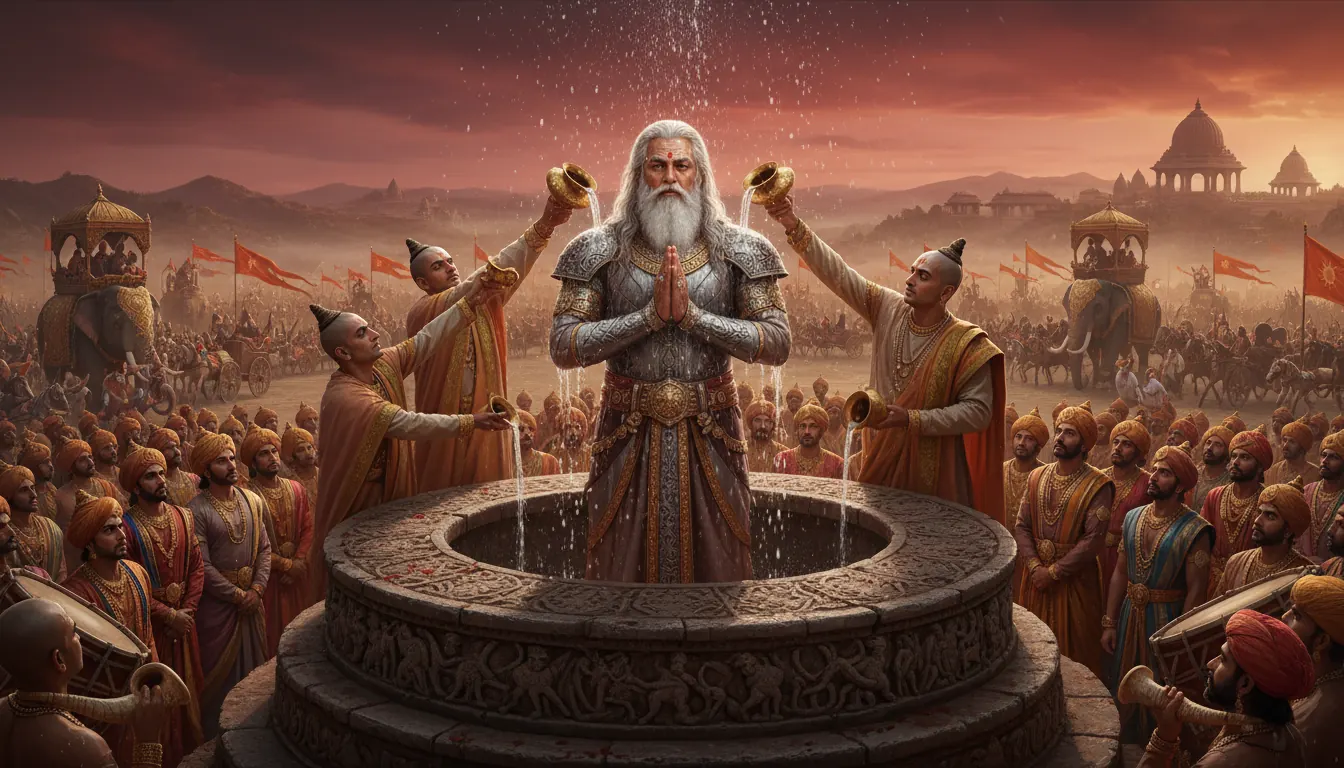
The Consecration of the Grandsire
Bhishma takes command on two conditions, and the sky rains blood
In short
Duryodhana arms his eleven akshauhinis with an inventory that reads like a siege manual, then asks Bhishma to lead them, arguing that an army obeys one voice or none. Bhishma accepts on two conditions: he will kill ten thousand a day but never the sons of Pandu, and either he or Karna must fight. At the consecration a cloudless sky rains blood.
Told in the Udyoga ParvaSet in Hastinapura and Kurukshetra15 min read
Superior, Middling, Inferior
After that night had passed away, Duryodhana distributed his eleven akshauhinis.
He did it the way a merchant sorts stock. He arranged his men, his elephants, his chariots and his horses into three classes, superior and middling and inferior, and then he distributed them among his divisions, putting the best in the van, the next in the centre, and the rest in the rear, so that the enemy would meet the finest thing he had on the first morning and the worst of it only if the first morning went badly.
There was nobody in that camp who did not know which of the three classes he had been put into. That is the thing about grading an army in front of itself. A man who has been told he is inferior stock and set in the rear does not fight the way a man in the van fights, and he does not need to be told twice which he is.
And having graded them, the Kuru king turned to the matter of what to put in their hands, and here the record stops sounding like a chronicle and begins to sound like a manual written by a man who intends to take a walled town and hold it afterwards.
The Inventory
Timber and planks, for repairing the damage the chariots would suffer in the press of battle. Large quivers carried on the chariots themselves. Tiger-skins and other stiff leather for covering the sides of the chariots.
Barbed javelins to be hurled by hand. Quivers carried on the backs of the horses and on the backs of the elephants. Long-handled spears of iron, and missiles. Quivers carried on the backs of the foot-soldiers, and heavy clubs of wood. Flagstaffs and banners. Long heavy arrows to be shot from bows. Many kinds of nooses and lassoes. Armour of various kinds. Short pointed clubs of wood.
Oil, treacle and sand.
Earthen pots filled with poisonous snakes.
Powdered lac and other things that burn. Short spears fitted with tinkling bells. Many weapons of iron, and machines for hurling hot treacle and water and stones. Whistling clubs of hard wood. Wax and heavy mallets. Clubs of wood set with iron spikes. Plough-poles and poisoned darts. Long syringes for pouring warm treacle, and planks of cane. Battleaxes and forked lances, and spiked gauntlets. Axes and pointed iron spikes. Chariots with their sides covered in the skins of tigers and leopards. Sharp-edged circular planks of wood. Horns. Axes of the kuthara kind, and spades. Cloths soaked in oil, and clarified butter.
A man does not put earthen pots of live snakes and syringes for hot treacle on his carts because he expects a contest between champions on an open plain. He puts them there because he has thought about what happens on the eighth day, and on the twelfth, and he has decided in advance that he does not mind.
And over all of it, the divisions of Duryodhana glittered with robes embroidered in gold and were decked with jewels and gems, and were made up of handsome warriors, and blazed like fire.
Three Drivers to a Chariot
For the chariots he would not take common men. Men of good birth, cased in coats of mail, well skilled in weapons and in the handling of horses, were employed as charioteers.
Every chariot was supplied with medicines. The horses had rows of bells and pearls on their heads, and there were banners and flagstaffs, and ornaments on the steeples and turrets of the chariots, and shields and swords and lances and javelins and spiked maces stowed within reach.
Each chariot had four horses of the best breed yoked to it. A hundred bows were kept in each chariot.
And each chariot had one driver in charge of the pair of horses in front, and two more drivers in charge of the pair attached to the wheels on either side; and both of those last two were themselves skilled chariot-warriors, while the chariot-warrior standing in the chariot was himself skilled in driving horses. Any one of the four men on that platform could have taken any of the other three positions.
Thousands of chariots fitted out in that way and decked with gold, guarded like fortified towns and impossible for foes to conquer, were stationed on all sides of the camp.
Seven Men on Every Elephant
The elephants were hung with rows of bells and pearls and decked with many ornaments, and in all that finery those animals looked like hills adorned with jewels.
On the back of each of them mounted seven warriors, and the seven were not seven of the same kind. Two were armed with hooks, to steer and to goad the animal. Two were excellent bowmen. Two were first-rate swordsmen. And one was armed with a lance and a trident.
The army of the Kuru king teemed with countless fierce elephants of that sort, carrying on their backs loads of weapons and quivers filled with arrows. And there were thousands of horses ridden by brave soldiers in mail, decked with ornaments and carrying flags; and all those horses, in their hundreds and thousands, were free of the habit of pawing the ground with their forehoofs, and all were well trained, and decked with ornaments of gold, and perfectly obedient to their riders.
And of foot-soldiers there were hundreds of thousands, of many looks, in armour of many kinds, armed with weapons of many sorts, and decked with golden ornaments.
The Arithmetic of an Army
To each chariot were assigned ten elephants as protectors. To each elephant, ten horses. To each horse, ten foot-soldiers. Nothing on that field was to stand alone.
And a large body of troops was kept back as a reserve, for rallying the ranks that would be broken, and it was reckoned on a different scale altogether: to each chariot of the reserve, fifty elephants; to each elephant, a hundred horses; to each horse, seven foot-soldiers. A commander who provides that carefully for rallying broken ranks has already decided which ranks are going to break.
Five hundred chariots, and as many elephants, and fifteen hundred horses, and two thousand five hundred foot-soldiers, make up a Sena. Ten Senas make a Pritana, and ten Pritanas a Vahini, though in common speech men use Sena and Vahini and Pritana and Dhwajini and Chamu and Akshauhini and Varuthini as though they all meant the same thing. Five times fifty men make up a Patti. Three Pattis make a Senamukha, which is also called a Gulma, and three Gulmas make a Gana; and in Duryodhana's army there were thousands upon hundreds of such Ganas, of warriors able to strike and longing for battle.
Between the two sides the total was eighteen akshauhinis. Seven of them were the Pandavas'. Ten and one more were the Kurus'.
Out of all those men Duryodhana chose the brave and the intelligent and made them the leaders of his troops, placing an akshauhini under each: Kripa; Drona; Shalya; Jayadratha the king of the Sindhus; Sudakshina the ruler of the Kambojas; Kritavarma; Drona's son Ashwatthama; Karna; Bhurishravas; Shakuni the son of Subala; and the mighty Bahlika. He used to bring them before him daily and at all hours and speak to them, and he honoured them again and again before his own eyes; and so appointed, all of them with all their followers became eager to do whatever would most please the king.
Eleven armies. Eleven commanders. And no one over them.
Like a Swarm of Ants
So Dhritarashtra's son, accompanied by all the kings, came before Bhishma the son of Shantanu, and stood with his hands joined together, which was not a posture he adopted often.
"Without a commander, even a mighty army is routed in battle like a swarm of ants," he said. "The minds of two men can never agree. And different commanders are jealous of one another's prowess."
It was true, and everybody standing in that hall knew exactly how true it was, because eleven of them had just been given an akshauhini apiece and every one of the eleven privately considered himself the equal of the other ten. Drona had taught half the men in the room. Kripa had taught the other half. Karna had been quarrelling with Bhishma for years about which of the two of them was the greater bowman, and Shalya was the maternal uncle of two Pandavas and had been tricked into that army with a banquet on a road. Dushasana would take an order from his brother and from nobody else alive. Jayadratha had been dragged by the hair through a forest by Bhima in the years of exile and had spent the time since composing what he would do about it. Shakuni had brought the whole thing about with a pair of dice and expected to be consulted about everything.
Eleven men of that description, each with some twenty-one thousand chariots and more elephants than a small kingdom, would on the second morning of a battle be eleven separate wars going on beside one another. Duryodhana could see it. Whatever else may be said about him, he could count, and he had just spent a night counting.
The Brahmanas and the Haihayas
"Wise one," Duryodhana went on, "we have heard that once the brahmanas, raising a standard of kusa grass, met in battle the kshatriyas of the Haihaya clan, who had boundless energy. And the vaishyas and the shudras followed the brahmanas, so that all three orders were on one side, while those bulls among the kshatriyas were alone on the other.
"In the battles that followed, the three orders broke again and again, and the kshatriyas, though alone, defeated the large army that faced them. Then those best of brahmanas asked the kshatriyas themselves what the cause was, and the virtuous among the kshatriyas gave the true answer: 'In battle we obey the orders of one man of great intelligence, while you are divided from one another and each acts on his own judgment.'
"The brahmanas then appointed one of themselves as their commander, a brave man versed in the ways of policy, and they defeated the kshatriyas. So people who appoint a skilled, brave and sinless commander, who looks to the good of the forces under him, always conquer their foes in battle.
"As for you, you are equal to Ushanas himself, and you always seek my good, and you cannot be slain, and you are devoted to virtue. So be our commander. Like the sun among all lights, like the moon among the delicious herbs, like Kubera among the yakshas, like Vasava among the gods, like Meru among mountains, like Suparna among birds, like Kumara among the gods, like Havyavaha among the Vasus, so are you among us. Protected by you as the gods are protected by Shakra, we will become invincible even to the gods. March at our head as Agni's son marches at the head of the gods, and let us follow you as calves follow the lead of a mighty bull."
Two Conditions
"It is as you say, mighty-armed one," said Bhishma. "But the Pandavas are as dear to me as you are. So I should certainly seek their good as well, although I will certainly fight for you, since I have given you my pledge.
"I do not see the warrior on earth who is my equal, except that tiger among men, Dhananjaya the son of Kunti. He is very intelligent, and he knows countless celestial weapons; but that son of Pandu will never fight me openly. With the power of my weapons I could destroy this universe with its gods and asuras and rakshasas and men in an instant. But I cannot exterminate the sons of Pandu."
Then he named his price, and there were two parts to it.
"Every day I will kill ten thousand warriors. If they do not kill me in battle first, I will go on slaughtering their forces in that way. That is the first thing.
"There is another condition on which I may willingly become the commander of your forces, and you must listen to it. Lord of the earth, either Karna should fight first, or I will fight first. The Suta's son is always boasting of his prowess in battle, comparing it with mine."
He had been asked for one voice and he had given two conditions, and neither of them was about the enemy. The first was about whom he would not kill. The second was about whom he would not stand beside.
So the old man had accepted, and in accepting had told the whole hall two things: that he would kill ten thousand a day and never one of the five men the war was actually about, and that he would not stand on the same field as the best archer his own side possessed.
Karna did not argue. He answered in two sentences and walked out of the war with them.
"As long as Ganga's son lives, king, I will never fight. After Bhishma is slain, I will fight the wielder of Gandiva."
A Cloudless Sky Rains Blood
After this, Dhritarashtra's son formally made Bhishma the commander of his force, handing out large presents; and once he was installed in the command he blazed with beauty, and at the king's order the musicians cheerfully played drums and blew conchs by hundreds and by thousands. Lion-like roars went up in great numbers, and all the animals in the camp cried out together.
It was the sound a coronation makes. The whole camp was told at once, in the way armies are told things, by noise: the drums came up first, then the conchs under them, then the roaring of the men, and last of all the animals, who did not know what was being celebrated and joined in anyway.
And then, although the sky was cloudless, a bloody shower fell and made the ground miry.
Fierce whirlwinds came. The earth shook. The elephants roared without being goaded. Bodiless voices were heard in the sky and flashes of falling meteors were seen there. Jackals howled fiercely, foretelling great calamity. These and a hundred other kinds of fierce omens appeared at the moment when the king installed Ganga's son in the command of his troops, and the hearts of all the warriors sank.
Nobody stopped the ceremony. The drums went on. The conchs went on. Men stood in a rain of blood on a bright morning, with the ground turning to mud under their feet and the jackals crying in daylight, and they finished the consecration, because eleven armies had already been graded and provisioned and handed out, and the pots of snakes were already loaded on the carts.
The Camp That Shone Like Hastinapura
Then, having made Bhishma, that crusher of enemy hosts, his general, and having had the brahmanas pronounce blessings on him in return for abundant gifts of cows and gold, and glorified by those blessings, and surrounded by his troops, with Ganga's son in the van and his brothers beside him, Duryodhana marched to Kurukshetra with his large host.
And the Kuru king went over the plain with Karna in his company, which is a detail worth keeping: the two of them rode out together to choose the ground, the commander-in-chief and the man who had just sworn not to fight under him, and between them they measured out the camp on a level part of that plain.
It was pitched on a delightful and fertile spot abounding with grass and fuel, and when it was finished it shone like Hastinapura itself.
He had been told that an army obeys one voice or it obeys none. He had said it himself, with his hands joined, out of a story about brahmanas beating kshatriyas with a standard of kusa grass. And then he had accepted a commander who would not kill the five men the war existed to kill, and who required that the second greatest bowman on the field sit in his tent for as long as he lived.
An army obeys one voice or it obeys none. That was the argument, and it was a good one, and Duryodhana had made it himself with his hands joined and eleven kings listening. What he got in exchange for it was a commander who had told him in advance, in front of everyone, the two places where the arrangement would not hold.
On the tenth day of the battle, Bhishma would be lying on a bed of arrows, and Karna would come into the war at last, and the arithmetic of that morning would begin to come due.
Dharma Lesson
An army obeys one voice or it obeys none, and Duryodhana argues that case himself with his hands joined. But the man who accepts command with conditions has already named the two places where he will fail, and everyone in the hall hears him name them. Bhishma will not kill the five men the war exists to kill, and will not stand on the field beside the best bowman his own side has.