Bhrigu in Agastya's Hair
How an unseen sage cursed the mortal king of heaven into a snake
In short
Bhishma tells Yudhishthira why the evening lamp matters, and answers with the fall of Nahusha. Granted a boon that drained the power of anyone he looked at, the mortal king of heaven had yoked the rishis to his chariot, and no curse could touch him. Bhrigu hid in the matted locks of Agastya on the day it was Agastya's turn to pull, kept his eyes turned away, and waited for the kick that would let him say one word.
Told in the Anushasana ParvaSet in Kurukshetra, Saraswati and Amaravati18 min read
The Question About Lamps
Yudhishthira had asked about flowers and incense and lights once already, and Bhishma had answered him at length, tracing the answer back through Manu to Shukra and to Vali the Asura king, and it had not settled the matter.
The king came back to it the next morning, on the field at Kurukshetra where the old man lay on his bed of arrows with the whole surviving court sitting around him in the dust.
"Chief of the Bharatas, I have heard what merit is won by those who offer flowers and incense and lights," he said. "I have also heard you speak of the merit of keeping the rules for the offering of the Vali properly. Grandsire, please speak to me on this subject once more. Tell me again of the merit of offering incense and lights. And tell me this: why do householders set down their Vali offerings on the ground?"
It is a small question, and Bhishma did not answer it with a rule. He answered it with a story about the sovereignty of heaven.
"On this subject," he said, "people recite an old story, the conversation between Nahusha and Agastya and Bhrigu."
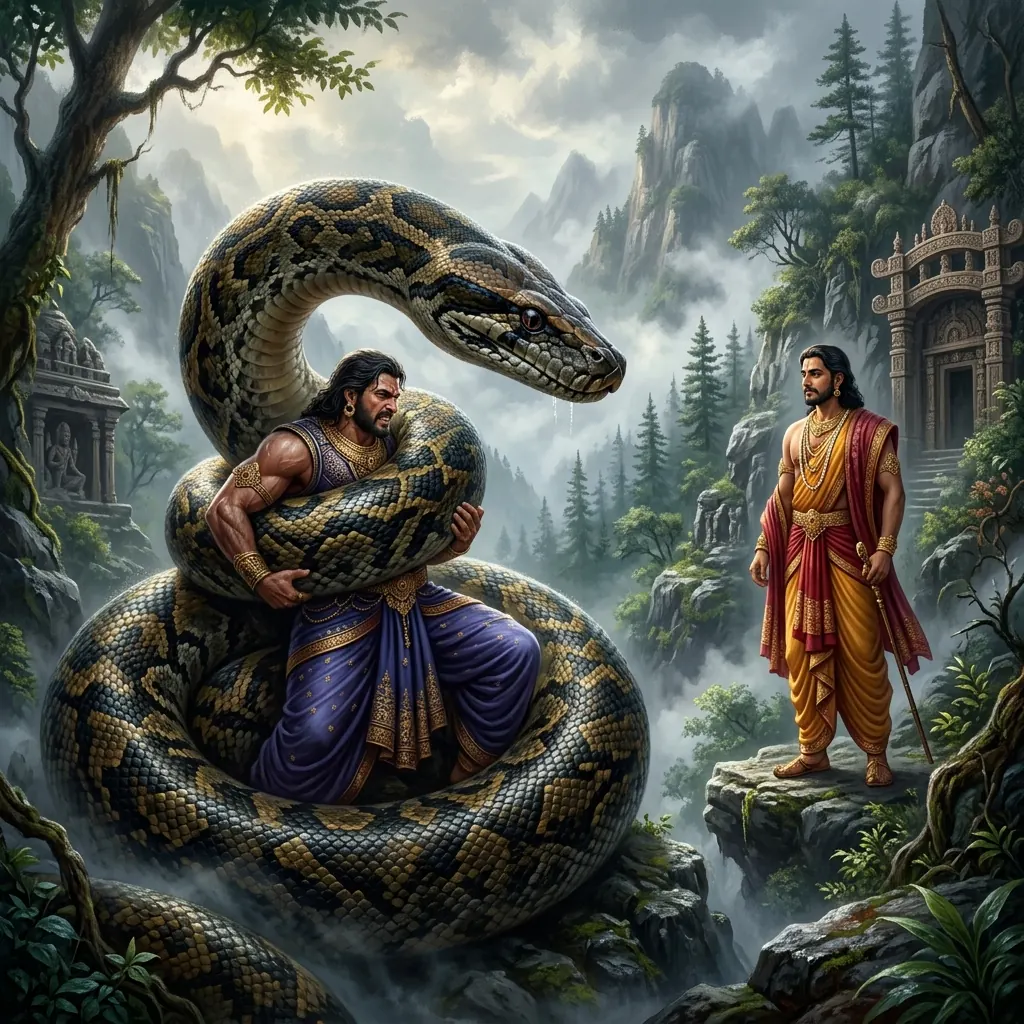
Yudhishthira knew the name in the middle of that list better than he wanted to. Nahusha was the king who had been made chief of the gods and lost the place again, and the Pandavas had met what was left of him in the forest, in the body of an enormous python that had caught Bhima in its coils and would not let go until the questions it asked were answered. Shalya had told the outline of the tale on the eve of the war.
What Bhishma was about to tell was how the mortal came down, told this time from inside Agastya's hair.
The King Who Kept the Rites in Heaven
"The royal sage Nahusha," said Bhishma, "rich in penances, won the sovereignty of Heaven by his own good deeds."
That is the first thing to hold on to, because everything that follows depends on it. He did not seize the throne of Amaravati and he was not given it as a favour. He earned it in the only currency heaven accepts, and when he arrived there he went on doing exactly what had earned it.
He lived in heaven with his senses under control, and Bhishma listed his days there like a man reading an inventory. The many rites of the sacrificial fire. The gathering of sacred fuel and of kusa grass, and of flowers. The offering of the Vali, food adorned with powdered fried paddy, set down for the household deities. The offering of incense. The offering of light.
All of these, said the grandsire, went on every day in the house of that great-souled king while he lived in heaven.
There is something absurd about it if you look at it directly. Here is a man living among the gods, performing the small evening observances that a householder performs for the gods, in the house of the gods. He kept the sacrifice of japa, the silent recitation, and the sacrifice of meditation, which are the two sacrifices that need no altar and no priest and no wealth at all. And although he had become the chief of the gods, he still worshipped all the gods with the proper rites and ceremonies, just as he always had.
He bowed to the beings he outranked. He lit lamps in the country where light comes from.
Human acts of many kinds and heavenly acts of many kinds flowed from him together, and the two kinds did not quarrel in him, and for that whole first stretch of his reign there was nothing in heaven to complain of.
Then, said Bhishma, some time later, Nahusha became aware of his position as chief of all the gods.
The Day He Remembered What He Was
Realising it filled him with pride.
Bhishma put the whole collapse into one sentence and did not decorate it. From that time all his acts of the kind spoken of were suspended. The fire, the fuel, the kusa grass, the flowers, the Vali on the ground, the incense, the lamp at evening. Not abolished by decree. Simply not done, by a man who had stopped seeing the point of doing them.
And what followed was not punishment. It was subtraction. Because he had given up all religious acts, his energy began to wane. The thing he had climbed on had been the thing holding him up, and he had let go of it while standing at the top.
Swollen with arrogance because of the boon all the gods had granted him, Nahusha made the very rishis carry him on their shoulders.
That is the sentence the whole story turns on. The rishis of the three worlds, men rich in penances, were harnessed to the palanquin of a king who had been one of them, and made to carry him about heaven at a walk. He did not do it once in a fit of temper. He organised it. He made the rishis do his degrading work by turns, which means there was a roster, and a man whose turn it was, and a man whose turn was coming.
The time was very long for which he kept it up.
And while the ascetics of the universe took their turns under the poles of his chariot, his energy went on waning, because he had not offered incense or set down a lamp in years, and no one in heaven could think of a way to stop him.
Then, said Bhishma, the day came when it was Agastya's turn.
Bhrigu Comes to the Hermitage
Agastya was sitting in his hermitage when Bhrigu came to him.
They were not small men. Agastya was the son of Mitravaruna, the sage who had drunk the ocean dry to expose the demons hiding in it and had pressed the Vindhya mountain down and kept it down. Bhrigu was the founder of a line of brahmanas that reached to Shukra himself, the foremost of all who know Brahma, a rishi whose curses were part of the furniture of the world.
Between them they had enough power to burn a kingdom, and both of them had a turn coming on the roster of a palanquin.
Bhrigu did not soften it.
"Great ascetic," he said, "why should we patiently put up with such indignity inflicted on us by this wicked-souled Nahusha who has become the chief of the deities?"
It is the question of a man who has been thinking about it for a long time and has come to the door of the one person he believes may already have an answer. There is no plan in it yet. There is only the plain refusal to keep calling the arrangement acceptable.
And Agastya, who was about to be yoked, did not answer with anger. He answered with the reason nobody had acted, and it was a better reason than Bhrigu had expected.
"How can I succeed in cursing Nahusha, great rishi?"
He said it as a question about method, not about will. He had considered it. Everyone had considered it. The difficulty was not that the rishis of heaven lacked the fire to burn a king. The difficulty, as Agastya was about to explain, was that the king had been to the Grandsire first, and had asked for exactly the right thing.
The Boon That Made Him Untouchable
"You know how Brahman himself, the giver of boons, gave Nahusha the best of boons," said Agastya.
Then he named it.
"When he came to heaven, the boon Nahusha asked for was this: that whoever came within his sight would lose all his energy and fall under his power."
Read what he had asked for. Not invulnerability, which can be worked around, and not a weapon, which can be answered with a weapon. He had asked that anyone he could see should lose his power and fall under his control, by the fact of being looked at. A rishi standing in front of Nahusha with a curse ready in his mouth was a rishi with nothing in his mouth at all. The energy went out of him at the moment he entered the king's field of vision, and it went into the king.
"The self-born Brahman granted him even that," said Agastya, "and that is why neither you nor I have been able to burn him up. Beyond doubt, that is why none of the other great rishis has been able to burn him up or throw him down from his high place."
And there was a second gift on top of the first.
"And Brahman once gave Nahusha nectar to drink, lord. That too has left us powerless against him."
Agastya said the next thing carefully, as a man says a thing he has turned over many times and does not entirely understand.
"It seems the supreme god gave Nahusha that boon to plunge all creatures into grief."
Then the complaint under the complaint, which is the same in every age.
"That wretch among men treats the brahmanas with no regard for right. You are the finest of speakers: tell us what should be done as things stand. I will certainly do whatever you advise."
He had been asked why he put up with it. He had answered, and then he had put himself in the other man's hands.
I Have Come at the Command of the Grandsire
Bhrigu had not walked into that hermitage by chance, and he said so.
"It is on the Grandsire's orders that I have come to you," he said, "to break the power of Nahusha, who has great energy but has been robbed of his wits by fate."
The being who had given the boon had sent the man who would get around it. Brahma had not revoked what he granted, because what Brahma grants is not revoked. He had simply sent Bhrigu down the hill to Agastya's door.
Then Bhrigu told him what was going to happen that day, in order, before any of it had happened.
"That utterly wicked creature who has become chief of the gods will yoke you to his chariot today. Today, by my own energy, I will throw him down from his place as Indra, because he has broken every bound. Today, before your very eyes, I will throw down the wicked and sinful Nahusha from that seat and restore the true Indra to his place, the one who performed a hundred horse-sacrifices."
And then the part that was not a prediction about Nahusha but a demand made of Agastya.
"Today that unrighteous chief of the gods will insult you with a kick, because fate has clouded his understanding, and so he will bring about his own downfall. Enraged at that insult, I will curse that sinful wretch, that enemy of the brahmanas who has broken every bound, saying: Become a snake. Today, great ascetic, before your very eyes, I will hurl the wicked Nahusha down to the earth, and he will be stripped of all his energy by the cries of Shame that will rise from every side."
He had described a foot coming down on Agastya's head, and he had described it to Agastya's face, and then he asked permission.
"I will do this, ascetic, if you agree."
When Bhrigu said this, Mitravaruna's son Agastya, whose power and glory never fade, was deeply pleased, and every anxiety left him.
He agreed to be kicked.
Do Not Close Your Eyes
By then the throne of heaven was not what it had been.
The chief of the gods, because he had stopped keeping the rules for offering incense and light, had gone on losing his energy, and Rakshasas were now disrupting his sacrifices and his gifts. That is what happens to a house where the evening lamp has stopped being lit. Things get in.
It was at this time, said Bhishma, that Nahusha yoked that foremost of rishis, Agastya, to his chariot.
He was in a good mood about it. Nahusha, a man of great strength, smiling all the while, quickly set the great rishi to the task, ordering him to carry the vehicle from the banks of the Saraswati to wherever he might say.
And on the bank of that river, before Agastya went up to the chariot, Bhrigu came to him with an instruction that sounds like nothing at all.
"Do not close your eyes until I have entered the matted locks on your head."
Agastya kept his eyes open and held still. This mattered. Bhrigu was about to make himself very small and very close to the one man Nahusha would certainly be looking at, and the boon worked by sight: what the king saw, the king drained.
So Agastya stood with his eyes open, and Bhrigu of unfading glory and mighty energy entered into the matted locks of Agastya, and the epic's line for the rishi at that moment is the best line in the story. Agastya stood still like a wooden post.
Not a sage gathering himself for a confrontation. A post. A thing to be harnessed, standing where it had been put, with the whole answer to the boon of Brahma folded up and waiting in its hair.
Soon afterwards, Nahusha saw Agastya coming to him to carry his vehicle.
Yoke Me Without Delay
Agastya spoke first, and he spoke like a servant.
"Yoke me to your vehicle at once. Where shall I carry you? Lord of the gods, I will carry you wherever you are pleased to say."
There was no protest in it and no irony that Nahusha could hear. At these words Nahusha had the ascetic yoked to his vehicle, and the pole came down on the shoulders of the man who had swallowed the sea.
Bhrigu, still inside the matted locks, was delighted at what Nahusha had done.
He was pleased because the king had just done the thing that would finish him, and because the arrangement was holding. And here Bhishma inserted the detail that shows how carefully the hidden man was working. He took care not to let his eyes fall on Nahusha. Bhrigu behaved this way because he knew all about the energy that the illustrious Nahusha had gained from the boon Brahman had granted him.
He did not look out. He rode in the hair of a harnessed sage with his eyes turned away from the king, because the boon did not care whether you were hiding. It cared whether you looked.
Agastya, though treated in this way, did not give way to wrath. He pulled.
Then King Nahusha drove Agastya on with his goad. A goad is for cattle. The righteous rishi still did not give way to anger, and did not go faster, and this is the point at which a man in the chariot begins to feel that the animal is refusing him without disobeying him.
The lord of the deities, himself giving way to anger, then struck Agastya on the head with his left foot.
That is the whole of the offence. One kick, delivered by a mortal who had been given heaven for his good conduct, with the left foot, onto the head of a brahmana, in front of a river.
Sarpa
Bhrigu, who was staying within Agastya's matted locks, became incensed.
He did not come out. He cursed from inside the hair, unseen, with his eyes still turned away from the man he was destroying.
"Because you have struck the head of this great rishi with your foot, fall down to the earth as a snake, you wretch of wicked mind."
The word was sarpa. Snake. It is not an elaborate curse and it does not name a term of years or a condition of release. It is the shortest possible statement of what the king had made of himself: a thing that goes on its belly on the ground, which is where the Vali is set down, which is where he had stopped setting anything down.
Cursed by Bhrigu, whom he had never seen, Nahusha at once became a snake and fell down to the earth.
Bhishma said the next sentence to make sure the king on the field understood what had actually defeated a boon of Brahma.
"If, monarch, Nahusha had seen Bhrigu, the latter would not then have succeeded, by his energy, in hurling the former down on the earth."
The boon never failed. Nothing in the story overpowers it. It was simply never engaged, because the one man in the three worlds who could burn the king had spent the entire afternoon within arm's reach of him and had never once been looked at. The most powerful defence in heaven was defeated by the ordinary fact that a man cannot see what is in another man's hair.
And the sovereignty of the gods, which had been won by penances and lost by pride, ended on a riverbank with a shout of Shame going up from every side and a snake in the grass where a chariot had been.
It should have ended there. It did not, and the reason it did not is the reason Bhishma was telling the story at all.
The Snake That Kept Its Memory
Because of the many gifts Nahusha had made, and his penances and religious observances, he kept his memory even though he had been hurled down to the earth.
That is what the lamps had bought him. Everything else was gone: the throne, the boon, the nectar, the shape he was born in. The years of small evening observances he had performed before he grew too grand for them had left him one thing. He knew who he was, lying in the grass.
So he began to plead with Bhrigu. And Agastya, whose head had been kicked an hour earlier, was filled with compassion and joined him in begging Bhrigu to set an end to the curse.
At last Bhrigu felt compassion for him.
"A king will appear on earth," he said, "named Yudhishthira, the foremost of his line. He will free you from this curse."
With that the rishi vanished before Nahusha's eyes, and Agastya, having done the true Indra's work, went back to his own hermitage, worshipped by all the twice-born.
Bhrigu went to the world of Brahman and told the Grandsire. The Grandsire called Indra back and spoke to the gods.
"Gods, it was through the boon I granted him that Nahusha won the sovereignty of heaven. He has lost it and been hurled down to the earth. You cannot live without a chief. So set Indra once more on the throne of Heaven."
The gods, filled with joy, said, "So be it." Brahma installed Indra, and Vasava began once more to shine in all his beauty and splendour.
Then Bhishma turned his head toward the eldest son of Pandu.
"You, king, freed Nahusha from Bhrigu's curse. Freed by you, he truly did rise to the world of Brahman before your eyes."
The python that had held Bhima in its coils in the forest had been waiting in that body for the man now sitting in front of Bhishma, because of a promise made on a riverbank in an age before the Kurus.
"So," said Bhishma, coming back to the small question he had been asked, "when evening comes, householders should give lights. Whoever gives lights is sure to gain heavenly sight after death, and shines like the full moon, and has beauty and strength for as many years as there are blinks of an eye in the time his lights burn."
A man who had been chief of the gods lost heaven for letting the lamp go out, and kept his memory for the years he had lit it.
Dharma Lesson
Nahusha did not lose heaven for cruelty first. He lost it for stopping the small things, the lamp and the incense and the food set down on the ground, once he decided he was too great to need them. The rites were not a tax on his greatness; they were what his greatness was made of, and his energy drained away in exact proportion to the observances he dropped. What he had already done saved what could still be saved: the lamps he had lit bought him his memory in the body of a snake, and a name to wait for.